
 My Inquiry
 My Account


Analog Devices Inc./Maxim Integrated DS2250-64-16
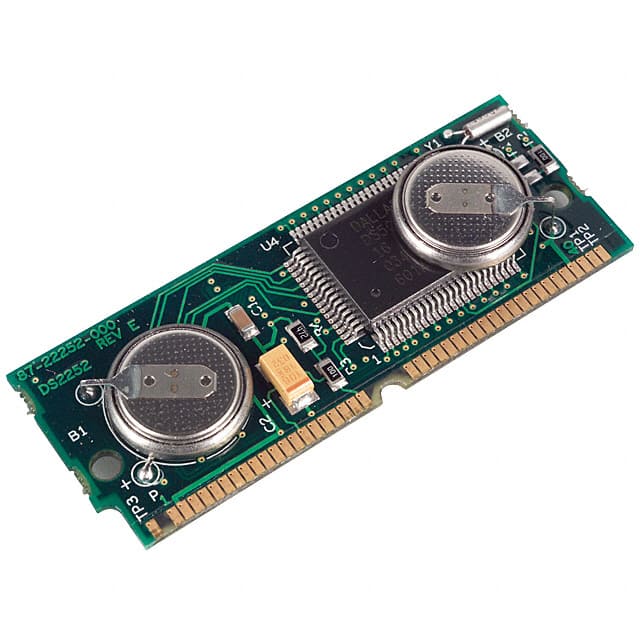
- Part No.:
- DS2250-64-16
- Manufacturer:
- Analog Devices Inc./Maxim Integrated
- Category:
- Microcontrollers
- Package:
- 40-SIMM
- Datasheet:
-
 DS2250-64-16.pdf
- Description:
- IC MCU 8BIT 64KB NVSRAM 40SIMM
- Quantity:
- Payment:

- Shipping:

Inventory:2,256
Please send an inquiry. Send us your inquiry, and we will respond immediately.
Product details
Overview
DS2250-64-16 from Maxim Integrated is an 8-bit 8051-compatible soft microcontroller module featuring 64kB of nonvolatile CMOS SRAM for program and data storage, 16MHz maximum crystal speed, 32 parallel I/O lines, and full-duplex on-chip UART - deployed in secure industrial control systems requiring persistent firmware retention after power loss.
For engineers reviewing the DS2250-64-16 datasheet, DS2250-64-16 pinout, DS2250-64-16 application, or DS2250-64-16 equivalent, key selection criteria include nonvolatile RAM endurance (10 years at room temperature), power-fail reset/interrupt capability, serial bootstrap loader support at multiple baud rates, and compatibility with standard 8051 development tools.
Technical Context
The DS2250-64-16 implements a fully 8051-object-code-compatible CPU core with internal nonvolatile SRAM mapped across separate 64kB program and 64kB data address spaces. Its memory architecture supports dynamic partitioning between code and data via MCON register configuration, enabling flexible runtime allocation within the 64kB NV RAM.
It integrates dual timer/event counters, two external interrupt inputs (INT0/INT1), expanded bus interface with ALE/PSEN/WR/RD control, and a serial port operating in Mode 0 (shift register) or Mode 1 (asynchronous). No real-time clock is included in the DS2250-64-16 variant - that functionality requires the 'T' suffix (e.g., DS2250T-64-16).
Key Specifications
| Parameter | Value and Actual Design Meaning |
|---|---|
| Core Architecture | 8051-compatible 8-bit CPU with object-code compatibility for existing 8051 toolchains |
| Nonvolatile Memory | 64kB CMOS SRAM retains program/data without VCC for ≥10 years at 25°C |
| Max Clock Speed | 16MHz crystal oscillator - defines instruction cycle timing and serial baud rate limits |
| I/O Lines | 32 general-purpose bidirectional I/O lines across Ports 0–3, with Port 0 open-drain requiring pullups |
| Serial Interface | Full-duplex UART supporting Mode 0 (8-bit shift register) and Mode 1 (asynchronous, 8N1) |
| Power Fail Detection | Dedicated VPFW threshold (4.15–4.75V) triggers early-warning interrupt before brownout reset |
| Operating Voltage | 4.05V to 4.65V minimum VCC - ensures reliable operation during supply sag |
| Current Consumption | 54mA typical at 16MHz/5V; 6.2mA in idle mode at 8MHz - enables low-power system states |
Pinout & Package
DS2250-64-16 uses a 40-pin SIMM (Single In-line Memory Module) package measuring 2.65″ × 2.385″ × 0.85″ (L×W×H), with gold-plated edge contacts and industry-standard pin spacing. The module is designed for socketed insertion into compatible carrier boards.
| Pin/Terminal | Circuit Role | Design Meaning |
|---|---|---|
| 1,3,5,7,9,11,13,15 | P1.0–P1.7 | General-purpose I/O port with internal pull-downs; no special alternate functions |
| 17 | RST | Active-high reset input; internally pulled down - safe to leave unconnected if unused |
| 19,21 | P3.0 (RXD), P3.1 (TXD) | UART receive/transmit pins - require level-shifting for RS-232 interfacing |
| 23,25 | P3.2 (INT0), P3.3 (INT1) | Active-low external interrupt inputs - edge-triggered, debounced in firmware |
| 27,29 | P3.4 (T0), P3.5 (T1) | Timer 0/1 external event counter inputs - support gated counting or pulse width measurement |
| 31,33 | P3.6 (WR), P3.7 (RD) | Expanded bus write/read strobes - used only when EA = VCC and external memory is enabled |
| 35,37 | XTAL2, XTAL1 | Crystal oscillator connections - XTAL1 is inverter input; XTAL2 is output; supports 1–16MHz crystals |
| 39 | GND | Logic ground reference - must be connected to system common ground plane |
| 2,4,6,8,10,12,14,16,18,20,22,24,26,28,30,32,34,36,38,40 | VCC, P0.x, P2.x, PSEN, ALE, EA | VCC (5V), Port 0 (open-drain multiplexed AD0–AD7), Port 2 (A8–A15), PSEN (external program enable), ALE (address latch enable), EA (external access control) |
Key Features
| Feature | Design Value |
|---|---|
| Nonvolatile Program/Data Storage | 64kB embedded SRAM retains firmware and runtime variables without backup battery or supercapacitor |
| End-System Software Loading | Serial bootstrap loader accepts Intel HEX over UART at 300–9600 bps - enables field updates and final-test programming |
| Self-Modifying Code Capability | Allows runtime patching of application code or data tables directly in NV RAM - no external reprogramming hardware needed |
| Power-Fail Management | Integrated voltage monitor generates early-warning interrupt (VPFW) and automatic reset below VCCmin - preserves state before shutdown |
| Security Lock & Encryption Support | MCON register controls security lock; K command loads 40-bit encryption key - prevents unauthorized readout of NV RAM contents |
| 8051 Development Compatibility | Uses standard 8051 instruction set and memory map - enables reuse of existing assemblers, C compilers, and debuggers |
Applications
| Industrial Data Logger | Secure Metering Terminal |
|---|---|
Use Scenario: Standalone environmental sensor node logging temperature/humidity every 5 minutes to local NV RAM, surviving daily power cycles and multi-year deployments without battery maintenance. IC Role / Device Role / Timing Role: Primary controller executing logging firmware, managing UART-based sensor reads, and preserving timestamped records in nonvolatile SRAM across power outages. Use Value: Eliminates need for EEPROM wear-leveling or FRAM cost premium while guaranteeing 10-year data retention at room temperature - reducing BOM and firmware complexity. | Use Scenario: Electricity meter head unit storing tariff schedules, consumption history, and cryptographic keys in tamper-resistant memory, with firmware updatable via isolated RS-485 link. IC Role / Device Role / Timing Role: Secure host MCU handling AES-encrypted firmware validation, secure boot, and encrypted data writes to its own 64kB NV RAM - no external secure element required. Use Value: Built-in encryption key loading (K command) and security lock (Z command) prevent extraction of billing logic or historical usage - meeting IEC 62055-41 security requirements. |
| Medical Device Controller | Legacy System Retrofit Module |
Use Scenario: Portable diagnostic instrument maintaining calibration coefficients, user preferences, and last-measurement context across battery swaps and unplanned shutdowns. IC Role / Device Role / Timing Role: Core controller executing real-time signal processing, managing SPI-connected ADCs, and preserving critical parameters in nonvolatile memory without relying on external NVRAM. Use Value: Guarantees zero data loss during power transitions - satisfying FDA Class II device reliability requirements for parameter persistence and deterministic restart behavior. | Use Scenario: Drop-in replacement for obsolete 8051-based controllers in factory automation PLCs, where legacy ladder logic must run unchanged on modern PCBs with tighter space constraints. IC Role / Device Role / Timing Role: Pin-compatible 8051 upgrade providing identical instruction timing and I/O mapping, while adding nonvolatile memory and serial loader for remote diagnostics. Use Value: Enables direct firmware migration using existing 8051 toolchain - no hardware redesign or timing revalidation needed despite doubling memory capacity to 64kB. |
Equivalent & Alternatives
The following parts are listed as comparable options for similar soft microcontroller applications.
| Alternative Part | Technical Difference | Application Difference | Selection Advice |
|---|---|---|---|
| DS2250-32-16 | Same architecture and package but with 32kB nonvolatile SRAM instead of 64kB; identical timing, I/O, and feature set | Suitable for applications with smaller firmware footprints or constrained memory budgets where 64kB is unnecessary | Select DS2250-32-16 when firmware size remains under 28kB to reduce cost and power consumption without sacrificing reliability |
| DS2250T-64-16 | Adds permanently powered real-time clock with on-board crystal; otherwise identical memory, speed, and I/O capabilities | Required for time-stamped logging, scheduled wake-up, or calendar-aware operations where DS2250-64-16 lacks RTC registers | Choose DS2250T-64-16 only if hardware-level timekeeping with hundredth-second resolution is mandatory - adds ~$1.20 and requires crystal layout |
Compared with DS2250-32-16, the DS2250-64-16 doubles available nonvolatile memory for larger firmware or extended data buffers; compared with DS2250T-64-16, it omits the RTC subsystem to reduce cost and board area - making it optimal for pure control applications without time-of-day dependency.
Availability
DS2250-64-16 is available at Aetrix Electronics and suitable for industrial data loggers, secure metering terminals, medical device controllers, and legacy system retrofit modules requiring stable component supply and long-term obsolescence management.
Supply support for DS2250-64-16 includes scheduled delivery planning, volume procurement assistance, BOM continuity management, traceable sourcing, and lifecycle availability coordination for OEM customers, industrial embedded developers, connected-device designers, and electronics production programs.
Manufacturer
Maxim Integrated (now part of Analog Devices) designs precision analog, mixed-signal, and embedded security ICs for industrial, medical, and communications applications.
The DS2250 product line delivers "soft" microcontrollers with integrated nonvolatile SRAM - engineered for applications demanding firmware persistence, field-upgradability, and tamper-resistant operation without external memory or batteries.
FAQ
What is the nonvolatile memory technology used in the DS2250-64-16?
The DS2250-64-16 uses nonvolatile CMOS SRAM technology, not flash or EEPROM. This allows unlimited write cycles, byte-level access, and full retention of program and data memory for over 10 years at room temperature without power. Unlike flash, it does not require erase-before-write sequences and supports true self-modifying code execution - all verified in the DS2250-64-16 datasheet's MEMORY ORGANIZATION section.
Does the DS2250-64-16 include a real-time clock (RTC)?
No, the DS2250-64-16 does not include a real-time clock. The 'T' suffix (e.g., DS2250T-64-16) denotes models with an integrated RTC and on-board crystal. The DS2250-64-16 datasheet explicitly lists "TIMEKEEPING?" as "No" in the ORDERING INFORMATION table and omits RTC register descriptions - confirming absence of timekeeping hardware in this variant.
How is firmware loaded into the DS2250-64-16 during production?
Firmware is loaded into the DS2250-64-16 via its serial bootstrap loader using a standard UART interface at baud rates from 300 to 9600 bps - supported by the L command accepting Intel HEX format. Alternatively, parallel programming is possible using an 87C51H-compatible protocol with VPP=13V pulses. Both methods are documented in the DS2250-64-16 PROGRAM LOADING section and require RST high + PSEN low to enter load mode.
What is the purpose of the MCON register in the DS2250-64-16?
The MCON register in the DS2250-64-16 controls memory configuration and security features: bit ECE2 (MCON.2) selects alternate data memory maps for RTC access (not used in DS2250-64-16), bit MCON.0 enables the security lock, and other bits configure RAM partitioning between program and data space. It is written using the W command in serial loader mode or via MOV instructions in firmware - per the DS2250-64-16 Secure Microcontroller User's Guide.
Is the DS2250-64-16 RoHS-compliant?
Yes, the DS2250-64-16 is RoHS-compliant. The ordering information table specifies that variants with a '+' suffix (e.g., DS2250-64-16+) denote lead-free/RoHS-compliant packages, while the base DS2250-64-16 is also RoHS-compliant per Maxim's documentation - confirmed by its listing in the RoHS-compliant devices section of the 060906 revision datasheet.
DS2250-64-16 Specifications
- Product attributes
- Attribute value
- Manufacturer:
- Analog Devices Inc./Maxim Integrated
- Package/Case:
- 40-SIMM
- Series:
- DS225x
- Packaging:
- Tray
- Product Status:
- Obsolete
- Programmable:
- Not Verified
- Core Processor:
- 8051
- Core Size:
- 8-Bit
- Speed:
- 16MHz
- Connectivity:
- SIO, UART/USART
- Peripherals:
- Power-Fail Reset, WDT
- Number of I/O:
- 32
- Program Memory Size:
- 64KB (64K x 8)
- Program Memory Type:
- NVSRAM
- EEPROM Size:
- -
- RAM Size:
- -
- Voltage - Supply (Vcc/Vdd):
- 4.75V ~ 5.25V
- Data Converters:
- -
- Oscillator Type:
- External
- Operating Temperature:
- 0°C ~ 70°C (TA)
- Grade:
- -
- Qualification:
- -
- Mounting Type:
- Surface Mount
- Supplier Device Package:
DS2250-64-16 FAQ
1.How can I place an order for DS2250-64-16 through Aetrix?
Please submit a Request for Quotation (RFQ) for DS2250-64-16 on Aetrix. Our sales agent will provide a competitive quotation and guide you through the order confirmation once you accept the terms.
2.Are the price and stock information for DS2250-64-16 reliable?
The price and inventory of DS2250-64-16 are updated periodically and may fluctuate due to market conditions. Stock and pricing data are typically refreshed every 24 hours. Quotation validity for DS2250-64-16 is usually 5 days.
3.What payment methods are accepted for DS2250-64-16?
We accept Wire Transfer, PayPal, Credit Card, Western Union, MoneyGram, and Escrow for DS2250-64-16 transactions.
Note: Certain payment methods may incur a processing fee.
4.How is shipping managed for DS2250-64-16?
DS2250-64-16 orders can be shipped via leading logistics carriers, including DHL, UPS, FedEx, TNT, or Registered Mail.
Once your DS2250-64-16 order is processed, you will receive an email with the shipment details and tracking number.
Note: Tracking information may take up to 24 hours to appear. Express delivery typically takes 3–5 business days.
5.How can I obtain technical support or documentation for DS2250-64-16?
For technical support, including DS2250-64-16 datasheets, pinout diagrams, or application guidance, please contact our engineering support team. They can provide detailed documentation and assistance for your DS2250-64-16 requirements.
6.How does Aetrix verify that DS2250-64-16 is sourced from the original manufacturer or authorized distributors?
All DS2250-64-16 products on Aetrix are procured from qualified distributors and authorized channels. Our dedicated quality assurance team conducts strict verification, including traceability checks and, if necessary, third-party testing. This ensures that DS2250-64-16 meets industry standards.
7.What is the process for return or replacement of DS2250-64-16?
All DS2250-64-16 units undergo pre-shipment inspection (PSI). If there is an issue with DS2250-64-16, returns or replacements are accepted under the following conditions:
1.Quantity discrepancies, incorrect items, or visible external defects (such as breakage or corrosion), acknowledged by Aetrix.
2.The issue is reported within 90 days of delivery.
3.The DS2250-64-16 part is unused and in its original packaging.
Return procedure for DS2250-64-16:
1.Submit a request within 90 days.
2.Obtain a Return Material Authorization (RMA) from Aetrix.
DS2250-64-16 Tags

-
ATTINY4-TSHR
Microchip Technology
-
ATTINY10-TSHR
Microchip Technology
-
ATTINY10-TS8R
Microchip Technology

-
ATTINY202-SSNR
Microchip Technology
-
ATTINY202-SSFR
Microchip Technology
-
ATTINY402-SSNR
Microchip Technology

-
PIC16F15213T-I/MF
Microchip Technology
-
PIC16F15213-E/MF
Microchip Technology

-
PIC10F200T-I/OT
Microchip Technology
-
ATTINY412-SSNR
Microchip Technology
-
PIC10F202T-I/OT
Microchip Technology

-
ATTINY404-SSNR
Microchip Technology
Tech Hub

A practical engineering guide to 3.3V and 5V logic compatibility, input thresholds, resistor dividers, translator ICs, MOSFET level shifting, I2C pull-ups, timing limits and power-sequencing risks.

The 74HC595 uses push-pull logic outputs, while the TPIC6B595 uses 50 V open-drain DMOS sinks for higher-power loads. This guide compares timing, current limits, 3.3 V interfacing, load wiring, thermal…

The 74HC595 converts serial data into eight stable parallel outputs. This guide covers pin functions, shift and storage timing, OE and MR behavior, drive-current limits, cascading, voltage compatibilit…

A technical comparison of level-sensitive latches and edge-triggered flip-flops, covering timing windows, setup and hold limits, master–slave operation, time borrowing, race-through, HDL inference and…

A D latch stores one bit while Enable controls when data can pass. This reference covers gate-level operation, truth tables, transparency, setup and hold timing, LE versus OE, common ICs and practical …

An SR latch stores one bit through cross-coupled feedback. This engineering reference covers NOR and NAND implementations, truth tables, forbidden-state recovery, gated operation, switch debouncing, fa…

Latch circuits retain one bit through feedback. This technical reference covers SR and D latches, truth tables, transparency, timing limits, latch-versus-flip-flop behavior, applications and common log…

An engineering guide to LED driver operation, constant-current and constant-voltage outputs, linear and switching topologies, dimming, IC selection, calculations, replacement compatibility, and fault c…

Operational amplifier guide covering op amp basics, feedback, ideal vs real op amps, common configurations, buffer circuits, offset, bias current, gain-bandwidth, slew rate, rail-to-rail limits and sel…

Jumper cables guide covering safe connection order, red and black clamp placement, final ground connection, cable gauge, length, clamp quality, copper vs CCA cables, jump starter comparison and battery…


