
 My Inquiry
 My Account


Analog Devices Inc./Maxim Integrated DS2252T-128-16
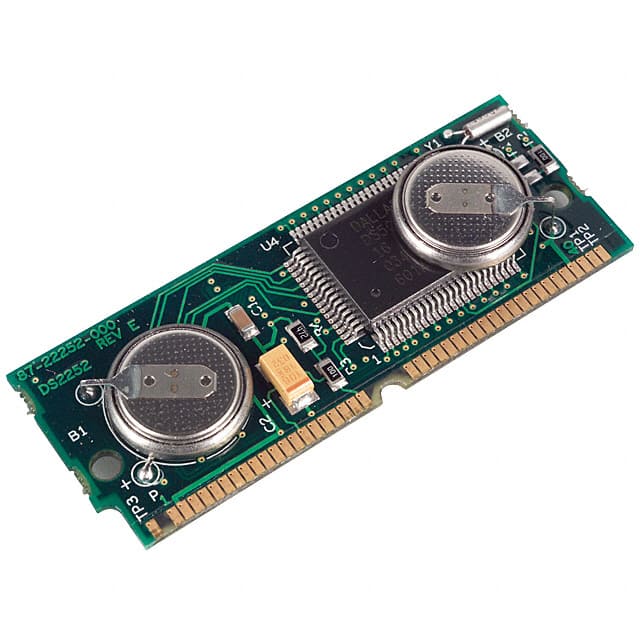
- Part No.:
- DS2252T-128-16
- Manufacturer:
- Analog Devices Inc./Maxim Integrated
- Category:
- Microcontrollers
- Package:
- 40-SIMM
- Datasheet:
-
 DS2252T-128-16.pdf
- Description:
- IC MCU 8BIT 128KB NVSRAM 40SIMM
- Quantity:
- Payment:

- Shipping:

Inventory:2,960
Please send an inquiry. Send us your inquiry, and we will respond immediately.
Product details
Overview
DS2252T-128-16 from Maxim Integrated is an 8051-compatible secure microcontroller module featuring 128kB nonvolatile SRAM, 16MHz crystal speed, and permanently powered real-time clock with 0.01s resolution. It executes encrypted code in-system, supports self-modifying firmware, and delivers crashproof operation for tamper-resistant embedded security applications such as cryptographic key storage and secure boot loaders.
For engineers reviewing the DS2252T-128-16 datasheet, DS2252T-128-16 pinout, DS2252T-128-16 application, or DS2252T-128-16 equivalent, this page provides verified technical context, pin-level circuit roles, memory partitioning behavior, power-fail interrupt timing, and validated alternative options for secure microcontroller selection in high-assurance systems.
Technical Context
The DS2252T-128-16 implements a hardened 8051 core with on-chip 64-bit encryption engine, automatic true random key generation, and hardware-enforced self-destruct via SDI input. Its NV RAM retains data >10 years at room temperature without VCC, backed by internal lithium cell and precision band-gap voltage monitoring.
It features dual power-fail detection thresholds (VPFW = 4.37V typ, VCCMIN = 4.12V typ), early-warning interrupt at 2Bh vector, and seamless switchover to battery backup below VLI. Memory organization excludes off-board program memory for security; partitionable mode is disabled in the 128kB variant per datasheet note.
Key Specifications
| Parameter | Value and Actual Design Meaning |
|---|---|
| Core Architecture | 8051-compatible instruction set with object-code compatibility for existing assemblers and compilers |
| Nonvolatile Memory | 128kB NV SRAM for program/data storage; retains contents >10 years at +25°C with no VCC |
| Real-Time Clock | Permanently powered RTC with 32kHz crystal; timekeeping resolution to 0.01 seconds |
| Crystal Speed | 16MHz maximum external crystal frequency; supports expanded bus timing at full speed |
| Power-Fail Detection | VPRW = 4.37V (typ), VCCMIN = 4.12V (typ); triggers interrupt then reset before battery switchover |
| Operating Voltage | 5V ±10%; absolute max VCC = +6.0V; VIH2 = 3.5V min for RST/XTAL1/PROG pins |
| Temperature Range | -40°C to +85°C operating; -55°C to +125°C storage (with VCC = VLI = 0V) |
Pinout & Package
DS2252T-128-16 uses a 40-pin SIMM package (2.65" × 2.385", 0.100" lead pitch) with gold-plated edge contacts. Pin 2 = VCC (+5V), Pin 39 = GND, Pin 20 = SDI (self-destruct trigger), Pin 17 = RST (active-high, internally pulled down), Pins 35/37 = XTAL1/XTAL2 (32kHz RTC crystal interface).
| Pin/Terminal | Circuit Role | Design Meaning |
|---|---|---|
| 1, 3–9, 11, 13, 15 | P1.0–P1.7 | General-purpose I/O port with no internal pullups; fully software-controllable |
| 4, 6, 8, 10, 12, 14, 16, 18 | P0.0–P0.7 | Open-drain I/O port; multiplexed address/data bus in expanded mode; requires external pullups |
| 40, 38, 36, 34, 32, 30, 28, 26 | P2.0–P2.7 | General-purpose I/O; MSB of expanded address bus when used externally |
| 19, 21, 23, 25, 27, 29, 31, 33 | P3.0–P3.7 | Multiplexed functions: UART (RXD/TXD), INT0/INT1, T0/T1, WR/RD strobes |
| 20 | SDI | Self-destruct input: logic high triggers immediate encryption key erasure and VCCO power removal |
| 22 | ALE | Address latch enable for demultiplexing P0 during expanded bus access |
| 24 | PROG | Falling-edge-triggered bootstrap loader activation; debounced input required |
| 17 | RST | Active-high reset; internally pulled down; no external RC circuit needed or recommended |
Key Features
| Feature | Design Value |
|---|---|
| In-system reprogrammability | Full firmware updates via on-chip serial port without removing device from system |
| Hardware-enforced memory protection | Encrypted NV RAM storage with on-chip 64-bit key; decrypted only inside CPU core |
| Crashproof state retention | All nonvolatile resources preserved >10 years at +25°C with zero VCC; lithium-backed backup |
| Real-time tamper response | SDI input causes instantaneous destruction of keys, vector RAM, and VCCO power path |
| Dual-voltage power monitoring | Separate VPFW (early warning) and VCCMIN (reset) thresholds with programmable interrupt vector |
Applications
| Secure Key Management System | Hardware Root-of-Trust Module |
|---|---|
|
Use Scenario: Storing and executing cryptographic keys for TLS handshake acceleration in network appliances. IC Role / Device Role / Timing Role: Secure microcontroller executing encrypted firmware; RTC provides trusted timestamp for certificate validation. Use Value: Prevents physical extraction of private keys via self-destruct on probe; 128kB NV RAM enables multi-algorithm support without external flash. |
Use Scenario: Boot-time verification of firmware signatures in industrial PLCs with field-upgradable logic. IC Role / Device Role / Timing Role: Trusted execution environment hosting secure bootloader; crashproof retention ensures integrity across brownouts. Use Value: Eliminates need for external secure element; in-system programming allows over-the-air key rotation without hardware replacement. |
| Smart Meter Security Coprocessor | EMV Payment Terminal Core |
|
Use Scenario: Tamper-evident energy metering with encrypted consumption logs and remote firmware updates. IC Role / Device Role / Timing Role: Secure data logger with RTC-stamped records; SDI connected to case-tamper switch. Use Value: Lithium-backed 10-year data retention meets ANSI C12.22 requirements; encrypted NV RAM prevents log manipulation. |
Use Scenario: PCI PTS-compliant payment terminal performing EMV transaction signing and PIN block encryption. IC Role / Device Role / Timing Role: FIPS 140-2 Level 3 compliant secure processor; self-destruct wipes keys on voltage glitch or probe attempt. Use Value: On-chip 64-bit key generation and real-time encryption eliminate external crypto ICs, reducing BOM cost and attack surface. |
Equivalent & Alternatives
The following parts are listed as comparable options for similar secure microcontroller applications.
| Alternative Part | Technical Difference | Application Difference | Selection Advice |
|---|---|---|---|
| DS5002FP | 64kB NV RAM, 16MHz, same 40-pin SIMM; lacks integrated RTC and SDI deglitching circuitry | No permanent RTC; requires external crystal oscillator and separate tamper-detection IC for equivalent security | Choose DS5002FP only if RTC functionality is handled externally and lower memory capacity suffices |
| MAX32550 | ARM Cortex-M3 core, 512kB flash, 128kB SRAM, integrated AES engine; RoHS-compliant QFN48 package | Higher performance but no lithium-backed NV RAM; relies on flash encryption and secure boot instead of runtime decryption | Select MAX32550 for applications needing modern ARM toolchains and higher throughput, accepting different security model |
Compared with DS2252T-128-16, DS5002FP offers identical architecture but reduced memory and no RTC-requiring external components to match timekeeping and tamper-response capabilities. MAX32550 provides greater computational power and modern peripherals but replaces lithium-backed NV RAM with flash-based security, shifting trust assumptions from physical memory retention to cryptographic key management.
Availability
DS2252T-128-16 is available at Aetrix Electronics and suitable for secure key management systems, hardware root-of-trust modules, smart meter security coprocessors, and EMV payment terminal cores requiring stable component supply and long-term lifecycle support.
Supply support for DS2252T-128-16 includes scheduled delivery planning, volume procurement assistance, BOM continuity management, traceable sourcing, and lifecycle availability coordination for OEM customers, industrial embedded developers, connected-device designers, and electronics production programs.
Manufacturer
Maxim Integrated (now part of Analog Devices) designs high-reliability analog and mixed-signal ICs for security, power, and sensing applications.
The DS2252T-128-16 belongs to Maxim's Secure Microcontroller family, engineered specifically for systems requiring physical tamper resistance, encrypted in-system programmability, and decade-long nonvolatile data retention without external power.
FAQ
What is the memory configuration of the DS2252T-128-16?
The DS2252T-128-16 contains 128kB of nonvolatile SRAM configured exclusively for program and/or data storage. Unlike smaller variants, it does not support dynamic partitioning between program and data spaces-this mode is explicitly disabled per datasheet Figure 3 note. All 128kB is accessible via the byte-wide bus, preserving I/O ports for application use, and off-board program memory is prohibited for security reasons.
Does the DS2252T-128-16 include a real-time clock, and how is it powered?
Yes, the DS2252T-128-16 integrates a permanently powered real-time clock with 0.01-second resolution, driven by an onboard 32kHz crystal connected to pins XTAL1 and XTAL2. The RTC operates independently of main VCC using an internal lithium cell, ensuring continuous timekeeping even during complete system power loss-critical for timestamping secure events without external backup.
How does the self-destruct mechanism work on the DS2252T-128-16?
The DS2252T-128-16 implements hardware-enforced self-destruct via the SDI (Self-Destruct Input) pin. Applying a logic high to pin 20 triggers immediate erasure of encryption keys, vector RAM contents, and momentary removal of power from the VCCO rail. The input is deglitched-pulses must exceed 10µs (tSPA) to guarantee activation-and is designed to respond to physical tampering attempts like probe contact or voltage glitching.
What are the power-fail detection thresholds for the DS2252T-128-16?
The DS2252T-128-16 features two precision power-fail thresholds: VPFW (power-fail warning) at 4.37V typical, which generates an interrupt at vector 2Bh while allowing continued operation; and VCCMIN (reset threshold) at 4.12V typical, which forces a hardware reset and disables all chip enables. Both are derived from an internal band-gap reference, ensuring stability across temperature and process variation.
Is the DS2252T-128-16 pin-compatible with other devices in the DS2252T family?
Yes, the DS2252T-128-16 shares identical 40-pin SIMM packaging and pinout with DS2252T-64-16 and DS2252T-128-16# variants, including RoHS-compliant versions. All share identical VCC, GND, RST, SDI, PROG, XTAL1/XTAL2, and I/O port assignments. Functional differences (e.g., memory size, partitioning support) are internal and do not affect board layout or interconnect design.
DS2252T-128-16 Specifications
- Product attributes
- Attribute value
- Manufacturer:
- Analog Devices Inc./Maxim Integrated
- Package/Case:
- 40-SIMM
- Series:
- DS225x
- Packaging:
- Tray
- Product Status:
- Obsolete
- Programmable:
- Not Verified
- Core Processor:
- 8051
- Core Size:
- 8-Bit
- Speed:
- 16MHz
- Connectivity:
- SIO, UART/USART
- Peripherals:
- Power-Fail Reset, WDT
- Number of I/O:
- 32
- Program Memory Size:
- 128KB (128K x 8)
- Program Memory Type:
- NVSRAM
- EEPROM Size:
- -
- RAM Size:
- -
- Voltage - Supply (Vcc/Vdd):
- 4.5V ~ 5.5V
- Data Converters:
- -
- Oscillator Type:
- External
- Operating Temperature:
- 0°C ~ 70°C (TA)
- Grade:
- -
- Qualification:
- -
- Mounting Type:
- Surface Mount
- Supplier Device Package:
DS2252T-128-16 FAQ
1.How can I place an order for DS2252T-128-16 through Aetrix?
Please submit a Request for Quotation (RFQ) for DS2252T-128-16 on Aetrix. Our sales agent will provide a competitive quotation and guide you through the order confirmation once you accept the terms.
2.Are the price and stock information for DS2252T-128-16 reliable?
The price and inventory of DS2252T-128-16 are updated periodically and may fluctuate due to market conditions. Stock and pricing data are typically refreshed every 24 hours. Quotation validity for DS2252T-128-16 is usually 5 days.
3.What payment methods are accepted for DS2252T-128-16?
We accept Wire Transfer, PayPal, Credit Card, Western Union, MoneyGram, and Escrow for DS2252T-128-16 transactions.
Note: Certain payment methods may incur a processing fee.
4.How is shipping managed for DS2252T-128-16?
DS2252T-128-16 orders can be shipped via leading logistics carriers, including DHL, UPS, FedEx, TNT, or Registered Mail.
Once your DS2252T-128-16 order is processed, you will receive an email with the shipment details and tracking number.
Note: Tracking information may take up to 24 hours to appear. Express delivery typically takes 3–5 business days.
5.How can I obtain technical support or documentation for DS2252T-128-16?
For technical support, including DS2252T-128-16 datasheets, pinout diagrams, or application guidance, please contact our engineering support team. They can provide detailed documentation and assistance for your DS2252T-128-16 requirements.
6.How does Aetrix verify that DS2252T-128-16 is sourced from the original manufacturer or authorized distributors?
All DS2252T-128-16 products on Aetrix are procured from qualified distributors and authorized channels. Our dedicated quality assurance team conducts strict verification, including traceability checks and, if necessary, third-party testing. This ensures that DS2252T-128-16 meets industry standards.
7.What is the process for return or replacement of DS2252T-128-16?
All DS2252T-128-16 units undergo pre-shipment inspection (PSI). If there is an issue with DS2252T-128-16, returns or replacements are accepted under the following conditions:
1.Quantity discrepancies, incorrect items, or visible external defects (such as breakage or corrosion), acknowledged by Aetrix.
2.The issue is reported within 90 days of delivery.
3.The DS2252T-128-16 part is unused and in its original packaging.
Return procedure for DS2252T-128-16:
1.Submit a request within 90 days.
2.Obtain a Return Material Authorization (RMA) from Aetrix.
DS2252T-128-16 Tags

-
ATTINY4-TSHR
Microchip Technology
-
ATTINY10-TSHR
Microchip Technology
-
ATTINY10-TS8R
Microchip Technology

-
ATTINY202-SSNR
Microchip Technology
-
ATTINY202-SSFR
Microchip Technology
-
ATTINY402-SSNR
Microchip Technology

-
PIC16F15213T-I/MF
Microchip Technology
-
PIC16F15213-E/MF
Microchip Technology

-
PIC10F200T-I/OT
Microchip Technology
-
ATTINY412-SSNR
Microchip Technology
-
PIC10F202T-I/OT
Microchip Technology

-
ATTINY404-SSNR
Microchip Technology
Tech Hub

A practical engineering guide to 3.3V and 5V logic compatibility, input thresholds, resistor dividers, translator ICs, MOSFET level shifting, I2C pull-ups, timing limits and power-sequencing risks.

The 74HC595 uses push-pull logic outputs, while the TPIC6B595 uses 50 V open-drain DMOS sinks for higher-power loads. This guide compares timing, current limits, 3.3 V interfacing, load wiring, thermal…

The 74HC595 converts serial data into eight stable parallel outputs. This guide covers pin functions, shift and storage timing, OE and MR behavior, drive-current limits, cascading, voltage compatibilit…

A technical comparison of level-sensitive latches and edge-triggered flip-flops, covering timing windows, setup and hold limits, master–slave operation, time borrowing, race-through, HDL inference and…

A D latch stores one bit while Enable controls when data can pass. This reference covers gate-level operation, truth tables, transparency, setup and hold timing, LE versus OE, common ICs and practical …

An SR latch stores one bit through cross-coupled feedback. This engineering reference covers NOR and NAND implementations, truth tables, forbidden-state recovery, gated operation, switch debouncing, fa…

Latch circuits retain one bit through feedback. This technical reference covers SR and D latches, truth tables, transparency, timing limits, latch-versus-flip-flop behavior, applications and common log…

An engineering guide to LED driver operation, constant-current and constant-voltage outputs, linear and switching topologies, dimming, IC selection, calculations, replacement compatibility, and fault c…

Operational amplifier guide covering op amp basics, feedback, ideal vs real op amps, common configurations, buffer circuits, offset, bias current, gain-bandwidth, slew rate, rail-to-rail limits and sel…

Jumper cables guide covering safe connection order, red and black clamp placement, final ground connection, cable gauge, length, clamp quality, copper vs CCA cables, jump starter comparison and battery…


