
 My Inquiry
 My Account


Analog Devices Inc./Maxim Integrated DS33X161+
- Part No.:
- DS33X161+
- Manufacturer:
- Analog Devices Inc./Maxim Integrated
- Category:
- Specialized
- Package:
- 256-LBGA, CSBGA
- Datasheet:
-
 DS33X161+.pdf
- Description:
- IC INTFACE SPECIALIZED 256CSBGA
- Quantity:
- Payment:

- Shipping:

Inventory:4,556
Please send an inquiry. Send us your inquiry, and we will respond immediately.
Product details
Overview
DS33X161+ from Maxim Integrated is a single-port Ethernet-over-PDH mapping IC that encapsulates IEEE 802.3 MAC frames in GFP-F, HDLC, cHDLC, or X.86 for transmission over T1/E1/J1, T3/E3, or xDSL TDM streams. It supports VCAT/LCAS link aggregation across up to 16 TDM links, provides wire-speed bridging and traffic shaping via CIR/CBS policing, and operates across -40°C to +85°C for carrier-grade access equipment.
For engineers reviewing the DS33X161+ datasheet, DS33X161+ pinout, DS33X161+ application, or DS33X161+ equivalent, this device is selected for deterministic Ethernet service delivery over legacy PDH infrastructure-particularly where multi-link inverse multiplexing, OAM frame handling, and QoS-aware GFP-F encapsulation are required.
Technical Context
The DS33X161+ implements a store-and-forward architecture with dual-layer classification: Layer 2 (VLAN ID, 802.1p priority) and Layer 3 (DSCP), enabling per-flow QoS enforcement. Its packet processor handles full GFP-F framing-including core header, payload header, and CRC-16-with optional idle insertion and payload scrambling.
VCAT/LCAS support enables dynamic bandwidth adjustment across up to 16 TDM links with up to 200ms differential delay tolerance. The device interfaces to external 125MHz DDR SDRAM for frame buffering and uses parallel or SPI microprocessor interfaces for configuration and OAM frame extraction/insertion.
Key Specifications
| Parameter | Value and Actual Design Meaning |
|---|---|
| MAC Interface | GMII/MII/RMII supporting 10/100/1000Mbps IEEE 802.3 with autonegotiation and flow control |
| TDM Ports | 16 synchronous serial ports supporting T1/E1/J1, T3/E3, or V.35/Optical physical layer interconnect |
| Encapsulation | GFP-F, X.86 (LAPS), HDLC, and cHDLC-each with configurable payload length and CRC options |
| Link Aggregation | VCAT/LCAS compliant for up to 16 links with real-time capacity adjustment and hitless reconfiguration |
| Buffer Memory | External 256Mb DDR SDRAM interface operating at 125MHz for frame storage and traffic conditioning |
| OAM Support | Full OAM frame trapping, extraction, and insertion via μP interface-enabling RFC 3440-compliant service management |
| Power Supplies | Independent 1.8V (core), 2.5V (I/O), and 3.3V (analog/SDRAM) rails with internal regulation |
Pinout & Package
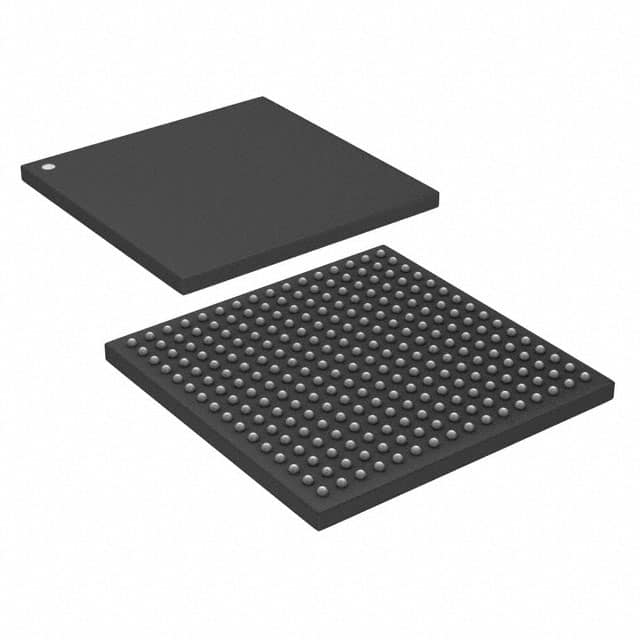
DS33X161+ is housed in a 256-ball, 17mm × 17mm CSBGA package (package code: 56-G6017-001) with 0.8mm ball pitch and Pb-free/RoHS-compliant finish. Thermal pad exposed on underside for enhanced heat dissipation in high-throughput carrier applications.
| Pin/Terminal | Circuit Role | Design Meaning |
|---|---|---|
| CLKIN | Primary reference clock input | Accepts 125MHz or 25MHz crystal or LVDS source for GMII/MII timing and internal PLL synchronization |
| MDIO / MDC | PHY management interface | IEEE 802.3-compliant MDIO bus for configuring external PHYs and monitoring link status |
| SDRAM_DQ[15:0] | DDR SDRAM data bus | 16-bit bidirectional data path to external 256Mb DDR SDRAM used for frame buffering and queue management |
| μP_ADDR[15:0] | Parallel microprocessor address bus | 16-bit address space for register-mapped configuration, statistics readback, and OAM frame access |
| SPI_CS / SPI_SCLK / SPI_MOSI / SPI_MISO | SPI serial interface | 4-wire SPI interface supporting 25MHz operation for bootloading, firmware updates, and low-pin-count host control |
| TDM_TX[15:0] / TDM_RX[15:0] | TDM serial data lanes | 16 independent full-duplex TDM channels supporting E1 (2.048Mbps) or T1 (1.544Mbps) framing with JTAG-accessible LIU control |
Key Features
| Feature | Design Value |
|---|---|
| GFP-F Encapsulation Engine | Hardware-accelerated GFP-F framing with configurable core header, payload header, and CRC-16-enabling standards-compliant Ethernet transport over SONET/SDH-aligned PDH |
| VCAT/LCAS Link Aggregation | Supports dynamic inverse multiplexing across up to 16 TDM links with LCAS hitless bandwidth adjustment and automatic failure recovery |
| Multi-Level QoS Enforcement | Simultaneous VLAN (802.1q), priority tagging (802.1p), Q-in-Q, and DSCP-based classification with programmable egress scheduling |
| OAM Frame Handling | Dedicated hardware path for trapping, extracting, and inserting IEEE 802.3ah and ITU-T Y.1731 OAM frames via μP interface-no CPU overhead |
| External DDR SDRAM Buffer | Configurable 256Mb DDR interface enables >100ms frame buffering depth for jitter compensation and burst absorption in asymmetric TDM networks |
Applications
| Bonded Transparent LAN Service (eLAN) | Ethernet Extension Over T1/E1 Trunks |
|---|---|
Use Scenario: Carrier delivers point-to-multipoint Layer 2 Ethernet service across geographically dispersed enterprise sites using existing T1/E1 infrastructure. IC Role / Device Role / Timing Role: DS33X161+ performs GFP-F encapsulation, VCAT link aggregation, and VLAN-aware bridging to unify multiple T1/E1 circuits into a single logical Ethernet pipe. Use Value: Enables deterministic 100Mbps+ throughput over bonded T1/E1 with sub-50μs latency variation and zero frame loss under LCAS reconfiguration. |
Use Scenario: Enterprise extends campus LAN across metro distances using leased T1/E1 lines instead of fiber or MPLS. IC Role / Device Role / Timing Role: DS33X161+ acts as edge mapper-converting native Ethernet frames to HDLC/GFP-F for TDM transport and reconstructing them at the far end. Use Value: Eliminates need for protocol converters; preserves native Ethernet MTU, MAC learning, and spanning tree behavior across the TDM segment. |
| eLINE Point-to-Point Service | Carrier Ethernet Access Node |
Use Scenario: Service provider offers dedicated Ethernet private line between two customer locations over legacy PDH network. IC Role / Device Role / Timing Role: DS33X161+ implements strict priority queuing and CIR/CBS policing to guarantee SLA-compliant bandwidth and jitter performance. Use Value: Delivers <10ms round-trip latency and <50μs jitter over 1–4 T1/E1 links while supporting OAM-based SLA verification. |
Use Scenario: DSLAM or MSPP edge node aggregates Ethernet client traffic onto backbone T3/E3 or OC-1 links. IC Role / Device Role / Timing Role: DS33X161+ serves as TDM-facing Ethernet mapper-handling classification, encapsulation, and buffer management before handing off to framer/LIU. Use Value: Offloads CPU-intensive frame processing from host processor; enables scalable 16×T1/E1 port density per ASIC in compact access platforms. |
Equivalent & Alternatives
The following parts are listed as comparable options for similar Ethernet-over-PDH mapping applications.
| Alternative Part | Technical Difference | Application Difference | Selection Advice |
|---|---|---|---|
| DS33X162+ | Two Ethernet MAC ports (vs. one), identical TDM port count (16), same VCAT/LCAS and GFP-F capabilities | Required when dual LAN-side connectivity (e.g., primary/backup, LAN/WAN separation) is needed | Select DS33X162+ only if dual-MAC topology is mandated; DS33X161+ reduces BOM cost and PCB routing complexity for single-LAN designs |
| DS33X81+ | 8 TDM ports (vs. 16), same single Ethernet MAC, identical encapsulation and QoS features | Suitable for lower-density T1/E1 aggregation (e.g., branch office with ≤8 circuits) | Choose DS33X81+ for cost-sensitive deployments with ≤8 TDM links; DS33X161+ maintains full feature parity at higher port count |
Compared with DS33X162+, DS33X161+ reduces system cost and layout complexity by eliminating redundant MAC logic while retaining full VCAT/LCAS, GFP-F, and OAM functionality. Against DS33X81+, it doubles TDM port density without sacrificing QoS granularity or buffer depth-critical for central office aggregation.
Availability
DS33X161+ is available at Aetrix Electronics and suitable for carrier Ethernet access nodes, TDM-to-Ethernet gateways, and managed service provider edge routers requiring stable component supply, long-term lifecycle support, and RoHS-compliant packaging.
Supply support for DS33X161+ includes scheduled delivery planning, volume procurement assistance, BOM continuity management, traceable sourcing, and lifecycle availability coordination for OEM customers, industrial embedded developers, connected-device designers, and electronics production programs.
Manufacturer
Maxim Integrated (now part of Analog Devices) is a semiconductor company specializing in high-performance analog, mixed-signal, and power management solutions for communications, industrial, and automotive markets.
The DS33X161+ belongs to Maxim's Ethernet-over-PDH mapping product line, designed specifically to enable carrier-grade Ethernet service delivery over legacy TDM infrastructure with full standards compliance and operational visibility.
FAQ
What is the primary function of the DS33X161+ in an Ethernet-over-PDH system?
The DS33X161+ functions as a standards-compliant Ethernet-to-TDM mapper, converting IEEE 802.3 frames into GFP-F, HDLC, cHDLC, or X.86 encapsulated payloads for transport over T1/E1/J1 or T3/E3 circuits. It performs wire-speed bridging, QoS classification, and VCAT/LCAS link aggregation-making DS33X161+ essential for delivering eLAN, eLINE, and VLAN services over legacy PDH networks.
Does the DS33X161+ support both GFP-F and HDLC encapsulation simultaneously?
Yes, the DS33X161+ supports per-port selection of GFP-F, HDLC, cHDLC, or X.86 encapsulation modes. Each of its 16 TDM ports can be independently configured for different protocols, allowing hybrid network deployments-for example, GFP-F for core trunk links and HDLC for legacy interconnects-without requiring separate devices or firmware changes to DS33X161+.
What external memory is required for the DS33X161+ to operate?
The DS33X161+ requires an external 256Mb DDR SDRAM running at 125MHz to serve as its frame buffer and queue management memory. This external memory is mandatory for store-and-forward operation, traffic shaping, and jitter compensation. No internal SRAM buffer exists-DS33X161+ relies entirely on the external DDR interface for all packet storage and forwarding decisions.
How does the DS33X161+ handle OAM frames for service management?
The DS33X161+ provides hardware-accelerated OAM frame handling: it can trap, extract, and insert IEEE 802.3ah and ITU-T Y.1731 OAM frames via its parallel or SPI microprocessor interface. This offloads OAM processing from the host CPU and ensures deterministic timing-critical for SLA monitoring. DS33X161+ does not terminate OAM; it forwards frames to the external processor for interpretation and response.
Is the DS33X161+ pin-compatible with other members of the DS33X family?
No, DS33X161+ is not pin-compatible with DS33X81+ or DS33X41+, though all share the same 256-ball CSBGA package footprint. Pin assignments differ significantly due to varying TDM port counts and internal resource allocation. For example, TDM_RX[15:8] on DS33X161+ map to unused balls on DS33X81+. Board redesign is required when substituting DS33X161+ for lower-port variants.
DS33X161+ Specifications
- Product attributes
- Attribute value
- Manufacturer:
- Analog Devices Inc./Maxim Integrated
- Series:
- -
- Package/Case:
- 256-LBGA, CSBGA
- Packaging:
- Bulk
- Product Status:
- Obsolete
- Applications:
- Data Transport
- Interface:
- Parallel/Serial
- Voltage - Supply:
- 1.8V, 2.5V, 3.3V
- Supplier Device Package:
- 256-CSBGA (17x17)
- Grade:
- -
- Qualification:
- -
- Mounting Type:
- Surface Mount
DS33X161+ FAQ
1.How can I place an order for DS33X161+ through Aetrix?
Please submit a Request for Quotation (RFQ) for DS33X161+ on Aetrix. Our sales agent will provide a competitive quotation and guide you through the order confirmation once you accept the terms.
2.Are the price and stock information for DS33X161+ reliable?
The price and inventory of DS33X161+ are updated periodically and may fluctuate due to market conditions. Stock and pricing data are typically refreshed every 24 hours. Quotation validity for DS33X161+ is usually 5 days.
3.What payment methods are accepted for DS33X161+?
We accept Wire Transfer, PayPal, Credit Card, Western Union, MoneyGram, and Escrow for DS33X161+ transactions.
Note: Certain payment methods may incur a processing fee.
4.How is shipping managed for DS33X161+?
DS33X161+ orders can be shipped via leading logistics carriers, including DHL, UPS, FedEx, TNT, or Registered Mail.
Once your DS33X161+ order is processed, you will receive an email with the shipment details and tracking number.
Note: Tracking information may take up to 24 hours to appear. Express delivery typically takes 3–5 business days.
5.How can I obtain technical support or documentation for DS33X161+?
For technical support, including DS33X161+ datasheets, pinout diagrams, or application guidance, please contact our engineering support team. They can provide detailed documentation and assistance for your DS33X161+ requirements.
6.How does Aetrix verify that DS33X161+ is sourced from the original manufacturer or authorized distributors?
All DS33X161+ products on Aetrix are procured from qualified distributors and authorized channels. Our dedicated quality assurance team conducts strict verification, including traceability checks and, if necessary, third-party testing. This ensures that DS33X161+ meets industry standards.
7.What is the process for return or replacement of DS33X161+?
All DS33X161+ units undergo pre-shipment inspection (PSI). If there is an issue with DS33X161+, returns or replacements are accepted under the following conditions:
1.Quantity discrepancies, incorrect items, or visible external defects (such as breakage or corrosion), acknowledged by Aetrix.
2.The issue is reported within 90 days of delivery.
3.The DS33X161+ part is unused and in its original packaging.
Return procedure for DS33X161+:
1.Submit a request within 90 days.
2.Obtain a Return Material Authorization (RMA) from Aetrix.
DS33X161+ Tags
-
NVT4857UKAZ
NXP Semiconductors
-
TCA8418RTWR
Texas Instruments
-
PCA9546APWR
Texas Instruments
-
MD0100N8-G
Microchip Technology
-
PCA9548APW,118
NXP Semiconductors
-
PCA9540BDP,118
NXP Semiconductors
-
PCA9548APWR
Texas Instruments
-
PCA9546APW,118
NXP Semiconductors
-
PTN3360DBS,518
NXP Semiconductors
-
PCA9546ABS,118
NXP Semiconductors
-
PCA9518PWR
Texas Instruments
-
PCA9545APW,118
NXP Semiconductors
Tech Hub

A practical engineering guide to 3.3V and 5V logic compatibility, input thresholds, resistor dividers, translator ICs, MOSFET level shifting, I2C pull-ups, timing limits and power-sequencing risks.

The 74HC595 uses push-pull logic outputs, while the TPIC6B595 uses 50 V open-drain DMOS sinks for higher-power loads. This guide compares timing, current limits, 3.3 V interfacing, load wiring, thermal…

The 74HC595 converts serial data into eight stable parallel outputs. This guide covers pin functions, shift and storage timing, OE and MR behavior, drive-current limits, cascading, voltage compatibilit…

A technical comparison of level-sensitive latches and edge-triggered flip-flops, covering timing windows, setup and hold limits, master–slave operation, time borrowing, race-through, HDL inference and…

A D latch stores one bit while Enable controls when data can pass. This reference covers gate-level operation, truth tables, transparency, setup and hold timing, LE versus OE, common ICs and practical …

An SR latch stores one bit through cross-coupled feedback. This engineering reference covers NOR and NAND implementations, truth tables, forbidden-state recovery, gated operation, switch debouncing, fa…

Latch circuits retain one bit through feedback. This technical reference covers SR and D latches, truth tables, transparency, timing limits, latch-versus-flip-flop behavior, applications and common log…

An engineering guide to LED driver operation, constant-current and constant-voltage outputs, linear and switching topologies, dimming, IC selection, calculations, replacement compatibility, and fault c…

Operational amplifier guide covering op amp basics, feedback, ideal vs real op amps, common configurations, buffer circuits, offset, bias current, gain-bandwidth, slew rate, rail-to-rail limits and sel…

Jumper cables guide covering safe connection order, red and black clamp placement, final ground connection, cable gauge, length, clamp quality, copper vs CCA cables, jump starter comparison and battery…


