
 My Inquiry
 My Account


Analog Devices Inc./Maxim Integrated DS33ZH11
- Part No.:
- DS33ZH11
- Manufacturer:
- Analog Devices Inc./Maxim Integrated
- Category:
- Specialized
- Package:
- 100-LFBGA, CSPBGA
- Datasheet:
-
 DS33ZH11.pdf
- Description:
- IC INTFACE SPECIALIZED 100CSBGA
- Quantity:
- Payment:

- Shipping:

Inventory:3,343
Please send an inquiry. Send us your inquiry, and we will respond immediately.
Product details
Overview
DS33ZH11 from Maxim Integrated is a 10/100 Ethernet-to-TDM mapper IC that encapsulates IEEE 802.3 MAC frames into HDLC or X.86 (LAPS) for transport over synchronous PDH/TDM links up to 52Mbps. It supports MII/RMII Ethernet interfaces, hardware/SPI-only operation mode, and features a CIR controller with 512kbps fractional bandwidth allocation. Used in LAN extension over T1/E1/J1, OC-1, or G.SHDSL infrastructure.
For engineers reviewing the DS33ZH11 datasheet, DS33ZH11 pinout, DS33ZH11 application, or DS33ZH11 equivalent, key selection considerations include its 100-ball CSBGA package, hardware-mode-only configuration, 1.8V core / 3.3V-tolerant I/O, JTAG debug support, and dedicated serial interface timing for TDM interconnects.
Technical Context
The DS33ZH11 implements store-and-forward packet processing with full wire-speed throughput across its 10/100 Ethernet MAC and synchronous 52Mbps TDM serial port. Its HDLC/X.86 mapper operates with programmable FCS and interframe fill, and the CIR controller enforces bandwidth limits in precise 512kbps increments on the WAN transmit path.
It supports dual-clock domains: independent transmit/receive timing on the serial interface and configurable Ethernet clocking (MII/RMII), with hardware-mode initialization via dedicated pins (MODEC, HWMODE). JTAG compliance (IEEE 1149.1) enables boundary-scan testing and register-level diagnostics without host processor involvement.
Key Specifications
| Parameter | Value and Actual Design Meaning |
|---|---|
| Max Serial Rate | 52Mbps synchronous TDM - supports OC-1, E3, T3, and xDSL physical layer interconnects |
| Ethernet Interface | MII and RMII - enables direct connection to standard 10/100 PHYs without glue logic |
| CIR Granularity | 512kbps increments - allows precise fractional bandwidth provisioning for SLA-compliant services |
| Core Supply | 1.8V ±0.1V - low-power operation compatible with modern DSP/FPGA power rails |
| I/O Voltage Tolerance | 3.3V tolerant - simplifies interface to legacy or mixed-voltage system components |
| Operating Temp | –40°C to +85°C - qualified for industrial and telecom central office environments |
| JTAG Support | IEEE 1149.1 compliant - enables production test, debug, and firmware update via boundary scan |
Pinout & Package
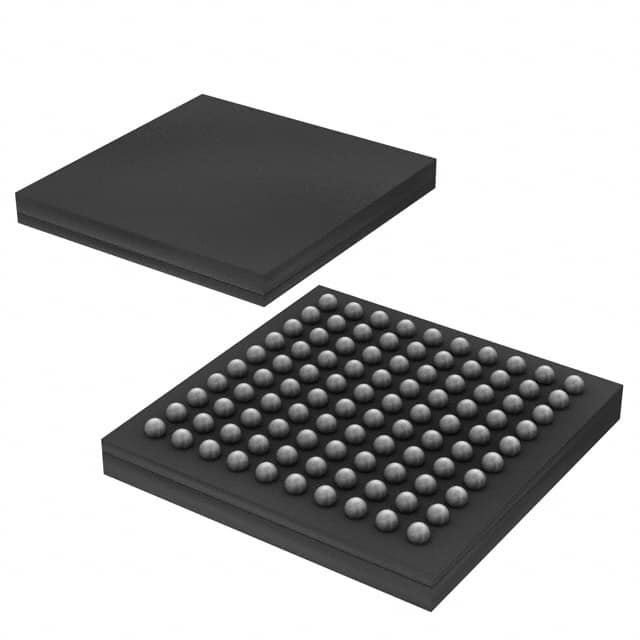
DS33ZH11 is housed in a 10mm × 10mm, 100-ball Chip-Scale Ball Grid Array (CSBGA) package, optimized for high-density PCB layouts and thermal performance in telecom line cards. Pinout is defined exclusively for Hardware Mode or SPI Mode operation - no microprocessor interface pins are active.
| Pin/Terminal | Circuit Role | Design Meaning |
|---|---|---|
| HWMODE | Hardware Mode Enable | Asserted high to disable host processor interface and activate fixed-function SPI/hardware boot |
| MODEC[1:0] | Configuration Mode Select | Defines default serial framing (HDLC/X.86), clock source, and duplex mode at power-up |
| CLKIN | Serial Interface Clock Input | Accepts external reference (e.g., 2.048MHz, 8.192MHz, or 16.384MHz) for WAN timing |
| TXCLK/RXCLK | Independent Serial Clock Outputs | Provides separate transmit/receive byte-sync clocks - eliminates need for external clock recovery |
| MII/RMII Signals (TXD[3:0], RXD[3:0], TXEN, RXDV, etc.) | Ethernet Physical Layer Interface | Direct connection to 10/100 PHY; RMII reduces pin count vs. MII while maintaining full bandwidth |
Key Features
| Feature | Design Value |
|---|---|
| Hardware/SPI-Only Operation | Eliminates external microcontroller requirement - reduces BOM cost and firmware validation burden |
| Programmable BERT | Enables in-system serial link integrity verification using PRBS7/PRBS15 patterns without test equipment |
| External SDRAM Support | Interfaces to 16MB, 100MHz SDRAM for deep packet buffering - essential for bursty LAN traffic over constrained TDM pipes |
| Flow Control Options | Supports full-duplex pause frames, half-duplex backpressure, and host-managed flow control - adapts to diverse network congestion policies |
| DTE/DCE Configurability | Runtime-selectable DTE or DCE role on Ethernet and WAN sides - simplifies deployment in asymmetric topologies |
Applications
| Transparent LAN Extension | Ethernet-over-T1/E1 Service |
|---|---|
|
Use Scenario: Extending corporate LAN across metro distances using existing T1/E1 leased lines without MPLS or IP routing. IC Role / Device Role / Timing Role: DS33ZH11 acts as a transparent frame mapper - converting Ethernet MAC frames to HDLC for TDM transport while preserving MAC addresses and VLAN tags. Use Value: Enables carrier-grade point-to-point Layer 2 connectivity with deterministic latency and sub-50ms failover when paired with redundant TDM paths. |
Use Scenario: Delivering business-class Ethernet access to SMB customers over incumbent telco T1/E1 infrastructure. IC Role / Device Role / Timing Role: DS33ZH11 serves as the edge mapper at the CO or DSLAM - performing X.86 encapsulation and CIR enforcement per subscriber. Use Value: Supports SLA-governed bandwidth tiers (e.g., 1.544Mbps, 3.088Mbps) with hardware-enforced rate limiting and jitter-free delivery. |
| G.SHDSL Backhaul | OC-1/EC-1 Fiber-to-Copper Bridge |
|
Use Scenario: Aggregating multiple Ethernet drops onto a single G.SHDSL copper pair for last-mile access in rural or legacy-building deployments. IC Role / Device Role / Timing Role: DS33ZH11 functions as the TDM framer - mapping Ethernet traffic into G.SHDSL-compatible HDLC frames with adaptive timing recovery. Use Value: Achieves up to 5.6Mbps symmetric throughput over 2km of Category 3 wiring, leveraging existing copper plant. |
Use Scenario: Interfacing fiber-based OC-1 SONET tributaries to copper-based enterprise LANs in campus or data center edge locations. IC Role / Device Role / Timing Role: DS33ZH11 operates as a protocol converter - extracting Ethernet payloads from SONET STS-1 payloads and re-encapsulating them for local switching. Use Value: Provides seamless interoperability between legacy SONET transport and modern Ethernet infrastructure without requiring full SONET termination. |
Equivalent & Alternatives
The following parts are listed as comparable options for similar Ethernet-to-TDM mapping applications.
| Alternative Part | Technical Difference | Application Difference | Selection Advice |
|---|---|---|---|
| DS33Z11 | 169-ball CSBGA; supports full microprocessor interface, EEPROM boot, and both hardware and SPI modes | Required where flexible firmware updates, dynamic configuration, or host-controlled diagnostics are needed | Select DS33Z11 if system design requires runtime register access, multi-protocol adaptation, or field-upgradable behavior |
| ICS8430I | Single-chip T1/E1 framer + Ethernet MAC; no HDLC/X.86 mapper; max 2.048Mbps WAN rate | Limited to low-bandwidth T1/E1 bridging without fractional CIR or LAPS support | Choose ICS8430I only for cost-sensitive, low-throughput T1/E1 extensions where advanced encapsulation is unnecessary |
Compared with DS33Z11, DS33ZH11 trades host interface flexibility for smaller footprint and simplified boot; compared with ICS8430I, it delivers 25× higher WAN throughput and standards-compliant LAPS framing essential for carrier interop.
Availability
DS33ZH11 is available at Aetrix Electronics and suitable for transparent LAN extension, Ethernet-over-T1/E1 service delivery, and G.SHDSL backhaul applications requiring stable component supply, long-term lifecycle assurance, and traceable sourcing from authorized channels.
Supply support for DS33ZH11 includes scheduled delivery planning, volume procurement assistance, BOM continuity management, traceable sourcing, and lifecycle availability coordination for OEM customers, industrial embedded developers, connected-device designers, and electronics production programs.
Manufacturer
Maxim Integrated (now part of Analog Devices) designs precision analog, mixed-signal, and high-reliability communication ICs for industrial, telecom, and computing markets.
The DS33ZH11 belongs to Maxim's Ethernet Mapper product line, engineered specifically for carrier-class LAN extension over legacy TDM infrastructure - emphasizing deterministic timing, hardware configurability, and standards-compliant framing (HDLC/X.86).
FAQ
What is the primary function of the DS33ZH11?
The DS33ZH11 is a dedicated Ethernet-to-TDM mapper IC that converts IEEE 802.3 MAC frames into HDLC or X.86 (LAPS) format for transmission over synchronous PDH/TDM networks. It performs store-and-forward packet processing at wire speed up to 52Mbps and supports hardware-only or SPI-based configuration - making the DS33ZH11 ideal for fixed-function telecom edge applications where microprocessor overhead must be eliminated.
Does the DS33ZH11 support both MII and RMII Ethernet interfaces?
Yes, the DS33ZH11 supports both MII and RMII interfaces for 10/100 Ethernet connectivity. The choice between them is configured at power-up via MODEC pins. RMII reduces pin count and simplifies layout, while MII provides greater timing margin and compatibility with legacy PHYs - both operate at full wire speed without packet loss. This dual-interface capability ensures the DS33ZH11 can integrate seamlessly into diverse Ethernet PHY ecosystems.
Can the DS33ZH11 operate without an external microprocessor?
Yes, the DS33ZH11 is explicitly designed for hardware-mode-only operation. When HWMODE is asserted, the microprocessor interface is disabled, and configuration is determined by strapping pins (MODEC[1:0]) and optional SPI EEPROM. This eliminates firmware development, boot-time dependencies, and runtime host intervention - a key differentiator from the pin-compatible DS33Z11, which requires host control for full functionality.
What is the role of the Committed Information Rate (CIR) controller in the DS33ZH11?
The CIR controller in the DS33ZH11 enforces guaranteed bandwidth allocation on the WAN transmit path in precise 512kbps increments, up to the full line rate. It shapes traffic to meet SLA requirements for business Ethernet services - ensuring minimum throughput for critical flows while preventing oversubscription. Unlike software-based policing, this hardware CIR block operates deterministically with zero latency impact on the DS33ZH11's store-and-forward pipeline.
Is JTAG debugging supported on the DS33ZH11?
Yes, the DS33ZH11 includes full IEEE 1149.1 JTAG support for boundary-scan testing, register access, and in-circuit diagnostics. JTAG operates independently of the hardware/SPI mode configuration, enabling production test, failure analysis, and low-level register inspection without requiring functional Ethernet or TDM links - a critical capability for validating DS33ZH11 integration in high-reliability telecom systems.
DS33ZH11 Specifications
- Product attributes
- Attribute value
- Manufacturer:
- Analog Devices Inc./Maxim Integrated
- Series:
- -
- Package/Case:
- 100-LFBGA, CSPBGA
- Packaging:
- Tray
- Product Status:
- Obsolete
- Applications:
- Data Transport
- Interface:
- Serial
- Voltage - Supply:
- 1.8V, 2.5V, 3.3V
- Supplier Device Package:
- 100-CSBGA (10x10)
- Grade:
- -
- Qualification:
- -
- Mounting Type:
- Surface Mount
DS33ZH11 FAQ
1.How can I place an order for DS33ZH11 through Aetrix?
Please submit a Request for Quotation (RFQ) for DS33ZH11 on Aetrix. Our sales agent will provide a competitive quotation and guide you through the order confirmation once you accept the terms.
2.Are the price and stock information for DS33ZH11 reliable?
The price and inventory of DS33ZH11 are updated periodically and may fluctuate due to market conditions. Stock and pricing data are typically refreshed every 24 hours. Quotation validity for DS33ZH11 is usually 5 days.
3.What payment methods are accepted for DS33ZH11?
We accept Wire Transfer, PayPal, Credit Card, Western Union, MoneyGram, and Escrow for DS33ZH11 transactions.
Note: Certain payment methods may incur a processing fee.
4.How is shipping managed for DS33ZH11?
DS33ZH11 orders can be shipped via leading logistics carriers, including DHL, UPS, FedEx, TNT, or Registered Mail.
Once your DS33ZH11 order is processed, you will receive an email with the shipment details and tracking number.
Note: Tracking information may take up to 24 hours to appear. Express delivery typically takes 3–5 business days.
5.How can I obtain technical support or documentation for DS33ZH11?
For technical support, including DS33ZH11 datasheets, pinout diagrams, or application guidance, please contact our engineering support team. They can provide detailed documentation and assistance for your DS33ZH11 requirements.
6.How does Aetrix verify that DS33ZH11 is sourced from the original manufacturer or authorized distributors?
All DS33ZH11 products on Aetrix are procured from qualified distributors and authorized channels. Our dedicated quality assurance team conducts strict verification, including traceability checks and, if necessary, third-party testing. This ensures that DS33ZH11 meets industry standards.
7.What is the process for return or replacement of DS33ZH11?
All DS33ZH11 units undergo pre-shipment inspection (PSI). If there is an issue with DS33ZH11, returns or replacements are accepted under the following conditions:
1.Quantity discrepancies, incorrect items, or visible external defects (such as breakage or corrosion), acknowledged by Aetrix.
2.The issue is reported within 90 days of delivery.
3.The DS33ZH11 part is unused and in its original packaging.
Return procedure for DS33ZH11:
1.Submit a request within 90 days.
2.Obtain a Return Material Authorization (RMA) from Aetrix.
DS33ZH11 Tags
-
NVT4857UKAZ
NXP Semiconductors
-
TCA8418RTWR
Texas Instruments

-
PCA9546APWR
Texas Instruments

-
MD0100N8-G
Microchip Technology
-
PCA9548APW,118
NXP Semiconductors
-
PCA9540BDP,118
NXP Semiconductors
-
PCA9548APWR
Texas Instruments
-
PCA9546APW,118
NXP Semiconductors
-
PTN3360DBS,518
NXP Semiconductors
-
PCA9546ABS,118
NXP Semiconductors
-
PCA9518PWR
Texas Instruments
-
PCA9545APW,118
NXP Semiconductors
Tech Hub

A practical engineering guide to 3.3V and 5V logic compatibility, input thresholds, resistor dividers, translator ICs, MOSFET level shifting, I2C pull-ups, timing limits and power-sequencing risks.

The 74HC595 uses push-pull logic outputs, while the TPIC6B595 uses 50 V open-drain DMOS sinks for higher-power loads. This guide compares timing, current limits, 3.3 V interfacing, load wiring, thermal…

The 74HC595 converts serial data into eight stable parallel outputs. This guide covers pin functions, shift and storage timing, OE and MR behavior, drive-current limits, cascading, voltage compatibilit…

A technical comparison of level-sensitive latches and edge-triggered flip-flops, covering timing windows, setup and hold limits, master–slave operation, time borrowing, race-through, HDL inference and…

A D latch stores one bit while Enable controls when data can pass. This reference covers gate-level operation, truth tables, transparency, setup and hold timing, LE versus OE, common ICs and practical …

An SR latch stores one bit through cross-coupled feedback. This engineering reference covers NOR and NAND implementations, truth tables, forbidden-state recovery, gated operation, switch debouncing, fa…

Latch circuits retain one bit through feedback. This technical reference covers SR and D latches, truth tables, transparency, timing limits, latch-versus-flip-flop behavior, applications and common log…

An engineering guide to LED driver operation, constant-current and constant-voltage outputs, linear and switching topologies, dimming, IC selection, calculations, replacement compatibility, and fault c…

Operational amplifier guide covering op amp basics, feedback, ideal vs real op amps, common configurations, buffer circuits, offset, bias current, gain-bandwidth, slew rate, rail-to-rail limits and sel…

Jumper cables guide covering safe connection order, red and black clamp placement, final ground connection, cable gauge, length, clamp quality, copper vs CCA cables, jump starter comparison and battery…


