
 My Inquiry
 My Account


Texas Instruments DS92LV0422SQ/NOPB
- Part No.:
- DS92LV0422SQ/NOPB
- Manufacturer:
- Texas Instruments
- Category:
- Serializers, Deserializers
- Package:
- -
- Datasheet:
-
 DS92LV0422SQ/NOPB.pdf
- Description:
- DS92LV0422 10 - 75 MHZ CHANNEL L
- Quantity:
- Payment:

- Shipping:

Inventory:24,000
Please send an inquiry. Send us your inquiry, and we will respond immediately.
Product details
Overview
DS92LV0422SQ/NOPB from Texas Instruments is a Channel Link II deserializer IC that converts high-speed CML serial data (1 pair) into 4-channel LVDS parallel video/data + clock for RGB-style display interfaces. It supports 10–75 MHz pixel clocks, 24-bit color depth, and operates with 1.8-V or 3.3-V I/O. Used in frame grabbers, medical imaging systems, and industrial displays requiring long-cable AC-coupled interconnects up to 10 m.
For engineers reviewing the DS92LV0422SQ/NOPB datasheet, DS92LV0422SQ/NOPB pinout, DS92LV0422SQ/NOPB application, or DS92LV0422SQ/NOPB equivalent, key selection criteria include its CML-to-LVDS conversion capability, programmable receiver equalization (EQ), LOCK status output, spread-spectrum clocking (SSCG), and compatibility with DS92LV0421 serializer in embedded video links.
Technical Context
The DS92LV0422SQ/NOPB implements a fully self-clocked deserialization architecture with no external reference clock required - it achieves fast random-data lock using embedded clock recovery. Its CML input stage includes configurable equalization gain (1.625 dB or ~13 dB via EQ pin), supporting lossy STP cables up to 10 m.
Internally, the device reconstructs a parallel Channel Link LVDS interface (4 data + 1 clock lanes) with selectable MSB/LSB mapping (MAPSEL), output voltage control (VODSEL = ±250 mV or ±400 mV), and flexible power-down (PDB) and output enable (OEN) logic. SSCG is supported across 10–65 MHz via SSC[2:0] pins with LFMODE-selectable frequency bands.
Key Specifications
| Parameter | Value and Actual Design Meaning |
|---|---|
| Clock Range | 10 MHz to 75 MHz - defines supported pixel rates for QVGA to XGA RGB displays |
| Input Interface | CML serial pair (RIN+/−) - enables AC-coupled, low-EMI transmission over 100-Ω STP cable |
| Output Interface | 5-lane Channel Link LVDS (TXOUT[3:0]± + TXCLKOUT±) - directly drives standard OpenLDI-compatible display controllers |
| Supply Voltages | VDDTX = 3.3 V ±10% (LVDS outputs); VDDIO = 1.8 V or 3.3 V ± tolerance - dual-rail I/O flexibility for mixed-voltage systems |
| Equalization Gain | Configurable via EQ pin: ~1.625 dB (EQ = 0) or ~13 dB (EQ = 1) - adapts to cable loss without firmware |
| ESD Rating | >±8 kV HBM on RIN+/− - robust protection for industrial and medical field-deployed video links |
| Operating Temp | −40°C to +85°C - qualified for extended-temperature industrial and automotive cabin applications |
Pinout & Package
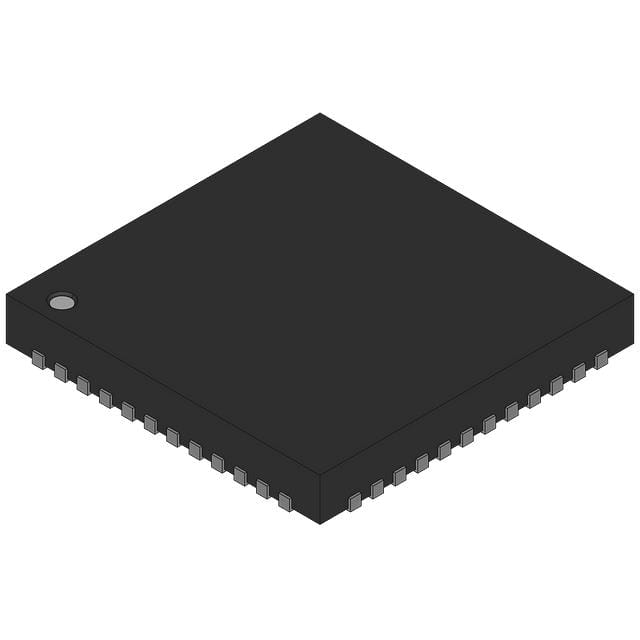
DS92LV0422SQ/NOPB uses a 48-pin WQFN package (7.0 mm × 7.0 mm, 0.5-mm pitch) with exposed thermal pad (DAP) requiring ≥9 vias to ground plane for thermal management.
| Pin/Terminal | Circuit Role | Design Meaning |
|---|---|---|
| RIN+/RIN− | CML serial data input pair | AC-coupled differential input accepting serialized video stream; requires 0.1-µF coupling caps |
| TXCLKOUT+/− | LVDS clock output pair | Reconstructed pixel clock output; must be terminated with 100-Ω differential load |
| TXOUT[3:0]+/− | LVDS data output lanes | 4-lane parallel video bus (24-bit RGB + 3-bit control); each lane requires 100-Ω termination |
| LOCK | LVCMOS status output | Active-high signal indicating PLL lock - used for system readiness detection and fault monitoring |
| OEN | LVCMOS output enable | Controls tri-state behavior of all LVDS outputs - enables hot-plug and power sequencing |
| EQ (PASS) | Strap pin for receiver gain | Direct hardware-selectable equalization: EQ = 1 enables ~13 dB boost for long-cable operation |
| CONFIG[1:0] | Mode configuration inputs | Selects interfacing partner (e.g., DS92LV0421, DS90UR241) and control filter settings |
| VODSEL | LVDS output swing select | VODSEL = 1 → ±400 mV (800 mVp-p) for noise immunity; VODSEL = 0 → ±250 mV (500 mVp-p) for low-power mode |
Key Features
| Feature | Design Value |
|---|---|
| Self-clocked deserialization | No external reference clock needed - reduces BOM count and board routing complexity in display subsystems |
| Hardware-configurable EQ gain | Two-level receiver equalization (1.625 dB / ~13 dB) set by single EQ pin - eliminates need for register programming during boot |
| Spread-spectrum clocking (SSCG) | SSC[2:0] + LFMODE pins enable EMI reduction across 10–65 MHz - critical for FCC/CE compliance in medical and office equipment |
| Tri-state LVDS outputs | OEN and PDB jointly control output driver state - supports safe hot-swap, power sequencing, and multi-drop bus sharing |
| Robust 10-m cable support | Integrated CML receiver + configurable EQ + DC-balanced serialization enables reliable 100-Ω STP transmission up to 10 meters |
Applications
| Medical Endoscopy Imaging | Industrial Frame Grabber |
|---|---|
Use Scenario: High-resolution real-time video capture from endoscopic camera head to processing unit across flexible cable harnesses inside surgical carts. IC Role / Device Role / Timing Role: Deserializes embedded-clock CML stream into parallel LVDS for FPGA-based image preprocessing; provides LOCK signal for system synchronization. Use Value: Enables 24-bit color fidelity and jitter-free timing over 8-m STP cable without external clock distribution or repeaters. | Use Scenario: Acquisition of machine vision data from line-scan or area-scan cameras in factory automation cells with vibration-prone cabling. IC Role / Device Role / Timing Role: Converts serialized camera sensor output into Channel Link LVDS for direct connection to PCIe frame grabber ASICs. Use Value: Eliminates skew between clock and data lanes inherent in wide parallel buses, improving pixel alignment accuracy at 75 MHz. |
| RGB Display Interface | Security Camera Video Distribution |
Use Scenario: Driving high-brightness LCD panels in kiosks or digital signage using compact, low-EMI cabling between controller and display module. IC Role / Device Role / Timing Role: Receives serialized graphics data from GPU or SoC and outputs synchronized LVDS clock + RGB data for panel timing controller (TCON). Use Value: Reduces EMI emissions by >10 dB compared to single-ended parallel interfaces - simplifies EMC testing and shielding requirements. | Use Scenario: Aggregating HD video streams from multiple IP or analog cameras into centralized DVR units via daisy-chained coaxial or STP infrastructure. IC Role / Device Role / Timing Role: Deserializes multiplexed video payloads over shared CML backplane; uses PASS output for automated BIST validation during maintenance cycles. Use Value: Provides deterministic link health reporting (via PASS pin) without host CPU intervention - improves remote diagnostics in unattended surveillance sites. |
Equivalent & Alternatives
The following parts are listed as comparable options for similar deserializer applications.
| Alternative Part | Technical Difference | Application Difference | Selection Advice |
|---|---|---|---|
| DS92LV2422 | Same Channel Link II protocol, but supports only 1.8-V LVDS outputs (no 3.3-V option); lacks SSCG and EQ strap pin | Best suited for low-power, short-cable (<3 m), fixed-frequency designs where EMI reduction is not required | Choose DS92LV2422 only if VDDTX = 1.8 V is acceptable and spread-spectrum or adaptive EQ is unnecessary |
| DS90UR241 | Supports higher data rates (up to 1.5 Gbps), includes integrated HDCP engine and MIPI D-PHY output; requires I²C configuration | Targeted at premium displays and automotive infotainment with content protection and mobile interface needs | Choose DS90UR241 when HDCP, higher bandwidth, or MIPI output are mandatory - not a drop-in replacement |
Compared with DS92LV2422 and DS90UR241, DS92LV0422SQ/NOPB uniquely balances industrial ruggedness (8-kV HBM), hardware-strapped configurability (EQ, SSCG, VODSEL), and dual-voltage LVDS outputs - making it optimal for cost-sensitive, long-cable, non-HDCP display links requiring zero-software bring-up.
Availability
DS92LV0422SQ/NOPB is available at Aetrix Electronics and suitable for medical imaging systems, industrial frame grabbers, RGB display interfaces, and security camera video distribution requiring stable component supply across extended temperature and long-cable deployment scenarios.
Supply support for DS92LV0422SQ/NOPB includes scheduled delivery planning, volume procurement assistance, BOM continuity management, traceable sourcing, and lifecycle availability coordination for OEM customers, industrial embedded developers, connected-device designers, and electronics production programs.
Manufacturer
Texas Instruments is a global semiconductor company specializing in analog, embedded processing, and connectivity technologies with broad industrial and automotive design expertise.
The DS92LV0422SQ/NOPB belongs to TI's Channel Link II chipset family, designed specifically to upgrade legacy LVDS display interfaces to embedded-clock serial links while preserving OpenLDI compatibility and minimizing EMI in space-constrained systems.
FAQ
What is the primary function of the DS92LV0422SQ/NOPB in a video interface system?
The DS92LV0422SQ/NOPB functions as a Channel Link II deserializer that recovers pixel clock and video data from a high-speed CML serial stream and outputs them as a standard 5-lane LVDS parallel interface (4 data + 1 clock). It enables seamless migration from wide parallel LVDS buses to compact, low-EMI serial links - a core capability of the DS92LV0422SQ/NOPB in display and imaging systems.
Does the DS92LV0422SQ/NOPB require an external reference clock to operate?
No, the DS92LV0422SQ/NOPB does not require an external reference clock. It performs self-clocked deserialization using embedded clock recovery from the incoming CML data stream. This eliminates clock distribution complexity and makes the DS92LV0422SQ/NOPB ideal for plug-and-play video links where timing synchronization must be autonomous.
How is receiver equalization configured on the DS92LV0422SQ/NOPB?
Receiver equalization on the DS92LV0422SQ/NOPB is configured via the EQ (also labeled PASS) strap pin: EQ = 1 enables ~13 dB gain for long-cable (>5 m) operation, while EQ = 0 sets ~1.625 dB gain for short-cable use. This hardware-selectable setting requires no register writes and is active immediately after power-up - a defining feature of the DS92LV0422SQ/NOPB's robustness.
What are the supported supply voltages for DS92LV0422SQ/NOPB LVDS outputs?
DS92LV0422SQ/NOPB supports dual-voltage LVDS outputs: VDDTX must be 3.3 V ±10% to drive the TXOUT[3:0]± and TXCLKOUT± lanes, while VDDIO may be either 1.8 V ±5% or 3.3 V ±10% for LVCMOS control pins. This separation allows the DS92LV0422SQ/NOPB to interface with both low-voltage logic and legacy 3.3-V display timing controllers.
Can the DS92LV0422SQ/NOPB be used with the DS92LV0421 serializer?
Yes, the DS92LV0422SQ/NOPB is fully interoperable with the DS92LV0421 serializer as part of the same Channel Link II chipset. Their pin configurations, timing protocols, and register maps are aligned - enabling direct integration in point-to-point video links. The DS92LV0422SQ/NOPB's CONFIG[1:0] pins must be set to '00' or '01' to match DS92LV0421 operation.
DS92LV0422SQ/NOPB Specifications
- Product attributes
- Attribute value
- Manufacturer:
- Texas Instruments
- Series:
- *
- Package/Case:
- -
- Packaging:
- Bulk
- Product Status:
- Active
- Function:
- -
- Data Rate:
- -
- Input Type:
- -
- Output Type:
- -
- Number of Inputs:
- -
- Number of Outputs:
- -
- Voltage - Supply:
- -
- Operating Temperature:
- -
- Grade:
- -
- Qualification:
- -
- Mounting Type:
- -
- Supplier Device Package:
- -
DS92LV0422SQ/NOPB FAQ
1.How can I place an order for DS92LV0422SQ/NOPB through Aetrix?
Please submit a Request for Quotation (RFQ) for DS92LV0422SQ/NOPB on Aetrix. Our sales agent will provide a competitive quotation and guide you through the order confirmation once you accept the terms.
2.Are the price and stock information for DS92LV0422SQ/NOPB reliable?
The price and inventory of DS92LV0422SQ/NOPB are updated periodically and may fluctuate due to market conditions. Stock and pricing data are typically refreshed every 24 hours. Quotation validity for DS92LV0422SQ/NOPB is usually 5 days.
3.What payment methods are accepted for DS92LV0422SQ/NOPB?
We accept Wire Transfer, PayPal, Credit Card, Western Union, MoneyGram, and Escrow for DS92LV0422SQ/NOPB transactions.
Note: Certain payment methods may incur a processing fee.
4.How is shipping managed for DS92LV0422SQ/NOPB?
DS92LV0422SQ/NOPB orders can be shipped via leading logistics carriers, including DHL, UPS, FedEx, TNT, or Registered Mail.
Once your DS92LV0422SQ/NOPB order is processed, you will receive an email with the shipment details and tracking number.
Note: Tracking information may take up to 24 hours to appear. Express delivery typically takes 3–5 business days.
5.How can I obtain technical support or documentation for DS92LV0422SQ/NOPB?
For technical support, including DS92LV0422SQ/NOPB datasheets, pinout diagrams, or application guidance, please contact our engineering support team. They can provide detailed documentation and assistance for your DS92LV0422SQ/NOPB requirements.
6.How does Aetrix verify that DS92LV0422SQ/NOPB is sourced from the original manufacturer or authorized distributors?
All DS92LV0422SQ/NOPB products on Aetrix are procured from qualified distributors and authorized channels. Our dedicated quality assurance team conducts strict verification, including traceability checks and, if necessary, third-party testing. This ensures that DS92LV0422SQ/NOPB meets industry standards.
7.What is the process for return or replacement of DS92LV0422SQ/NOPB?
All DS92LV0422SQ/NOPB units undergo pre-shipment inspection (PSI). If there is an issue with DS92LV0422SQ/NOPB, returns or replacements are accepted under the following conditions:
1.Quantity discrepancies, incorrect items, or visible external defects (such as breakage or corrosion), acknowledged by Aetrix.
2.The issue is reported within 90 days of delivery.
3.The DS92LV0422SQ/NOPB part is unused and in its original packaging.
Return procedure for DS92LV0422SQ/NOPB:
1.Submit a request within 90 days.
2.Obtain a Return Material Authorization (RMA) from Aetrix.
DS92LV0422SQ/NOPB Tags
-
SN65HVS880PWPR
Texas Instruments
-
SN65HVS882PWPR
Texas Instruments
-
FIN3386MTDX
onsemi
-
FIN3385MTDX
onsemi
-
SN65LV1023ARHBR
Texas Instruments
-
SN65LV1023ADBR
Texas Instruments
-
SN65LV1224BDBR
Texas Instruments
-
SN65LVDS93ADGGR
Texas Instruments
-
SN65LVDS93DGGR
Texas Instruments
-
TDES954RGZT
Texas Instruments
-
SN65LV1224BRHBT
Texas Instruments
-
DS90UB914QSQE/NOPB
Texas Instruments
Tech Hub

A practical engineering guide to 3.3V and 5V logic compatibility, input thresholds, resistor dividers, translator ICs, MOSFET level shifting, I2C pull-ups, timing limits and power-sequencing risks.

The 74HC595 uses push-pull logic outputs, while the TPIC6B595 uses 50 V open-drain DMOS sinks for higher-power loads. This guide compares timing, current limits, 3.3 V interfacing, load wiring, thermal…

The 74HC595 converts serial data into eight stable parallel outputs. This guide covers pin functions, shift and storage timing, OE and MR behavior, drive-current limits, cascading, voltage compatibilit…

A technical comparison of level-sensitive latches and edge-triggered flip-flops, covering timing windows, setup and hold limits, master–slave operation, time borrowing, race-through, HDL inference and…

A D latch stores one bit while Enable controls when data can pass. This reference covers gate-level operation, truth tables, transparency, setup and hold timing, LE versus OE, common ICs and practical …

An SR latch stores one bit through cross-coupled feedback. This engineering reference covers NOR and NAND implementations, truth tables, forbidden-state recovery, gated operation, switch debouncing, fa…

Latch circuits retain one bit through feedback. This technical reference covers SR and D latches, truth tables, transparency, timing limits, latch-versus-flip-flop behavior, applications and common log…

An engineering guide to LED driver operation, constant-current and constant-voltage outputs, linear and switching topologies, dimming, IC selection, calculations, replacement compatibility, and fault c…

Operational amplifier guide covering op amp basics, feedback, ideal vs real op amps, common configurations, buffer circuits, offset, bias current, gain-bandwidth, slew rate, rail-to-rail limits and sel…

Jumper cables guide covering safe connection order, red and black clamp placement, final ground connection, cable gauge, length, clamp quality, copper vs CCA cables, jump starter comparison and battery…


