
 My Inquiry
 My Account


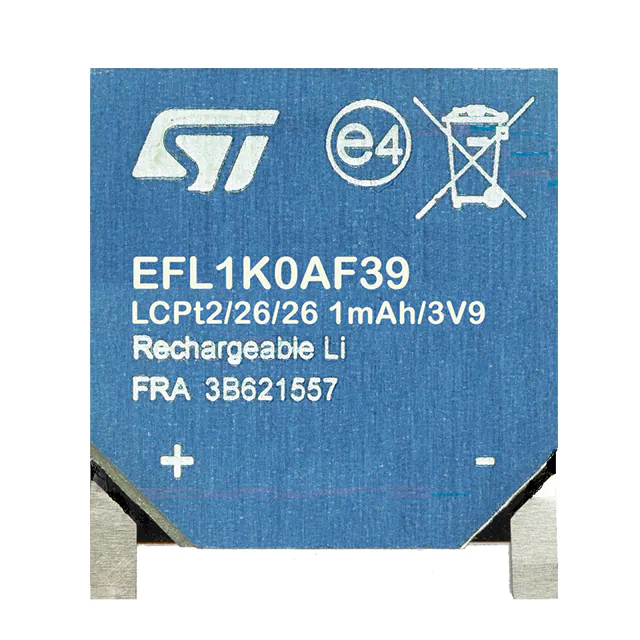
STMicroelectronics EFL1K0AF39RL
- Part No.:
- EFL1K0AF39RL
- Manufacturer:
- STMicroelectronics
- Category:
- Batteries Rechargeable (Secondary)
- Package:
- Datasheet:
-
 EFL1K0AF39RL.pdf
- Description:
- BATTERY LITHIUM 3.9V 1MAH
- Quantity:
- Payment:

- Shipping:

Inventory:4,793
Please send an inquiry. Send us your inquiry, and we will respond immediately.
Product details
Overview
EFL1K0AF39RL from STMicroelectronics is a solid-state thin-film rechargeable lithium microbattery with LiCoO₂ cathode, LiPON ceramic electrolyte, and lithium anode; nominal capacity 1 mAh, nominal voltage 3.9 V, internal resistance 80 Ω, operating voltage range 3.0–4.2 V, and thickness 160 µm; used for energy storage in ultra-low-power IoT sensor nodes and wearable health monitors.
For engineers reviewing the EFL1K0AF39RL datasheet, EFL1K0AF39RL pinout (two-terminal construction), EFL1K0AF39RL application in energy harvesting systems, or EFL1K0AF39RL equivalent for low-profile backup power, this page delivers verified electrical specs, mechanical constraints, embedded assembly guidance, and ST-validated charge/discharge protocols.
Technical Context
The EFL1K0AF39RL employs all-solid-state architecture with a LiPON (lithium phosphorus oxynitride) electrolyte enabling stable ion conduction without liquid leakage or thermal runaway risk. Its 160 µm thickness and 25.8 mm × 28.8 mm footprint support integration into space-constrained flexible PCBs and laminated smart cards.
It delivers 1 mAh capacity at 100 µA discharge (4.2 V → 3.0 V, 25 °C), supports 15 mA pulsed discharge (100 ms on/900 ms off), and retains ≥80% capacity after 4000 cycles at 25 °C under 1 C cycling between 75% and 0% SoC.
Key Specifications
| Parameter | Value and Actual Design Meaning |
|---|---|
| Capacity | 1 mAh minimum at 100 µA discharge (4.2 V → 3.0 V, 25 °C); enables >1 year runtime for 0.1 µA average IoT sensor load |
| Nominal Voltage | 3.9 V; matches standard LDO input ranges and simplifies power management for 3.3 V logic systems |
| Operating Voltage Range | 3.0–4.2 V; allows full utilization of stored energy while maintaining compatibility with 3.3 V microcontrollers |
| Internal Resistance | 80 Ω at 25 °C; limits continuous discharge to 5 mA but supports 15 mA pulses for short-duration RF transmission bursts |
| Thickness | 160 µm; enables lamination beneath flexible displays or within <0.3 mm smart card layers without mechanical interference |
| Self-Discharge | 3% recoverable loss/year at 25 °C, 50% SoC; ensures >90% usable capacity after 12 months shelf storage |
| Cycle Life | 4000 cycles to 80% initial capacity at 25 °C; supports >10 years of daily charge/discharge in maintenance-free edge devices |
Pinout & Package
EnFilm™ microbattery EFL1K0AF39RL uses a two-terminal surface-mount structure: anode and cathode pads located on opposite long edges of the rectangular 25.8 mm × 28.8 mm substrate. No leadframe or wirebonding - terminals are metallized Ni strips (F designation) for solder or conductive adhesive attachment. Thickness is fixed at 160 µm; no mechanical mounting holes or clips required.
| Pin/Terminal | Circuit Role | Design Meaning |
|---|---|---|
| Anode (Ni strip) | Negative terminal | Connected to system ground; requires non-corrosive solder (e.g., SnAgCu) and <100 °C reflow profile to avoid electrolyte degradation |
| Cathode (Ni strip) | Positive terminal | Connected to battery charger output or load input; polarity reversal causes irreversible capacity loss and must be prevented by layout-level diode or IC protection |
Key Features
| Feature | Design Value |
|---|---|
| All-solid-state LiPON electrolyte | Eliminates flammability and leakage risks; enables operation from −20 °C to +60 °C without thermal management |
| Ultra-thin 160 µm profile | Permits embedding in laminated smart cards and conformal wearables where Z-height is constrained to <0.2 mm |
| Fast recharge to 80% capacity | 20 minutes at 4.2 V constant voltage; reduces downtime in field-deployed sensor networks requiring frequent energy harvesting top-ups |
| Low non-recoverable aging | 20% capacity loss over 10 years at 25 °C; ensures long-term BOM stability for infrastructure-grade IoT deployments |
| RoHS-compliant construction | No lead, cadmium, mercury, or brominated flame retardants; meets EU Directive 2011/65/EU for consumer and medical wearable applications |
Applications
| Wireless Sensor Nodes | Smart Wearables |
|---|---|
Use Scenario: Battery-powered temperature/humidity sensor node harvesting ambient light via mini-PV cell, transmitting data every 5 minutes via BLE. IC Role / Device Role / Timing Role: Primary energy reservoir buffering intermittent harvest energy and delivering regulated 3.3 V to MCU and radio during 15 ms TX burst. Use Value: 1 mAh capacity sustains >2 years of operation at 0.1 µA average current; 15 mA pulse capability powers BLE peak current without voltage sag. | Use Scenario: Flexible wristband monitoring heart rate and SpO₂, recharged via contactless inductive coupling during nightly docking. IC Role / Device Role / Timing Role: Rechargeable backup source maintaining real-time clock and memory state during primary battery replacement or charging gaps. Use Value: 160 µm thickness conforms to curved elastomer housing; 3% annual self-discharge preserves timekeeping accuracy across 6-month user intervals. |
| RFID Smart Tags | Energy Harvesting Modules |
Use Scenario: Passive UHF RFID tag augmented with local sensing and secure NDEF storage, powered by ambient RF energy and backed by thin-film storage. IC Role / Device Role / Timing Role: On-tag energy buffer enabling cryptographic signing and multi-packet response when incident RF power drops below reader threshold. Use Value: 80 Ω internal resistance permits efficient coupling to high-impedance rectifier outputs; 25.8 mm × 28.8 mm footprint aligns with ISO/IEC 18000-6C antenna layouts. | Use Scenario: Industrial vibration monitor harvesting kinetic energy via piezoelectric transducer, storing charge for periodic wireless diagnostics upload. IC Role / Device Role / Timing Role: Low-leakage storage element accumulating micro-coulomb-level harvest pulses and releasing energy in controlled 100 ms bursts to MCU and sub-GHz transceiver. Use Value: 4000-cycle life exceeds 10-year equipment service interval; 3.0–4.2 V operating window matches typical piezo rectifier output swing without DC-DC overhead. |
Equivalent & Alternatives
The following parts are listed as comparable options for similar thin-film microbattery applications.
| Alternative Part | Technical Difference | Application Difference | Selection Advice |
|---|---|---|---|
| Cymbet EnerChip CC1002 | 0.1 mAh capacity, 3.7 V nominal, 100 µm thick; amorphous silicon-based solid-state chemistry | Lower energy density suits ultra-miniature hearables; limited to ≤5 mA continuous discharge | Select when footprint <15 mm² is mandatory and average load <1 µA |
| Infinite Power Solutions THINERGY® MEC225 | 2.5 mAh capacity, 3.8 V nominal, 300 µm thick; LiMnO₂ cathode, LiPON electrolyte | Higher capacity supports longer sleep intervals but requires 2× Z-space; rated for −30 °C operation | Select when >2 mAh is needed and operating temperature extends below −20 °C |
Compared with Cymbet CC1002 and Infinite Power THINERGY® MEC225, EFL1K0AF39RL offers optimal balance of capacity (1 mAh), ultra-thinness (160 µm), and industrial-grade cycle life (4000 cycles), making it preferred for space-limited, multi-year IoT nodes where moderate pulse current and strict RoHS compliance are critical.
Availability
EFL1K0AF39RL is available at Aetrix Electronics and suitable for wireless sensor nodes, smart wearables, RFID smart tags, and energy harvesting modules requiring stable component supply, long-life embedded power, and RoHS-compliant thin-film battery technology.
Supply support for EFL1K0AF39RL includes scheduled delivery planning, volume procurement assistance, BOM continuity management, traceable sourcing, and lifecycle availability coordination for OEM customers, industrial embedded developers, connected-device designers, and electronics production programs.
Manufacturer
STMicroelectronics is a global semiconductor leader headquartered in Geneva, Switzerland, designing and manufacturing microcontrollers, analog ICs, MEMS sensors, and power management solutions for industrial, automotive, and consumer markets.
The EnFilm™ microbattery product line targets ultra-low-power, space-constrained applications including IoT edge nodes, medical wearables, and smart packaging, where solid-state reliability and sub-0.2 mm form factor are non-negotiable design requirements.
FAQ
What is the maximum safe reflow temperature for EFL1K0AF39RL during PCB assembly?
The EFL1K0AF39RL must not exceed 100 °C during solder reflow. ST's TN1249 technical note specifies peak temperature ≤95 °C for ≤60 seconds using SnAgCu paste. Exceeding this degrades the LiPON electrolyte, increasing internal resistance and reducing cycle life. Conductive adhesive bonding is recommended for higher-temperature processes.
Can EFL1K0AF39RL be charged directly from a solar cell without a dedicated charger IC?
Yes - the battery accepts constant-voltage charging at 4.2 V ±0.05 V with or without current limiting. A properly sized solar cell delivering ≤4.25 V open-circuit and ≤15 mA short-circuit can charge it directly, provided a series Schottky diode prevents reverse leakage at night. For reliable long-term operation, a dedicated LDO-based charger (e.g., ST's SPV1040) is recommended to enforce voltage precision and thermal cutoff.
Is EFL1K0AF39RL qualified for use in implantable medical devices?
No. ST explicitly prohibits use in implantable medical devices (defined as devices placed under the skin), US government custom applications, and wafer test equipment. While approved for external healthcare wearables (e.g., pulse oximeters, activity trackers), it lacks biocompatibility certification and hermetic sealing required for implantation. Refer to Section 2 of the datasheet for full Prohibited Applications listing.
How does the 0% state-of-charge requirement affect embedded assembly?
ST mandates that EFL1K0AF39RL be assembled at 0% SoC to minimize internal resistance drift and capacity loss during lamination or pressure bonding. Charging before assembly induces electrochemical stress under heat/pressure, causing irreversible Li dendrite formation. The battery must be pre-discharged to ≤2.5 V using a 1 kΩ load prior to placement, then charged only after full mechanical integration and environmental stabilization.
EFL1K0AF39RL Specifications
- Product attributes
- Attribute value
- Manufacturer:
- STMicroelectronics
- Series:
- EnFilm™
- Packaging:
- Tape & Reel (TR)
- Product Status:
- Obsolete
- Battery Chemistry:
- Thin Film (Lithium)
- Battery Cell Size:
- -
- Voltage - Rated:
- 3.9 V
- Capacity:
- 1mAh
- Size / Dimension:
- 1.02" L x 1.02" W x 0.01" H (25.8mm x 25.8mm x 0.2mm)
- Termination Style:
- -
EFL1K0AF39RL FAQ
1.How can I place an order for EFL1K0AF39RL through Aetrix?
Please submit a Request for Quotation (RFQ) for EFL1K0AF39RL on Aetrix. Our sales agent will provide a competitive quotation and guide you through the order confirmation once you accept the terms.
2.Are the price and stock information for EFL1K0AF39RL reliable?
The price and inventory of EFL1K0AF39RL are updated periodically and may fluctuate due to market conditions. Stock and pricing data are typically refreshed every 24 hours. Quotation validity for EFL1K0AF39RL is usually 5 days.
3.What payment methods are accepted for EFL1K0AF39RL?
We accept Wire Transfer, PayPal, Credit Card, Western Union, MoneyGram, and Escrow for EFL1K0AF39RL transactions.
Note: Certain payment methods may incur a processing fee.
4.How is shipping managed for EFL1K0AF39RL?
EFL1K0AF39RL orders can be shipped via leading logistics carriers, including DHL, UPS, FedEx, TNT, or Registered Mail.
Once your EFL1K0AF39RL order is processed, you will receive an email with the shipment details and tracking number.
Note: Tracking information may take up to 24 hours to appear. Express delivery typically takes 3–5 business days.
5.How can I obtain technical support or documentation for EFL1K0AF39RL?
For technical support, including EFL1K0AF39RL datasheets, pinout diagrams, or application guidance, please contact our engineering support team. They can provide detailed documentation and assistance for your EFL1K0AF39RL requirements.
6.How does Aetrix verify that EFL1K0AF39RL is sourced from the original manufacturer or authorized distributors?
All EFL1K0AF39RL products on Aetrix are procured from qualified distributors and authorized channels. Our dedicated quality assurance team conducts strict verification, including traceability checks and, if necessary, third-party testing. This ensures that EFL1K0AF39RL meets industry standards.
7.What is the process for return or replacement of EFL1K0AF39RL?
All EFL1K0AF39RL units undergo pre-shipment inspection (PSI). If there is an issue with EFL1K0AF39RL, returns or replacements are accepted under the following conditions:
1.Quantity discrepancies, incorrect items, or visible external defects (such as breakage or corrosion), acknowledged by Aetrix.
2.The issue is reported within 90 days of delivery.
3.The EFL1K0AF39RL part is unused and in its original packaging.
Return procedure for EFL1K0AF39RL:
1.Submit a request within 90 days.
2.Obtain a Return Material Authorization (RMA) from Aetrix.
EFL1K0AF39RL Tags
-
ML414H IV01E
Seiko Instruments
-
MS621FE
Seiko Instruments
-
MS518SE-FL35E
Seiko Instruments
-
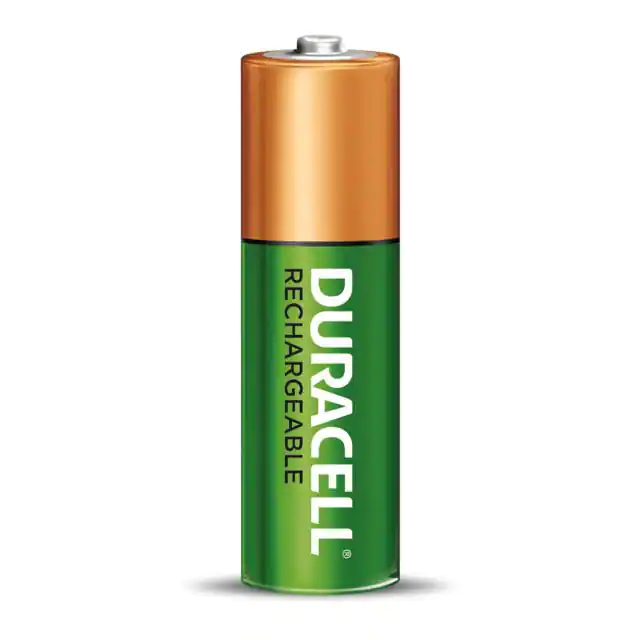
AAA-NIMH-DURACELL
Duracell Industrial Operations, Inc.

-
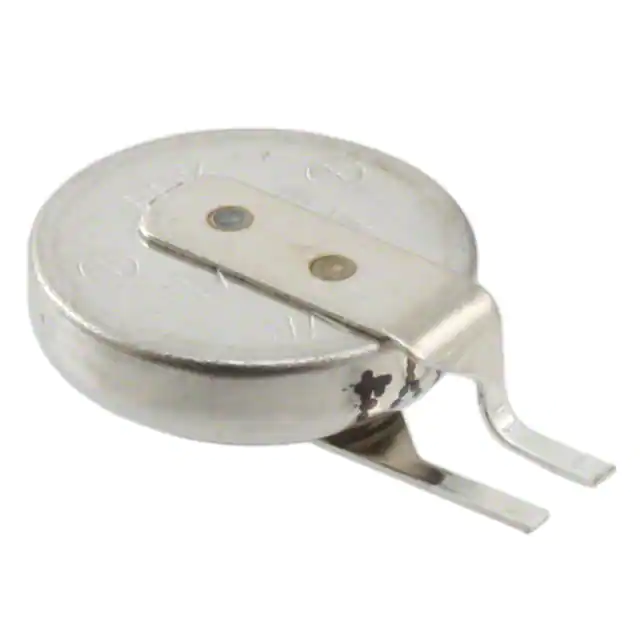
MS621FE-FL11E
Seiko Instruments
-
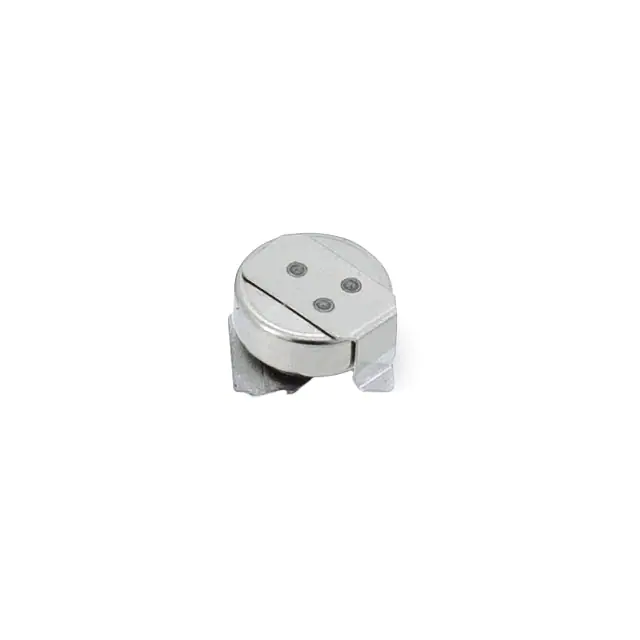
ML621-TZ1
FDK America, Inc., a member of Fujitsu Group
-
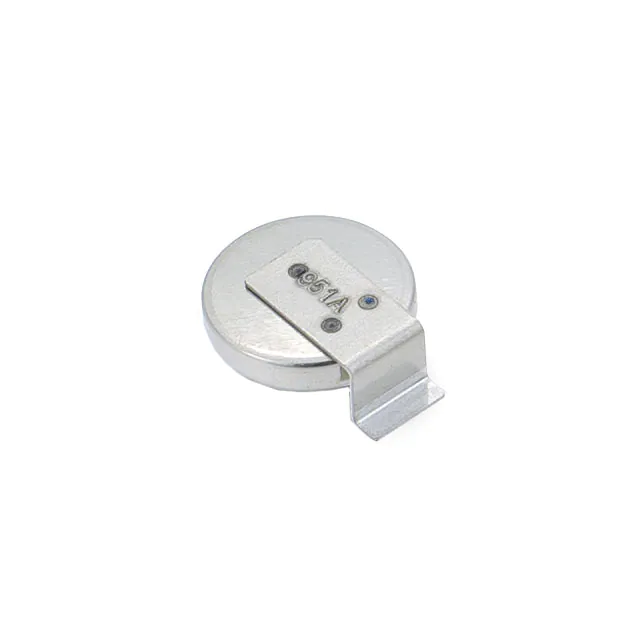
MS421R IV03E
Seiko Instruments
-
MS621R II27E
Seiko Instruments
-
ML-2020/G1AN
Panasonic - BSG
-
TS621E-FL11E
Seiko Instruments
-
HHR-70AAAE4
Panasonic - BSG
-
MS920T-FL27E
Seiko Instruments
Tech Hub

A practical engineering guide to 3.3V and 5V logic compatibility, input thresholds, resistor dividers, translator ICs, MOSFET level shifting, I2C pull-ups, timing limits and power-sequencing risks.

The 74HC595 uses push-pull logic outputs, while the TPIC6B595 uses 50 V open-drain DMOS sinks for higher-power loads. This guide compares timing, current limits, 3.3 V interfacing, load wiring, thermal…

The 74HC595 converts serial data into eight stable parallel outputs. This guide covers pin functions, shift and storage timing, OE and MR behavior, drive-current limits, cascading, voltage compatibilit…

A technical comparison of level-sensitive latches and edge-triggered flip-flops, covering timing windows, setup and hold limits, master–slave operation, time borrowing, race-through, HDL inference and…

A D latch stores one bit while Enable controls when data can pass. This reference covers gate-level operation, truth tables, transparency, setup and hold timing, LE versus OE, common ICs and practical …

An SR latch stores one bit through cross-coupled feedback. This engineering reference covers NOR and NAND implementations, truth tables, forbidden-state recovery, gated operation, switch debouncing, fa…

Latch circuits retain one bit through feedback. This technical reference covers SR and D latches, truth tables, transparency, timing limits, latch-versus-flip-flop behavior, applications and common log…

An engineering guide to LED driver operation, constant-current and constant-voltage outputs, linear and switching topologies, dimming, IC selection, calculations, replacement compatibility, and fault c…

Operational amplifier guide covering op amp basics, feedback, ideal vs real op amps, common configurations, buffer circuits, offset, bias current, gain-bandwidth, slew rate, rail-to-rail limits and sel…

Jumper cables guide covering safe connection order, red and black clamp placement, final ground connection, cable gauge, length, clamp quality, copper vs CCA cables, jump starter comparison and battery…


