
 My Inquiry
 My Account


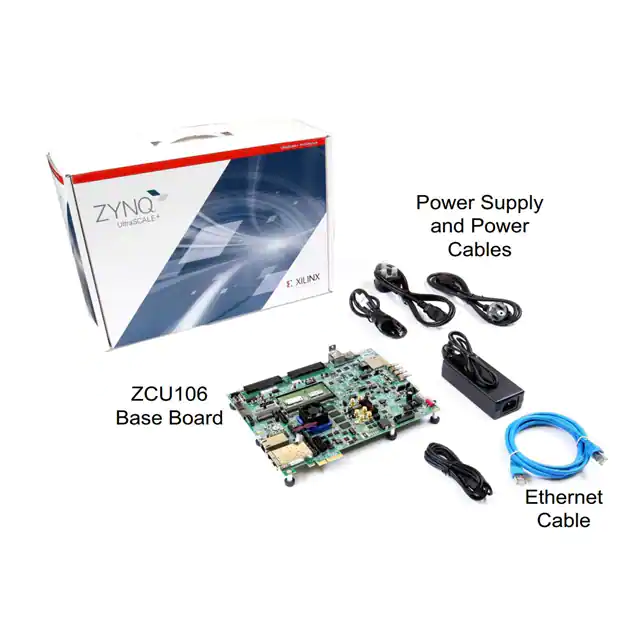
AMD EK-U1-ZCU106-G-ED
- Part No.:
- EK-U1-ZCU106-G-ED
- Manufacturer:
- AMD
- Package:
- Datasheet:
-
 EK-U1-ZCU106-G-ED.pdf
- Description:
- KIT EVAL ZYNQUS+ MPSOC ZCU106 ED
- Quantity:
- Payment:

- Shipping:

Inventory:1,874
Please send an inquiry. Send us your inquiry, and we will respond immediately.
Product details
Overview
Ek-U1-ZCU106-G-ED is the official Xilinx Zynq UltraScale+ MPSoC Evaluation Kit, designed for rapid prototyping and validation of heterogeneous SoC designs integrating ARM Cortex-A53 application processors, ARM Cortex-R5 real-time processors, programmable logic (PL), and high-speed I/O including PCIe Gen3, DDR4, and 10GbE. It features the XCZU7EV-2FFVC1156 MPSoC, 4GB DDR4 SODIMM, dual 10GbE SFP+, HDMI 2.0 input/output, and FMC+ expansion.
For engineers reviewing the EK-U1-ZCU106-G-ED datasheet, pinout, applications, or equivalent options, this page delivers verified hardware capabilities, validated boot flow, BIST test coverage, Vivado tool integration, and board-level interface mapping - all critical for MPSoC-based video processing, ADAS prototyping, and embedded AI accelerator development.
Technical Context
The EK-U1-ZCU106-G-ED implements the full Zynq UltraScale+ MPSoC architecture with dual ARM Cortex-A53 clusters (64-bit, up to 1.5GHz), dual-core ARM Cortex-R5F for real-time control, Mali-400 GPU, and 1.1M logic cells in the PL fabric. It supports PS-to-PL AXI HP/ACP/ACCP interfaces, PL-to-PS interrupt routing, and dynamic power management across PS/PL domains.
Hardware validation includes built-in self-test (BIST) covering Clock generation (PS & PL), BRAM integrity, PL-DDR4 and PS-DDR4 memory subsystems, Quad-SPI Flash configuration, I²C peripherals, DIP switch inputs (SW13), pushbutton inputs (SW15), and GPIO-driven LEDs - all executed without host PC dependency.
Key Specifications
| Parameter | Value and Actual Design Meaning |
|---|---|
| MPSoC Device | XCZU7EV-2FFVC1156: 7EV speed grade, 1156-pin flip-chip BGA, -2 speed bin, EV variant with H.264/H.265 VCU and 10GbE MAC support. |
| Memory | 4GB DDR4 SODIMM (PS side), 512MB DDR4 on PL side (via AXI HP ports); supports 2400MT/s data rate and ECC-capable configuration. |
| High-Speed Interfaces | Dual 10GbE SFP+ cages (Xilinx GTY transceivers), HDMI 2.0 Tx/Rx (4K60 capable), PCIe Gen3 x4 root port, USB 3.0 host/device via ULPI PHY. |
| Expansion | FMC+ LPC connector (VITA 57.4 compliant) with 160 single-ended / 80 differential I/O, supporting RF, ADC/DAC, and optical mezzanine cards. |
| Configuration & Boot | Quad-SPI Flash (QSPI32 mode), SD card slot, JTAG (Xilinx Platform Cable USB II), and UART-to-USB bridge for console access and firmware loading. |
| Power Delivery | 12V DC input via 6-pin terminal block (J52); monitored Power Good signals per rail; thermal sensor and fan control header for active cooling validation. |
Availability
EK-U1-ZCU106-G-ED is available at Aetrix Electronics and suitable for video codec acceleration, automotive ADAS algorithm validation, and industrial real-time control system development requiring stable component supply, long-term evaluation platform availability, and vendor-supported toolchain integration.
Supply support for EK-U1-ZCU106-G-ED includes scheduled delivery planning, volume procurement assistance, BOM continuity management, traceable sourcing, and lifecycle availability coordination for OEM customers, industrial embedded developers, connected-device designers, and electronics production programs.
Manufacturer
Xilinx (now part of AMD) is a semiconductor company specializing in adaptive computing solutions, including FPGAs, MPSoCs, and ACAPs, serving aerospace, automotive, data center, and communications markets.
The ZCU106 kit belongs to Xilinx's UltraScale+ MPSoC Evaluation Kit product line, engineered to accelerate design convergence for heterogeneous compute applications demanding simultaneous CPU, GPU, real-time processor, and FPGA fabric execution.
FAQ
What is the primary target device on the EK-U1-ZCU106-G-ED evaluation board?
The EK-U1-ZCU106-G-ED evaluation board integrates the XCZU7EV-2FFVC1156 MPSoC as its core device. This device combines quad-core ARM Cortex-A53, dual-core ARM Cortex-R5F, Mali-400 GPU, and 1.1 million logic cells in programmable logic. The EK-U1-ZCU106-G-ED leverages this silicon to enable full-system validation of heterogeneous software-hardware co-design workflows.
Does the EK-U1-ZCU106-G-ED include a license for Vivado Design Suite?
Yes, the EK-U1-ZCU106-G-ED includes a node-locked and device-locked Vivado Design Suite: Design Edition voucher code valid for the XCZU7EV device. The voucher must be redeemed at www.xilinx.com/getlicense within one year of purchase. Once activated, it enables synthesis, implementation, and bitstream generation specifically for the MPSoC on the EK-U1-ZCU106-G-ED.
How does the built-in self-test (BIST) on the EK-U1-ZCU106-G-ED operate?
The EK-U1-ZCU106-G-ED executes an autonomous BIST at power-on that validates Clock, BRAM, PL-DDR4, PS-DDR4, Quad-SPI Flash, and I²C functionality without host interaction. User-triggered tests include DIP switch (SW13) toggling and pushbutton (SW15) actuation. Each passing test illuminates a dedicated PL GPIO LED; failure leaves the LED unlit - providing immediate hardware health feedback directly on the EK-U1-ZCU106-G-ED board.
What high-speed I/O interfaces are accessible on the EK-U1-ZCU106-G-ED?
The EK-U1-ZCU106-G-ED provides dual 10GbE SFP+ cages using GTY transceivers, HDMI 2.0 Tx/Rx supporting 4K60 video, PCIe Gen3 x4 root port, and USB 3.0 host/device capability. These interfaces are electrically routed to the XCZU7EV device with documented pin assignments and signal integrity validation - enabling direct evaluation of high-bandwidth protocols on the EK-U1-ZCU106-G-ED.
Is the EK-U1-ZCU106-G-ED compatible with Xilinx Vitis and PetaLinux tools?
Yes, the EK-U1-ZCU106-G-ED is fully supported by Xilinx Vitis unified software platform and PetaLinux tools for embedded Linux development. Reference BSPs, device trees, and pre-built images targeting the XCZU7EV on the EK-U1-ZCU106-G-ED are provided in the Xilinx GitHub repositories and included in Vivado 2018.2+ releases - ensuring seamless software stack bring-up on the EK-U1-ZCU106-G-ED.
EK-U1-ZCU106-G-ED Specifications
- Product attributes
- Attribute value
- Manufacturer:
- AMD
- Series:
- Zynq® UltraScale+™
- Packaging:
- Box
- Product Status:
- Obsolete
- Type:
- FPGA + MCU/MPU SoC
- For Use With/Related Products:
- XCZU7EV
- Platform:
- Zynq UltraScale+ MPSoC ZCU106 Encryption Disabled PCIe Card
- Contents:
- Board(s), Cable(s), Power Supply
EK-U1-ZCU106-G-ED FAQ
1.How can I place an order for EK-U1-ZCU106-G-ED through Aetrix?
Please submit a Request for Quotation (RFQ) for EK-U1-ZCU106-G-ED on Aetrix. Our sales agent will provide a competitive quotation and guide you through the order confirmation once you accept the terms.
2.Are the price and stock information for EK-U1-ZCU106-G-ED reliable?
The price and inventory of EK-U1-ZCU106-G-ED are updated periodically and may fluctuate due to market conditions. Stock and pricing data are typically refreshed every 24 hours. Quotation validity for EK-U1-ZCU106-G-ED is usually 5 days.
3.What payment methods are accepted for EK-U1-ZCU106-G-ED?
We accept Wire Transfer, PayPal, Credit Card, Western Union, MoneyGram, and Escrow for EK-U1-ZCU106-G-ED transactions.
Note: Certain payment methods may incur a processing fee.
4.How is shipping managed for EK-U1-ZCU106-G-ED?
EK-U1-ZCU106-G-ED orders can be shipped via leading logistics carriers, including DHL, UPS, FedEx, TNT, or Registered Mail.
Once your EK-U1-ZCU106-G-ED order is processed, you will receive an email with the shipment details and tracking number.
Note: Tracking information may take up to 24 hours to appear. Express delivery typically takes 3–5 business days.
5.How can I obtain technical support or documentation for EK-U1-ZCU106-G-ED?
For technical support, including EK-U1-ZCU106-G-ED datasheets, pinout diagrams, or application guidance, please contact our engineering support team. They can provide detailed documentation and assistance for your EK-U1-ZCU106-G-ED requirements.
6.How does Aetrix verify that EK-U1-ZCU106-G-ED is sourced from the original manufacturer or authorized distributors?
All EK-U1-ZCU106-G-ED products on Aetrix are procured from qualified distributors and authorized channels. Our dedicated quality assurance team conducts strict verification, including traceability checks and, if necessary, third-party testing. This ensures that EK-U1-ZCU106-G-ED meets industry standards.
7.What is the process for return or replacement of EK-U1-ZCU106-G-ED?
All EK-U1-ZCU106-G-ED units undergo pre-shipment inspection (PSI). If there is an issue with EK-U1-ZCU106-G-ED, returns or replacements are accepted under the following conditions:
1.Quantity discrepancies, incorrect items, or visible external defects (such as breakage or corrosion), acknowledged by Aetrix.
2.The issue is reported within 90 days of delivery.
3.The EK-U1-ZCU106-G-ED part is unused and in its original packaging.
Return procedure for EK-U1-ZCU106-G-ED:
1.Submit a request within 90 days.
2.Obtain a Return Material Authorization (RMA) from Aetrix.
EK-U1-ZCU106-G-ED Tags

-
EK-10M08E144
Intel
-
DK-DEV-10M08E144-B
Intel
-
XYLONI
Efinix, Inc.
-
410-328-35
Digilent, Inc.
-
410-376
Digilent, Inc.
-
EK-10CL025U256
Intel
-
P0082
Terasic Inc.
-
SLG4DVKADV
Renesas
-
TEBA0841-02
Trenz Electronic GmbH
-
MPFS-DISCO-KIT
Microchip Technology
-
P0466
Terasic Inc.
-
410-370
Digilent, Inc.
Tech Hub

A practical engineering and sourcing framework covering lifecycle verification, lifetime-buy calculations, replacement qualification, supplier checks and counterfeit-risk controls.

TTL and CMOS logic families differ in thresholds, loading, output drive, power and timing. This engineering guide compares 74HC and 74HCT, calculates noise margins and checks 3.3 V/5 V compatibility.

A practical engineering guide to 3.3V and 5V logic compatibility, input thresholds, resistor dividers, translator ICs, MOSFET level shifting, I2C pull-ups, timing limits and power-sequencing risks.

The 74HC595 uses push-pull logic outputs, while the TPIC6B595 uses 50 V open-drain DMOS sinks for higher-power loads. This guide compares timing, current limits, 3.3 V interfacing, load wiring, thermal…

The 74HC595 converts serial data into eight stable parallel outputs. This guide covers pin functions, shift and storage timing, OE and MR behavior, drive-current limits, cascading, voltage compatibilit…

A technical comparison of level-sensitive latches and edge-triggered flip-flops, covering timing windows, setup and hold limits, master–slave operation, time borrowing, race-through, HDL inference and…

A D latch stores one bit while Enable controls when data can pass. This reference covers gate-level operation, truth tables, transparency, setup and hold timing, LE versus OE, common ICs and practical …

An SR latch stores one bit through cross-coupled feedback. This engineering reference covers NOR and NAND implementations, truth tables, forbidden-state recovery, gated operation, switch debouncing, fa…

Latch circuits retain one bit through feedback. This technical reference covers SR and D latches, truth tables, transparency, timing limits, latch-versus-flip-flop behavior, applications and common log…

An engineering guide to LED driver operation, constant-current and constant-voltage outputs, linear and switching topologies, dimming, IC selection, calculations, replacement compatibility, and fault c…


