
 My Inquiry
 My Account


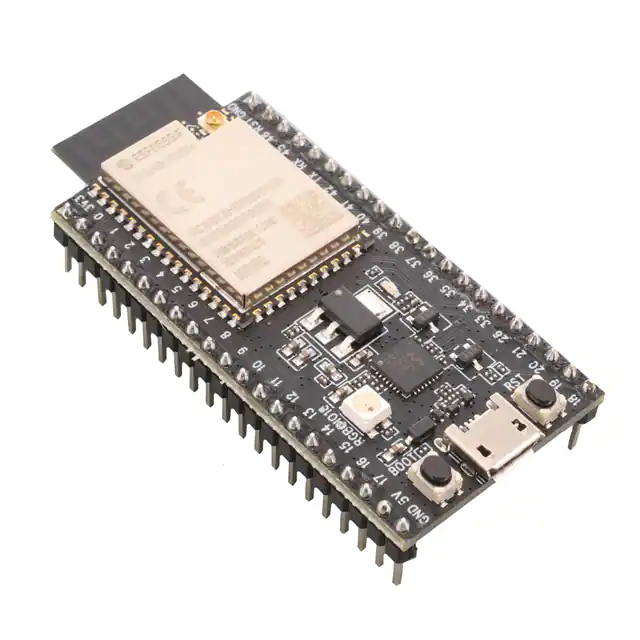
Espressif Systems ESP32-S2-SAOLA-1RI
- Part No.:
- ESP32-S2-SAOLA-1RI
- Manufacturer:
- Espressif Systems
- Category:
- RF, RFID, Wireless Evaluation Boards
- Package:
- Datasheet:
-
 ESP32-S2-SAOLA-1RI.pdf
- Description:
- ESP32-S2-WROVER-I DEV 4MB FLASH
- Quantity:
- Payment:

- Shipping:

Inventory:1,312
Please send an inquiry. Send us your inquiry, and we will respond immediately.
Product details
Overview
ESP32-S2-SAOLA-1RI from Espressif Systems is a single-core 2.4 GHz Wi-Fi MCU intended for embedded wireless control, protocol processing, sensor acquisition, and connected-device firmware execution.
Designed for USB-connected IoT devices, smart home panels, touch controllers, Wi-Fi sensors, camera interfaces, industrial control boards, and low-power Wi-Fi endpoints, the ESP32-S2-SAOLA-1RI fits systems that require embedded wireless connectivity, deterministic control, software-defined peripheral assignment, and compact production hardware. Compared with simple radio modules, Espressif devices usually combine MCU execution, RF connectivity, security blocks, power management, and SDK support within one chip or module family.
The ESP32-S2 platform provides Xtensa single-core 32-bit LX7 microprocessor operating up to 240 MHz, 2.4 GHz 802.11 b/g/n Wi-Fi with 1T1R mode and data rate up to 150 Mbps, 128 KB ROM, 320 KB SRAM, 16 KB RTC SRAM, and external flash/PSRAM support depending on variant or module, and up to 43 programmable GPIOs, SPI, I2S, I2C, UART, RMT, LED PWM, pulse counters, full-speed USB OTG, LCD interface, DVP camera interface, TWAI, ADC, DAC, touch sensor, and temperature sensor. For engineers evaluating the ESP32-S2-SAOLA-1RI datasheet, ESP32-S2-SAOLA-1RI pinout, ESP32-S2-SAOLA-1RI application, or ESP32-S2-SAOLA-1RI equivalent, the device should be selected by matching wireless protocol, memory size, antenna path, GPIO count, package footprint, security requirements, and software ecosystem support.
Technical Context
In embedded development architectures, ESP32-S2-SAOLA-1RI is used as a general-purpose development board for the ESP32-S2 platform. It allows engineers to evaluate firmware evaluation, GPIO/peripheral expansion, USB/UART download, power validation, and prototype development before transferring the design to a custom module or SoC-level PCB.
The underlying ESP32-S2 platform provides single-core Xtensa LX7 up to 240 MHz. Wireless connectivity is defined as 2.4 GHz Wi-Fi 4; Bluetooth is not part of the ESP32-S2 platform, while the available memory resources are tied to the mounted module or orderable board suffix: memory configuration defined by the exact Espressif orderable suffix. This makes the board useful for firmware validation, protocol testing, peripheral bring-up, OTA update testing, and early system integration.
During board-level evaluation, engineers should verify USB or UART programming access, boot-mode behavior, exposed GPIO headers, reset and download control, power input range, regulator capacity, RF antenna placement, and any board-specific connectors for display, camera, audio, Ethernet, sensors, or expansion. The development board should not be treated as the final production footprint; production layouts still need a module or SoC hardware design review.
Key Specifications
| Parameter | Value and Actual Design Meaning |
|---|---|
| Product Type | Development kit / evaluation board for ESP32-S2 hardware and firmware evaluation. |
| Platform / Main Device | ESP32-S2 platform with single-core Xtensa LX7 up to 240 MHz. |
| Wireless Connectivity | 2.4 GHz Wi-Fi 4; Bluetooth is not part of the ESP32-S2 platform. |
| Board Focus | general-purpose development board; used for firmware evaluation, GPIO/peripheral expansion, USB/UART download, power validation, and prototype development. |
| Memory Configuration | memory configuration defined by the exact Espressif orderable suffix. |
| Exposed Development Resources | USB or UART download path, reset/boot controls, GPIO expansion, power input, and board-specific connectors depending on the kit. |
| Peripheral Evaluation | USB OTG, SPI, I2C, I2S, UART, LCD interface, camera interface, RMT, LED PWM, MCPWM, ADC, DAC, touch sensing, timers, and GPIO matrix. |
| Security / Firmware Support | secure boot, flash encryption, cryptographic acceleration, RNG, and device security resources for connected Wi-Fi products. |
| Design Meaning | Useful for firmware bring-up and subsystem validation, but final production hardware must still confirm module/SoC pinout, power, RF, and memory configuration. |
Pinout & Package
ESP32-S2-SAOLA-1RI is a chip-level implementation of the ESP32-S2 Wi-Fi MCU platform. Its pinout must be planned around RF matching, power-domain decoupling, boot-mode pins, flash or PSRAM interface requirements, programming/debug access, and the GPIO matrix used to assign serial, analog, timing, and control peripherals.
External or embedded flash and PSRAM routing should follow the memory interface used by the selected Espressif platform and package variant. For chip-level PCB design, the RF path and crystal area should be isolated from noisy digital and switching-power sections, while EN, boot strapping, download, and debug pins should remain accessible for manufacturing and firmware recovery.
| Pin / Function | PCB Design and Circuit Role |
|---|---|
| RF / Antenna Path | The Wi-Fi RF interface requires controlled impedance, antenna keep-out, and isolation from switching supplies and high-speed digital buses. |
| USB OTG Pins | Native USB OTG routing should follow differential-pair practices with ESD protection and short routing to the connector. |
| GPIO / Touch / ADC Pins | GPIO assignments may include capacitive touch, ADC, camera/LCD support, SPI, I2C, I2S, UART, RMT, and PWM functions. |
| Boot / Strapping Pins | Download-mode and boot-strap pins require fixed reset states and should not be tied to heavy loads or ambiguous external circuits. |
| Flash / PSRAM Interface | Embedded or external flash/PSRAM assumptions should match the selected ESP32-S2 package and memory variant. |
Key Features
- ESP32-S2 platform integration: combines MCU processing, wireless connectivity, memory architecture, and peripheral routing in a single Espressif ecosystem device.
- Wireless protocol coverage: 2.4 GHz 802.11 b/g/n Wi-Fi with 1T1R mode and data rate up to 150 Mbps.
- Embedded software support: suitable for ESP-IDF-based firmware development, OTA workflows, provisioning, networking stacks, and security configuration.
- Hardware integration focus: RF layout, power integrity, boot strapping, flash/PSRAM selection, and antenna design should be validated against the Espressif reference material.
- Production suitability: modules and DevKits simplify evaluation, while SoC-level variants support custom PCB designs requiring full RF and power-layout control.
- Security and lifecycle value: secure boot, flash encryption, cryptographic accelerators, and device identity features help support connected-product deployment.
Applications
| ESP32-S2 Firmware Evaluation | Wireless Provisioning and Cloud Connectivity |
|---|---|
|
Use Scenario: Wi-Fi sensors, USB-connected controls, smart appliances, HMI accessories, data loggers, and embedded cloud-connected equipment IC Role: ESP32-S2-SAOLA-1RI provides a ready-to-use ESP32-S2 evaluation platform for testing firmware, wireless operation, and board-level peripherals. Use Value: Reduces early bring-up time before committing to custom SoC or module hardware. |
Use Scenario: Mobile-app provisioning, cloud connection, OTA update testing, and local wireless control. IC Role: The 2.4 GHz Wi-Fi 4; Bluetooth is not part of the ESP32-S2 platform resources allow developers to validate network onboarding and application communication. Use Value: Helps verify real-world RF and software behavior using Espressif's hardware ecosystem. |
| GPIO and Peripheral Prototyping | Production Hardware Migration |
|
Use Scenario: Sensors, relays, displays, audio devices, motors, or expansion modules connected through the board headers or connectors. IC Role: The MCU peripheral set covers USB OTG, SPI, I2C, I2S, UART, LCD interface, camera interface, RMT, LED PWM, MCPWM, ADC, DAC, touch sensing, timers, and GPIO matrix. Use Value: Allows application-specific circuits to be tested before final PCB integration. |
Use Scenario: Custom modules, compact controllers, gateways, smart appliances, and industrial boards. IC Role: ESP32-S2-SAOLA-1RI serves as an evaluation reference for moving the selected ESP32-S2 design into production. Use Value: Final product design should preserve memory suffix, antenna layout, power design, boot pins, and firmware compatibility. |
Equivalent & Alternatives
When evaluating a ESP32-S2-SAOLA-1RI equivalent, engineers should compare wireless protocol support, CPU architecture, memory configuration, antenna option, GPIO availability, package footprint, module certification route, software compatibility, and long-term availability.
| Alternative Part | Technical Difference | Application Difference | Selection Advice |
|---|---|---|---|
| ESP32-S2-SOLO / ESP32-S2-SOLO-U | Module options for ESP32-S2 with antenna variants and flash/PSRAM options. | Used for Wi-Fi-only products requiring module integration. | Choose ESP32-S2-SAOLA-1RI when its package or module suffix matches the intended board design. |
| ESP32-S3 family | Adds dual-core processing and Bluetooth LE while retaining advanced Wi-Fi MCU resources. | Used for AIoT, BLE provisioning, voice, and display workloads. | Use ESP32-S2 when Wi-Fi-only operation, USB OTG, and lower system complexity are sufficient. |
| ESP32-C3 family | RISC-V Wi-Fi/BLE alternative with different peripheral and memory architecture. | Used for compact Wi-Fi/BLE endpoints. | Use ESP32-S2 when USB OTG, larger GPIO count, or Wi-Fi-only architecture is preferred. |
Selection Recommendation: ESP32-S2-SAOLA-1RI is most suitable when the design requirements align with the ESP32-S2 platform, the exact ordering suffix, and the Espressif datasheet or module reference design. Replacement should not be based on wireless protocol alone; memory size, antenna configuration, boot pins, RF layout, and software compatibility must also match.
Quality
For reliable deployment, ESP32-S2-SAOLA-1RI should be sourced as an original Espressif Systems component or Espressif development product with traceable procurement records, manufacturer labeling verification, ESD-safe handling, and moisture-sensitive-device control where applicable.
Inspection processes may include package marking review, reel or tray label verification, module shield inspection, solderability testing, X-ray inspection for modules or SiP devices, RF functional testing, programming verification, and incoming inspection under production requirements.
Because Espressif devices combine RF, MCU, memory, and security resources, production reliability depends on correct power sequencing, RF layout, boot-mode configuration, firmware validation, thermal margin, antenna matching, and ESP-IDF software compatibility.
Availability
ESP32-S2-SAOLA-1RI available at Aetrix Electronics and suitable for engineering evaluation, prototype development, production sourcing, IoT product manufacturing, module replacement, and wireless embedded system integration.
Supply support may include reel or tray procurement, module sourcing, development-board sourcing, scheduled delivery planning, BOM continuity assistance, shortage mitigation, and long-term lifecycle support for connected-device production.
For production deployment, confirming the exact part number, datasheet revision, memory suffix, antenna type, operating temperature, package footprint, programming method, and software compatibility helps reduce sourcing and design-in risk.
Manufacturer
Espressif Systems is a semiconductor company focused on wireless SoCs, modules, development platforms, and software ecosystems for IoT, AIoT, smart home, industrial control, consumer electronics, low-power sensing, and connected embedded devices.
The Espressif portfolio includes ESP32, ESP32-S, ESP32-C, ESP32-H, ESP868x, ESP8266, modules, DevKits, production tools, and software frameworks such as ESP-IDF, enabling designers to build Wi-Fi, Bluetooth, Thread, Zigbee, Matter, and multi-protocol connected products.
FAQ
What is ESP32-S2-SAOLA-1RI used for?
ESP32-S2-SAOLA-1RI is used for ESP32-S2 Firmware Evaluation, Wireless Provisioning and Cloud Connectivity, GPIO and Peripheral Prototyping, Production Hardware Migration. It is intended for firmware development, peripheral bring-up, wireless feature evaluation, prototype testing, and early product validation on the ESP32-S2 platform.
What platform or product type does ESP32-S2-SAOLA-1RI belong to?
ESP32-S2-SAOLA-1RI is an ESP32-S2-based development or evaluation board. ESP32-S2 platform with single-core Xtensa LX7 up to 240 MHz.
What hardware design points matter for ESP32-S2-SAOLA-1RI?
For ESP32-S2-SAOLA-1RI, engineers should check USB power and download circuitry, boot/reset control, exposed GPIO or expansion connectors, board-specific display/audio/camera/sensor interfaces, and the ESP32-S2 pin mapping used by the example firmware.
What configuration details should be checked for ESP32-S2-SAOLA-1RI?
For ESP32-S2-SAOLA-1RI, the main configuration points are Board Focus: general-purpose development board; used for firmware evaluation, GPIO/peripheral expansion, USB/UART download, power validation, and prototype development. Platform / Main Device: ESP32-S2 platform with single-core Xtensa LX7 up to 240 MHz. Wireless Connectivity: 2.4 GHz Wi-Fi 4; Bluetooth is not part of the ESP32-S2 platform.
What are common ESP32-S2-SAOLA-1RI alternative or comparison points?
ESP32-S2-SAOLA-1RI should be compared with other ESP32-S2 development boards by main SoC, onboard interfaces, USB path, display/audio/camera resources, antenna implementation, and example-project support.
What documents are important for ESP32-S2-SAOLA-1RI design or production?
For ESP32-S2-SAOLA-1RI, use the board user guide, schematic, PCB layout files, BOM, pin assignment table, example project notes, and the related ESP32-S2 datasheet before hardware evaluation.
ESP32-S2-SAOLA-1RI Specifications
- Product attributes
- Attribute value
- Manufacturer:
- Espressif Systems
- Series:
- ESP32-S
- Packaging:
- Box
- Product Status:
- Obsolete
- Type:
- Transceiver; 802.11 b/g/n (Wi-Fi, WiFi, WLAN)
- Frequency:
- 2.4GHz
- Contents:
- Board(s)
- Utilized IC / Part:
- ESP32-S2-WROVER-I
ESP32-S2-SAOLA-1RI FAQ
1.How can I place an order for ESP32-S2-SAOLA-1RI through Aetrix?
Please submit a Request for Quotation (RFQ) for ESP32-S2-SAOLA-1RI on Aetrix. Our sales agent will provide a competitive quotation and guide you through the order confirmation once you accept the terms.
2.Are the price and stock information for ESP32-S2-SAOLA-1RI reliable?
The price and inventory of ESP32-S2-SAOLA-1RI are updated periodically and may fluctuate due to market conditions. Stock and pricing data are typically refreshed every 24 hours. Quotation validity for ESP32-S2-SAOLA-1RI is usually 5 days.
3.What payment methods are accepted for ESP32-S2-SAOLA-1RI?
We accept Wire Transfer, PayPal, Credit Card, Western Union, MoneyGram, and Escrow for ESP32-S2-SAOLA-1RI transactions.
Note: Certain payment methods may incur a processing fee.
4.How is shipping managed for ESP32-S2-SAOLA-1RI?
ESP32-S2-SAOLA-1RI orders can be shipped via leading logistics carriers, including DHL, UPS, FedEx, TNT, or Registered Mail.
Once your ESP32-S2-SAOLA-1RI order is processed, you will receive an email with the shipment details and tracking number.
Note: Tracking information may take up to 24 hours to appear. Express delivery typically takes 3–5 business days.
5.How can I obtain technical support or documentation for ESP32-S2-SAOLA-1RI?
For technical support, including ESP32-S2-SAOLA-1RI datasheets, pinout diagrams, or application guidance, please contact our engineering support team. They can provide detailed documentation and assistance for your ESP32-S2-SAOLA-1RI requirements.
6.How does Aetrix verify that ESP32-S2-SAOLA-1RI is sourced from the original manufacturer or authorized distributors?
All ESP32-S2-SAOLA-1RI products on Aetrix are procured from qualified distributors and authorized channels. Our dedicated quality assurance team conducts strict verification, including traceability checks and, if necessary, third-party testing. This ensures that ESP32-S2-SAOLA-1RI meets industry standards.
7.What is the process for return or replacement of ESP32-S2-SAOLA-1RI?
All ESP32-S2-SAOLA-1RI units undergo pre-shipment inspection (PSI). If there is an issue with ESP32-S2-SAOLA-1RI, returns or replacements are accepted under the following conditions:
1.Quantity discrepancies, incorrect items, or visible external defects (such as breakage or corrosion), acknowledged by Aetrix.
2.The issue is reported within 90 days of delivery.
3.The ESP32-S2-SAOLA-1RI part is unused and in its original packaging.
Return procedure for ESP32-S2-SAOLA-1RI:
1.Submit a request within 90 days.
2.Obtain a Return Material Authorization (RMA) from Aetrix.
ESP32-S2-SAOLA-1RI Tags
-
113991054
Seeed Technology Co., Ltd
-
SC0918
Raspberry Pi

-
113991114
Seeed Technology Co., Ltd
-
ESP32-C6-DEVKITM-1-N4
Espressif Systems
-
ESP32-DEVKITM-1
Espressif Systems
-
C008
M5Stack Technology Co., Ltd.
-
ESP32-C3-DEVKITC-02
Espressif Systems
-
ESP32-C6-DEVKITC-1-N8
Espressif Systems
-
DFR0478
DFRobot
-
102010448
Seeed Technology Co., Ltd
-
ESP32-DEVKITC-32E
Espressif Systems
-
ESP32-DEVKITC-32UE
Espressif Systems
Tech Hub

Jumper cables guide covering safe connection order, red and black clamp placement, final ground connection, cable gauge, length, clamp quality, copper vs CCA cables, jump starter comparison and battery…

LDO regulator guide covering low dropout voltage, power dissipation, thermal design, PSRR, output noise, capacitor stability, adjustable LDO circuits, LDO vs buck converter and datasheet selection chec…

Conditional Access Module guide covering CAM meaning, CI/CI+ interface, smart card authorization, DVB security workflow, TV and set-top box compatibility, internal electronics, ESD protection, connecto…

Guide to electronic component obsolescence covering EOL risk, PCN/PDN notices, last-time buy planning, replacement options, form-fit-function validation, counterfeit risk and BOM lifecycle management.

18650 battery guide covering lithium-ion cell basics, 3.6V/3.7V voltage, 4.2V charging, mAh and Wh capacity, protected cells, chargers, BMS, series-parallel packs, holders, welding and sourcing checks.…

Hall effect sensor guide covering working principle, linear and digital sensors, Arduino circuits, current sensing, speed detection, automotive applications, A3144 examples, signal filtering and datash…

Product Change Notification guide for electronic components, covering PCN meaning, PCN vs PDN/EOL, common change types, risk levels, form-fit-function review, engineering validation, BOM control, LTB/L…

A practical guide to blend door actuators, covering HVAC function, symptoms, location, AC and heater issues, reset and calibration, replacement cost, electrical diagnosis, compatibility checks, and rep…

Engineering guide to Raspberry Pi alternatives, covering chip-level differences, Orange Pi, ROCK, Jetson, Banana Pi, NanoPi, Compute Module, Pico, GPIO, camera, HAT compatibility, and replacement risks…
Engineering guide to dynamic load response testing for high-current buck converters, covering load step setup, slew rate, Vcore undershoot, overshoot, recovery time, probe location, output capacitors a…


