
 My Inquiry
 My Account


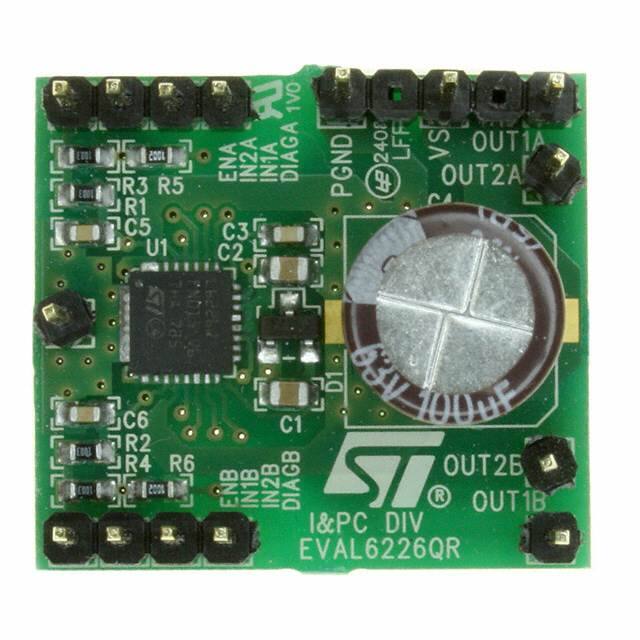
STMicroelectronics EVAL6226QR
- Part No.:
- EVAL6226QR
- Manufacturer:
- STMicroelectronics
- Package:
- Datasheet:
-
 EVAL6226QR.pdf
- Description:
- EVAL BOARD FOR L6226Q
- Quantity:
- Payment:

- Shipping:

Inventory:1,068
Please send an inquiry. Send us your inquiry, and we will respond immediately.
Product details
Overview
EVAL6226QR from STMicroelectronics is a compact (27 × 24.5 mm) demonstration board built around the L6226Q dual full-bridge motor driver IC, designed for bipolar stepper, DC, and inductive load control. It supports 8–52 Vdc supply, delivers up to 1.4 A RMS per bridge, operates up to 100 kHz switching frequency, and integrates overcurrent/thermal protection with open-drain DIAG outputs.
For engineers reviewing the EVAL6226QR datasheet, EVAL6226QR pinout, EVAL6226QR application, or EVAL6226QR equivalent, this board serves as a validated reference design for rapid prototyping of dual H-bridge motor control systems requiring precise current limiting, compact layout, and robust fault signaling.
Technical Context
The EVAL6226QR implements a complete dual full-bridge drive solution using the L6226Q VFQFPN5x5 package IC. It includes integrated charge pump (D1, C1, C3) for high-side gate drive, configurable current sensing (R5/R6 set ~1.1 A threshold), and active fault management via ENA/ENB tied to DIAGA/DIAGB with 200 µs disable time.
All logic inputs (IN1A/IN2A/IN1B/IN2B) accept 0–5 V TTL-compatible signals; power routing separates PGND (power ground) and SGND (signal ground); thermal performance is enhanced by dedicated GND copper area and 42°C/W junction-to-ambient resistance of the L6226Q.
Key Specifications
| Parameter | Value and Actual Design Meaning |
|---|---|
| Board Dimensions | 27 mm × 24.5 mm - enables integration into space-constrained motor control modules. |
| Supply Voltage Range | 8–52 Vdc - supports wide-range industrial and automotive battery-fed applications. |
| RMS Output Current | Up to 1.4 A per bridge - sufficient for driving NEMA 11–17 bipolar stepper motors or dual 12 V DC motors. |
| Switching Frequency | Up to 100 kHz - allows high-resolution PWM control and reduced audible noise in motion systems. |
| Fault Response Time | ~200 µs disable time - ensures fast shutdown during overcurrent events to protect MOSFETs and loads. |
| Current Sense Threshold | ~1.1 A typical (set by R5/R6) - provides repeatable, resistor-programmable trip point without external op-amps. |
Availability
EVAL6226QR is available at Aetrix Electronics and suitable for industrial automation, robotics actuation, precision lab equipment, and embedded motion control systems requiring stable component supply and proven reference design validation.
Supply support for EVAL6226QR includes scheduled delivery planning, volume procurement assistance, BOM continuity management, traceable sourcing, and lifecycle availability coordination for OEM customers, industrial embedded developers, connected-device designers, and electronics production programs.
Manufacturer
STMicroelectronics is a global semiconductor leader headquartered in Geneva, delivering microcontrollers, power ICs, sensors, and analog/mixed-signal solutions across industrial, automotive, and consumer markets.
The EVAL6226QR belongs to ST's motor control evaluation board portfolio, developed specifically to accelerate adoption of their L62xx dual H-bridge drivers in cost-sensitive, thermally demanding motion applications.
FAQ
What motor types can be driven using the EVAL6226QR?
The board supports two-phase bipolar stepper motors (up to 1 A DC), brushed DC motors (dual independent channels), and generic inductive loads such as solenoids or relays. Its 1.4 A RMS per bridge rating and 8–52 Vdc input range make it suitable for 12 V and 24 V industrial actuators and lab-grade positioning stages.
How are overcurrent and thermal faults signaled and handled?
Overcurrent or thermal events on Bridge A or B pull DIAGA or DIAGB low via internal open-drain transistors. These pins are intended to be wired to ENA/ENB to automatically disable the respective bridge within ~200 µs. External pull-up resistors and logic-level interfacing are required for host MCU monitoring.
Is external current sensing required for operation?
No - the EVAL6226QR uses the L6226Q's internal current sense architecture. R5 and R6 (10 kΩ) set the detection threshold to ~1.1 A; no external shunt, amplifier, or ADC is needed for basic overcurrent protection and shutdown functionality.
Can the EVAL6226QR be used with microcontrollers operating at 3.3 V logic levels?
Yes - all logic inputs (IN1A, IN2A, ENA, IN1B, IN2B, ENB) accept 0–5 V signals, making them compatible with both 3.3 V and 5 V MCUs. No level-shifting circuitry is required, though signal integrity should be maintained via short PCB traces and proper grounding.
EVAL6226QR Specifications
- Product attributes
- Attribute value
- Manufacturer:
- STMicroelectronics
- Series:
- -
- Packaging:
- Bulk
- Product Status:
- Obsolete
- Type:
- Power Management
- Function:
- Motor Controller/Driver
- Embedded:
- No
- Utilized IC / Part:
- L6226Q
- Primary Attributes:
- -
- Secondary Attributes:
- -
- Contents:
- Board(s)
EVAL6226QR FAQ
1.How can I place an order for EVAL6226QR through Aetrix?
Please submit a Request for Quotation (RFQ) for EVAL6226QR on Aetrix. Our sales agent will provide a competitive quotation and guide you through the order confirmation once you accept the terms.
2.Are the price and stock information for EVAL6226QR reliable?
The price and inventory of EVAL6226QR are updated periodically and may fluctuate due to market conditions. Stock and pricing data are typically refreshed every 24 hours. Quotation validity for EVAL6226QR is usually 5 days.
3.What payment methods are accepted for EVAL6226QR?
We accept Wire Transfer, PayPal, Credit Card, Western Union, MoneyGram, and Escrow for EVAL6226QR transactions.
Note: Certain payment methods may incur a processing fee.
4.How is shipping managed for EVAL6226QR?
EVAL6226QR orders can be shipped via leading logistics carriers, including DHL, UPS, FedEx, TNT, or Registered Mail.
Once your EVAL6226QR order is processed, you will receive an email with the shipment details and tracking number.
Note: Tracking information may take up to 24 hours to appear. Express delivery typically takes 3–5 business days.
5.How can I obtain technical support or documentation for EVAL6226QR?
For technical support, including EVAL6226QR datasheets, pinout diagrams, or application guidance, please contact our engineering support team. They can provide detailed documentation and assistance for your EVAL6226QR requirements.
6.How does Aetrix verify that EVAL6226QR is sourced from the original manufacturer or authorized distributors?
All EVAL6226QR products on Aetrix are procured from qualified distributors and authorized channels. Our dedicated quality assurance team conducts strict verification, including traceability checks and, if necessary, third-party testing. This ensures that EVAL6226QR meets industry standards.
7.What is the process for return or replacement of EVAL6226QR?
All EVAL6226QR units undergo pre-shipment inspection (PSI). If there is an issue with EVAL6226QR, returns or replacements are accepted under the following conditions:
1.Quantity discrepancies, incorrect items, or visible external defects (such as breakage or corrosion), acknowledged by Aetrix.
2.The issue is reported within 90 days of delivery.
3.The EVAL6226QR part is unused and in its original packaging.
Return procedure for EVAL6226QR:
1.Submit a request within 90 days.
2.Obtain a Return Material Authorization (RMA) from Aetrix.
EVAL6226QR Tags
-
BOB-12009
SparkFun Electronics
-
106990290
Seeed Technology Co., Ltd
-
BOB-11771
SparkFun Electronics
-
BOB-09118
SparkFun Electronics

-
4410
Adafruit Industries LLC
-
5335
Adafruit Industries LLC
-
BOB-11189
SparkFun Electronics
-
3295
Adafruit Industries LLC
-
3421
Adafruit Industries LLC
-
1904
Adafruit Industries LLC
-
2717
Adafruit Industries LLC
-
3190
Adafruit Industries LLC
Tech Hub

An engineering guide to LED driver operation, constant-current and constant-voltage outputs, linear and switching topologies, dimming, IC selection, calculations, replacement compatibility, and fault c…

Operational amplifier guide covering op amp basics, feedback, ideal vs real op amps, common configurations, buffer circuits, offset, bias current, gain-bandwidth, slew rate, rail-to-rail limits and sel…

Jumper cables guide covering safe connection order, red and black clamp placement, final ground connection, cable gauge, length, clamp quality, copper vs CCA cables, jump starter comparison and battery…

LDO regulator guide covering low dropout voltage, power dissipation, thermal design, PSRR, output noise, capacitor stability, adjustable LDO circuits, LDO vs buck converter and datasheet selection chec…

Conditional Access Module guide covering CAM meaning, CI/CI+ interface, smart card authorization, DVB security workflow, TV and set-top box compatibility, internal electronics, ESD protection, connecto…

Guide to electronic component obsolescence covering EOL risk, PCN/PDN notices, last-time buy planning, replacement options, form-fit-function validation, counterfeit risk and BOM lifecycle management.

18650 battery guide covering lithium-ion cell basics, 3.6V/3.7V voltage, 4.2V charging, mAh and Wh capacity, protected cells, chargers, BMS, series-parallel packs, holders, welding and sourcing checks.…

Hall effect sensor guide covering working principle, linear and digital sensors, Arduino circuits, current sensing, speed detection, automotive applications, A3144 examples, signal filtering and datash…

Product Change Notification guide for electronic components, covering PCN meaning, PCN vs PDN/EOL, common change types, risk levels, form-fit-function review, engineering validation, BOM control, LTB/L…

A practical guide to blend door actuators, covering HVAC function, symptoms, location, AC and heater issues, reset and calibration, replacement cost, electrical diagnosis, compatibility checks, and rep…


