
 My Inquiry
 My Account


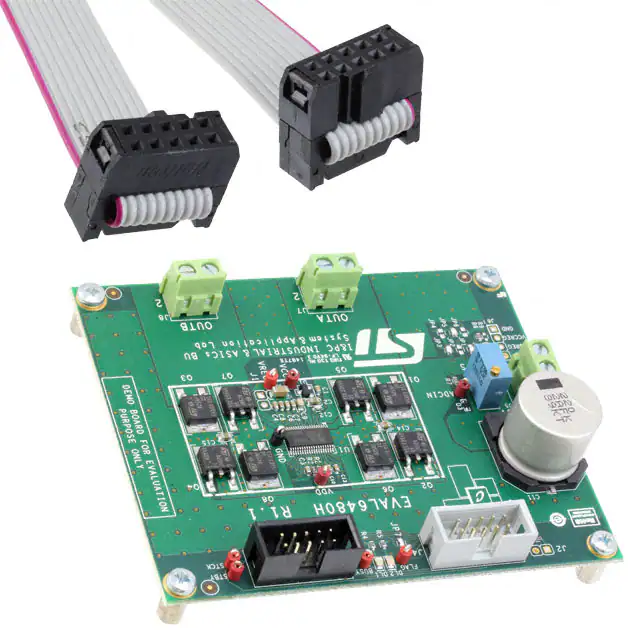
STMicroelectronics EVAL6480H
- Part No.:
- EVAL6480H
- Manufacturer:
- STMicroelectronics
- Package:
- Datasheet:
-
 EVAL6480H.pdf
- Description:
- EVAL BOARD FOR L6480
- Quantity:
- Payment:

- Shipping:

Inventory:1,324
Please send an inquiry. Send us your inquiry, and we will respond immediately.
Product details
Overview
EVAL6480H from STMicroelectronics is a high-power stepper motor driver evaluation board built around the L6480 microstepping driver IC, supporting 10.5–85 V supply, 25 Ar.m.s./phase output, daisy-chain SPI, and dual LED status indicators (FLAG/BUSY). It enables full functional validation of voltage-mode driving, parameter tuning, and multi-motor system evaluation when paired with STEVAL-PCC009V2 and official software.
For engineers reviewing the EVAL6480H datasheet, EVAL6480H pinout, EVAL6480H application, or EVAL6480H equivalent, this board serves as a production-ready platform for validating L6480-based bipolar stepper motor control in industrial motion systems requiring precise current regulation, thermal robustness, and scalable SPI configuration.
Technical Context
The EVAL6480H implements a two-phase, high-voltage H-bridge driver stage using eight STD25NF10 DPAK MOSFETs (Rds(on) = 33 mΩ typical), controlled by the L6480 HTSSOP-38 IC. It supports both standalone step-clock operation and SPI-configured microstepping up to 1/128 resolution.
Power management includes independent regulation paths for VS, VSREG, VCC, VCCREG, VREG, and VDD (3.3 V logic), with configurable jumpers (JP1–JP8) enabling flexible supply routing and daisy-chain termination. The board accepts external ADCIN for supply voltage compensation and provides dedicated test points for BUSY/SYNC and STBY signals.
Key Specifications
| Parameter | Value and Actual Design Meaning |
|---|---|
| Supply voltage (VS) | 10.5 V to 85 V - supports wide-range industrial DC bus inputs including 24 V, 48 V, and 72 V systems. |
| Max output current (per phase) | 25 Ar.m.s. at 25 °C - enables direct drive of high-torque NEMA 34+ stepper motors without external heatsinking under nominal conditions. |
| MOSFET Rds(on) | 33 mΩ typical at 25 °C - minimizes conduction loss and thermal rise in high-current bridge legs. |
| SPI interface | Daisy-chain capable - allows synchronized configuration and monitoring of multiple EVAL6480H boards from a single master controller. |
| Logic supply voltage | 3.3 V or 5 V tolerant - accommodates both modern low-voltage MCUs and legacy 5 V controllers via jumper-selectable VDD sourcing. |
| Operating temperature | −25 °C to +125 °C - validated for use in enclosed industrial enclosures with passive cooling only. |
| ADC input (ADCIN) | Motor supply voltage compensation input - enables real-time adjustment of current references to maintain torque across varying input voltage. |
Availability
EVAL6480H is available at Aetrix Electronics and suitable for industrial CNC motion control, automated packaging machinery, and high-precision laboratory positioning systems requiring stable component supply and proven reference design validation.
Supply support for EVAL6480H includes scheduled delivery planning, volume procurement assistance, BOM continuity management, traceable sourcing, and lifecycle availability coordination for OEM customers, industrial embedded developers, connected-device designers, and electronics production programs.
Manufacturer
STMicroelectronics is a global semiconductor leader headquartered in Geneva, Switzerland, designing and manufacturing microcontrollers, power ICs, sensors, and analog/mixed-signal solutions for industrial, automotive, and consumer markets.
The EVAL6480H belongs to ST's motor control evaluation platform family, developed specifically to accelerate adoption of the L6480 high-voltage stepper driver in demanding motion applications where reliability, configurability, and thermal resilience are critical.
FAQ
Does EVAL6480H require an external microcontroller to operate?
No - the board supports standalone operation via its step-clock (STCK) and standby/reset (STBY_RESET) inputs, allowing basic microstepping without SPI communication. However, full feature access-including current profiling, acceleration/deceleration ramps, and diagnostic flag interpretation-requires connection to a host MCU via SPI.
What is the purpose of the JP7 daisy-chain termination jumper?
JP7 configures the SPI signal path between J3 (master) and J4 (slave): when closed, it connects the SDO output of one board to the SDI input of the next in a daisy chain; when open, it isolates the board for standalone use. This enables synchronized multi-axis control without additional level-shifting hardware.
Can EVAL6480H drive unipolar stepper motors?
No - the board implements a dual H-bridge topology optimized exclusively for bipolar stepper motors. Its gate drivers, current sensing, and L6480 firmware are designed for two-phase, four-wire bipolar configurations; unipolar motors (5/6-wire) are incompatible due to missing center-tap drive capability and mismatched commutation logic.
Is the 25 Ar.m.s. rating sustainable at maximum ambient temperature?
No - the 25 Ar.m.s. rating applies only at TA = 25 °C with adequate PCB copper area and airflow. At 125 °C ambient, derating reduces usable current to approximately 12–14 Ar.m.s. per phase, as confirmed by thermal simulation data in the L6480 datasheet and board layout thermal analysis (Doc ID 023675 Rev 1, p.6).
EVAL6480H Specifications
- Product attributes
- Attribute value
- Manufacturer:
- STMicroelectronics
- Series:
- -
- Packaging:
- Box
- Product Status:
- Active
- Type:
- Power Management
- Function:
- Motor Controller/Driver, Stepper
- Embedded:
- No
- Utilized IC / Part:
- L6480
- Primary Attributes:
- -
- Secondary Attributes:
- -
- Contents:
- Board(s)
EVAL6480H FAQ
1.How can I place an order for EVAL6480H through Aetrix?
Please submit a Request for Quotation (RFQ) for EVAL6480H on Aetrix. Our sales agent will provide a competitive quotation and guide you through the order confirmation once you accept the terms.
2.Are the price and stock information for EVAL6480H reliable?
The price and inventory of EVAL6480H are updated periodically and may fluctuate due to market conditions. Stock and pricing data are typically refreshed every 24 hours. Quotation validity for EVAL6480H is usually 5 days.
3.What payment methods are accepted for EVAL6480H?
We accept Wire Transfer, PayPal, Credit Card, Western Union, MoneyGram, and Escrow for EVAL6480H transactions.
Note: Certain payment methods may incur a processing fee.
4.How is shipping managed for EVAL6480H?
EVAL6480H orders can be shipped via leading logistics carriers, including DHL, UPS, FedEx, TNT, or Registered Mail.
Once your EVAL6480H order is processed, you will receive an email with the shipment details and tracking number.
Note: Tracking information may take up to 24 hours to appear. Express delivery typically takes 3–5 business days.
5.How can I obtain technical support or documentation for EVAL6480H?
For technical support, including EVAL6480H datasheets, pinout diagrams, or application guidance, please contact our engineering support team. They can provide detailed documentation and assistance for your EVAL6480H requirements.
6.How does Aetrix verify that EVAL6480H is sourced from the original manufacturer or authorized distributors?
All EVAL6480H products on Aetrix are procured from qualified distributors and authorized channels. Our dedicated quality assurance team conducts strict verification, including traceability checks and, if necessary, third-party testing. This ensures that EVAL6480H meets industry standards.
7.What is the process for return or replacement of EVAL6480H?
All EVAL6480H units undergo pre-shipment inspection (PSI). If there is an issue with EVAL6480H, returns or replacements are accepted under the following conditions:
1.Quantity discrepancies, incorrect items, or visible external defects (such as breakage or corrosion), acknowledged by Aetrix.
2.The issue is reported within 90 days of delivery.
3.The EVAL6480H part is unused and in its original packaging.
Return procedure for EVAL6480H:
1.Submit a request within 90 days.
2.Obtain a Return Material Authorization (RMA) from Aetrix.
EVAL6480H Tags
-
BOB-12009
SparkFun Electronics
-
106990290
Seeed Technology Co., Ltd
-
BOB-11771
SparkFun Electronics
-
BOB-09118
SparkFun Electronics

-
4410
Adafruit Industries LLC
-
5335
Adafruit Industries LLC
-
BOB-11189
SparkFun Electronics
-
3295
Adafruit Industries LLC
-
3421
Adafruit Industries LLC
-
1904
Adafruit Industries LLC
-
2717
Adafruit Industries LLC
-
3190
Adafruit Industries LLC
Tech Hub

A practical engineering and sourcing framework covering lifecycle verification, lifetime-buy calculations, replacement qualification, supplier checks and counterfeit-risk controls.

TTL and CMOS logic families differ in thresholds, loading, output drive, power and timing. This engineering guide compares 74HC and 74HCT, calculates noise margins and checks 3.3 V/5 V compatibility.

A practical engineering guide to 3.3V and 5V logic compatibility, input thresholds, resistor dividers, translator ICs, MOSFET level shifting, I2C pull-ups, timing limits and power-sequencing risks.

The 74HC595 uses push-pull logic outputs, while the TPIC6B595 uses 50 V open-drain DMOS sinks for higher-power loads. This guide compares timing, current limits, 3.3 V interfacing, load wiring, thermal…

The 74HC595 converts serial data into eight stable parallel outputs. This guide covers pin functions, shift and storage timing, OE and MR behavior, drive-current limits, cascading, voltage compatibilit…

A technical comparison of level-sensitive latches and edge-triggered flip-flops, covering timing windows, setup and hold limits, master–slave operation, time borrowing, race-through, HDL inference and…

A D latch stores one bit while Enable controls when data can pass. This reference covers gate-level operation, truth tables, transparency, setup and hold timing, LE versus OE, common ICs and practical …

An SR latch stores one bit through cross-coupled feedback. This engineering reference covers NOR and NAND implementations, truth tables, forbidden-state recovery, gated operation, switch debouncing, fa…

Latch circuits retain one bit through feedback. This technical reference covers SR and D latches, truth tables, transparency, timing limits, latch-versus-flip-flop behavior, applications and common log…

An engineering guide to LED driver operation, constant-current and constant-voltage outputs, linear and switching topologies, dimming, IC selection, calculations, replacement compatibility, and fault c…


