
 My Inquiry
 My Account


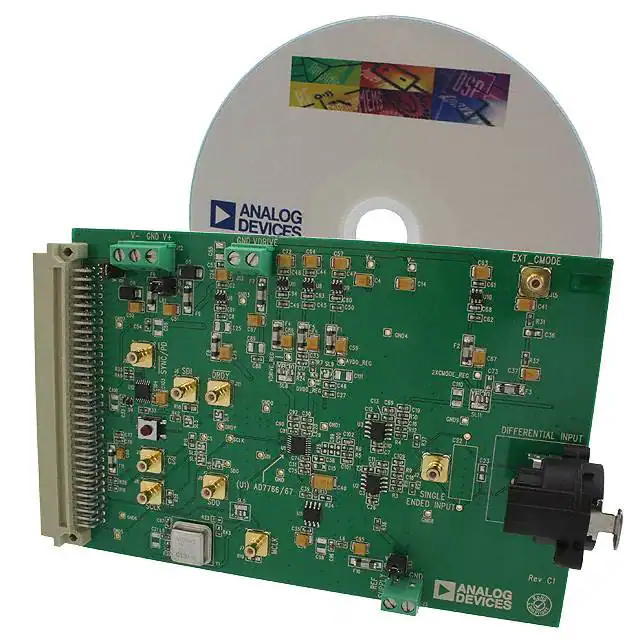
Analog Devices Inc. EVAL-AD7767-2EDZ
- Part No.:
- EVAL-AD7767-2EDZ
- Manufacturer:
- Analog Devices Inc.
- Package:
- Datasheet:
-
 EVAL-AD7767-2EDZ.pdf
- Description:
- BOARD EVALUATION FOR AD7767
- Quantity:
- Payment:

- Shipping:

Inventory:3,007
Please send an inquiry. Send us your inquiry, and we will respond immediately.
Product details
Overview
EVAL-AD7767-2EDZ from Analog Devices is a dedicated evaluation board for the AD7767-2 - a 24-bit, single-channel, oversampled SAR ADC with 64 kSPS maximum output data rate, 109 dB SNR, and 8.5 mW power consumption. It supports standalone operation or integration with the EVAL-CED1Z control board, features on-board ADR445 5 V reference and dual ADA4841-1 op-amps, and enables precision linearity testing of high-resolution audio and instrumentation signal chains.
For engineers reviewing the EVAL-AD7767-2EDZ datasheet, EVAL-AD7767-2EDZ pinout, EVAL-AD7767-2EDZ application, or EVAL-AD7767-2EDZ equivalent, key selection considerations include MCLK source flexibility (1 MHz crystal or external 1.024 MHz), VDRIVE voltage configuration options (2.5 V via regulator, CED, or external), daisy-chain support via SDI/SDO, and compatibility with CED-based automated test workflows.
Technical Context
The EVAL-AD7767-2EDZ is designed exclusively for evaluating the AD7767-2 ADC and shares hardware compatibility with AD7767 and AD7767-1 variants. It implements differential analog input conditioning using two ADA4841-1 op-amps powered from ±7.5 V/–2.5 V supplies, with common-mode voltage set to 2.5 V (VREF/2) and precision buffered by an ADR445 5 V reference.
Signal routing is managed through a 96-way CED-compatible connector and 12 SMB sockets (J2–J15), supporting external MCLK, SCLK, CS, DRDY, SDI, SDO, SYNC/PD, and EXT_CMODE inputs. Link options (LK1–LK3, SL1–SL11) configure power sourcing, clock paths, and interface modes - including stand-alone vs. CED-coupled operation and daisy-chain verification capability.
Key Specifications
| Parameter | Value and Actual Design Meaning |
|---|---|
| Target Device | AD7767-2: 24-bit SAR ADC with 64 kSPS max output rate and 109 dB SNR |
| Reference Voltage | 5 V ultrahigh-precision ADR445, enabling full-scale input range of ±2.5 V differential |
| Analog Front-End | Dual ADA4841-1 op-amps configured for differential drive with 2.5 V common-mode bias |
| MCLK Options | On-board 1 MHz crystal (Y1) or external 1.024 MHz via J7; supports 128/64/32 kSPS rates per device variant |
| Interface Compatibility | CED-compatible 96-way digital interface; supports SPI-like serial communication (CS, SCLK, SDO, SDI, DRDY) |
| Power Inputs | +7.5 V and –2.5 V at J12 for op-amp rails; 2.5 V AVDD1/DVDD/VDRIVE derived internally via ADP3330 regulators |
| Software Support | Windows® 2000/XP-compatible PC software for real-time waveform capture, FFT analysis, histogram generation, and 21-bit INL/DNL linearity evaluation |
Availability
EVAL-AD7767-2EDZ is available at Aetrix Electronics and suitable for high-fidelity audio converter validation, precision instrumentation ADC characterization, and industrial sensor signal chain prototyping requiring stable component supply and traceable evaluation infrastructure.
Supply support for EVAL-AD7767-2EDZ includes scheduled delivery planning, volume procurement assistance, BOM continuity management, traceable sourcing, and lifecycle availability coordination for OEM customers, industrial embedded developers, connected-device designers, and electronics production programs.
Manufacturer
Analog Devices, Inc. is a global leader in high-performance analog, mixed-signal, and digital signal processing semiconductors, headquartered in Norwood, MA.
The EVAL-AD7767-2EDZ belongs to Analog Devices' precision data converter evaluation platform family, engineered to accelerate validation of 24-bit sigma-delta and SAR ADCs in metrology, seismic, and high-end audio applications.
FAQ
What is the primary function of the EVAL-AD7767-2EDZ?
The EVAL-AD7767-2EDZ is a dedicated evaluation board for the AD7767-2 24-bit SAR ADC. It provides complete signal conditioning, precise voltage referencing, configurable clocking, and digital interface circuitry to enable accurate performance characterization - including SNR, THD, INL, and DNL - under real-world analog input conditions. The EVAL-AD7767-2EDZ does not operate as a standalone data acquisition system but requires connection to the EVAL-CED1Z or compatible host controller for full functionality.
Which ADC variants does the EVAL-AD7767-2EDZ support?
The EVAL-AD7767-2EDZ supports three variants: AD7767 (128 kSPS), AD7767-1 (32 kSPS), and AD7767-2 (64 kSPS). All share identical pinout, power architecture, and analog front-end design. Differences in output data rate and digital filtering are configured via software-controlled register settings and MCLK selection - the EVAL-AD7767-2EDZ hardware itself is fully common across all three devices.
How is the analog input conditioned on the EVAL-AD7767-2EDZ?
The EVAL-AD7767-2EDZ uses two ADA4841-1 operational amplifiers to buffer and drive the AD7767-2's differential analog inputs. These op-amps are powered from +7.5 V and –2.5 V supplies applied at J12, and configured to deliver a 2.5 V common-mode voltage (VREF/2) with ±2.5 V differential swing. Input options include XLR (J4) for balanced audio sources and BNC (J2) for single-ended signals converted to differential mode.
Can the EVAL-AD7767-2EDZ operate without the EVAL-CED1Z?
Yes - the EVAL-AD7767-2EDZ supports stand-alone operation using external logic signals. Solder links SL1–SL6 allow routing of SCLK, CS, DRDY, SDO, and MCLK to SMB connectors (J5–J11), enabling direct interfacing with FPGA or microcontroller-based test systems. However, the included PC software and automated analysis features require the EVAL-CED1Z; stand-alone use demands custom host firmware and signal generation.
What software tools are provided with the EVAL-AD7767-2EDZ?
The EVAL-AD7767-2EDZ ships with Windows® 2000/XP-compatible evaluation software that runs only when connected to the EVAL-CED1Z. It provides real-time waveform display, FFT spectrum analysis, histogram generation, statistical metrics (SNR, THD, SFDR), and dedicated linearity evaluation with 21-bit INL/DNL plots. The software includes driver installation, automatic USB enumeration, and front-panel controls for sampling rate, buffer depth, and trigger configuration - all calibrated specifically for the EVAL-AD7767-2EDZ hardware layout and AD7767-2 timing parameters.
EVAL-AD7767-2EDZ Specifications
- Product attributes
- Attribute value
- Manufacturer:
- Analog Devices Inc.
- Series:
- -
- Packaging:
- Box
- Product Status:
- Active
- Number of A/D Converters:
- 1
- Number of Bits:
- 24
- Sampling Rate (Per Second):
- 32k
- Data Interface:
- Serial
- Input Range:
- ±VREF
- Power (Typ) @ Conditions:
- 8.5mW @ 32kSPS
- Utilized IC / Part:
- AD7767-2
- Contents:
- Board(s)
EVAL-AD7767-2EDZ FAQ
1.How can I place an order for EVAL-AD7767-2EDZ through Aetrix?
Please submit a Request for Quotation (RFQ) for EVAL-AD7767-2EDZ on Aetrix. Our sales agent will provide a competitive quotation and guide you through the order confirmation once you accept the terms.
2.Are the price and stock information for EVAL-AD7767-2EDZ reliable?
The price and inventory of EVAL-AD7767-2EDZ are updated periodically and may fluctuate due to market conditions. Stock and pricing data are typically refreshed every 24 hours. Quotation validity for EVAL-AD7767-2EDZ is usually 5 days.
3.What payment methods are accepted for EVAL-AD7767-2EDZ?
We accept Wire Transfer, PayPal, Credit Card, Western Union, MoneyGram, and Escrow for EVAL-AD7767-2EDZ transactions.
Note: Certain payment methods may incur a processing fee.
4.How is shipping managed for EVAL-AD7767-2EDZ?
EVAL-AD7767-2EDZ orders can be shipped via leading logistics carriers, including DHL, UPS, FedEx, TNT, or Registered Mail.
Once your EVAL-AD7767-2EDZ order is processed, you will receive an email with the shipment details and tracking number.
Note: Tracking information may take up to 24 hours to appear. Express delivery typically takes 3–5 business days.
5.How can I obtain technical support or documentation for EVAL-AD7767-2EDZ?
For technical support, including EVAL-AD7767-2EDZ datasheets, pinout diagrams, or application guidance, please contact our engineering support team. They can provide detailed documentation and assistance for your EVAL-AD7767-2EDZ requirements.
6.How does Aetrix verify that EVAL-AD7767-2EDZ is sourced from the original manufacturer or authorized distributors?
All EVAL-AD7767-2EDZ products on Aetrix are procured from qualified distributors and authorized channels. Our dedicated quality assurance team conducts strict verification, including traceability checks and, if necessary, third-party testing. This ensures that EVAL-AD7767-2EDZ meets industry standards.
7.What is the process for return or replacement of EVAL-AD7767-2EDZ?
All EVAL-AD7767-2EDZ units undergo pre-shipment inspection (PSI). If there is an issue with EVAL-AD7767-2EDZ, returns or replacements are accepted under the following conditions:
1.Quantity discrepancies, incorrect items, or visible external defects (such as breakage or corrosion), acknowledged by Aetrix.
2.The issue is reported within 90 days of delivery.
3.The EVAL-AD7767-2EDZ part is unused and in its original packaging.
Return procedure for EVAL-AD7767-2EDZ:
1.Submit a request within 90 days.
2.Obtain a Return Material Authorization (RMA) from Aetrix.
EVAL-AD7767-2EDZ Tags
-
1083
Adafruit Industries LLC
-
1085
Adafruit Industries LLC
-
ADS7038Q1EVM-PDK
Texas Instruments
-
ADS8688EVM-PDK
Texas Instruments
-
EVAL-AD7606C18FMCZ
Analog Devices Inc.
-
ADS1232REF
Texas Instruments
-
EVAL-AD4134FMCZ
Analog Devices Inc.
-
EVAL-AD7768FMCZ
Analog Devices Inc.
-
ADC128S102EVM
Texas Instruments
-
ADS124S08EVM
Texas Instruments
-
ADC6140EVM-PDK
Texas Instruments
-
ADS7066EVM-PDK
Texas Instruments
Tech Hub

A practical engineering guide to 3.3V and 5V logic compatibility, input thresholds, resistor dividers, translator ICs, MOSFET level shifting, I2C pull-ups, timing limits and power-sequencing risks.

The 74HC595 uses push-pull logic outputs, while the TPIC6B595 uses 50 V open-drain DMOS sinks for higher-power loads. This guide compares timing, current limits, 3.3 V interfacing, load wiring, thermal…

The 74HC595 converts serial data into eight stable parallel outputs. This guide covers pin functions, shift and storage timing, OE and MR behavior, drive-current limits, cascading, voltage compatibilit…

A technical comparison of level-sensitive latches and edge-triggered flip-flops, covering timing windows, setup and hold limits, master–slave operation, time borrowing, race-through, HDL inference and…

A D latch stores one bit while Enable controls when data can pass. This reference covers gate-level operation, truth tables, transparency, setup and hold timing, LE versus OE, common ICs and practical …

An SR latch stores one bit through cross-coupled feedback. This engineering reference covers NOR and NAND implementations, truth tables, forbidden-state recovery, gated operation, switch debouncing, fa…

Latch circuits retain one bit through feedback. This technical reference covers SR and D latches, truth tables, transparency, timing limits, latch-versus-flip-flop behavior, applications and common log…

An engineering guide to LED driver operation, constant-current and constant-voltage outputs, linear and switching topologies, dimming, IC selection, calculations, replacement compatibility, and fault c…

Operational amplifier guide covering op amp basics, feedback, ideal vs real op amps, common configurations, buffer circuits, offset, bias current, gain-bandwidth, slew rate, rail-to-rail limits and sel…

Jumper cables guide covering safe connection order, red and black clamp placement, final ground connection, cable gauge, length, clamp quality, copper vs CCA cables, jump starter comparison and battery…


