
 My Inquiry
 My Account


Analog Devices Inc. EVAL-CHAMBER
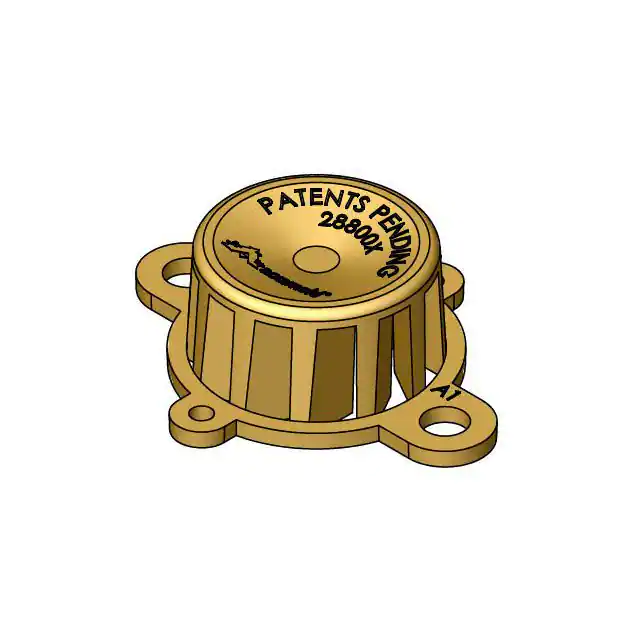
- Part No.:
- EVAL-CHAMBER
- Manufacturer:
- Analog Devices Inc.
- Category:
- Accessories
- Package:
- Datasheet:
-
 EVAL-CHAMBER.pdf
- Description:
- SMOKE CHAMBER
- Quantity:
- Payment:

- Shipping:

Inventory:3,846
Please send an inquiry. Send us your inquiry, and we will respond immediately.
Product details
Overview
EVAL-CHAMBER from Accumold Corporation is a precision-machined optical smoke chamber designed for integration with the ADPD188BI optical sensor IC. It features critical internal dimensions including 11.80±0.05 mm ID, 12.50 mm outer diameter, and 30 mm height, with angular tolerance ±1° and positional alignment controlled to ±0.0002" on critical features. It enables reliable light-scattering detection in residential and commercial smoke alarms.
For engineers reviewing the EVAL-CHAMBER datasheet, EVAL-CHAMBER mechanical drawing, EVAL-CHAMBER mounting interface, or EVAL-CHAMBER compatibility with ADPD188BI, key considerations include internal cavity geometry, optical path alignment, dimensional repeatability across production lots, and thermal stability under UL/EN smoke alarm environmental test profiles.
Technical Context
The EVAL-CHAMBER is a passive optical cavity component that defines the physical sensing volume and light path between the ADPD188BI's integrated LED emitters and photodiode receivers. Its internal surface finish, wall geometry, and inlet/outlet port placement directly influence scattering efficiency and false-alarm immunity.
Manufactured via high-precision micro-molding per Accumold drawing 28800X Rev B, it conforms to third-angle projection standards with critical tolerances held to ±0.0002" (±5 µm) on datum-controlled features. Dimensional compliance ensures repeatable optical coupling and mechanical registration to the ADPD188BI evaluation PCB.
Key Specifications
| Parameter | Value and Actual Design Meaning |
|---|---|
| ID | 11.80 ± 0.05 mm - defines minimum optical path length and particle interaction volume |
| OD | 12.50 mm - ensures press-fit compatibility with standard smoke alarm housing apertures |
| Height | 30 mm - sets vertical optical axis length and aligns with ADPD188BI emitter/receiver spacing |
| Angular Tolerance | ±1° - maintains collimation integrity of emitted light relative to photodiode field-of-view |
| Critical Feature Tolerance | ±0.0002" (±5 µm) - guarantees repeatable mechanical registration to ADPD188BI evaluation board fiducials |
| Material | Black ABS - provides >99% light absorption to minimize stray reflections and background noise |
Availability
EVAL-CHAMBER is available at Aetrix Electronics and suitable for smoke detector development, UL-certified alarm system prototyping, and optical sensing validation requiring stable component supply and traceable mechanical specifications.
Supply support for EVAL-CHAMBER includes scheduled delivery planning, volume procurement assistance, BOM continuity management, traceable sourcing, and lifecycle availability coordination for OEM customers, industrial embedded developers, connected-device designers, and electronics production programs.
Manufacturer
Accumold Corporation is a U.S.-based precision micro-molding specialist serving medical, sensing, and optical markets with sub-10 µm tolerance capability and ISO 13485 certification.
The 28800X product line delivers application-specific optical cavities engineered for co-design with Analog Devices' ADPD188BI, targeting low-noise, high-reliability smoke detection systems compliant with UL 217 and EN 14604.
FAQ
What is the primary function of the EVAL-CHAMBER in a smoke detection system?
The EVAL-CHAMBER serves as the calibrated optical sensing chamber that houses the ADPD188BI sensor IC. It defines the precise light-scattering volume where smoke particles interrupt the LED-to-photodiode optical path. Its geometry and surface finish are optimized to maximize signal-to-noise ratio and minimize false alarms. The EVAL-CHAMBER must be used with the ADPD188BI to achieve specified detection sensitivity and response time per UL 217.
Is the EVAL-CHAMBER compatible with sensors other than the ADPD188BI?
No - the EVAL-CHAMBER is mechanically and optically tuned specifically for the ADPD188BI's dual-LED/dual-PD architecture, emitter wavelength (525 nm and 850 nm), and PCB footprint. Its internal dimensions, port locations, and alignment datums do not support interchangeability with other optical sensors. Use of EVAL-CHAMBER with non-ADPD188BI devices is not validated or supported.
Does the EVAL-CHAMBER include mounting hardware or PCB assembly?
No - the EVAL-CHAMBER is a standalone machined plastic component without screws, gaskets, or circuitry. It is intended for manual or automated press-fit installation onto an ADPD188BI-equipped evaluation board (e.g., ADPD188BI-ARDZ). No soldering, adhesives, or fasteners are supplied with the EVAL-CHAMBER unit itself.
What dimensional standard does the EVAL-CHAMBER drawing follow?
The EVAL-CHAMBER drawing follows ANSI Y14.5-2018 geometric dimensioning and tolerancing (GD&T) standards, with third-angle projection and dual-unit annotation (inches/mm). Critical dimensions are annotated with star (*) symbols and controlled to ±0.0002", per Accumold drawing 28800X Rev B dated 9/30/2019. All tolerances are explicitly stated - no defaults apply.
How does the black ABS material contribute to EVAL-CHAMBER performance?
The black ABS material provides >99% diffuse light absorption across 400–1000 nm, eliminating internal reflections that would corrupt the ADPD188BI's scattered-light measurement. Its low outgassing and thermal stability (−10°C to +60°C operating range) prevent contamination of optical surfaces and maintain dimensional integrity during smoke alarm temperature cycling tests required by UL 217.
EVAL-CHAMBER Specifications
- Product attributes
- Attribute value
- Manufacturer:
- Analog Devices Inc.
- Series:
- -
- Packaging:
- Box
- Product Status:
- Active
- Accessory Type:
- Smoke Chamber
- For Use With/Related Products:
- ADPD188BI
EVAL-CHAMBER FAQ
1.How can I place an order for EVAL-CHAMBER through Aetrix?
Please submit a Request for Quotation (RFQ) for EVAL-CHAMBER on Aetrix. Our sales agent will provide a competitive quotation and guide you through the order confirmation once you accept the terms.
2.Are the price and stock information for EVAL-CHAMBER reliable?
The price and inventory of EVAL-CHAMBER are updated periodically and may fluctuate due to market conditions. Stock and pricing data are typically refreshed every 24 hours. Quotation validity for EVAL-CHAMBER is usually 5 days.
3.What payment methods are accepted for EVAL-CHAMBER?
We accept Wire Transfer, PayPal, Credit Card, Western Union, MoneyGram, and Escrow for EVAL-CHAMBER transactions.
Note: Certain payment methods may incur a processing fee.
4.How is shipping managed for EVAL-CHAMBER?
EVAL-CHAMBER orders can be shipped via leading logistics carriers, including DHL, UPS, FedEx, TNT, or Registered Mail.
Once your EVAL-CHAMBER order is processed, you will receive an email with the shipment details and tracking number.
Note: Tracking information may take up to 24 hours to appear. Express delivery typically takes 3–5 business days.
5.How can I obtain technical support or documentation for EVAL-CHAMBER?
For technical support, including EVAL-CHAMBER datasheets, pinout diagrams, or application guidance, please contact our engineering support team. They can provide detailed documentation and assistance for your EVAL-CHAMBER requirements.
6.How does Aetrix verify that EVAL-CHAMBER is sourced from the original manufacturer or authorized distributors?
All EVAL-CHAMBER products on Aetrix are procured from qualified distributors and authorized channels. Our dedicated quality assurance team conducts strict verification, including traceability checks and, if necessary, third-party testing. This ensures that EVAL-CHAMBER meets industry standards.
7.What is the process for return or replacement of EVAL-CHAMBER?
All EVAL-CHAMBER units undergo pre-shipment inspection (PSI). If there is an issue with EVAL-CHAMBER, returns or replacements are accepted under the following conditions:
1.Quantity discrepancies, incorrect items, or visible external defects (such as breakage or corrosion), acknowledged by Aetrix.
2.The issue is reported within 90 days of delivery.
3.The EVAL-CHAMBER part is unused and in its original packaging.
Return procedure for EVAL-CHAMBER:
1.Submit a request within 90 days.
2.Obtain a Return Material Authorization (RMA) from Aetrix.
EVAL-CHAMBER Tags
-
261
Adafruit Industries LLC
-
5385
Adafruit Industries LLC
-
FIT0587
DFRobot
-
PRT-14427
SparkFun Electronics
-
PRT-10474
SparkFun Electronics
-
PRT-15109
SparkFun Electronics
-
PRT-11417
SparkFun Electronics
-
FIT0586
DFRobot

-
1131
Adafruit Industries LLC
-
MIKROE-485
MikroElektronika
-
2223
Adafruit Industries LLC
-
PRT-14017
SparkFun Electronics
Tech Hub

A practical engineering guide to 3.3V and 5V logic compatibility, input thresholds, resistor dividers, translator ICs, MOSFET level shifting, I2C pull-ups, timing limits and power-sequencing risks.

The 74HC595 uses push-pull logic outputs, while the TPIC6B595 uses 50 V open-drain DMOS sinks for higher-power loads. This guide compares timing, current limits, 3.3 V interfacing, load wiring, thermal…

The 74HC595 converts serial data into eight stable parallel outputs. This guide covers pin functions, shift and storage timing, OE and MR behavior, drive-current limits, cascading, voltage compatibilit…

A technical comparison of level-sensitive latches and edge-triggered flip-flops, covering timing windows, setup and hold limits, master–slave operation, time borrowing, race-through, HDL inference and…

A D latch stores one bit while Enable controls when data can pass. This reference covers gate-level operation, truth tables, transparency, setup and hold timing, LE versus OE, common ICs and practical …

An SR latch stores one bit through cross-coupled feedback. This engineering reference covers NOR and NAND implementations, truth tables, forbidden-state recovery, gated operation, switch debouncing, fa…

Latch circuits retain one bit through feedback. This technical reference covers SR and D latches, truth tables, transparency, timing limits, latch-versus-flip-flop behavior, applications and common log…

An engineering guide to LED driver operation, constant-current and constant-voltage outputs, linear and switching topologies, dimming, IC selection, calculations, replacement compatibility, and fault c…

Operational amplifier guide covering op amp basics, feedback, ideal vs real op amps, common configurations, buffer circuits, offset, bias current, gain-bandwidth, slew rate, rail-to-rail limits and sel…

Jumper cables guide covering safe connection order, red and black clamp placement, final ground connection, cable gauge, length, clamp quality, copper vs CCA cables, jump starter comparison and battery…


