
 My Inquiry
 My Account


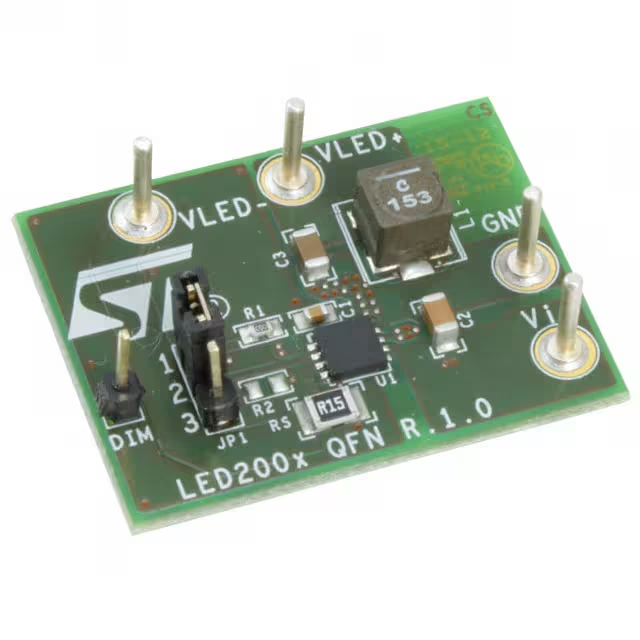
STMicroelectronics EVALED2000P
- Part No.:
- EVALED2000P
- Manufacturer:
- STMicroelectronics
- Category:
- LED Driver Evaluation Boards
- Package:
- Datasheet:
-
 EVALED2000P.pdf
- Description:
- EVAL BOARD FOR LED2000
- Quantity:
- Payment:

- Shipping:

Inventory:4,124
Please send an inquiry. Send us your inquiry, and we will respond immediately.
Product details
Overview
LED2000P from STMicroelectronics is a monolithic 3 A synchronous step-down constant-current LED driver IC with fixed 850 kHz switching frequency, ±7% output current accuracy, and integrated PWM dimming control. It operates from 3.0 V to 18 V input, delivers precise current regulation via external sense resistor, and targets high-brightness LED arrays in automotive lighting and signage.
For engineers reviewing the LED2000P datasheet, LED2000P pinout, LED2000P application, or LED2000P equivalent, key selection criteria include its 100 mV typical sense voltage, thermal shutdown at 150 °C, VFQFPN-8 (4 mm × 4 mm) package, and compatibility with ceramic output capacitors for compact, high-efficiency designs.
Technical Context
The LED2000P implements peak current mode control with an embedded 850 kHz oscillator, transconductance error amplifier referenced to 97 mV (typ), and internal slope compensation to prevent subharmonic oscillation above 50% duty cycle. Its synchronous rectification uses integrated high-side (95 mΩ RDS(on)) and low-side (69 mΩ RDS(on)) MOSFETs.
Functional blocks include soft-start (1 ms ramp), pulse-by-pulse overcurrent protection triggering hiccup mode, dimming logic that disables switching on DIM low and enables PWM dimming on square-wave input, and thermal shutdown with 15 °C hysteresis. The FB pin senses voltage across an external current-sense resistor to regulate LED current.
Key Specifications
| Parameter | Value and Actual Design Meaning |
|---|---|
| Input voltage range | 3.0 V to 18 V - supports 12 V automotive and 5–15 V industrial LED strings without external pre-regulation. |
| Output current accuracy | ±7% - ensures consistent brightness across temperature (-40 °C to +125 °C) and unit-to-unit variation. |
| Sense voltage (VFB) | 97 mV (typ) - enables low-power, high-accuracy current sensing with minimal I²R loss in sense resistor. |
| Switching frequency | 850 kHz (typ) - allows use of small inductors (< 4.7 µH) and ceramic output capacitors for compact PCB layout. |
| RDS(on) HS / LS | 95 mΩ / 69 mΩ - reduces conduction losses and improves efficiency (>90% typical at 2 A, 12 VIN, 5 VOUT). |
| Thermal shutdown | 150 °C (typ) with 15 °C hysteresis - prevents latch-up during transient overload and enables safe recovery. |
| Dimming interface | DIM pin accepts 0–VINA logic; 1.2 V threshold enables direct MCU GPIO control without level-shifting. |
Pinout & Package
LED2000P is available in VFQFPN-8 (4 mm × 4 mm, 1.08 mm height) and SO8-BW packages. The VFQFPN variant provides superior thermal performance (RthJA = 40 °C/W) and is recommended for high-current operation.
| Pin/Terminal | Circuit Role | Design Meaning |
|---|---|---|
| VINA | Analog supply | Powers internal reference, error amplifier, and logic; must be decoupled near pin to suppress noise coupling into FB path. |
| DIM | Digital dimming control | Active-high enable; PWM signal directly modulates LED current-no external gate driver needed. |
| FB | Current sense feedback | Connects to low-side of external sense resistor; 97 mV reference sets IOUT = 0.097 V / RSENSE. |
| AGND | Analog ground | Separate ground return for precision analog circuitry; must be star-connected to PGND at single point to avoid noise injection. |
| VINSW | Power input | High-current input node for switch node and internal power FETs; requires low-ESR bulk capacitor within 5 mm. |
| SW | Switch node | Connects to inductor; high dv/dt node-requires tight loop area with PGND and minimized trace length to reduce EMI. |
| PGND | Power ground | High-current return path for HS/LS FETs and inductor; must be solid copper pour under VFQFPN exposed pad. |
| GND | Ground tie | Internally connected to AGND; externally tie to AGND to ensure reference stability and avoid offset errors. |
Key Features
| Feature | Design Value |
|---|---|
| Embedded compensation network | RC = 70 kΩ, CC = 195 pF - eliminates need for external compensation components, reducing BOM count and layout sensitivity. |
| Ceramic capacitor compliance | Stable with X5R/X7R MLCCs ≥ 4.7 µF - enables smaller, more reliable output filtering vs. electrolytic alternatives. |
| Synchronous rectification | Integrated HS/LS MOSFETs - achieves >92% efficiency at 3 A, eliminating external diode and associated thermal management. |
| Pulse-by-pulse overcurrent protection | Triggers hiccup mode at 5 A limit - protects against shorted LED strings without latching off, enabling automatic recovery. |
| Soft-start duration | 1 ms (typ) - limits inrush current during power-up, preventing input rail sag and stress on input capacitors. |
Applications
| Automotive Exterior Lighting | Architectural Signage |
|---|---|
Use Scenario: Driving 3–5 high-power white LEDs in headlamp position lights or DRL modules on 12 V vehicle battery. IC Role / Device Role / Timing Role: Constant-current source regulating LED string current at 1.5–3 A with PWM dimming synchronized to CAN bus commands. Use Value: Delivers stable luminance across wide input voltage (9–16 V) and ambient temperature (-40 °C to +105 °C), meeting AEC-Q100 Class 2 requirements. | Use Scenario: Powering RGB LED modules in outdoor digital billboards requiring uniform brightness and flicker-free dimming. IC Role / Device Role / Timing Role: Synchronous buck LED driver with 850 kHz switching enabling <100 ns dimming edge control for high-refresh-rate video content. Use Value: Ceramic-capable design supports compact, fanless enclosures; ±7% current accuracy ensures color consistency across thousands of pixels. |
| Industrial Machine Vision | Commercial Retail Lighting |
Use Scenario: Illuminating high-speed inspection lines with strobed LED arrays triggered by encoder signals. IC Role / Device Role / Timing Role: Fast-response current source enabling microsecond-scale on/off transitions via DIM pin for precise exposure timing. Use Value: 1 ms soft-start and hiccup-mode OCP allow rapid restart after brief overloads common in robotic motion environments. | Use Scenario: Replacing halogen MR16 lamps in track lighting systems using 12 V AC/DC secondary distribution. IC Role / Device Role / Timing Role: Step-down constant-current regulator converting 12 V DC to drive 1–3串联 LEDs at 350 mA–1 A with analog/PWM hybrid dimming. Use Value: 100 mV sense voltage minimizes power loss in sense resistor, improving thermal margin in enclosed fixtures. |
Equivalent & Alternatives
The following parts are listed as comparable options for similar constant-current LED driver applications.
| Alternative Part | Technical Difference | Application Difference | Selection Advice |
|---|---|---|---|
| LM3409HV | Adjustable 1 MHz frequency; requires external compensation; no integrated LS FET (external diode needed). | Lacks synchronous rectification → lower efficiency (~85% at 3 A); higher thermal footprint. | Choose when programmable frequency or external MOSFET control is required; avoid for space-constrained 3 A designs. |
| TPS92691 | Current-mode controller with external HS/LS FETs; supports up to 5 A; includes analog dimming and fault reporting pins. | Higher system complexity (6 external FETs + gate drivers); better suited for multi-string or fault-diagnostic systems. | Prefer for scalable multi-channel architectures; LED2000P offers lower BOM cost and smaller footprint for single-string 3 A needs. |
Compared with LM3409HV and TPS92691, the LED2000P delivers higher integration (integrated synchronous FETs, compensation, dimming logic), smaller solution size, and superior thermal performance in VFQFPN-8-making it optimal for cost-sensitive, space-limited single-string LED applications up to 3 A.
Availability
LED2000P is available at Aetrix Electronics and suitable for automotive exterior lighting, architectural signage, industrial machine vision, and commercial retail lighting requiring stable component supply and long-term production continuity.
Supply support for LED2000P includes scheduled delivery planning, volume procurement assistance, BOM continuity management, traceable sourcing, and lifecycle availability coordination for OEM customers, industrial embedded developers, connected-device designers, and electronics production programs.
Manufacturer
STMicroelectronics is a global semiconductor leader headquartered in Geneva, Switzerland, designing and manufacturing microcontrollers, power management ICs, sensors, and analog products for industrial, automotive, and consumer markets.
The LED2000P belongs to ST's LED driver product line, engineered specifically for high-efficiency, thermally robust constant-current regulation in demanding lighting applications where reliability, small form factor, and design simplicity are critical.
FAQ
What is the minimum recommended sense resistor value for 3 A output current?
The LED2000P regulates current using a 97 mV (typ) feedback reference. For 3 A output, RSENSE = 0.097 V / 3 A = 32.3 mΩ. ST recommends ≥0.05 W metal-strip or thin-film resistors with <50 ppm/°C TCR to maintain ±7% accuracy across temperature. Lower values increase noise susceptibility; higher values raise power loss.
Can the LED2000P drive LEDs with forward voltage exceeding 15 V?
No-the maximum input voltage is 18 V, and the device requires sufficient headroom between VIN and VLED for regulation. With typical dropout of ~1.2 V (HS RDS(on) × IOUT + diode drop), the practical maximum VLED is ~16.5 V at 12 V input. For higher-Vf strings, use a boost+constant-current architecture or select a higher-input-voltage driver.
How does the DIM pin behave during thermal shutdown?
During thermal shutdown, the internal power stage is disabled and the DIM pin remains functional but has no effect-the device holds output current at zero until junction temperature falls below (150 °C – 15 °C hysteresis) = 135 °C. DIM logic state is preserved; normal operation resumes automatically without reset.
Is the VFQFPN-8 package RoHS-compliant and lead-free?
Yes-the LED2000P VFQFPN-8 package (part number LED2000PTR) is fully RoHS-compliant and lead-free, with matte tin (Sn) termination per JEDEC J-STD-020 moisture sensitivity level 3 (MSL3). The package meets IPC/JEDEC J-STD-020D reflow profile requirements and supports standard Pb-free soldering processes.
EVALED2000P Specifications
- Product attributes
- Attribute value
- Manufacturer:
- STMicroelectronics
- Series:
- -
- Packaging:
- Box
- Product Status:
- Obsolete
- Current - Output / Channel:
- 3A
- Outputs and Type:
- 1 Non-Isolated Output
- Voltage - Output:
- -
- Features:
- Dimmable
- Voltage - Input:
- 3V ~ 18V
- Contents:
- Board(s)
- Utilized IC / Part:
- LED2000
EVALED2000P FAQ
1.How can I place an order for EVALED2000P through Aetrix?
Please submit a Request for Quotation (RFQ) for EVALED2000P on Aetrix. Our sales agent will provide a competitive quotation and guide you through the order confirmation once you accept the terms.
2.Are the price and stock information for EVALED2000P reliable?
The price and inventory of EVALED2000P are updated periodically and may fluctuate due to market conditions. Stock and pricing data are typically refreshed every 24 hours. Quotation validity for EVALED2000P is usually 5 days.
3.What payment methods are accepted for EVALED2000P?
We accept Wire Transfer, PayPal, Credit Card, Western Union, MoneyGram, and Escrow for EVALED2000P transactions.
Note: Certain payment methods may incur a processing fee.
4.How is shipping managed for EVALED2000P?
EVALED2000P orders can be shipped via leading logistics carriers, including DHL, UPS, FedEx, TNT, or Registered Mail.
Once your EVALED2000P order is processed, you will receive an email with the shipment details and tracking number.
Note: Tracking information may take up to 24 hours to appear. Express delivery typically takes 3–5 business days.
5.How can I obtain technical support or documentation for EVALED2000P?
For technical support, including EVALED2000P datasheets, pinout diagrams, or application guidance, please contact our engineering support team. They can provide detailed documentation and assistance for your EVALED2000P requirements.
6.How does Aetrix verify that EVALED2000P is sourced from the original manufacturer or authorized distributors?
All EVALED2000P products on Aetrix are procured from qualified distributors and authorized channels. Our dedicated quality assurance team conducts strict verification, including traceability checks and, if necessary, third-party testing. This ensures that EVALED2000P meets industry standards.
7.What is the process for return or replacement of EVALED2000P?
All EVALED2000P units undergo pre-shipment inspection (PSI). If there is an issue with EVALED2000P, returns or replacements are accepted under the following conditions:
1.Quantity discrepancies, incorrect items, or visible external defects (such as breakage or corrosion), acknowledged by Aetrix.
2.The issue is reported within 90 days of delivery.
3.The EVALED2000P part is unused and in its original packaging.
Return procedure for EVALED2000P:
1.Submit a request within 90 days.
2.Obtain a Return Material Authorization (RMA) from Aetrix.
EVALED2000P Tags
-
COM-13716
SparkFun Electronics
-
B-G474E-DPOW1
STMicroelectronics

-
EVB81116-A2
Melexis Technologies NV
-
EVB81116-A3
Melexis Technologies NV
-
LP5036EVM
Texas Instruments
-
LP5813-12WCSPEVM
Texas Instruments
-
LP8863EVM
Texas Instruments
-
1455
Adafruit Industries LLC
-
1427
Adafruit Industries LLC
-
WIG-13279
SparkFun Electronics
-
5650
Adafruit Industries LLC
-
1429
Adafruit Industries LLC
Tech Hub

A practical engineering and sourcing framework covering lifecycle verification, lifetime-buy calculations, replacement qualification, supplier checks and counterfeit-risk controls.

TTL and CMOS logic families differ in thresholds, loading, output drive, power and timing. This engineering guide compares 74HC and 74HCT, calculates noise margins and checks 3.3 V/5 V compatibility.

A practical engineering guide to 3.3V and 5V logic compatibility, input thresholds, resistor dividers, translator ICs, MOSFET level shifting, I2C pull-ups, timing limits and power-sequencing risks.

The 74HC595 uses push-pull logic outputs, while the TPIC6B595 uses 50 V open-drain DMOS sinks for higher-power loads. This guide compares timing, current limits, 3.3 V interfacing, load wiring, thermal…

The 74HC595 converts serial data into eight stable parallel outputs. This guide covers pin functions, shift and storage timing, OE and MR behavior, drive-current limits, cascading, voltage compatibilit…

A technical comparison of level-sensitive latches and edge-triggered flip-flops, covering timing windows, setup and hold limits, master–slave operation, time borrowing, race-through, HDL inference and…

A D latch stores one bit while Enable controls when data can pass. This reference covers gate-level operation, truth tables, transparency, setup and hold timing, LE versus OE, common ICs and practical …

An SR latch stores one bit through cross-coupled feedback. This engineering reference covers NOR and NAND implementations, truth tables, forbidden-state recovery, gated operation, switch debouncing, fa…

Latch circuits retain one bit through feedback. This technical reference covers SR and D latches, truth tables, transparency, timing limits, latch-versus-flip-flop behavior, applications and common log…

An engineering guide to LED driver operation, constant-current and constant-voltage outputs, linear and switching topologies, dimming, IC selection, calculations, replacement compatibility, and fault c…


