
 My Inquiry
 My Account


Monolithic Power Systems Inc. EVKT-8861
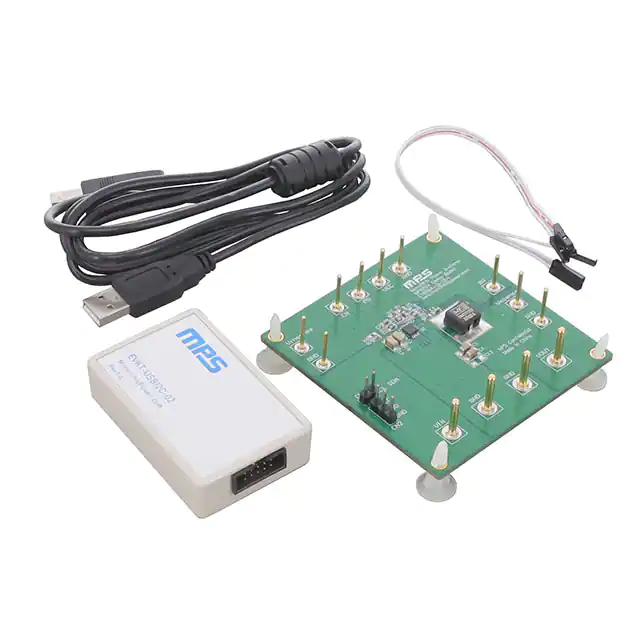
- Part No.:
- EVKT-8861
- Manufacturer:
- Monolithic Power Systems Inc.
- Package:
- Datasheet:
-
 EVKT-8861.pdf
- Description:
- EVAL BOARD FOR MP8861
- Quantity:
- Payment:

- Shipping:

Inventory:4,486
Please send an inquiry. Send us your inquiry, and we will respond immediately.
Product details
Overview
EVKT-8861 from Monolithic Power Systems is an evaluation kit for the MP8861 synchronous step-down converter IC, enabling rapid functional validation and I²C-based configuration of output voltage (1V), current limit (6A), slew rate, OVP/OCP modes, and telemetry monitoring. It comprises the EV8861-L-00A evaluation board and EVKT-USBI2C-02 USB-to-I²C interface, supporting input voltages from 2.85V to 18V in industrial power supply and embedded DC/DC design workflows.
For engineers reviewing the EVKT-8861 datasheet, EVKT-8861 pinout, EVKT-8861 application, or EVKT-8861 equivalent, this page delivers verified hardware specifications, GUI software integration details, I²C register control mapping (VSEL, SysCntlreg1, SysCntlreg2), thermal shutdown behavior, and USBXpress driver compatibility guidance for Windows XP–11 environments.
Technical Context
The EVKT-8861 implements a complete digital evaluation platform centered on the MP8861GL - a high-frequency, I²C-programmable buck regulator with integrated MOSFETs, real-time output voltage/current telemetry, and configurable protection thresholds (OVP, OCP, OTP). It operates across 2.85V–18V input and delivers stable 1V/6A output.
Hardware interaction relies on the EVKT-USBI2C-02 interface, which provides PMBus/I²C bridge functionality using Silicon Labs' USBXpress protocol. All register modifications (e.g., soft-stop enable, PG deglitch time, PFM mode selection) are volatile and reset on power cycle - requiring reconfiguration after each startup.
Key Specifications
| Parameter | Value and Actual Design Meaning |
|---|---|
| Kit Composition | EV8861-L-00A eval board + EVKT-USBI2C-02 USB-to-I²C interface + USB cable + ribbon cable |
| Input Voltage Range | 2.85V–18V - supports wide-input industrial and automotive auxiliary rails |
| Output Voltage | 1V fixed - configured via VSEL register; matches core voltage requirements of modern SoCs/FPGAs |
| Max Continuous Output | 6A - validated at full load with thermal management per EV8861-L-00A layout |
| I²C Register Access | VSEL, SysCntlreg1, SysCntlreg2 - enables runtime adjustment of OCP, slew rate, and work mode without hardware change |
| Evaluation Board Size | 8.5 cm × 8.5 cm - compact form factor for benchtop prototyping and lab integration |
| Software Interface | MPS I²C GUI (Windows XP–11, .NET 4.0, ≥22.2 MB free space) - provides real-time register read/write and telemetry display |
Availability
EVKT-8861 is available at Aetrix Electronics and suitable for DC/DC converter evaluation, power management IC qualification, and embedded system bring-up requiring stable component supply, repeatable test setup, and traceable firmware/software toolchain support.
Supply support for EVKT-8861 includes scheduled delivery planning, volume procurement assistance, BOM continuity management, traceable sourcing, and lifecycle availability coordination for OEM customers, industrial embedded developers, connected-device designers, and electronics production programs.
Manufacturer
Monolithic Power Systems (MPS) is a fabless semiconductor company specializing in high-performance power management ICs, including DC/DC converters, LED drivers, and motor drivers, with global design and support infrastructure.
The EVKT-8861 belongs to MPS's digital power evaluation platform family, designed specifically to accelerate adoption of I²C/PMBus-configurable buck regulators like the MP8861 in space-constrained, thermally demanding applications.
FAQ
Does EVKT-8861 retain I²C configuration after power cycling?
No. All I²C register settings - including output voltage, current limit, and protection thresholds - are volatile and reset to factory defaults upon power-down. Users must reapply configurations via the MPS I²C GUI at each startup to maintain custom operation.
Which USB-to-I²C interface is required for EVKT-8861?
The EVKT-8861 requires the EVKT-USBI2C-02 interface, which uses Silicon Labs' USBXpress driver. EVKT-USBI2C-01 (CyUSB3-based) is incompatible and will not establish communication with the MP8861 evaluation board.
What operating systems support the MPS I²C GUI software?
The official MPS I²C GUI supports Windows XP, Windows 7, Windows 8, Windows 10, and Windows 11. It requires Microsoft .NET Framework 4.0 or later and at least 22.2 MB of free disk space for installation.
How is output current monitored on EVKT-8861?
Output current is measured internally by the MP8861 and reported via I²C telemetry registers. The MPS I²C GUI reads and displays real-time current values - no external shunt or probe is needed - enabling dynamic load profiling during evaluation.
What happens if input voltage drops below 2.85V during operation?
The MP8861 activates its under-voltage lockout (UVLO) circuit: operation halts immediately when AVIN falls below the UVLO falling threshold (~2.7V typical), and the device enters no-supply state until input rises above the UVLO rising threshold (~2.85V).
Can EVKT-8861 be used to evaluate other MP88xx devices?
No. The EV8861-L-00A board is specifically laid out for the MP8861GL package and pinout. While the EVKT-USBI2C-02 interface is reusable, the evaluation board itself is not compatible with other MP88xx variants due to differences in register maps, protection thresholds, and internal architecture.
EVKT-8861 Specifications
- Product attributes
- Attribute value
- Manufacturer:
- Monolithic Power Systems Inc.
- Series:
- -
- Packaging:
- Box
- Product Status:
- Active
- Main Purpose:
- DC/DC, Step Down
- Outputs and Type:
- 1 Non-Isolated Output
- Voltage - Output:
- -
- Current - Output:
- 1V
- Voltage - Input:
- 6A
- Regulator Topology:
- 2.85V ~ 18V
- Frequency - Switching:
- Buck
- Contents:
- -
- Utilized IC / Part:
- Board(s), Cable(s), Accessories
- Power - Output:
- MP8861
EVKT-8861 FAQ
1.How can I place an order for EVKT-8861 through Aetrix?
Please submit a Request for Quotation (RFQ) for EVKT-8861 on Aetrix. Our sales agent will provide a competitive quotation and guide you through the order confirmation once you accept the terms.
2.Are the price and stock information for EVKT-8861 reliable?
The price and inventory of EVKT-8861 are updated periodically and may fluctuate due to market conditions. Stock and pricing data are typically refreshed every 24 hours. Quotation validity for EVKT-8861 is usually 5 days.
3.What payment methods are accepted for EVKT-8861?
We accept Wire Transfer, PayPal, Credit Card, Western Union, MoneyGram, and Escrow for EVKT-8861 transactions.
Note: Certain payment methods may incur a processing fee.
4.How is shipping managed for EVKT-8861?
EVKT-8861 orders can be shipped via leading logistics carriers, including DHL, UPS, FedEx, TNT, or Registered Mail.
Once your EVKT-8861 order is processed, you will receive an email with the shipment details and tracking number.
Note: Tracking information may take up to 24 hours to appear. Express delivery typically takes 3–5 business days.
5.How can I obtain technical support or documentation for EVKT-8861?
For technical support, including EVKT-8861 datasheets, pinout diagrams, or application guidance, please contact our engineering support team. They can provide detailed documentation and assistance for your EVKT-8861 requirements.
6.How does Aetrix verify that EVKT-8861 is sourced from the original manufacturer or authorized distributors?
All EVKT-8861 products on Aetrix are procured from qualified distributors and authorized channels. Our dedicated quality assurance team conducts strict verification, including traceability checks and, if necessary, third-party testing. This ensures that EVKT-8861 meets industry standards.
7.What is the process for return or replacement of EVKT-8861?
All EVKT-8861 units undergo pre-shipment inspection (PSI). If there is an issue with EVKT-8861, returns or replacements are accepted under the following conditions:
1.Quantity discrepancies, incorrect items, or visible external defects (such as breakage or corrosion), acknowledged by Aetrix.
2.The issue is reported within 90 days of delivery.
3.The EVKT-8861 part is unused and in its original packaging.
Return procedure for EVKT-8861:
1.Submit a request within 90 days.
2.Obtain a Return Material Authorization (RMA) from Aetrix.
EVKT-8861 Tags
-
DFR0571
DFRobot
-
DFR0379
DFRobot
-
DFR0205
DFRobot

-
1385
Adafruit Industries LLC
-
COM-15208
SparkFun Electronics
-
1944
Adafruit Industries LLC
-
2465
Adafruit Industries LLC
-
DC2468A
Analog Devices Inc.
-
DC2841A
Analog Devices Inc.

-
TPS552892EVM-111
Texas Instruments
-
TPS55289EVM-093
Texas Instruments
-
EPC9158
EPC
Tech Hub

Operational amplifier guide covering op amp basics, feedback, ideal vs real op amps, common configurations, buffer circuits, offset, bias current, gain-bandwidth, slew rate, rail-to-rail limits and sel…

Jumper cables guide covering safe connection order, red and black clamp placement, final ground connection, cable gauge, length, clamp quality, copper vs CCA cables, jump starter comparison and battery…

LDO regulator guide covering low dropout voltage, power dissipation, thermal design, PSRR, output noise, capacitor stability, adjustable LDO circuits, LDO vs buck converter and datasheet selection chec…

Conditional Access Module guide covering CAM meaning, CI/CI+ interface, smart card authorization, DVB security workflow, TV and set-top box compatibility, internal electronics, ESD protection, connecto…

Guide to electronic component obsolescence covering EOL risk, PCN/PDN notices, last-time buy planning, replacement options, form-fit-function validation, counterfeit risk and BOM lifecycle management.

18650 battery guide covering lithium-ion cell basics, 3.6V/3.7V voltage, 4.2V charging, mAh and Wh capacity, protected cells, chargers, BMS, series-parallel packs, holders, welding and sourcing checks.…

Hall effect sensor guide covering working principle, linear and digital sensors, Arduino circuits, current sensing, speed detection, automotive applications, A3144 examples, signal filtering and datash…

Product Change Notification guide for electronic components, covering PCN meaning, PCN vs PDN/EOL, common change types, risk levels, form-fit-function review, engineering validation, BOM control, LTB/L…

A practical guide to blend door actuators, covering HVAC function, symptoms, location, AC and heater issues, reset and calibration, replacement cost, electrical diagnosis, compatibility checks, and rep…

Engineering guide to Raspberry Pi alternatives, covering chip-level differences, Orange Pi, ROCK, Jetson, Banana Pi, NanoPi, Compute Module, Pico, GPIO, camera, HAT compatibility, and replacement risks…


