
 My Inquiry
 My Account


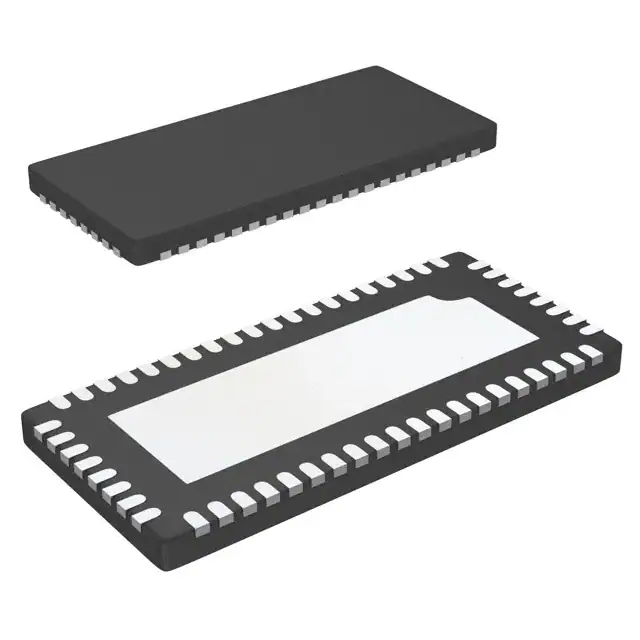
Texas Instruments FPC402RHUR
- Part No.:
- FPC402RHUR
- Manufacturer:
- Texas Instruments
- Category:
- Specialized
- Package:
- 56-WFQFN Exposed Pad
- Datasheet:
-
 FPC402RHUR.pdf
- Description:
- IC INTERFACE SPECIALIZED 56WQFN
- Quantity:
- Payment:

- Shipping:

Inventory:1,046
Please send an inquiry. Send us your inquiry, and we will respond immediately.
Product details
Overview
FPC402RHUR from Texas Instruments is a quad-port low-speed signal aggregator IC designed for optical module management in high-density networking hardware. It consolidates I²C, status inputs (IN_A/B/C), and control outputs (OUT_A/B/C/D) across four SFP/QSFP/OSFP ports into a single host interface, supports up to 1 MHz I²C or 10 MHz SPI host communication, operates with dual supplies (VDD1 = 3.3 V, VDD2 = 1.8–3.3 V), and delivers programmable LED blinking/dimming via dedicated OUT_C/OUT_D drivers.
For engineers reviewing the FPC402RHUR datasheet, FPC402RHUR pinout, FPC402RHUR application, or FPC402RHUR equivalent, this device addresses port-count scalability, PCB routing reduction under press-fit connectors, elimination of discrete I²C muxes and FPGA-based control logic, and synchronized LED status indication across multi-controller systems - all critical in ToR switch, baseband unit, and storage rack designs.
Technical Context
The FPC402RHUR implements a dual-voltage architecture: VDD1 powers internal logic and port-side I²C masters (MOD_SCL/SDA), while VDD2 independently supplies host-side CTRL[4:1] pins - enabling interoperability with 1.8 V, 2.5 V, or 3.3 V host controllers. Its PROTOCOL_SEL pin selects between I²C (up to 1 MHz Fast-mode Plus) and SPI (up to 10 MHz) host interfaces, with dedicated open-drain MOD_SCL/SDA outputs per port supporting SFF-8431/8436/8449 compliance.
Each of the four ports features four bidirectional low-speed control/status channels: IN_A/B/C for module presence, fault, and loss-of-signal detection; OUT_A/B for Tx_Disable/ResetL and LPMode control; and OUT_C/D for active-low LED driving with built-in dimming and blink timing. The device supports broadcast writes across cascaded FPC402RHUR units and automatic prefetching of user-defined module registers to minimize host polling overhead.
Key Specifications
| Parameter | Value and Actual Design Meaning |
|---|---|
| Host Interface | I²C up to 1 MHz (Fast-mode Plus) or SPI up to 10 MHz - selectable via PROTOCOL_SEL pin strap |
| Port Count | 4 independent optical module ports (SFP, QSFP, QSFP-DD, OSFP, Mini-SAS HD) |
| Supply Voltages | VDD1 = 3.3 V ±5%; VDD2 = 1.8 V to 3.3 V ±5% - enables mixed-voltage host interfacing |
| LED Control Outputs | OUT_C[3:0] and OUT_D[3:0] - programmable blink/dim, active-low, 18 mA sink capability per pin |
| Input De-glitch Filter | tSP-LS = 30–50 µs on all IN_* pins - suppresses noise on hot-plug status signals |
| Power-On Reset | TPOR = 30–60 ms - ensures stable initialization before port-side or host-side I²C/SPI operation |
| Thermal Resistance | RθJA = 30.1 °C/W (WQFN-56) - supports operation at TJ ≤ 125 °C in 85 °C ambient |
Pinout & Package
The FPC402RHUR is housed in a 56-pin WQFN package (RHU) measuring 5.00 mm × 11.00 mm, optimized for bottom-side PCB placement beneath press-fit optical connectors to minimize trace length and layer congestion.
| Pin/Terminal | Circuit Role | Design Meaning |
|---|---|---|
| MOD_SCL[0–3] | Port-side I²C clock output | Open-drain, 3.3-V tolerant, drives SFP/QSFP module clocks; requires external 2–5 kΩ pull-up |
| MOD_SDA[0–3] | Port-side I²C data I/O | Open-drain, 3.3-V tolerant, bidirectional module data line; requires external 2–5 kΩ pull-up |
| IN_A[0–3] | Port status input A | Weak-pullup inputs for Mod_ABS or ModPrsL - detects module insertion/removal |
| OUT_C[0–3] | LED green-status output | Active-low, programmable blink/dim, default-enabled at power-up; requires ≥33 Ω series resistor |
| OUT_D[0–3] | LED yellow-status output | Active-low, programmable blink/dim, default-enabled at power-up; requires ≥33 Ω series resistor |
| CTRL1–CTRL4 | Host interface pins | Configurable as I²C (SCL/SDA/SET_ADDR_N/ADDR_DONE_N) or SPI (SCK/SS_N/MOSI/MISO) |
| PROTOCOL_SEL | Interface mode select | Float/High = I²C; GND = SPI - determines CTRL[4:1] function mapping and timing behavior |
| HOST_INT_N | Open-drain interrupt output | Active-low, 3.3-V tolerant, wired-OR capable across multiple FPC402RHUR units for system-wide event notification |
Key Features
| Feature | Design Value |
|---|---|
| Quad-port I²C aggregation | Replaces discrete I²C muxes and reduces host I/O count by consolidating four independent port interfaces into one host bus |
| Programmable LED control | OUT_C/OUT_D support configurable blink rate, duty cycle, and dimming - eliminates need for external LED drivers |
| Broadcast write capability | Simultaneous register writes across all ports and all cascaded FPC402RHUR devices - simplifies firmware synchronization |
| Automatic data prefetch | Preloads user-specified module registers (e.g., DOM temperature, TX bias) into local cache - reduces host polling latency and bandwidth demand |
| Dual-supply I/O flexibility | VDD2 independence allows direct interfacing with 1.8 V microcontrollers or FPGAs without level shifters |
Applications
| Optical Switch Port Management | Wireless Baseband Unit (BBU) |
|---|---|
Use Scenario: Managing 32+ SFP+/QSFP28 ports in a top-of-rack Ethernet switch with space-constrained front-panel layout. IC Role / Device Role / Timing Role: Aggregates low-speed control (Tx_Disable, ModPrsL, Rx_LOS) and I²C management traffic from four ports per FPC402RHUR, presenting unified SPI interface to switch ASIC. Use Value: Enables bottom-side PCB placement under connectors, cuts routing layers by >40%, and eliminates need for 8+ discrete I²C buffers per 32-port design. |
Use Scenario: Controlling modular RRH/FRH optical links in 5G massive MIMO base stations with thermal and density constraints. IC Role / Device Role / Timing Role: Monitors hot-plug status (IN_A/B/C) and drives per-port green/yellow LEDs (OUT_C/D) for link health, while prefetching DOM data for real-time RF calibration. Use Value: Reduces FPGA I/O usage by 64 pins per 4-port group and supports deterministic <60 ms power-on readiness (TPOR) for rapid cell bring-up. |
| Storage Rack Module Control | Video Routing Infrastructure |
Use Scenario: Managing hot-swappable NVMe SSD trays and SAS expanders in enterprise storage enclosures with 48+ Mini-SAS HD ports. IC Role / Device Role / Timing Role: Interfaces to SFF-8485-compliant modules via MOD_SCL/SDA, reads temperature/voltage telemetry, and asserts OUT_A[3:0] to enable/disable drive power sequencing. Use Value: Eliminates requirement for CPLD-based control logic; supports broadcast reset of all trays via single SPI command. |
Use Scenario: Controlling multi-format video transceivers (SDI over SFP, HDMI over QSFP-DD) in broadcast production switchers requiring precise LED status feedback. IC Role / Device Role / Timing Role: Drives dual-color status LEDs (OUT_C = link OK, OUT_D = error/warning) with synchronized blink patterns across 16+ ports using SPI_LED_SYNC. Use Value: Provides deterministic LED timing (±5% accuracy) without host CPU intervention - critical for live production visual cues. |
Equivalent & Alternatives
The following parts are listed as comparable options for similar quad-port optical module control applications.
| Alternative Part | Technical Difference | Application Difference | Selection Advice |
|---|---|---|---|
| FPC401RHUR | Supports only MSA-defined I²C addresses (0xA0, 0xA2); lacks broadcast write, prefetch, and SPI interface | Limited to basic SFP/QSFP presence/fault monitoring without advanced LED or register caching | Select when cost sensitivity outweighs feature requirements and port count ≤ 4 with fixed addressing |
| MAX5980GTJ+ | Hot-swap controller with integrated power MOSFET drivers; no I²C aggregation or LED control | Focused on power sequencing/supervision for pluggable modules, not signal aggregation or status indication | Choose when primary need is 12 V/3.3 V rail control and fault protection - not low-speed signal consolidation |
Compared with FPC401RHUR, the FPC402RHUR adds SPI support, broadcast capability, and data prefetch - enabling scalable multi-controller systems. Against MAX5980GTJ+, it trades power control for comprehensive signal aggregation and LED management, making it unsuitable for rail supervision but optimal for status/control consolidation.
Availability
FPC402RHUR is available at Aetrix Electronics and suitable for ToR switch, wireless infrastructure BBU, and storage rack applications requiring stable component supply, long-term lifecycle support, and guaranteed traceable sourcing for industrial-grade deployments.
Supply support for FPC402RHUR includes scheduled delivery planning, volume procurement assistance, BOM continuity management, traceable sourcing, and lifecycle availability coordination for OEM customers, industrial embedded developers, connected-device designers, and electronics production programs.
Manufacturer
Texas Instruments is a global semiconductor leader specializing in analog, embedded processing, and connectivity solutions, with decades of expertise in high-reliability communications ICs.
The FPC402RHUR belongs to TI's optical module interface product line, engineered specifically to reduce system complexity in high-port-count networking equipment by replacing FPGA-based glue logic with integrated, standards-compliant port control.
FAQ
What host interface protocols does the FPC402RHUR support?
The FPC402RHUR supports two mutually exclusive host-side protocols selected by the PROTOCOL_SEL pin: I²C up to 1 MHz (Fast-mode Plus compliant) or SPI up to 10 MHz. In I²C mode, CTRL1–CTRL4 function as SCL, SDA, SET_ADDR_N, and ADDR_DONE_N; in SPI mode, they become SCK, SS_N, MOSI, and MISO. The FPC402RHUR does not support concurrent or auto-sensing operation between the two interfaces.
How does the FPC402RHUR handle LED control for optical modules?
The FPC402RHUR provides dedicated active-low LED drivers on OUT_C[3:0] and OUT_D[3:0], each capable of sinking up to 18 mA. These outputs support programmable blink frequency (0.1–10 Hz), duty cycle (10–90%), and dimming (8-level current control). The FPC402RHUR uses internal timers - no host CPU involvement is required once configured - and supports synchronized blinking across multiple FPC402RHUR units via SPI_LED_SYNC in SPI mode.
Can multiple FPC402RHUR devices be cascaded, and how is communication managed?
Yes, up to 14 FPC402RHUR devices can be cascaded to manage 56 ports total. They share a common host interface (I²C or SPI) using individual I²C addresses or daisy-chained SPI. Broadcast writes - enabled via register bit - allow simultaneous configuration of identical registers across all devices. Interrupts (HOST_INT_N) can be wired-OR'd to a single host line, with source identification handled through device-specific status registers in the FPC402RHUR.
What is the role of the CAPL pin on the FPC402RHUR?
The CAPL pin on the FPC402RHUR requires connection to a single 2.2-µF capacitor tied to GND. This capacitor stabilizes the internal low-dropout regulator that supplies core logic voltage, ensuring reliable power-on reset (TPOR) behavior and noise immunity during dynamic port activity. Omitting or undersizing the CAPL capacitor may cause intermittent initialization failures or I²C communication dropouts, especially under hot-plug transients.
Does the FPC402RHUR support hot-plug detection and automatic module enumeration?
Yes, the FPC402RHUR natively supports hot-plug detection via its weak-pullup IN_A[3:0] inputs (ModPrsL/Mod_ABS), which trigger configurable interrupts on module insertion/removal. It does not perform autonomous enumeration; instead, it provides ready-access registers indicating port presence, fault state, and LOS condition. Host firmware uses these flags to initiate I²C reads of module EEPROM (via MOD_SDA/SCL), with optional prefetch acceleration for frequently accessed DOM registers.
FPC402RHUR Specifications
- Product attributes
- Attribute value
- Manufacturer:
- Texas Instruments
- Series:
- -
- Package/Case:
- 56-WFQFN Exposed Pad
- Packaging:
- Tape & Reel (TR)
- Product Status:
- Active
- Applications:
- -
- Interface:
- I2C
- Voltage - Supply:
- 1.8V ~ 3.3V
- Supplier Device Package:
- 56-WQFN (5x11)
- Grade:
- -
- Qualification:
- -
- Mounting Type:
- Surface Mount
FPC402RHUR FAQ
1.How can I place an order for FPC402RHUR through Aetrix?
Please submit a Request for Quotation (RFQ) for FPC402RHUR on Aetrix. Our sales agent will provide a competitive quotation and guide you through the order confirmation once you accept the terms.
2.Are the price and stock information for FPC402RHUR reliable?
The price and inventory of FPC402RHUR are updated periodically and may fluctuate due to market conditions. Stock and pricing data are typically refreshed every 24 hours. Quotation validity for FPC402RHUR is usually 5 days.
3.What payment methods are accepted for FPC402RHUR?
We accept Wire Transfer, PayPal, Credit Card, Western Union, MoneyGram, and Escrow for FPC402RHUR transactions.
Note: Certain payment methods may incur a processing fee.
4.How is shipping managed for FPC402RHUR?
FPC402RHUR orders can be shipped via leading logistics carriers, including DHL, UPS, FedEx, TNT, or Registered Mail.
Once your FPC402RHUR order is processed, you will receive an email with the shipment details and tracking number.
Note: Tracking information may take up to 24 hours to appear. Express delivery typically takes 3–5 business days.
5.How can I obtain technical support or documentation for FPC402RHUR?
For technical support, including FPC402RHUR datasheets, pinout diagrams, or application guidance, please contact our engineering support team. They can provide detailed documentation and assistance for your FPC402RHUR requirements.
6.How does Aetrix verify that FPC402RHUR is sourced from the original manufacturer or authorized distributors?
All FPC402RHUR products on Aetrix are procured from qualified distributors and authorized channels. Our dedicated quality assurance team conducts strict verification, including traceability checks and, if necessary, third-party testing. This ensures that FPC402RHUR meets industry standards.
7.What is the process for return or replacement of FPC402RHUR?
All FPC402RHUR units undergo pre-shipment inspection (PSI). If there is an issue with FPC402RHUR, returns or replacements are accepted under the following conditions:
1.Quantity discrepancies, incorrect items, or visible external defects (such as breakage or corrosion), acknowledged by Aetrix.
2.The issue is reported within 90 days of delivery.
3.The FPC402RHUR part is unused and in its original packaging.
Return procedure for FPC402RHUR:
1.Submit a request within 90 days.
2.Obtain a Return Material Authorization (RMA) from Aetrix.
FPC402RHUR Tags
-
NVT4857UKAZ
NXP Semiconductors
-
TCA8418RTWR
Texas Instruments
-
PCA9546APWR
Texas Instruments
-
MD0100N8-G
Microchip Technology
-
PCA9548APW,118
NXP Semiconductors
-
PCA9540BDP,118
NXP Semiconductors
-
PCA9548APWR
Texas Instruments
-
PCA9546APW,118
NXP Semiconductors
-
PTN3360DBS,518
NXP Semiconductors
-
PCA9546ABS,118
NXP Semiconductors
-
PCA9518PWR
Texas Instruments
-
PCA9545APW,118
NXP Semiconductors
Tech Hub

A practical engineering guide to 3.3V and 5V logic compatibility, input thresholds, resistor dividers, translator ICs, MOSFET level shifting, I2C pull-ups, timing limits and power-sequencing risks.

The 74HC595 uses push-pull logic outputs, while the TPIC6B595 uses 50 V open-drain DMOS sinks for higher-power loads. This guide compares timing, current limits, 3.3 V interfacing, load wiring, thermal…

The 74HC595 converts serial data into eight stable parallel outputs. This guide covers pin functions, shift and storage timing, OE and MR behavior, drive-current limits, cascading, voltage compatibilit…

A technical comparison of level-sensitive latches and edge-triggered flip-flops, covering timing windows, setup and hold limits, master–slave operation, time borrowing, race-through, HDL inference and…

A D latch stores one bit while Enable controls when data can pass. This reference covers gate-level operation, truth tables, transparency, setup and hold timing, LE versus OE, common ICs and practical …

An SR latch stores one bit through cross-coupled feedback. This engineering reference covers NOR and NAND implementations, truth tables, forbidden-state recovery, gated operation, switch debouncing, fa…

Latch circuits retain one bit through feedback. This technical reference covers SR and D latches, truth tables, transparency, timing limits, latch-versus-flip-flop behavior, applications and common log…

An engineering guide to LED driver operation, constant-current and constant-voltage outputs, linear and switching topologies, dimming, IC selection, calculations, replacement compatibility, and fault c…

Operational amplifier guide covering op amp basics, feedback, ideal vs real op amps, common configurations, buffer circuits, offset, bias current, gain-bandwidth, slew rate, rail-to-rail limits and sel…

Jumper cables guide covering safe connection order, red and black clamp placement, final ground connection, cable gauge, length, clamp quality, copper vs CCA cables, jump starter comparison and battery…


