
 My Inquiry
 My Account


Renesas HZ3B3-E
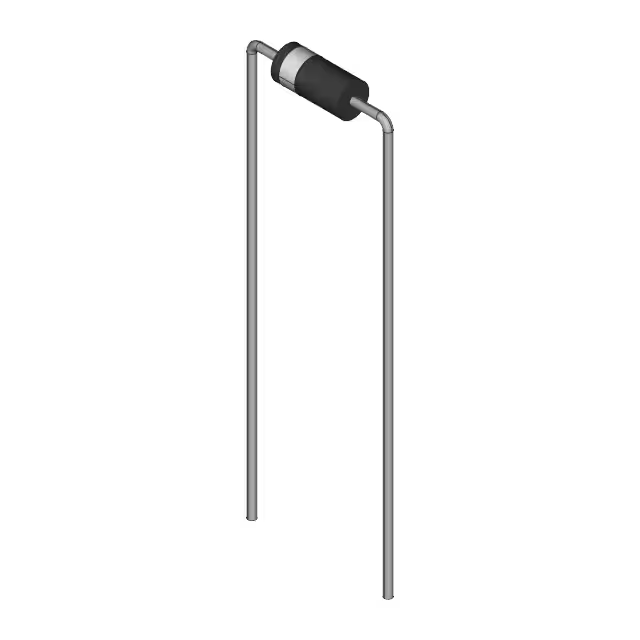
- Part No.:
- HZ3B3-E
- Manufacturer:
- Renesas
- Category:
- Single Zener Diodes
- Package:
- -
- Datasheet:
-
 HZ3B3-E.pdf
- Description:
- DIODE ZENER 0.5W
- Quantity:
- Payment:

- Shipping:

Inventory:18,630
Please send an inquiry. Send us your inquiry, and we will respond immediately.
Product details
Overview
HZ3B3-E from Renesas is a silicon planar Zener diode designed for precision voltage regulation in low-power stabilized DC supplies, featuring a nominal zener voltage of 3.3 V ±0.2 V at 5 mA, 500 mW power dissipation, and low dynamic impedance of 100 Ω - deployed in industrial sensor biasing and microcontroller reference circuits.
For engineers reviewing the HZ3B3-E datasheet, HZ3B3-E pinout, HZ3B3-E application, or HZ3B3-E equivalent, key selection criteria include verified zener voltage tolerance (±0.2 V), DO-35 package thermal derating above 25°C, reverse leakage under 0.5 µA at 1 V, and compatibility with low-current shunt regulator topologies requiring stable 3.3 V references.
Technical Context
The HZ3B3-E operates as a two-terminal shunt voltage regulator, conducting in reverse breakdown to clamp voltage across load terminals. Its planar junction construction ensures repeatable zener characteristics and low temperature coefficient (−0.04 %/°C typical at 3.3 V).
It is rated for continuous operation up to 175°C junction temperature and exhibits stable regulation under DC test conditions per JEITA standard GRZZ0002ZB-A. Dynamic resistance remains ≤100 Ω at IZ = 5 mA, enabling effective ripple suppression in low-noise analog subsystems.
Key Specifications
| Parameter | Value and Actual Design Meaning |
|---|---|
| Zener Voltage (VZ) | 3.1 V to 3.5 V at IZ = 5 mA - defines precise clamping range for 3.3 V rail stabilization |
| Power Dissipation (Pd) | 500 mW at Ta = 25°C - sets maximum continuous shunt current limit (~151 mA at 3.3 V) |
| Dynamic Resistance (rd) | ≤100 Ω at IZ = 5 mA - determines output impedance and AC ripple rejection capability |
| Reverse Leakage (IR) | ≤0.5 µA at VR = 1 V - ensures minimal quiescent current draw in standby mode |
| Junction Temperature (Tj) | −55°C to +175°C - supports operation in extended-temperature industrial environments |
| Package | DO-35 (JEITA GRZZ0002ZB-A) - standard axial-leaded glass package with navy-blue cathode band |
Pinout & Package
DO-35 glass axial package with cathode identified by navy-blue band; total mass 0.13 g, body diameter 2.0 mm max, lead spacing 4.2 mm, length 26.0 mm.
| Pin/Terminal | Circuit Role | Design Meaning |
|---|---|---|
| 1 (banded end) | Cathode | Connected to regulated voltage node; reverse-biased terminal during regulation |
| 2 (non-banded end) | Anode | Connected to circuit ground or common return path; completes shunt current loop |
Key Features
| Feature | Design Value |
|---|---|
| Low zener impedance | ≤100 Ω enables <10 mV ripple attenuation at 10 kHz in shunt regulator designs |
| Wide zener voltage spectrum | Part of HZ Series covering 1.6 V–38 V - allows single-supplier sourcing across multiple voltage rails |
| Stable temperature coefficient | −0.04 %/°C typical at 3.3 V - minimizes drift over −40°C to +85°C ambient range |
| Low leakage current | ≤0.5 µA at 1 V reverse bias - preserves battery life in always-on sensor nodes |
Applications
| Industrial Sensor Signal Conditioning | Microcontroller Reference Voltage |
|---|---|
Use Scenario: Biasing bridge sensors and op-amp input stages in factory-floor pressure transmitters. IC Role / Device Role / Timing Role: Shunt voltage reference providing stable 3.3 V excitation and ADC reference. Use Value: Maintains <±0.5% full-scale accuracy over temperature due to low rd and predictable γZ. | Use Scenario: Supplying clean reference voltage to 10-bit SAR ADCs in programmable logic controllers. IC Role / Device Role / Timing Role: Precision voltage clamp replacing higher-cost bandgap references where 1% tolerance suffices. Use Value: Enables 3.3 V ADC full-scale resolution without external filtering, reducing BOM count by one IC. |
| Low-Power IoT Node Regulation | Legacy RS-232 Interface Clamping |
Use Scenario: Regulating coin-cell-powered environmental monitors operating intermittently for >5 years. IC Role / Device Role / Timing Role: Low-leakage shunt regulator maintaining 3.3 V for MCU sleep/wake cycles. Use Value: Draws only 0.5 µA standby current - extends battery life beyond 60 months at 10 µA average load. | Use Scenario: Protecting UART level-shifters from ESD-induced overvoltage on legacy industrial serial ports. IC Role / Device Role / Timing Role: Fast-acting voltage clamp limiting RS-232 line swing to ±3.3 V. Use Value: Responds within nanoseconds to transient spikes while surviving repeated 15 kV HBM events per JEDEC JESD22-A114. |
Equivalent & Alternatives
The following parts are listed as comparable options for similar Zener diode voltage regulation applications.
| Alternative Part | Technical Difference | Application Difference | Selection Advice |
|---|---|---|---|
| 1N4728A | Zener voltage 3.3 V ±5%, Pd = 1 W, DO-41 package, rd = 10 Ω | Higher power handling but larger footprint and looser initial tolerance | Select when board space permits larger DO-41 and tighter dynamic impedance is critical |
| BZX55C3V3 | Zener voltage 3.3 V ±5%, Pd = 500 mW, DO-35 package, rd = 90 Ω, IR = 1 µA @ 1 V | Nearly identical form factor but higher leakage and wider VZ tolerance | Choose for cost-sensitive replacements where ±5% regulation is acceptable |
Compared with 1N4728A and BZX55C3V3, the HZ3B3-E delivers tighter initial VZ tolerance (±0.2 V vs. ±5%), lower leakage (0.5 µA vs. ≥1 µA), and guaranteed DO-35 mechanical compatibility - making it optimal for space-constrained, low-drift analog designs where calibration headroom is limited.
Availability
HZ3B3-E is available at Aetrix Electronics and suitable for industrial sensor conditioning, microcontroller reference voltage generation, and low-power IoT node regulation requiring stable component supply across multi-year production cycles.
Supply support for HZ3B3-E includes scheduled delivery planning, volume procurement assistance, BOM continuity management, traceable sourcing, and lifecycle availability coordination for OEM customers, industrial embedded developers, connected-device designers, and electronics production programs.
Manufacturer
Renesas Technology Corp. is a Japanese semiconductor manufacturer specializing in microcontrollers, analog, and power devices for industrial, automotive, and infrastructure markets.
The HZ Series was developed specifically for high-reliability, low-drift shunt regulation in space-constrained industrial power supplies - emphasizing tight VZ grading, low rd, and robust thermal performance in DO-35 packaging.
FAQ
What is the exact zener voltage range specified for HZ3B3-E at 5 mA test current?
The HZ3B3-E has a guaranteed zener voltage range of 3.1 V to 3.5 V when tested at IZ = 5 mA and Ta = 25°C. This ±0.2 V tolerance reflects Grade B3 specification per Renesas REJ03G0180-0600 Rev.6.00, distinguishing it from broader-tolerance variants like HZ3C3 (±0.3 V) or HZ3A3 (±0.1 V). The HZ3B3-E achieves this via post-process binning and is documented on page 2 of the official datasheet.
Does HZ3B3-E support operation above 85°C ambient temperature?
Yes, the HZ3B3-E is rated for storage from −55°C to +175°C and junction operation up to 175°C. Its DO-35 package allows reliable function at 105°C ambient when derated per Figure 3 in the datasheet - delivering ~350 mW at 105°C. Designers must calculate power dissipation (VZ × IZ) and ensure heatsinking or airflow prevents Tj exceedance. The HZ3B3-E's thermal design enables use in sealed industrial enclosures without active cooling.
What is the dynamic resistance value of HZ3B3-E and why does it matter in regulation circuits?
The HZ3B3-E has a maximum dynamic resistance (rd) of 100 Ω at IZ = 5 mA and 25°C. This parameter directly determines how much output voltage changes with load current variation - e.g., a 1 mA change in shunt current causes ≤100 mV shift in regulated voltage. In precision analog front-ends, low rd ensures stable reference voltage despite varying sensor bias currents. The HZ3B3-E's rd is confirmed in Table "Electrical Characteristics" on page 2 of the Renesas datasheet.
Can HZ3B3-E be used as a direct replacement for BZX55C3V3 in existing DO-35 layouts?
Yes, the HZ3B3-E shares identical DO-35 mechanical dimensions, pinout, and cathode band orientation with BZX55C3V3, enabling drop-in replacement without PCB modification. However, its tighter VZ tolerance (±0.2 V vs. ±5%) and lower leakage (0.5 µA vs. 1 µA) may improve system accuracy and battery life. Verify that the improved specs align with your design margins - the HZ3B3-E performs identically in layout but exceeds BZX55C3V3 in precision-critical roles.
Is HZ3B3-E compliant with RoHS and lead-free soldering requirements?
Yes, the HZ3B3-E meets RoHS Directive 2011/65/EU and is compatible with lead-free reflow profiles (JEDEC J-STD-020). Renesas confirms halogen-free and lead-free construction in the "Environmental Data" section of the HZ Series product brief (REJ03G0180-0600). The DO-35 glass package contains no restricted substances above threshold limits, and the HZ3B3-E withstands peak reflow temperatures up to 260°C for 10 seconds - consistent with standard Pb-free assembly processes.
HZ3B3-E Specifications
- Product attributes
- Attribute value
- Manufacturer:
- Renesas
- Series:
- *
- Package/Case:
- -
- Packaging:
- Bulk
- Product Status:
- Active
- Voltage - Zener (Nom) (Vz):
- -
- Tolerance:
- -
- Power - Max:
- -
- Impedance (Max) (Zzt):
- -
- Current - Reverse Leakage @ Vr:
- -
- Voltage - Forward (Vf) (Max) @ If:
- -
- Operating Temperature:
- -
- Grade:
- -
- Qualification:
- -
- Mounting Type:
- -
- Supplier Device Package:
- -
HZ3B3-E FAQ
1.How can I place an order for HZ3B3-E through Aetrix?
Please submit a Request for Quotation (RFQ) for HZ3B3-E on Aetrix. Our sales agent will provide a competitive quotation and guide you through the order confirmation once you accept the terms.
2.Are the price and stock information for HZ3B3-E reliable?
The price and inventory of HZ3B3-E are updated periodically and may fluctuate due to market conditions. Stock and pricing data are typically refreshed every 24 hours. Quotation validity for HZ3B3-E is usually 5 days.
3.What payment methods are accepted for HZ3B3-E?
We accept Wire Transfer, PayPal, Credit Card, Western Union, MoneyGram, and Escrow for HZ3B3-E transactions.
Note: Certain payment methods may incur a processing fee.
4.How is shipping managed for HZ3B3-E?
HZ3B3-E orders can be shipped via leading logistics carriers, including DHL, UPS, FedEx, TNT, or Registered Mail.
Once your HZ3B3-E order is processed, you will receive an email with the shipment details and tracking number.
Note: Tracking information may take up to 24 hours to appear. Express delivery typically takes 3–5 business days.
5.How can I obtain technical support or documentation for HZ3B3-E?
For technical support, including HZ3B3-E datasheets, pinout diagrams, or application guidance, please contact our engineering support team. They can provide detailed documentation and assistance for your HZ3B3-E requirements.
6.How does Aetrix verify that HZ3B3-E is sourced from the original manufacturer or authorized distributors?
All HZ3B3-E products on Aetrix are procured from qualified distributors and authorized channels. Our dedicated quality assurance team conducts strict verification, including traceability checks and, if necessary, third-party testing. This ensures that HZ3B3-E meets industry standards.
7.What is the process for return or replacement of HZ3B3-E?
All HZ3B3-E units undergo pre-shipment inspection (PSI). If there is an issue with HZ3B3-E, returns or replacements are accepted under the following conditions:
1.Quantity discrepancies, incorrect items, or visible external defects (such as breakage or corrosion), acknowledged by Aetrix.
2.The issue is reported within 90 days of delivery.
3.The HZ3B3-E part is unused and in its original packaging.
Return procedure for HZ3B3-E:
1.Submit a request within 90 days.
2.Obtain a Return Material Authorization (RMA) from Aetrix.
HZ3B3-E Tags
-
MMBZ5240B-7-F
Diodes Incorporated
-
BZT52C5V6T-7
Diodes Incorporated
-
MMSZ5231B-7-F
Diodes Incorporated
-
BZT52C15-7-F
Diodes Incorporated
-
BZX84C3V3LT1G
onsemi
-
MMSZ5245BS-7-F
Diodes Incorporated
-
MMSZ4682T1G
onsemi
-
BZT52C15S-7-F
Diodes Incorporated
-
MM5Z5V1ST1G
onsemi
-
SMAJ4744A-TP
Micro Commercial Co
-
BZT52C3V6LP-7
Diodes Incorporated
-
SMAZ12-13-F
Diodes Incorporated
Tech Hub

TTL and CMOS logic families differ in thresholds, loading, output drive, power and timing. This engineering guide compares 74HC and 74HCT, calculates noise margins and checks 3.3 V/5 V compatibility.

A practical engineering guide to 3.3V and 5V logic compatibility, input thresholds, resistor dividers, translator ICs, MOSFET level shifting, I2C pull-ups, timing limits and power-sequencing risks.

The 74HC595 uses push-pull logic outputs, while the TPIC6B595 uses 50 V open-drain DMOS sinks for higher-power loads. This guide compares timing, current limits, 3.3 V interfacing, load wiring, thermal…

The 74HC595 converts serial data into eight stable parallel outputs. This guide covers pin functions, shift and storage timing, OE and MR behavior, drive-current limits, cascading, voltage compatibilit…

A technical comparison of level-sensitive latches and edge-triggered flip-flops, covering timing windows, setup and hold limits, master–slave operation, time borrowing, race-through, HDL inference and…

A D latch stores one bit while Enable controls when data can pass. This reference covers gate-level operation, truth tables, transparency, setup and hold timing, LE versus OE, common ICs and practical …

An SR latch stores one bit through cross-coupled feedback. This engineering reference covers NOR and NAND implementations, truth tables, forbidden-state recovery, gated operation, switch debouncing, fa…

Latch circuits retain one bit through feedback. This technical reference covers SR and D latches, truth tables, transparency, timing limits, latch-versus-flip-flop behavior, applications and common log…

An engineering guide to LED driver operation, constant-current and constant-voltage outputs, linear and switching topologies, dimming, IC selection, calculations, replacement compatibility, and fault c…

Operational amplifier guide covering op amp basics, feedback, ideal vs real op amps, common configurations, buffer circuits, offset, bias current, gain-bandwidth, slew rate, rail-to-rail limits and sel…


