
 My Inquiry
 My Account


Renesas ISL22444UFV20Z
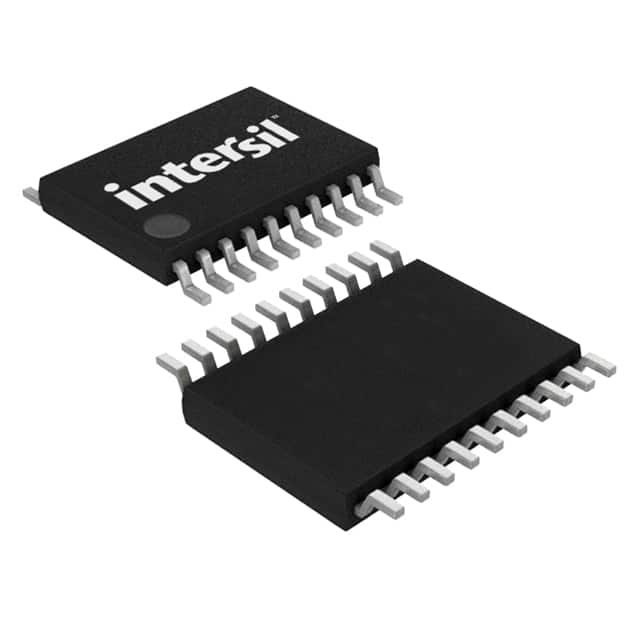
- Part No.:
- ISL22444UFV20Z
- Manufacturer:
- Renesas
- Category:
- Digital Potentiometers
- Package:
- 20-TSSOP (0.173", 4.40mm Width)
- Datasheet:
-
 ISL22444UFV20Z.pdf
- Description:
- IC DGT POT 50KOHM 256TAP 20TSSOP
- Quantity:
- Payment:

- Shipping:

Inventory:4,886
Please send an inquiry. Send us your inquiry, and we will respond immediately.
Product details
Overview
ISL22444UFV20Z from Renesas Electronics (formerly Intersil) is a quad digitally controlled potentiometer (XDCP™) with 256-tap resolution, SPI interface, non-volatile wiper storage, and dual-supply operation (VCC = 2.25–5.5V, V− = −2.25 to −5.5V). It integrates four independent 50kΩ DCPs in a 20-lead TSSOP package and supports voltage divider or rheostat configurations for precision analog control in industrial signal conditioning circuits.
For engineers reviewing the ISL22444UFV20Z datasheet, ISL22444UFV20Z pinout, ISL22444UFV20Z application, or ISL22444UFV20Z equivalent, key selection considerations include its 50kΩ end-to-end resistance, ±45 ppm/°C end-to-end tempco, shutdown mode (<4µA), 70Ω typical wiper resistance, and compatibility with bipolar terminal voltages spanning V− to VCC.
Technical Context
The ISL22444UFV20Z implements four independent resistor arrays using CMOS-switched ladder networks, each controlled by an 8-bit volatile Wiper Register (WRi) and backed by a non-volatile Initial Value Register (IVRi). At power-up, IVRi contents are automatically loaded into WRi, ensuring repeatable startup positions without host intervention.
Its SPI interface operates in Mode 0 (CPOL=0, CPHA=0), supporting daisy-chain configuration and full read/write access to WRi, IVRi, and 11 general-purpose non-volatile registers. The device features make-before-break switching, shutdown mode (RWi shorted to RLi, DCP open-circuited), and dual supply rails enabling true bipolar analog signal routing.
Key Specifications
| Parameter | Value and Actual Design Meaning |
|---|---|
| Total Resistance | 50kΩ - defines maximum end-to-end resistance per DCP; sets gain/attenuation range in voltage divider or current-limiting applications. |
| Wiper Resistance | 70Ω typical @ 1mA - low on-resistance minimizes signal path error and loading effects in precision biasing or feedback networks. |
| End-to-End Tempco | ±45 ppm/°C - ensures stable resistance over −40°C to +125°C; critical for temperature-invariant gain control in instrumentation. |
| Voltage Range | V− to VCC (−5.5V to +5.5V) - enables bipolar signal handling across DCP terminals without external level-shifting circuitry. |
| Shutdown Current | <4µA max - allows ultra-low-power system sleep states while preserving wiper position in non-volatile memory. |
| DNL / INL | ±0.15 / ±0.2 LSB (voltage divider mode) - guarantees monotonicity and high linearity for closed-loop calibration and sensor trimming. |
| EEPROM Endurance | 1,000,000 write cycles - supports frequent field recalibration or adaptive tuning without register wear-out concerns. |
Pinout & Package
ISL22444UFV20Z is housed in a 20-lead TSSOP (M20.173) package with exposed pad connected to V−. Pin functions are electrically identical to the QFN variant but mapped to different physical locations per datasheet Page 3.
| Pin | Circuit Role | Design Meaning |
|---|---|---|
| RH0–RH3 | High terminal of DCP0–DCP3 | Fixed "top" node of each potentiometer array; referenced to VCC in unipolar use or V−/VCC in bipolar configurations. |
| RL0–RL3 | Low terminal of DCP0–DCP3 | Fixed "bottom" node; tied to GND or V− depending on supply topology; defines reference point for wiper voltage/resistance. |
| RW0–RW3 | Wiper terminal of DCP0–DCP3 | Programmable tap output; connects to feedback nodes, bias points, or sensor interfaces requiring dynamic resistance adjustment. |
| SCK, SDI, SDO, CS | SPI serial interface signals | Enable microcontroller-based digital control; support daisy-chaining up to multiple devices on single bus with no additional chip selects. |
| VCC, V−, GND | Power supply pins | VCC (2.25–5.5V) and V− (−2.25 to −5.5V) provide dual-rail operation; GND serves as digital reference only - not analog ground return. |
Key Features
| Feature | Design Value |
|---|---|
| Quad 256-tap DCPs | Four independent digitally adjustable resistors in one IC reduce board space and BOM count versus discrete trimmers or multiple single-channel DCPs. |
| Non-volatile IVR storage | Each DCP retains its power-up wiper position in EEPROM; eliminates boot-time host initialization and ensures deterministic startup behavior. |
| Dual-supply operation | V− rail enables true bipolar analog signal routing (e.g., ±2.5V input to op-amp), avoiding clipping or DC offset errors in AC-coupled systems. |
| 11 GP non-volatile registers | Store calibration coefficients, lookup tables, or device-specific settings; survive power cycles and enable self-contained adaptive functionality. |
| Shutdown mode | Hardware-controlled disable (via ACR[6]) forces RWi→RLi short and opens RH–RL path - ideal for power-gated subsystems or fault-safe shutdown. |
Applications
| Industrial Sensor Calibration | Programmable Gain Amplifier |
|---|---|
|
Use Scenario: Calibrating offset and span of RTD or thermocouple front-ends across temperature extremes. IC Role / Device Role / Timing Role: ISL22444UFV20Z acts as digitally programmable reference resistor in Wheatstone bridge arms and amplifier feedback paths. Use Value: ±45 ppm/°C tempco and 0.2 LSB INL ensure calibration stability over −40°C to +125°C without software compensation. |
Use Scenario: Setting precise gain in programmable instrumentation amplifiers for multi-range data acquisition systems. IC Role / Device Role / Timing Role: ISL22444UFV20Z configures feedback resistance in op-amp gain stages via SPI under MCU control. Use Value: 50kΩ total resistance and 70Ω wiper resistance minimize gain error and thermal drift in high-precision analog signal chains. |
| Bipolar Signal Conditioning | Embedded System Power Trim |
|
Use Scenario: Biasing AC-coupled audio or motor control signals requiring symmetric positive/negative swing capability. IC Role / Device Role / Timing Role: ISL22444UFV20Z provides programmable DC bias offsets using V−/VCC rails to set common-mode voltage in differential receivers. Use Value: Dual-supply operation (V− to VCC) enables direct connection to ±2.5V or ±5V signal domains without level-shifting components. |
Use Scenario: Fine-tuning reference voltages or LDO feedback dividers in battery-powered IoT edge nodes. IC Role / Device Role / Timing Role: ISL22444UFV20Z replaces mechanical trimpots in power management feedback loops, updated dynamically during firmware calibration. Use Value: <4µA shutdown current and EEPROM retention allow long-term accuracy maintenance with zero active power draw between updates. |
Equivalent & Alternatives
The following parts are listed as comparable options for similar digitally controlled potentiometer applications.
| Alternative Part | Technical Difference | Application Difference | Selection Advice |
|---|---|---|---|
| ISL22424WFV20Z | Single-channel, 10kΩ, same 20-lead TSSOP package and SPI interface; lacks GP registers and dual supply support. | Lower channel count and resistance range limit use to simpler single-point trim; no bipolar signal support. | Select when only one DCP is needed and V− rail is unnecessary; lower cost but reduced flexibility. |
| AD5242BRUZ50 | Dual-channel, 50kΩ, I²C interface, 24-lead TSSOP; no V− rail, only single 2.7–5.5V supply; 256 taps, non-volatile wiper. | I²C simplifies MCU integration where SPI is unavailable; lacks shutdown mode and GP registers; limited to unipolar operation. | Choose for I²C-based designs needing two channels; verify compatibility with existing bus architecture and voltage domain constraints. |
Compared with ISL22444UFV20Z, ISL22424WFV20Z reduces channel count and removes bipolar capability, while AD5242BRUZ50 trades SPI for I²C and sacrifices shutdown mode and GP register storage - making ISL22444UFV20Z uniquely suited for multi-channel, bipolar, low-power industrial control.
Availability
ISL22444UFV20Z is available at Aetrix Electronics and suitable for industrial sensor calibration, programmable gain amplifiers, bipolar signal conditioning, and embedded power trim applications requiring stable component supply across extended temperature ranges.
Supply support for ISL22444UFV20Z includes scheduled delivery planning, volume procurement assistance, BOM continuity management, traceable sourcing, and lifecycle availability coordination for OEM customers, industrial embedded developers, connected-device designers, and electronics production programs.
Manufacturer
Renesas Electronics acquired Intersil in 2017 and maintains legacy product support, quality assurance, and documentation for precision analog ICs including the XDCP™ family.
The ISL22444UFV20Z belongs to Renesas' digitally controlled potentiometer product line, designed specifically for replacing mechanical trimmers in high-reliability industrial, automotive, and medical systems requiring non-volatile setting retention and wide-temperature operation.
FAQ
What is the total resistance value of the ISL22444UFV20Z?
The ISL22444UFV20Z has a nominal end-to-end resistance of 50kΩ per digitally controlled potentiometer channel. This value is fixed and specified in the Ordering Information table of the FN6426 datasheet under the "U" resistance option. It applies across all four DCPs and remains stable within ±20% tolerance over temperature and voltage conditions.
Does the ISL22444UFV20Z support bipolar analog signal routing?
Yes, the ISL22444UFV20Z supports true bipolar operation via separate VCC (2.25–5.5V) and V− (−2.25 to −5.5V) supply pins. This allows DCP terminals (RH, RL, RW) to swing between V− and VCC, enabling direct interfacing with ±2.5V or ±5V signal domains without external level shifters - a capability confirmed in the Absolute Maximum Ratings and Recommended Operating Conditions sections.
How does the non-volatile memory function in the ISL22444UFV20Z?
The ISL22444UFV20Z includes four non-volatile Initial Value Registers (IVRi), one per DCP, which store wiper positions written via SPI. At power-up, each IVRi value is automatically loaded into its corresponding volatile Wiper Register (WRi). This ensures repeatable startup behavior without host intervention. IVRi endurance is rated at 1,000,000 cycles with 50-year data retention at ≤+55°C.
Can multiple ISL22444UFV20Z devices be connected on a single SPI bus?
Yes, the ISL22444UFV20Z supports daisy-chain configuration using its SPI interface. In this mode, the SDO of one device connects to the SDI of the next, allowing sequential communication with multiple units using a single CS line. The datasheet confirms this capability in the "Daisy Chain Configuration" section on Page 14 and specifies timing compatibility across chained devices.
What is the wiper resistance specification for the ISL22444UFV20Z?
The ISL22444UFV20Z has a typical wiper resistance of 70Ω at 1mA, with a maximum of 250Ω across temperature and voltage ranges. This parameter is measured with RH floating and RLi tied to V−, and directly impacts insertion loss and signal fidelity in voltage divider or rheostat configurations - especially critical in high-impedance feedback networks.
ISL22444UFV20Z Specifications
- Product attributes
- Attribute value
- Manufacturer:
- Renesas
- Series:
- XDCP™
- Package/Case:
- 20-TSSOP (0.173", 4.40mm Width)
- Packaging:
- Tube
- Product Status:
- Obsolete
- Programmable:
- Not Verified
- Taper:
- Linear
- Configuration:
- Potentiometer
- Number of Circuits:
- 4
- Number of Taps:
- 256
- Resistance (Ohms):
- 50k
- Interface:
- SPI
- Memory Type:
- Non-Volatile
- Voltage - Supply:
- ±2.25V ~ 5.5V
- Features:
- -
- Tolerance:
- ±20%
- Temperature Coefficient (Typ):
- ±45ppm/°C
- Mounting Type:
- Surface Mount
- Grade:
- -
- Qualification:
- -
- Supplier Device Package:
- 20-TSSOP
- Operating Temperature:
- -40°C ~ 125°C
- Resistance - Wiper (Ohms) (Typ):
- 70
ISL22444UFV20Z FAQ
1.How can I place an order for ISL22444UFV20Z through Aetrix?
Please submit a Request for Quotation (RFQ) for ISL22444UFV20Z on Aetrix. Our sales agent will provide a competitive quotation and guide you through the order confirmation once you accept the terms.
2.Are the price and stock information for ISL22444UFV20Z reliable?
The price and inventory of ISL22444UFV20Z are updated periodically and may fluctuate due to market conditions. Stock and pricing data are typically refreshed every 24 hours. Quotation validity for ISL22444UFV20Z is usually 5 days.
3.What payment methods are accepted for ISL22444UFV20Z?
We accept Wire Transfer, PayPal, Credit Card, Western Union, MoneyGram, and Escrow for ISL22444UFV20Z transactions.
Note: Certain payment methods may incur a processing fee.
4.How is shipping managed for ISL22444UFV20Z?
ISL22444UFV20Z orders can be shipped via leading logistics carriers, including DHL, UPS, FedEx, TNT, or Registered Mail.
Once your ISL22444UFV20Z order is processed, you will receive an email with the shipment details and tracking number.
Note: Tracking information may take up to 24 hours to appear. Express delivery typically takes 3–5 business days.
5.How can I obtain technical support or documentation for ISL22444UFV20Z?
For technical support, including ISL22444UFV20Z datasheets, pinout diagrams, or application guidance, please contact our engineering support team. They can provide detailed documentation and assistance for your ISL22444UFV20Z requirements.
6.How does Aetrix verify that ISL22444UFV20Z is sourced from the original manufacturer or authorized distributors?
All ISL22444UFV20Z products on Aetrix are procured from qualified distributors and authorized channels. Our dedicated quality assurance team conducts strict verification, including traceability checks and, if necessary, third-party testing. This ensures that ISL22444UFV20Z meets industry standards.
7.What is the process for return or replacement of ISL22444UFV20Z?
All ISL22444UFV20Z units undergo pre-shipment inspection (PSI). If there is an issue with ISL22444UFV20Z, returns or replacements are accepted under the following conditions:
1.Quantity discrepancies, incorrect items, or visible external defects (such as breakage or corrosion), acknowledged by Aetrix.
2.The issue is reported within 90 days of delivery.
3.The ISL22444UFV20Z part is unused and in its original packaging.
Return procedure for ISL22444UFV20Z:
1.Submit a request within 90 days.
2.Obtain a Return Material Authorization (RMA) from Aetrix.
ISL22444UFV20Z Tags
-
MCP4018T-103E/LT
Microchip Technology
-
MCP4018T-503E/LT
Microchip Technology

-
MCP4011T-103E/SN
Microchip Technology
-
MCP4018T-104E/LT
Microchip Technology
-
MCP4017T-503E/LT
Microchip Technology
-
MCP4018T-502E/LT
Microchip Technology
-
MCP4017T-103E/LT
Microchip Technology
-
MCP4531T-103E/MF
Microchip Technology
-
MCP4021T-202E/SN
Microchip Technology

-
MCP4023T-103E/CH
Microchip Technology
-
MCP4022T-503E/CH
Microchip Technology
-
MCP4551T-502E/MS
Microchip Technology
Tech Hub

TTL and CMOS logic families differ in thresholds, loading, output drive, power and timing. This engineering guide compares 74HC and 74HCT, calculates noise margins and checks 3.3 V/5 V compatibility.

A practical engineering guide to 3.3V and 5V logic compatibility, input thresholds, resistor dividers, translator ICs, MOSFET level shifting, I2C pull-ups, timing limits and power-sequencing risks.

The 74HC595 uses push-pull logic outputs, while the TPIC6B595 uses 50 V open-drain DMOS sinks for higher-power loads. This guide compares timing, current limits, 3.3 V interfacing, load wiring, thermal…

The 74HC595 converts serial data into eight stable parallel outputs. This guide covers pin functions, shift and storage timing, OE and MR behavior, drive-current limits, cascading, voltage compatibilit…

A technical comparison of level-sensitive latches and edge-triggered flip-flops, covering timing windows, setup and hold limits, master–slave operation, time borrowing, race-through, HDL inference and…

A D latch stores one bit while Enable controls when data can pass. This reference covers gate-level operation, truth tables, transparency, setup and hold timing, LE versus OE, common ICs and practical …

An SR latch stores one bit through cross-coupled feedback. This engineering reference covers NOR and NAND implementations, truth tables, forbidden-state recovery, gated operation, switch debouncing, fa…

Latch circuits retain one bit through feedback. This technical reference covers SR and D latches, truth tables, transparency, timing limits, latch-versus-flip-flop behavior, applications and common log…

An engineering guide to LED driver operation, constant-current and constant-voltage outputs, linear and switching topologies, dimming, IC selection, calculations, replacement compatibility, and fault c…

Operational amplifier guide covering op amp basics, feedback, ideal vs real op amps, common configurations, buffer circuits, offset, bias current, gain-bandwidth, slew rate, rail-to-rail limits and sel…


