
 My Inquiry
 My Account


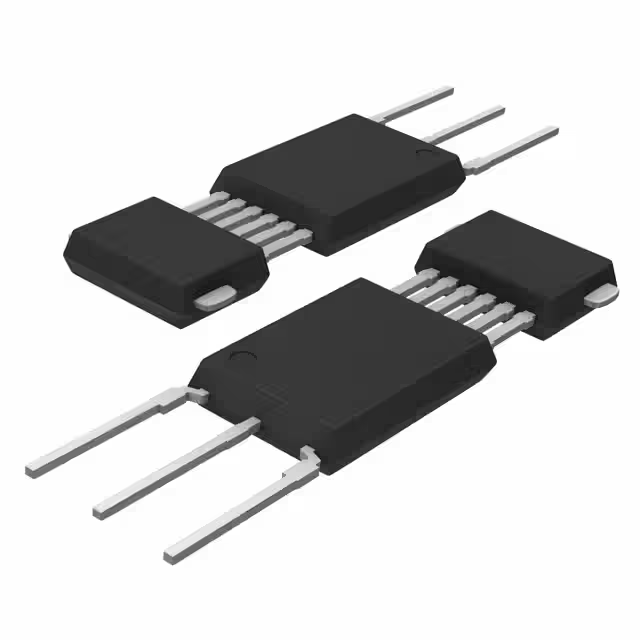
NXP Semiconductors KMA199E,115
- Part No.:
- KMA199E,115
- Manufacturer:
- NXP Semiconductors
- Category:
- Angle, Linear Position Measuring
- Package:
- 3-SIP Module
- Datasheet:
-
 KMA199E,115.pdf
- Description:
- SENSOR ANGLE 180DEG PC PIN
- Quantity:
- Payment:

- Shipping:

Inventory:4,899
Please send an inquiry. Send us your inquiry, and we will respond immediately.
Product details
Overview
KMA199E from NXP Semiconductors is a pre-calibrated, single-package magnetic angle sensor system integrating magneto-resistive (MR) bridges and mixed-signal IC circuitry. It delivers ratiometric analog output voltage proportional to measured mechanical angle, supports user-programmable zero angle (0–180°), angular range (5–180°), and clamping voltages, and operates across −40 °C to +160 °C ambient temperature - enabling direct integration into automotive throttle, steering, and industrial rotary position sensing.
For engineers reviewing the KMA199E datasheet, KMA199E pinout, KMA199E application, or KMA199E equivalent, key selection considerations include its 0.04° angle resolution, CORDIC-based digital angle computation, One-Wire Interface (OWI) programming capability, magnet-lost and power-lost diagnostics, and fail-safe EEPROM with CRC/EDC supervision.
Technical Context
The KMA199E digitizes orthogonal differential MR bridge signals via an on-chip ADC, computes angle using a hardware CORDIC algorithm, and converts result to ratiometric analog output via internal DAC and output buffer. Signal path includes offset cancellation, digital filtering, averaging, and programmable angular range mapping.
Diagnostics are embedded in real time: magnet-lost detection triggers output clamping outside 4–96% VDD; power-lost detection connects OUT/DIGINT to remaining supply/ground via internal switches; EEPROM integrity is verified at power-on with CRC and corrected via 22-bit protected 16-bit words.
Key Specifications
| Parameter | Value and Actual Design Meaning |
|---|---|
| Angle resolution | 0.04° - enables high-precision closed-loop motor control and fine-position feedback |
| Angular range | Programmable 5° to 180° - supports custom mechanical travel limits without external scaling |
| Zero angle | Programmable 0° to 180° - allows field calibration to mechanical reference point |
| Output type | Ratiometric analog voltage (5–95% VDD) - eliminates supply drift sensitivity in measurement chain |
| Update frequency | 3.125 kHz typical - supports real-time dynamic angle tracking in fast-rotating systems |
| Operating temperature | −40 °C to +160 °C - qualified for under-hood automotive and high-temp industrial environments |
| Supply voltage | 4.5 V to 5.5 V - compatible with standard 5 V automotive and industrial rails |
| Linearity error | ±1.55° max - ensures accurate angular reporting across full programmed range |
Pinout & Package
Package: SOT880 - plastic single-ended multi-chip package with 3 in-line leads and 6 interconnections.
| Pin/Terminal | Circuit Role | Design Meaning |
|---|---|---|
| VDD | Supply voltage input | Primary 4.5–5.5 V power rail; powers all internal regulators (VDDA, VDDD, VDDS) |
| GND | Ground reference | Analog/digital common return; critical for noise immunity and power-lost detection function |
| OUT/DIGINT | Bidirectional analog output / OWI interface | Delivers ratiometric angle voltage in normal mode; serves as One-Wire bus for EEPROM programming and diagnostics |
Key Features
| Feature | Design Value |
|---|---|
| CORDIC-based angle computation | Hardware-accelerated real-time conversion of MR bridge signals to linear angular output without host MCU intervention |
| Fail-safe EEPROM with CRC/EDC | 22-bit protected storage per 16-bit word enables single-bit error correction and double-bit error detection during operation |
| Magnet-lost and power-lost detection | Dual diagnostic modes drive output to <4% VDD or >96% VDD - provides unambiguous fault signaling to downstream ADC or controller |
| One-Wire Interface (OWI) | Single-pin bidirectional programming channel supporting zero-angle, range, clamping, and identifier configuration without additional pins or protocol overhead |
| Transient protection & built-in ESD | Integrated protection diodes and robust layout reduce need for external TVS components in harsh EMC environments |
| Temperature drift error | ≤0.8° over −40 °C to +140 °C - maintains accuracy without software compensation in wide thermal ranges |
Applications
| Automotive Throttle Position Sensing | Industrial Rotary Valve Control |
|---|---|
|
Use Scenario: Monitoring throttle plate angle in gasoline/diesel engines for precise air-fuel ratio control and emissions compliance. IC Role / Device Role / Timing Role: Primary angular transducer delivering ratiometric analog output synchronized to engine control unit sampling. Use Value: Factory-calibrated linearity (±1.55°) and −40 °C to +160 °C operation ensure reliable signal integrity across cold start to full-load thermal cycling. |
Use Scenario: Measuring rotational position of pneumatic/hydraulic actuator shafts in process automation systems. IC Role / Device Role / Timing Role: Standalone angle sensor interfacing directly to PLC analog inputs or local microcontroller ADC. Use Value: Programmable zero angle and angular range allow one KMA199E variant to support multiple valve stroke configurations without hardware change. |
| Electric Power Steering (EPS) Torque Sensor Auxiliary | Robot Joint Position Feedback |
|
Use Scenario: Redundant or secondary angle measurement in EPS column modules to cross-check primary sensor output. IC Role / Device Role / Timing Role: Fail-safe secondary angle source with independent magnet-lost and power-lost diagnostics. Use Value: Diagnostic output clamping (<4% or >96% VDD) enables immediate fault isolation without protocol parsing - critical for ASIL-B functional safety paths. |
Use Scenario: Compact joint angle feedback in collaborative robots where space, weight, and thermal resilience are constrained. IC Role / Device Role / Timing Role: High-resolution (0.04°), low-noise (0.4–2.5 mV RMS) analog angle source for closed-loop servo control. Use Value: 3.125 kHz update rate and 1.8 ms settling time after 45° step support responsive motion control loops with minimal latency. |
Equivalent & Alternatives
The following parts are listed as comparable options for similar magnetic angle sensor applications.
| Alternative Part | Technical Difference | Application Difference | Selection Advice |
|---|---|---|---|
| AS5055A-DSOM | 12-bit SPI output only; no analog output; requires external MCU for angle processing | Designed for digital-only systems with available SPI interface and processing resources | Choose when digital interface, higher resolution (0.087°), and lower power (5 mA) outweigh need for analog simplicity |
| TLE5012B E1000 | Includes dual-output (analog + SENT); higher ESD rating (±8 kV); supports 3.3 V and 5 V supply | Targeted at automotive ASIL-B systems requiring dual-channel redundancy and SENT diagnostics | Choose when SENT protocol compliance, extended diagnostics, or dual-output flexibility are required beyond KMA199E's analog+OWI scope |
Compared with AS5055A-DSOM and TLE5012B E1000, the KMA199E uniquely combines factory-calibrated analog output, One-Wire programmability, and integrated diagnostics in a 3-pin SOT880 package - reducing BOM count and eliminating need for external ADC or communication interface logic.
Availability
KMA199E is available at Aetrix Electronics and suitable for automotive throttle position sensing, industrial rotary valve control, electric power steering auxiliary monitoring, and robot joint position feedback requiring stable component supply across extended temperature and long product lifecycles.
Supply support for KMA199E includes scheduled delivery planning, volume procurement assistance, BOM continuity management, traceable sourcing, and lifecycle availability coordination for OEM customers, industrial embedded developers, connected-device designers, and electronics production programs.
Manufacturer
NXP Semiconductors is a global semiconductor company specializing in secure connectivity solutions for automotive, industrial, and IoT applications, with leadership in sensor signal conditioning and embedded processing.
The KMA199E belongs to NXP's programmable magnetic angle sensor product line, designed specifically for high-reliability, contactless angular position measurement in thermally demanding environments where analog simplicity and diagnostic robustness are critical.
FAQ
What is the operating temperature range of the KMA199E?
The KMA199E operates from −40 °C to +160 °C ambient temperature, making it suitable for under-hood automotive applications and high-temperature industrial environments. This range is validated per IEC 60134 limiting values and includes full functionality of analog output, diagnostics, and EEPROM programming within the specified 10 °C to 70 °C programming ambient window.
How does the KMA199E handle magnet absence or power interruption?
The KMA199E implements dedicated hardware-level detection: magnet-lost condition pulls the OUT/DIGINT pin to <4% VDD or >96% VDD depending on diagnostic mode setting; power-lost detection closes internal switches to connect OUT/DIGINT to the remaining functional supply or ground rail. Both mechanisms provide deterministic, protocol-free fault signaling without requiring host processor interpretation - a core feature of the KMA199E design.
Can the KMA199E be reprogrammed in-system, and what interface is used?
Yes, the KMA199E supports in-system programming via its One-Wire Interface (OWI) on the OUT/DIGINT pin. Users can adjust zero angle, angular range, clamping voltages, and 32-bit identifier without removing the device from the PCB. Programming requires overdriving the output buffer with ≥20 mA current during command entry and uses a defined timing protocol with start/stop conditions, handover/takeover bits, and charge-pump enable sequence - all documented in the KMA199E datasheet.
What is the angular accuracy specification of the KMA199E, and how is it achieved?
The KMA199E achieves ±1.55° linearity error (Δφlin) and ≤0.8° temperature drift error (Δφtemp) over −40 °C to +140 °C. Accuracy stems from factory calibration of MR bridge offsets and sensitivities, on-chip CORDIC computation eliminating software interpolation errors, and analog output stage trimmed to maintain ratiometric behavior. These parameters are guaranteed under specified operating conditions including 4.5–5.5 V supply and ≥35 kA/m external magnetic field strength.
Does the KMA199E require external passive components for basic operation?
Yes, the KMA199E requires two external capacitors per datasheet recommendations: a 100 nF blocking capacitor (Cblock) between VDD and GND, placed as close as possible to the package; and a 0.33–22 nF load capacitance (CL) between OUT/DIGINT and GND. These components stabilize internal regulators, suppress switching noise from the CORDIC/DAC chain, and ensure stable OWI communication timing - omission risks output instability or programming failure.
KMA199E,115 Specifications
- Product attributes
- Attribute value
- Manufacturer:
- NXP Semiconductors
- Package/Case:
- 3-SIP Module
- Series:
- -
- Packaging:
- Tape & Reel (TR)
- Product Status:
- Obsolete
- Programmable:
- -
- For Measuring:
- Angle
- Technology:
- Magnetoresistive
- Rotation Angle - Electrical, Mechanical:
- 0° ~ 180°
- Linear Range:
- -
- Output:
- Analog Voltage
- Output Signal:
- Clockwise Increase
- Actuator Type:
- External Magnet, Not Included
- Linearity:
- ±1.2%
- Resistance:
- -
- Resistance Tolerance:
- -
- Voltage - Supply:
- 4.5V ~ 5.5V
- Mounting Type:
- Through Hole
- Termination Style:
- PC Pin
- Operating Temperature:
- -40°C ~ 160°C
- Grade:
- -
- Qualification:
- -
- Supplier Device Package:
- 3-SIP
KMA199E,115 FAQ
1.How can I place an order for KMA199E,115 through Aetrix?
Please submit a Request for Quotation (RFQ) for KMA199E,115 on Aetrix. Our sales agent will provide a competitive quotation and guide you through the order confirmation once you accept the terms.
2.Are the price and stock information for KMA199E,115 reliable?
The price and inventory of KMA199E,115 are updated periodically and may fluctuate due to market conditions. Stock and pricing data are typically refreshed every 24 hours. Quotation validity for KMA199E,115 is usually 5 days.
3.What payment methods are accepted for KMA199E,115?
We accept Wire Transfer, PayPal, Credit Card, Western Union, MoneyGram, and Escrow for KMA199E,115 transactions.
Note: Certain payment methods may incur a processing fee.
4.How is shipping managed for KMA199E,115?
KMA199E,115 orders can be shipped via leading logistics carriers, including DHL, UPS, FedEx, TNT, or Registered Mail.
Once your KMA199E,115 order is processed, you will receive an email with the shipment details and tracking number.
Note: Tracking information may take up to 24 hours to appear. Express delivery typically takes 3–5 business days.
5.How can I obtain technical support or documentation for KMA199E,115?
For technical support, including KMA199E,115 datasheets, pinout diagrams, or application guidance, please contact our engineering support team. They can provide detailed documentation and assistance for your KMA199E,115 requirements.
6.How does Aetrix verify that KMA199E,115 is sourced from the original manufacturer or authorized distributors?
All KMA199E,115 products on Aetrix are procured from qualified distributors and authorized channels. Our dedicated quality assurance team conducts strict verification, including traceability checks and, if necessary, third-party testing. This ensures that KMA199E,115 meets industry standards.
7.What is the process for return or replacement of KMA199E,115?
All KMA199E,115 units undergo pre-shipment inspection (PSI). If there is an issue with KMA199E,115, returns or replacements are accepted under the following conditions:
1.Quantity discrepancies, incorrect items, or visible external defects (such as breakage or corrosion), acknowledged by Aetrix.
2.The issue is reported within 90 days of delivery.
3.The KMA199E,115 part is unused and in its original packaging.
Return procedure for KMA199E,115:
1.Submit a request within 90 days.
2.Obtain a Return Material Authorization (RMA) from Aetrix.
KMA199E,115 Tags
-
TLV493DA1B6HTSA2
Infineon Technologies
-
EVW-AE4001B14
Panasonic Electronic Components
-
3382G-1-103G
Bourns Inc.
-
TLE5501E0001XUMA1
Infineon Technologies
-
HAL830UT-A
TDK-Micronas GmbH
-
TLE5009E1000FUMA1
Infineon Technologies
-
TLE5501E0002XUMA1
Infineon Technologies
-
HAL3725DJ-A
TDK-Micronas GmbH
-
HAL3727DJ-A
TDK-Micronas GmbH
-
HMC1501-TR
Honeywell Aerospace
-
HMC1512-TR
Honeywell Aerospace

-
AAS33001LLEATR-5
Allegro MicroSystems
Tech Hub

A practical engineering guide to 3.3V and 5V logic compatibility, input thresholds, resistor dividers, translator ICs, MOSFET level shifting, I2C pull-ups, timing limits and power-sequencing risks.

The 74HC595 uses push-pull logic outputs, while the TPIC6B595 uses 50 V open-drain DMOS sinks for higher-power loads. This guide compares timing, current limits, 3.3 V interfacing, load wiring, thermal…

The 74HC595 converts serial data into eight stable parallel outputs. This guide covers pin functions, shift and storage timing, OE and MR behavior, drive-current limits, cascading, voltage compatibilit…

A technical comparison of level-sensitive latches and edge-triggered flip-flops, covering timing windows, setup and hold limits, master–slave operation, time borrowing, race-through, HDL inference and…

A D latch stores one bit while Enable controls when data can pass. This reference covers gate-level operation, truth tables, transparency, setup and hold timing, LE versus OE, common ICs and practical …

An SR latch stores one bit through cross-coupled feedback. This engineering reference covers NOR and NAND implementations, truth tables, forbidden-state recovery, gated operation, switch debouncing, fa…

Latch circuits retain one bit through feedback. This technical reference covers SR and D latches, truth tables, transparency, timing limits, latch-versus-flip-flop behavior, applications and common log…

An engineering guide to LED driver operation, constant-current and constant-voltage outputs, linear and switching topologies, dimming, IC selection, calculations, replacement compatibility, and fault c…

Operational amplifier guide covering op amp basics, feedback, ideal vs real op amps, common configurations, buffer circuits, offset, bias current, gain-bandwidth, slew rate, rail-to-rail limits and sel…

Jumper cables guide covering safe connection order, red and black clamp placement, final ground connection, cable gauge, length, clamp quality, copper vs CCA cables, jump starter comparison and battery…


