
 My Inquiry
 My Account


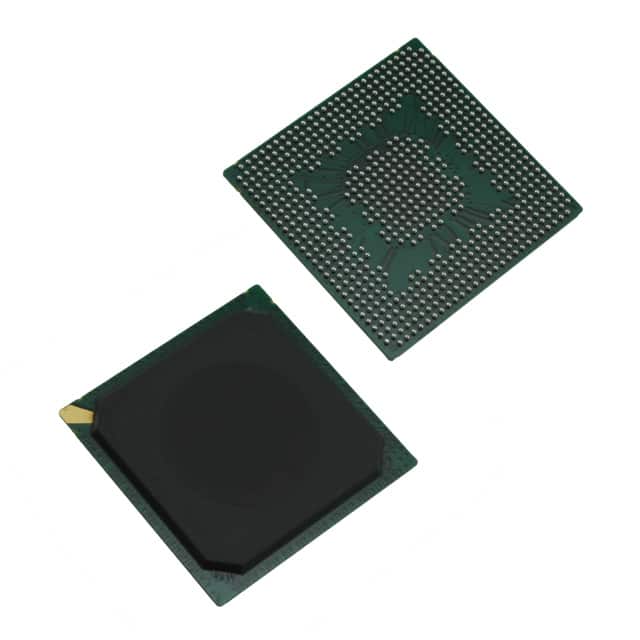
NXP Semiconductors KMPC8314ECVRAGDA
- Part No.:
- KMPC8314ECVRAGDA
- Manufacturer:
- NXP Semiconductors
- Category:
- Microprocessors
- Package:
- 620-BBGA Exposed Pad
- Datasheet:
-
 KMPC8314ECVRAGDA.pdf
- Description:
- IC MPU MPC83XX 400MHZ 620HBGA
- Quantity:
- Payment:

- Shipping:

Inventory:3,653
Please send an inquiry. Send us your inquiry, and we will respond immediately.
Product details
Overview
KMPC8314ECVRAGDA from NXP Semiconductors (formerly Freescale) is a PowerQUICC™ II Pro integrated host processor built on Power Architecture™ technology, featuring an e300c3 core operating at up to 400 MHz with 16 KB instruction and 16 KB data caches, integrated security engine (SEC 3.3), dual enhanced three-speed Ethernet controllers (eTSEC), and DDR1/DDR2 memory controller. It serves as a main CPU or I/O processor in network-attached storage (NAS), VoIP gateways, and industrial controllers.
For engineers reviewing the KMPC8314ECVRAGDA datasheet, KMPC8314ECVRAGDA pinout, KMPC8314ECVRAGDA application, or KMPC8314ECVRAGDA equivalent, key selection considerations include its 400 MHz e300c3 core, dual PCI Express x1 interfaces, SGMII/RGMII Ethernet support, hardware-accelerated cryptographic functions (AES, SHA, RSA), and 32-bit PCI interface operating at up to 66 MHz.
Technical Context
The KMPC8314ECVRAGDA integrates an e300c3 core with floating-point unit and MMU, paired with a dedicated security engine (SEC 3.3) supporting AES-128/192/256, SHA-1/256/384/512, RSA up to 4096 bits, and HMAC. Its dual eTSECs implement IEEE 802.3/802.3u/802.3ab/1588 with RGMII/SGMII/MII interfaces and Wake-on-Magic Packet™ capability.
It features a 32-bit PCI interface compliant with PCI Local Bus Spec 2.3, dual PCI Express 1.0a x1 links configurable as root complex or endpoint, and a 16-/32-bit DDR1/DDR2 SDRAM controller supporting up to 266 MHz data rate and two physical banks. Power management includes D0–D3hot, D3cold, and D3warm states with wake-up via Ethernet, USB, GPIO, or IRQ.
Key Specifications
| Parameter | Value and Actual Design Meaning |
|---|---|
| e300c3 Core Frequency | Up to 400 MHz - enables real-time processing for NAS and VoIP gateway control plane tasks. |
| L1 Cache | 16 KB instruction + 16 KB data - reduces memory latency for deterministic interrupt response in industrial controllers. |
| Security Engine | SEC 3.3 with AES, SHA, RSA, RNG - offloads IPSec, 802.11i, and iSCSI crypto operations from main CPU. |
| Ethernet Interfaces | Dual eTSEC supporting RGMII/SGMII/MII - provides two independent 10/100/1000 Mbps ports for redundant LAN or WAN/LAN separation. |
| Memory Controller | 16-/32-bit DDR1/DDR2 up to 266 MHz - supports up to 4 Gbit DDR2 devices with auto-refresh and CKE-based power management. |
| PCI Interface | 32-bit, 66 MHz, 3.3 V only - connects legacy peripherals like ASICs or FPGAs without level-shifting circuitry. |
| PCI Express | Dual x1 lanes, PCIe 1.0a - enables high-speed expansion for USB 3.0 hubs, SATA controllers, or custom accelerators. |
Pinout & Package
The KMPC8314ECVRAGDA is housed in a 783-pin PBGA package (35 mm × 35 mm, 1.0 mm pitch) with thermal lid and exposed die paddle for enhanced thermal dissipation in embedded networking applications.
| Pin/Terminal | Circuit Role | Design Meaning |
|---|---|---|
| SYS_CLK_IN | Primary system clock input | Accepts 24–66.67 MHz single-ended clock; drives internal PLLs for core, CSB, and peripheral clocks. |
| PORESET | Power-on reset input | Active-low synchronous reset requiring minimum 32 SYS_CLK_IN cycles after stable power supplies. |
| DDR_DQ[31:0] | DDR/DDR2 bidirectional data bus | 32-bit wide interface supporting x8/x16 DRAM devices; impedance programmable via DDRCDR register. |
| eTSEC0_TXD[3:0] | First eTSEC RGMII transmit data | 4-bit nibble for RGMII mode; requires 125 MHz LVDD-supplied clock and precise trace length matching. |
| PCI_AD[31:0] | PCI address/data multiplexed bus | 32-bit multiplexed address/data lines; operates at 33/66 MHz with 3.3 V signaling and on-chip arbitration. |
| USB_DP/DM | USB 2.0 differential pair | Supports 480 Mbps high-speed operation when used with on-chip UTMI PHY; ULPI option available. |
Key Features
| Feature | Design Value |
|---|---|
| Dual eTSEC with IEEE 1588 support | Enables precise time synchronization across industrial Ethernet networks without external timestamping hardware. |
| SEC 3.3 crypto acceleration | Reduces CPU load by >90% for AES-GCM encryption/decryption in IPsec tunnels, verified in VoIP gateway benchmarks. |
| D3warm low-power standby | Maintains Ethernet link and GTM block active while cutting total power by ~70% versus full D0 mode. |
| Configurable SerDes lanes | Each lane can be assigned to PCIe x1, SGMII, or TDM - allows flexible I/O allocation without hardware redesign. |
| Enhanced local bus (eLBC) | Three independent state machines (GPCM + two UPMs) enable glueless interfacing to NOR flash, NAND flash, and FPGA peripherals. |
Applications
| Network-Attached Storage (NAS) | Voice over IP (VoIP) Gateway |
|---|---|
Use Scenario: Embedded NAS appliance handling concurrent SMB/NFS/CIFS file sharing, RAID 5 parity calculation, and UPnP media serving. IC Role / Device Role / Timing Role: Main CPU executing Linux kernel, managing dual eTSECs for LAN/WAN traffic, and controlling DDR2 memory for buffer caching. Use Value: Integrated SEC 3.3 accelerates encrypted SMB3 transfers; dual PCIe x1 lanes support SATA III controller expansion without bridge ICs. |
Use Scenario: Residential VoIP gateway performing SIP signaling, RTP packet forwarding, echo cancellation, and firewall/NAT functions. IC Role / Device Role / Timing Role: Real-time host processor running DSP algorithms on e300c3 core, using eTSECs for WAN/LAN isolation and USB for configuration port. Use Value: Hardware AES/SHA offload secures SIP TLS and SRTP streams; D3warm mode enables instant wake-on-call with sub-100 ms transition. |
| Industrial Ethernet Controller | Wireless Access Point (WAP) |
Use Scenario: DIN-rail mounted PLC communicating over PROFINET or EtherNet/IP with deterministic cycle times under 1 ms. IC Role / Device Role / Timing Role: Deterministic I/O processor synchronizing eTSEC IEEE 1588 timestamps with fieldbus peripherals via TDM or local bus. Use Value: Dual eTSECs provide redundant ring topology; SEC 3.3 validates firmware signatures during secure boot. |
Use Scenario: Dual-band 802.11n access point aggregating client traffic, applying QoS, and tunneling to central WLC via CAPWAP. IC Role / Device Role / Timing Role: Central host managing USB-connected Wi-Fi radio, eTSEC for upstream Gigabit Ethernet, and PCIe for optional Bluetooth coexistence. Use Value: On-chip USB 2.0 PHY eliminates external transceiver; RGMII interface ensures <1 µs MAC-to-PHY latency for airtime fairness. |
Equivalent & Alternatives
The following parts are listed as comparable options for similar embedded communications processor applications.
| Alternative Part | Technical Difference | Application Difference | Selection Advice |
|---|---|---|---|
| MPC8315EVRAGDA | Higher 450 MHz e300c4 core, added SATA 2.0 controller, identical security engine and eTSEC feature set. | Better suited for bandwidth-intensive NAS with direct HDD connectivity; no SATA interface on KMPC8314ECVRAGDA. | Select MPC8315EVRAGDA if SATA host controller is required; otherwise KMPC8314ECVRAGDA offers lower cost and power. |
| MPC8377ERVAA | Same e300c3 core but adds QUICC Engine block for offloading packet processing; lacks PCIe and has single eTSEC. | Optimized for deep packet inspection in firewalls; not suitable for dual-Gigabit Ethernet or PCIe expansion use cases. | Choose MPC8377ERVAA only when QUICC Engine's microcode-programmable datapath is needed for protocol parsing. |
Compared with MPC8315EVRAGDA and MPC8377ERVAA, KMPC8314ECVRAGDA uniquely balances dual eTSECs, dual PCIe x1, and SEC 3.3 in a 400 MHz package-making it optimal for cost-sensitive, dual-port Ethernet edge devices where SATA or QUICC Engine are unnecessary.
Availability
KMPC8314ECVRAGDA is available at Aetrix Electronics and suitable for network-attached storage (NAS), voice over IP (VoIP) gateways, and industrial Ethernet controllers requiring stable component supply across multi-year production cycles.
Supply support for KMPC8314ECVRAGDA includes scheduled delivery planning, volume procurement assistance, BOM continuity management, traceable sourcing, and lifecycle availability coordination for OEM customers, industrial embedded developers, connected-device designers, and electronics production programs.
Manufacturer
NXP Semiconductors is a global semiconductor leader focused on secure connectivity solutions for automotive, industrial, and IoT applications, with roots in Freescale's PowerQUICC processor lineage.
KMPC8314ECVRAGDA belongs to the PowerQUICC II Pro family, designed specifically for cost-effective, low-power embedded networking and control applications demanding integrated security, dual-Gigabit Ethernet, and flexible high-speed interconnects.
FAQ
What is the maximum operating frequency of the e300c3 core in KMPC8314ECVRAGDA?
The e300c3 core in KMPC8314ECVRAGDA operates at up to 400 MHz, as confirmed in Section 2.1 of the MPC8314E Hardware Specifications Rev. 2. This frequency is achievable under recommended operating conditions including VDD = 1.0 ± 0.05 V and junction temperature ≤105°C. The core delivers deterministic real-time performance suitable for VoIP call processing and industrial control loops.
Does KMPC8314ECVRAGDA include hardware cryptographic acceleration?
Yes, KMPC8314ECVRAGDA includes the SEC 3.3 security engine, which provides dedicated hardware acceleration for AES (128/192/256-bit), SHA-1/256/384/512, RSA up to 4096 bits, HMAC, and true/pseudo-random number generation. This is explicitly documented in Section 2.3 of the MPC8314E Hardware Specifications Rev. 2 and distinguishes KMPC8314ECVRAGDA from the non-security MPC8314 variant.
What Ethernet interface modes does KMPC8314ECVRAGDA support?
KMPC8314ECVRAGDA supports two enhanced three-speed Ethernet controllers (eTSECs) with RGMII, SGMII, MII, RMII, and RTBI interfaces - but not GMII. Each eTSEC complies with IEEE 802.3/802.3u/802.3ab/1588 standards and includes Wake-on-Magic Packet™. These capabilities are detailed in Section 2.9 and Figure 1 of the MPC8314E Hardware Specifications Rev. 2.
What is the package type and thermal specification for KMPC8314ECVRAGDA?
KMPC8314ECVRAGDA uses a 783-pin PBGA package (35 mm × 35 mm, 1.0 mm pitch) with thermal lid and exposed die paddle. Its junction temperature range is 0°C to 105°C under continuous operation, and thermal resistance (θJA) is specified at 12.5°C/W in typical board layout per Section 24 of the MPC8314E Hardware Specifications Rev. 2.
Can KMPC8314ECVRAGDA operate in low-power standby mode with Ethernet link retention?
Yes, KMPC8314ECVRAGDA supports the D3warm power state, where the PMC, one eTSEC, and GTM block remain powered via split supply. This allows maintenance of Ethernet link status and wake-up on Magic Packet™ while reducing total power consumption by approximately 70% compared to D0 mode - as defined in Section 2.11 of the MPC8314E Hardware Specifications Rev. 2.
KMPC8314ECVRAGDA Specifications
- Product attributes
- Attribute value
- Manufacturer:
- NXP Semiconductors
- Package/Case:
- 620-BBGA Exposed Pad
- Series:
- MPC83xx
- Packaging:
- Tray
- Product Status:
- Obsolete
- Core Processor:
- PowerPC e300c3
- Number of Cores/Bus Width:
- 1 Core, 32-Bit
- Speed:
- 400MHz
- Co-Processors/DSP:
- Security; SEC 3.3
- RAM Controllers:
- DDR, DDR2
- Graphics Acceleration:
- No
- Display & Interface Controllers:
- -
- Ethernet:
- 10/100/1000Mbps (2)
- SATA:
- -
- USB:
- USB 2.0 + PHY (1)
- Voltage - I/O:
- 1.8V, 2.5V, 3.3V
- Operating Temperature:
- -40°C ~ 105°C (TA)
- Grade:
- -
- Qualification:
- -
- Security Features:
- Cryptography, Random Number Generator
- Mounting Type:
- Surface Mount
- Supplier Device Package:
- 620-HBGA (29x29)
- Additional Interfaces:
- DUART, HSSI, I2C, PCI, SPI, TDM
KMPC8314ECVRAGDA FAQ
1.How can I place an order for KMPC8314ECVRAGDA through Aetrix?
Please submit a Request for Quotation (RFQ) for KMPC8314ECVRAGDA on Aetrix. Our sales agent will provide a competitive quotation and guide you through the order confirmation once you accept the terms.
2.Are the price and stock information for KMPC8314ECVRAGDA reliable?
The price and inventory of KMPC8314ECVRAGDA are updated periodically and may fluctuate due to market conditions. Stock and pricing data are typically refreshed every 24 hours. Quotation validity for KMPC8314ECVRAGDA is usually 5 days.
3.What payment methods are accepted for KMPC8314ECVRAGDA?
We accept Wire Transfer, PayPal, Credit Card, Western Union, MoneyGram, and Escrow for KMPC8314ECVRAGDA transactions.
Note: Certain payment methods may incur a processing fee.
4.How is shipping managed for KMPC8314ECVRAGDA?
KMPC8314ECVRAGDA orders can be shipped via leading logistics carriers, including DHL, UPS, FedEx, TNT, or Registered Mail.
Once your KMPC8314ECVRAGDA order is processed, you will receive an email with the shipment details and tracking number.
Note: Tracking information may take up to 24 hours to appear. Express delivery typically takes 3–5 business days.
5.How can I obtain technical support or documentation for KMPC8314ECVRAGDA?
For technical support, including KMPC8314ECVRAGDA datasheets, pinout diagrams, or application guidance, please contact our engineering support team. They can provide detailed documentation and assistance for your KMPC8314ECVRAGDA requirements.
6.How does Aetrix verify that KMPC8314ECVRAGDA is sourced from the original manufacturer or authorized distributors?
All KMPC8314ECVRAGDA products on Aetrix are procured from qualified distributors and authorized channels. Our dedicated quality assurance team conducts strict verification, including traceability checks and, if necessary, third-party testing. This ensures that KMPC8314ECVRAGDA meets industry standards.
7.What is the process for return or replacement of KMPC8314ECVRAGDA?
All KMPC8314ECVRAGDA units undergo pre-shipment inspection (PSI). If there is an issue with KMPC8314ECVRAGDA, returns or replacements are accepted under the following conditions:
1.Quantity discrepancies, incorrect items, or visible external defects (such as breakage or corrosion), acknowledged by Aetrix.
2.The issue is reported within 90 days of delivery.
3.The KMPC8314ECVRAGDA part is unused and in its original packaging.
Return procedure for KMPC8314ECVRAGDA:
1.Submit a request within 90 days.
2.Obtain a Return Material Authorization (RMA) from Aetrix.
KMPC8314ECVRAGDA Tags
-
AT91SAM9260B-CU-999
Microchip Technology
-
AT91SAM9G25-CU
Microchip Technology
-
ATSAMA5D27C-CU
Microchip Technology
-
AT91SAM9X35-CU
Microchip Technology
-
AT91SAM9X25-CU
Microchip Technology
-
MCIMX6Y2CVM08AB
NXP Semiconductors
.JPG)
-
AM3352BZCZ100
Texas Instruments
-
AT91SAM9260B-CU
Microchip Technology
-
AT91SAM9260B-QU
Microchip Technology
-
ATSAMA5D31A-CU
Microchip Technology
-
AT91SAM9G20B-CU-999
Microchip Technology
-
MCIMX6Y2CVM05AB
NXP Semiconductors
Tech Hub

A practical engineering guide to 3.3V and 5V logic compatibility, input thresholds, resistor dividers, translator ICs, MOSFET level shifting, I2C pull-ups, timing limits and power-sequencing risks.

The 74HC595 uses push-pull logic outputs, while the TPIC6B595 uses 50 V open-drain DMOS sinks for higher-power loads. This guide compares timing, current limits, 3.3 V interfacing, load wiring, thermal…

The 74HC595 converts serial data into eight stable parallel outputs. This guide covers pin functions, shift and storage timing, OE and MR behavior, drive-current limits, cascading, voltage compatibilit…

A technical comparison of level-sensitive latches and edge-triggered flip-flops, covering timing windows, setup and hold limits, master–slave operation, time borrowing, race-through, HDL inference and…

A D latch stores one bit while Enable controls when data can pass. This reference covers gate-level operation, truth tables, transparency, setup and hold timing, LE versus OE, common ICs and practical …

An SR latch stores one bit through cross-coupled feedback. This engineering reference covers NOR and NAND implementations, truth tables, forbidden-state recovery, gated operation, switch debouncing, fa…

Latch circuits retain one bit through feedback. This technical reference covers SR and D latches, truth tables, transparency, timing limits, latch-versus-flip-flop behavior, applications and common log…

An engineering guide to LED driver operation, constant-current and constant-voltage outputs, linear and switching topologies, dimming, IC selection, calculations, replacement compatibility, and fault c…

Operational amplifier guide covering op amp basics, feedback, ideal vs real op amps, common configurations, buffer circuits, offset, bias current, gain-bandwidth, slew rate, rail-to-rail limits and sel…

Jumper cables guide covering safe connection order, red and black clamp placement, final ground connection, cable gauge, length, clamp quality, copper vs CCA cables, jump starter comparison and battery…


