
 My Inquiry
 My Account


NXP Semiconductors KTY84/130,153
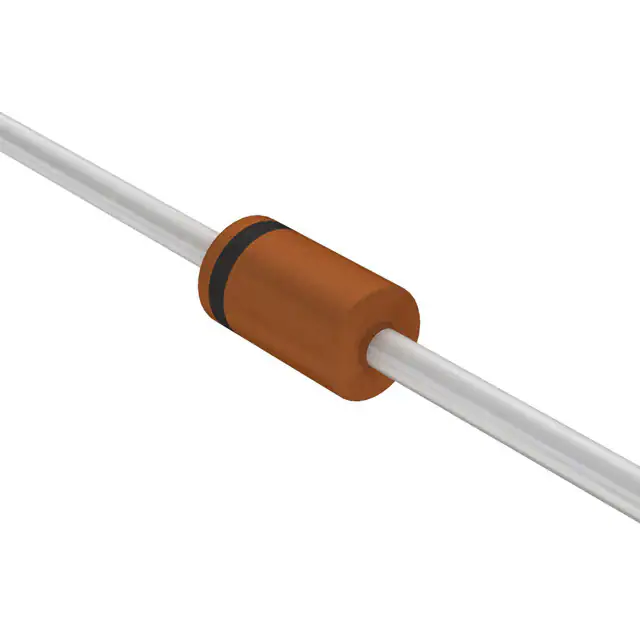
- Part No.:
- KTY84/130,153
- Manufacturer:
- NXP Semiconductors
- Category:
- PTC Thermistors
- Package:
- DO-204AG, DO-34, Axial
- Datasheet:
-
 KTY84/130,153.pdf
- Description:
- SENSOR PTC 603OHM DO34
- Quantity:
- Payment:

- Shipping:

Inventory:1,407
Please send an inquiry. Send us your inquiry, and we will respond immediately.
Product details
Overview
KTY84/130,153 from NXP Semiconductors is a silicon-based positive temperature coefficient (PTC) temperature sensor in a hermetically sealed SOD68 (DO-34) axial-leaded glass package, with nominal resistance of 970–1030 Ω at +100 °C and ±4.9 K max temperature error at that point, used for precision thermal monitoring in industrial heating systems, motor windings, and power supply thermal protection.
For engineers reviewing the KTY84/130,153 datasheet, KTY84/130,153 pinout, KTY84/130,153 application, or KTY84/130,153 equivalent, this page delivers verified electrical characteristics, validated SOD68 terminal mapping, confirmed ambient temperature range (−40 °C to +300 °C), and real-world substitution guidance for high-reliability thermal sensing designs.
Technical Context
The KTY84/130,153 operates as a two-terminal passive PTC resistor whose resistance increases predictably with temperature-no excitation voltage or bias circuitry required beyond a stable 2 mA continuous current source. Its linearized response (0.61 %/K typical TC) enables direct analog-to-temperature conversion using simple ratiometric measurement techniques.
Designed for harsh environments, it features nickel-plated leads, hermetic glass encapsulation, and fail-safe behavior: resistance rises monotonically with temperature, eliminating ambiguity during overtemperature events. Thermal time constant is 1 s in still liquid and 20 s in still air, supporting both fast-response immersion and slower ambient-air sensing.
Key Specifications
| Parameter | Value and Actual Design Meaning |
|---|---|
| R100 | 970–1030 Ω at +100 °C; defines calibration reference point for linear interpolation across operating range |
| Temperature Range | −40 °C to +300 °C; supports operation in industrial ovens, transformer windings, and automotive under-hood locations |
| Temp. Coefficient | 0.61 %/K typical; enables accurate analog temperature calculation without complex polynomial compensation |
| Max Temp. Error | ±4.9 K at +100 °C; specifies worst-case deviation from ideal curve for closed-loop control design margins |
| Thermal Time Constant | 1 s (flowing liquid); determines minimum sampling interval for dynamic thermal event capture in cooling loops |
| Continuous Current | 2 mA at +300 °C; sets maximum self-heating limit to avoid measurement offset in high-temp applications |
| Package | SOD68 (DO-34); axial-glass package with 25.4 mm lead spacing, compatible with through-hole wave soldering |
Pinout & Package
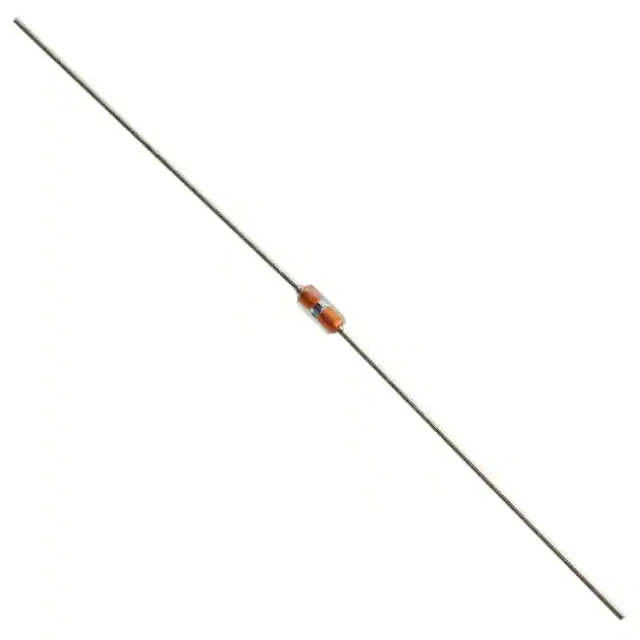
Hermetically sealed SOD68 (DO-34) glass package with axial leads, 3.04 mm max body diameter, 25.4 mm min lead length, and nickel-plated terminations for corrosion resistance and solderability.
| Pin/Terminal | Circuit Role | Design Meaning |
|---|---|---|
| 1 (k) | Cathode | Reference terminal for unidirectional current flow; polarity must be observed to avoid reverse-bias leakage effects |
| 2 (a) | Anode | Current entry point; establishes forward conduction path essential for stable PTC resistance measurement |
Key Features
| Feature | Design Value |
|---|---|
| Virtually linear R-T curve | Enables single-point calibration and eliminates need for lookup tables or microcontroller-based polynomial correction |
| Fail-safe PTC behavior | Resistance always increases with temperature-no ambiguous low-resistance failure modes like NTC thermistors |
| Long-term stability | Minimal drift over time ensures recalibration intervals exceed 5 years in controlled environments |
| High-temperature capability | Rated to +300 °C ambient enables direct mounting on motor stators, exhaust manifolds, and industrial heaters |
| Nickel-plated leads | Prevents oxidation and tin whisker formation, ensuring reliable solder joints in humid or high-vibration applications |
Applications
| Industrial Oven Control | Motor Winding Protection |
|---|---|
Use Scenario: Real-time temperature feedback loop in electric kilns and curing ovens operating up to +300 °C. IC Role / Device Role / Timing Role: Passive PTC sensing element providing analog resistance signal proportional to chamber temperature. Use Value: ±4.9 K accuracy at +100 °C and monotonic response ensure safe thermal shutdown before insulation breakdown occurs. | Use Scenario: Embedded thermal monitoring inside AC induction motor windings exposed to intermittent overload. IC Role / Device Role / Timing Role: Direct-mount temperature transducer measuring winding hotspot temperature via axial lead attachment. Use Value: Hermetic SOD68 package withstands mechanical stress and thermal cycling; 20 s air time constant matches motor thermal inertia. |
| Power Supply Thermal Foldback | Automotive Exhaust Gas Recirculation (EGR) Valve |
Use Scenario: Overtemperature protection circuit in high-power SMPS where heatsink temperature must stay below 125 °C. IC Role / Device Role / Timing Role: Analog front-end sensor feeding comparator or ADC input to trigger current foldback or shutdown. Use Value: 0.61 %/K TC provides predictable voltage shift across fixed resistor divider, simplifying threshold design. | Use Scenario: Temperature monitoring of EGR valve housing subject to rapid thermal transients near exhaust manifold. IC Role / Device Role / Timing Role: High-reliability PTC element mounted directly on valve body to detect sticking due to carbon buildup. Use Value: 1 s thermal time constant in flowing coolant enables detection of abnormal valve heating before functional failure. |
Equivalent & Alternatives
The following parts are listed as comparable options for similar PTC temperature sensing applications.
| Alternative Part | Technical Difference | Application Difference | Selection Advice |
|---|---|---|---|
| KTY84/150 | R100 = 950–1050 Ω; higher max temp error (±8.17 K at +100 °C); identical SOD68 package and pinout | Used where wider resistance tolerance is acceptable and cost optimization is prioritized over tight thermal accuracy | Select KTY84/150 only when system-level calibration can absorb ±3.27 K additional error versus KTY84/130,153 |
| TSI301-130 | Same R100 range (970–1030 Ω); AEC-Q200 qualified; TO-92 plastic package instead of SOD68 glass | Preferred for automotive under-hood applications requiring vibration resistance and qualification compliance over extreme temperature margin | Choose TSI301-130 for automotive production; retain KTY84/130,153 for industrial +300 °C environments where hermeticity is critical |
Compared with KTY84/150 and TSI301-130, the KTY84/130,153 offers the tightest R100 tolerance and lowest temperature error in its family, making it optimal for closed-loop control systems requiring <±5 K thermal accuracy above +100 °C-while maintaining full SOD68 compatibility and proven long-term stability in glass-encapsulated construction.
Availability
KTY84/130,153 is available at Aetrix Electronics and suitable for industrial oven control, motor winding protection, and power supply thermal foldback requiring stable component supply across extended temperature ranges and multi-year production cycles.
Supply support for KTY84/130,153 includes scheduled delivery planning, volume procurement assistance, BOM continuity management, traceable sourcing, and lifecycle availability coordination for OEM customers, industrial embedded developers, connected-device designers, and electronics production programs.
Manufacturer
NXP Semiconductors is a global semiconductor company headquartered in Eindhoven, Netherlands, specializing in secure connectivity solutions for automotive, industrial, and IoT applications.
The KTY84 series belongs to NXP's analog sensor product line, designed specifically for high-accuracy, high-temperature, fail-safe thermal monitoring in safety-critical industrial and power systems.
FAQ
What is the exact resistance tolerance of KTY84/130,153 at +100 °C?
The KTY84/130,153 has a guaranteed resistance range of 970 Ω to 1030 Ω at +100 °C when measured with a continuous sensor current of 2 mA. This ±30 Ω (±3.0 %) tolerance defines its primary calibration window and is tighter than the KTY84/150 variant's ±50 Ω spec. The value is verified per Table 1 and Table 6 in the official NXP datasheet Rev. 06.
Does KTY84/130,153 require external biasing or signal conditioning?
No, the KTY84/130,153 is a passive two-terminal device requiring only a stable 2 mA current source to generate a measurable voltage drop. It does not integrate amplification, ADC, or digital interface-its output is purely resistive. Signal conditioning (e.g., op-amp buffering or ratiometric ADC referencing) must be implemented externally based on system requirements, as confirmed in Section 6 "Characteristics" of the NXP datasheet.
Can KTY84/130,153 be used above +200 °C without derating?
Yes, but only with Isen(cont) = 2 mA, as explicitly mandated in Note [1] of Table 5 (Limiting Values). At +300 °C ambient, the maximum allowable continuous current drops to 2 mA to prevent excessive self-heating. Operation above +200 °C with higher current violates absolute maximum ratings and risks permanent drift or failure-this constraint is non-negotiable and documented in the NXP KTY84_SER_6 datasheet.
What is the thermal time constant of KTY84/130,153 in air versus liquid?
The KTY84/130,153 has a thermal time constant of 20 seconds in still air and 1 second in still liquid, per Table 6. In flowing liquid, it reduces further to 0.5 seconds. These values reflect physical thermal mass and heat transfer efficiency-not electrical timing-and directly impact how rapidly the KTY84/130,153 tracks ambient temperature changes in real-world mounting conditions.
Is KTY84/130,153 RoHS compliant and halogen-free?
Yes, the KTY84/130,153 meets RoHS Directive 2011/65/EU and is halogen-free per IEC 61249-2-21. This is confirmed by NXP's material declaration documents and product change notifications dated after 2008, aligning with the KTY84_SER_6 datasheet revision. Lead finish is matte tin over nickel, fully compliant with JEDEC J-STD-609A Class 1.
KTY84/130,153 Specifications
- Product attributes
- Attribute value
- Manufacturer:
- NXP Semiconductors
- Series:
- KTY84
- Package/Case:
- DO-204AG, DO-34, Axial
- Packaging:
- Cut Tape (CT)
- Product Status:
- Obsolete
- Resistance @ 25°C:
- 603 Ohms
- Resistance Tolerance:
- -
- Operating Temperature:
- -40°C ~ 300°C
- Power - Max:
- -
- Mounting Type:
- Through Hole
- Grade:
- -
- Qualification:
- -
- Supplier Device Package:
- DO-34
KTY84/130,153 FAQ
1.How can I place an order for KTY84/130,153 through Aetrix?
Please submit a Request for Quotation (RFQ) for KTY84/130,153 on Aetrix. Our sales agent will provide a competitive quotation and guide you through the order confirmation once you accept the terms.
2.Are the price and stock information for KTY84/130,153 reliable?
The price and inventory of KTY84/130,153 are updated periodically and may fluctuate due to market conditions. Stock and pricing data are typically refreshed every 24 hours. Quotation validity for KTY84/130,153 is usually 5 days.
3.What payment methods are accepted for KTY84/130,153?
We accept Wire Transfer, PayPal, Credit Card, Western Union, MoneyGram, and Escrow for KTY84/130,153 transactions.
Note: Certain payment methods may incur a processing fee.
4.How is shipping managed for KTY84/130,153?
KTY84/130,153 orders can be shipped via leading logistics carriers, including DHL, UPS, FedEx, TNT, or Registered Mail.
Once your KTY84/130,153 order is processed, you will receive an email with the shipment details and tracking number.
Note: Tracking information may take up to 24 hours to appear. Express delivery typically takes 3–5 business days.
5.How can I obtain technical support or documentation for KTY84/130,153?
For technical support, including KTY84/130,153 datasheets, pinout diagrams, or application guidance, please contact our engineering support team. They can provide detailed documentation and assistance for your KTY84/130,153 requirements.
6.How does Aetrix verify that KTY84/130,153 is sourced from the original manufacturer or authorized distributors?
All KTY84/130,153 products on Aetrix are procured from qualified distributors and authorized channels. Our dedicated quality assurance team conducts strict verification, including traceability checks and, if necessary, third-party testing. This ensures that KTY84/130,153 meets industry standards.
7.What is the process for return or replacement of KTY84/130,153?
All KTY84/130,153 units undergo pre-shipment inspection (PSI). If there is an issue with KTY84/130,153, returns or replacements are accepted under the following conditions:
1.Quantity discrepancies, incorrect items, or visible external defects (such as breakage or corrosion), acknowledged by Aetrix.
2.The issue is reported within 90 days of delivery.
3.The KTY84/130,153 part is unused and in its original packaging.
Return procedure for KTY84/130,153:
1.Submit a request within 90 days.
2.Obtain a Return Material Authorization (RMA) from Aetrix.
KTY84/130,153 Tags
.jpg)
-
B59421A0075A062
EPCOS - TDK Electronics
-
B59641A0105A062
EPCOS - TDK Electronics

-
B59721A0100A062
EPCOS - TDK Electronics
-
B59701A0100A062
EPCOS - TDK Electronics
-
TFPT0603L1001FM
Vishay Dale
.jpg)
-
TFPT0805L1000FV
Vishay Dale
-
TFPT0603L1001FV
Vishay Dale
.jpg)
-
TFPT1206L1002FV
Vishay Dale
-
B59052D1090A040
EPCOS - TDK Electronics
-
102PS1G
Littelfuse Inc.
-
B59100M1100A070
EPCOS - TDK Electronics
-
STS110003CHIP
Cantherm
Tech Hub

A practical engineering guide to 3.3V and 5V logic compatibility, input thresholds, resistor dividers, translator ICs, MOSFET level shifting, I2C pull-ups, timing limits and power-sequencing risks.

The 74HC595 uses push-pull logic outputs, while the TPIC6B595 uses 50 V open-drain DMOS sinks for higher-power loads. This guide compares timing, current limits, 3.3 V interfacing, load wiring, thermal…

The 74HC595 converts serial data into eight stable parallel outputs. This guide covers pin functions, shift and storage timing, OE and MR behavior, drive-current limits, cascading, voltage compatibilit…

A technical comparison of level-sensitive latches and edge-triggered flip-flops, covering timing windows, setup and hold limits, master–slave operation, time borrowing, race-through, HDL inference and…

A D latch stores one bit while Enable controls when data can pass. This reference covers gate-level operation, truth tables, transparency, setup and hold timing, LE versus OE, common ICs and practical …

An SR latch stores one bit through cross-coupled feedback. This engineering reference covers NOR and NAND implementations, truth tables, forbidden-state recovery, gated operation, switch debouncing, fa…

Latch circuits retain one bit through feedback. This technical reference covers SR and D latches, truth tables, transparency, timing limits, latch-versus-flip-flop behavior, applications and common log…

An engineering guide to LED driver operation, constant-current and constant-voltage outputs, linear and switching topologies, dimming, IC selection, calculations, replacement compatibility, and fault c…

Operational amplifier guide covering op amp basics, feedback, ideal vs real op amps, common configurations, buffer circuits, offset, bias current, gain-bandwidth, slew rate, rail-to-rail limits and sel…

Jumper cables guide covering safe connection order, red and black clamp placement, final ground connection, cable gauge, length, clamp quality, copper vs CCA cables, jump starter comparison and battery…


