
 My Inquiry
 My Account


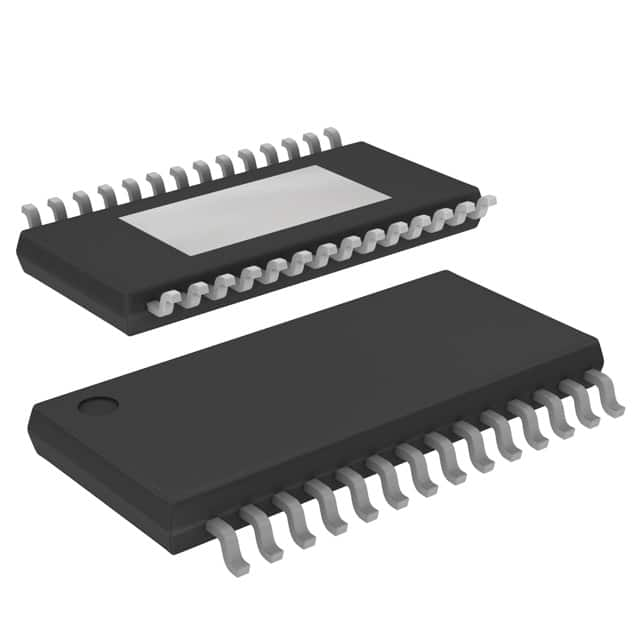
STMicroelectronics L6472HTR
- Part No.:
- L6472HTR
- Manufacturer:
- STMicroelectronics
- Category:
- Motor Drivers, Controllers
- Package:
- 28-TSSOP (0.173", 4.40mm Width) Exposed Pad
- Datasheet:
-
 L6472HTR.pdf
- Description:
- IC MTR DRV BIPLR 3.3/5V 28HTSSOP
- Quantity:
- Payment:

- Shipping:

Inventory:4,067
Please send an inquiry. Send us your inquiry, and we will respond immediately.
Product details
Overview
L6472HTR from STMicroelectronics is a fully integrated microstepping motor driver IC for two-phase bipolar stepper motors, featuring 8–45 V operation, 7.0 A peak / 3.0 A rms output current, adaptive decay predictive current control, up to 1/16 microstepping resolution, and SPI interface (5 Mbit/s). It enables precise open-loop motion control in compact industrial positioning systems.
For engineers reviewing the L6472HTR datasheet, L6472HTR pinout, L6472HTR application, or L6472HTR equivalent, this page delivers verified electrical specs, HTSSOP28 package mapping, functional alternatives, real-world use cases, and supply support - all grounded in ST's production-grade documentation (DocID022729 Rev 5).
Technical Context
The L6472HTR integrates dual low-RDS(on) DMOS full bridges with on-chip non-dissipative current sensing, enabling predictive current control and adaptive decay mode switching without external sense resistors. Its digital motion engine executes acceleration/deceleration profiles, absolute position tracking, and GoTo/GoUntil commands via SPI register writes.
It features dual overtemperature protection (warning + shutdown), programmable slew rate and deadtime for EMI optimization, internal 3 V LDO for logic supply, and BUSY/SYNC pins supporting synchronized multi-axis timing. The device operates autonomously after configuration, requiring no continuous host intervention during motion execution.
Key Specifications
| Parameter | Value and Actual Design Meaning |
|---|---|
| Supply Voltage | 8–45 V DC input range - supports wide industrial bus voltages including 12 V, 24 V, and 36 V systems without external regulators. |
| Output Current | 7.0 A peak / 3.0 A rms - delivers high torque at low speeds while maintaining thermal stability in HTSSOP28 package. |
| Microstepping Resolution | Up to 1/16 step - enables smooth motion and reduced resonance in precision positioning applications like lab automation stages. |
| SPI Interface Speed | 5 Mbit/s - allows rapid parameter updates and status reads, minimizing command latency in closed-loop hybrid systems. |
| Current Sensing | Non-dissipative on-chip sensing - eliminates external shunt resistors and associated power loss, improving efficiency and board space utilization. |
| Protection Features | Programmable overcurrent per MOSFET, UVLO, dual thermal thresholds (warning + shutdown) - ensures robust operation under stall, overload, or ambient temperature rise. |
| Decay Mode Control | Adaptive decay with predictive current regulation - dynamically adjusts fast/slow decay ratio per step to maintain torque linearity and reduce audible noise. |
Pinout & Package
Package: HTSSOP28 (thermally enhanced, 0.65 mm pitch, exposed thermal pad). Pinout validated per STMicroelectronics Figure 2 (HTSSOP28 top view) and Table 6 (Pin description) in DocID022729 Rev 5.
| Pin/Terminal | Circuit Role | Design Meaning |
|---|---|---|
| VDD | Logic supply input | 3.3 V ±5 % supply for internal digital core and SPI interface; decoupling required near pin. |
| VCC | Power stage supply input | Main 8–45 V motor supply; connects to external bulk capacitor and traces sized for 7 A peak current. |
| OUT1A–OUT2B | Full-bridge power outputs | Four terminals driving bipolar stepper coil phases (A+, A−, B+, B−); require low-inductance PCB layout. |
| REFIN | Reference voltage input | Analog reference for current regulation; sets full-scale current via external resistor network (TVAL registers). |
| SPI_CLK, SPI_MOSI, SPI_MISO, SPI_NSS | SPI interface signals | Standard 4-wire SPI interface operating up to 5 Mbit/s; NSS active-low enables multi-device sharing. |
| BUSY/SYNC | Multi-function status/timing pin | Configurable as BUSY flag (motion active) or SYNC clock output (for synchronized multi-driver systems). |
| FLAG | Interrupt output | Open-drain alert pin signaling alarms (overcurrent, thermal warning, undervoltage) or motion completion events. |
| SW | External switch input | Hardware limit switch interface supporting GoUntil and ReleaseSW commands with configurable polarity and debounce. |
Key Features
| Feature | Design Value |
|---|---|
| Programmable speed profiles | Acceleration, deceleration, max/min speed, and target position defined in registers - enables smooth S-curve motion without host CPU overhead. |
| Predictive current control | Real-time current prediction reduces chopper instability and improves torque consistency across microstep positions. |
| Non-dissipative current sensing | Integrated MOSFET RDS(on)-based sensing eliminates external shunts - cuts BOM cost and PCB area while preserving accuracy. |
| Adaptive decay mode | Automatic fast/slow decay ratio adjustment per step - minimizes current ripple and audible motor noise during microstepping. |
| Two-level thermal protection | Dedicated thermal warning (TWARN) and shutdown (TSHUT) thresholds - allows graceful fault handling before catastrophic failure. |
Applications
| Lab Automation Stage | Medical Infusion Pump |
|---|---|
|
Use Scenario: High-precision linear actuation of optical alignment stages with sub-micron repeatability requirements. IC Role / Device Role: Primary motion controller executing GoTo and Move commands with real-time position tracking via ABS_POS register. Use Value: 1/16 microstepping and predictive current control suppress vibration-induced image blur during microscope focusing sequences. |
Use Scenario: Silent, accurate syringe plunger advancement in portable infusion devices with battery-powered operation. IC Role / Device Role: Integrated driver managing torque-regulated acceleration and stall detection via OCD_TH and FLAG alerts. Use Value: Low quiescent current (<10 µA in standby) and non-dissipative sensing extend battery life while ensuring dose accuracy. |
| Industrial CNC Router | Automated Test Equipment (ATE) |
|
Use Scenario: Multi-axis X/Y gantry control in compact benchtop CNC machines with limited heatsinking capability. IC Role / Device Role: Dual full-bridge driver delivering 3.0 A rms per phase with adaptive decay to maintain torque at high step rates. Use Value: Thermal warning output triggers firmware-based speed derating before reaching shutdown threshold, avoiding abrupt motion stop. |
Use Scenario: Precision probe positioning in semiconductor wafer testers requiring repeatable 10 µm step accuracy. IC Role / Device Role: SPI-configured motion engine synchronizing with test sequencer via BUSY/SYNC pin for deterministic timing. Use Value: Absolute position counter (ABS_POS) enables zero-loss homing after power cycle without external encoders. |
Equivalent & Alternatives
The following parts are listed as comparable options for similar stepper motor driver applications.
| Alternative Part | Technical Difference | Application Difference | Selection Advice |
|---|---|---|---|
| TMC2209-LA | Integrated UART interface, stealthChop2 quiet stepping, lower max voltage (46 V), no internal LDO - requires external 3.3 V rail. | Better acoustic performance in consumer-grade printers; lacks dual thermal thresholds and SW pin hardware interrupt. | Choose for ultra-low-noise operation where SPI is not required and external logic supply is available. |
| DRV8825PWPR | Fixed decay mode, external current sense resistors, higher RDS(on), no position counter or motion engine - requires host MCU for profile generation. | Suitable for cost-sensitive, low-complexity systems; lacks autonomous motion execution and advanced protections. | Choose when BOM simplicity outweighs integrated motion intelligence and thermal robustness. |
Compared with TMC2209-LA, L6472HTR offers superior thermal fault management and SPI-driven motion autonomy; versus DRV8825PWPR, it eliminates external sensing components and offloads motion profiling - making it optimal for space-constrained industrial motion nodes requiring reliability and minimal host intervention.
Availability
L6472HTR is available at Aetrix Electronics and suitable for industrial CNC routers, medical infusion pumps, automated test equipment, and lab automation stages requiring stable component supply, long-term lifecycle assurance, and traceable sourcing.
Supply support for L6472HTR includes scheduled delivery planning, volume procurement assistance, BOM continuity management, traceable sourcing, and lifecycle availability coordination for OEM customers, industrial embedded developers, connected-device designers, and electronics production programs.
Manufacturer
STMicroelectronics is a global semiconductor leader headquartered in Geneva, specializing in power management, motion control, and microcontrollers for industrial, automotive, and consumer markets.
The L6472HTR belongs to ST's dedicated motion control IC portfolio, designed specifically for intelligent, highly integrated stepper motor solutions that reduce system complexity and improve positioning fidelity in resource-constrained embedded platforms.
FAQ
What is the maximum microstepping resolution supported by the L6472HTR?
The L6472HTR supports up to 1/16 microstepping, configured via the STEP_MODE register. This resolution is achieved using adaptive decay mode and predictive current control - not fixed decay - ensuring consistent torque and minimal resonance across all microstep positions. No external components are required to enable this mode.
Does the L6472HTR require external current sense resistors?
No. The L6472HTR uses non-dissipative on-chip current sensing based on internal MOSFET RDS(on) monitoring, eliminating the need for external shunt resistors. Current regulation is set digitally via TVAL_HOLD, TVAL_RUN, TVAL_ACC, and TVAL_DEC registers, referenced to the REFIN pin voltage.
Can the L6472HTR operate without an external microcontroller after initialization?
Yes. Once configured via SPI (e.g., setting SPEED, ACC, DEC, and STEP_MODE), the L6472HTR executes motion commands autonomously - including Run, Move, GoTo, and GoUntil - using its internal motion engine and absolute position counter (ABS_POS). Host intervention is only needed for new commands or status reads.
How does thermal protection work on the L6472HTR?
The L6472HTR implements two independent thermal thresholds: a warning level (~140 °C) asserted on the FLAG pin, and a shutdown level (~165 °C) that disables outputs. Both thresholds are factory-trimmed and do not require external components. The thermal warning allows firmware to initiate derating before shutdown occurs.
L6472HTR Specifications
- Product attributes
- Attribute value
- Manufacturer:
- STMicroelectronics
- Series:
- STSPIN L64
- Package/Case:
- 28-TSSOP (0.173", 4.40mm Width) Exposed Pad
- Packaging:
- Tape & Reel (TR)
- Product Status:
- Active
- Motor Type - Stepper:
- Bipolar
- Motor Type - AC, DC:
- -
- Function:
- Driver - Fully Integrated, Control and Power Stage
- Output Configuration:
- Half Bridge (4)
- Interface:
- SPI
- Technology:
- DMOS
- Step Resolution:
- 1 ~ 1/16
- Applications:
- General Purpose
- Current - Output:
- 3A
- Voltage - Supply:
- 3.3V, 5V
- Voltage - Load:
- 8V ~ 45V
- Operating Temperature:
- -40°C ~ 150°C (TJ)
- Grade:
- -
- Qualification:
- -
- Mounting Type:
- Surface Mount
- Supplier Device Package:
- 28-HTSSOP
L6472HTR FAQ
1.How can I place an order for L6472HTR through Aetrix?
Please submit a Request for Quotation (RFQ) for L6472HTR on Aetrix. Our sales agent will provide a competitive quotation and guide you through the order confirmation once you accept the terms.
2.Are the price and stock information for L6472HTR reliable?
The price and inventory of L6472HTR are updated periodically and may fluctuate due to market conditions. Stock and pricing data are typically refreshed every 24 hours. Quotation validity for L6472HTR is usually 5 days.
3.What payment methods are accepted for L6472HTR?
We accept Wire Transfer, PayPal, Credit Card, Western Union, MoneyGram, and Escrow for L6472HTR transactions.
Note: Certain payment methods may incur a processing fee.
4.How is shipping managed for L6472HTR?
L6472HTR orders can be shipped via leading logistics carriers, including DHL, UPS, FedEx, TNT, or Registered Mail.
Once your L6472HTR order is processed, you will receive an email with the shipment details and tracking number.
Note: Tracking information may take up to 24 hours to appear. Express delivery typically takes 3–5 business days.
5.How can I obtain technical support or documentation for L6472HTR?
For technical support, including L6472HTR datasheets, pinout diagrams, or application guidance, please contact our engineering support team. They can provide detailed documentation and assistance for your L6472HTR requirements.
6.How does Aetrix verify that L6472HTR is sourced from the original manufacturer or authorized distributors?
All L6472HTR products on Aetrix are procured from qualified distributors and authorized channels. Our dedicated quality assurance team conducts strict verification, including traceability checks and, if necessary, third-party testing. This ensures that L6472HTR meets industry standards.
7.What is the process for return or replacement of L6472HTR?
All L6472HTR units undergo pre-shipment inspection (PSI). If there is an issue with L6472HTR, returns or replacements are accepted under the following conditions:
1.Quantity discrepancies, incorrect items, or visible external defects (such as breakage or corrosion), acknowledged by Aetrix.
2.The issue is reported within 90 days of delivery.
3.The L6472HTR part is unused and in its original packaging.
Return procedure for L6472HTR:
1.Submit a request within 90 days.
2.Obtain a Return Material Authorization (RMA) from Aetrix.
L6472HTR Tags
-
DRV2603RUNR
Texas Instruments
-
DRV8837CDSGR
Texas Instruments
-
DRV8837DSGR
Texas Instruments
-
DRV8838DSGR
Texas Instruments
-
DRV8839DSSR
Texas Instruments
-
EMC2301-1-ACZL-TR
Microchip Technology
-
DRV8231ADSGR
Texas Instruments
-
EMC2302-2-AIZL-TR
Microchip Technology
-
DRV8800PWPR
Texas Instruments
-
DRV8835DSSR
Texas Instruments
-
EMC2303-1-KP-TR
Microchip Technology
-
DRV8876PWPR
Texas Instruments
Tech Hub

An engineering guide to LED driver operation, constant-current and constant-voltage outputs, linear and switching topologies, dimming, IC selection, calculations, replacement compatibility, and fault c…

Operational amplifier guide covering op amp basics, feedback, ideal vs real op amps, common configurations, buffer circuits, offset, bias current, gain-bandwidth, slew rate, rail-to-rail limits and sel…

Jumper cables guide covering safe connection order, red and black clamp placement, final ground connection, cable gauge, length, clamp quality, copper vs CCA cables, jump starter comparison and battery…

LDO regulator guide covering low dropout voltage, power dissipation, thermal design, PSRR, output noise, capacitor stability, adjustable LDO circuits, LDO vs buck converter and datasheet selection chec…

Conditional Access Module guide covering CAM meaning, CI/CI+ interface, smart card authorization, DVB security workflow, TV and set-top box compatibility, internal electronics, ESD protection, connecto…

Guide to electronic component obsolescence covering EOL risk, PCN/PDN notices, last-time buy planning, replacement options, form-fit-function validation, counterfeit risk and BOM lifecycle management.

18650 battery guide covering lithium-ion cell basics, 3.6V/3.7V voltage, 4.2V charging, mAh and Wh capacity, protected cells, chargers, BMS, series-parallel packs, holders, welding and sourcing checks.…

Hall effect sensor guide covering working principle, linear and digital sensors, Arduino circuits, current sensing, speed detection, automotive applications, A3144 examples, signal filtering and datash…

Product Change Notification guide for electronic components, covering PCN meaning, PCN vs PDN/EOL, common change types, risk levels, form-fit-function review, engineering validation, BOM control, LTB/L…

A practical guide to blend door actuators, covering HVAC function, symptoms, location, AC and heater issues, reset and calibration, replacement cost, electrical diagnosis, compatibility checks, and rep…


