
 My Inquiry
 My Account


STMicroelectronics L9639
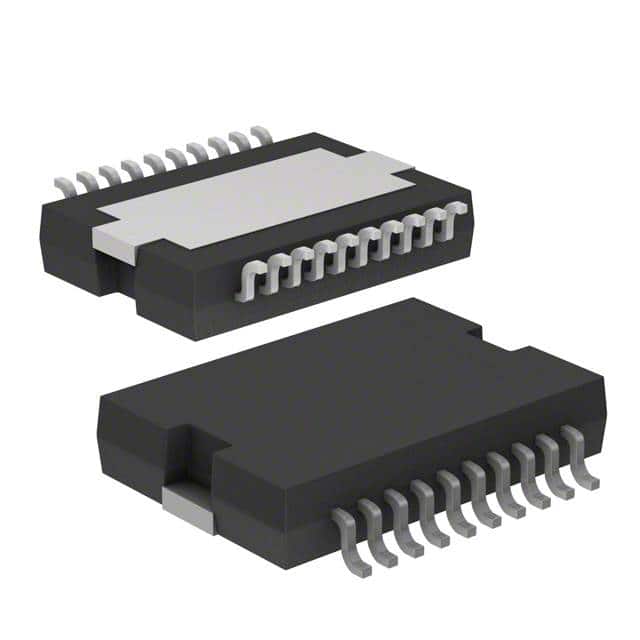
- Part No.:
- L9639
- Manufacturer:
- STMicroelectronics
- Category:
- Motor Drivers, Controllers
- Package:
- 20-SOIC (0.433", 11.00mm Width) Exposed Pad
- Datasheet:
-
 L9639.pdf
- Description:
- IC MOTOR DRIVER 8V-17V 20POWERSO
- Quantity:
- Payment:

- Shipping:

Inventory:2,018
Please send an inquiry. Send us your inquiry, and we will respond immediately.
Product details
Overview
L9639 from STMicroelectronics is a bidirectional motor stop controller IC with integrated dual DMOS power switches, active diode bridge, and programmable current thresholds (ITH = 70–135 µA reference, ITHCC = 240–690 µA) for start-up and end-of-travel detection. It delivers >8 A output current capability, 50 V max supply voltage, thermal protection, and short-circuit shutdown in <100 µs - used in DC motor servomechanisms for position-limited actuators such as automotive HVAC flaps and industrial valve drives.
For engineers reviewing the L9639 datasheet, L9639 pinout, L9639 application, or L9639 equivalent, this page provides verified functional identity, PowerSO-20 package mapping, live/common polarity reversal control logic, external RSHUNT/CEX/REX programming interface, and confirmed alternatives for motor end-stop replacement circuits requiring stall-current-based timing and overcurrent safety.
Technical Context
The L9639 implements a polarity-reversal-triggered bidirectional motor control architecture using an internally fused active bridge to power its logic from either COMMON–LIVE polarity configuration. Its current sensing relies on a precision internal reference (VTH ≈ 100 mV typical) compared against voltage across an external shunt resistor to detect both start-up stall and mechanical end-of-travel conditions.
Timing delay TD for motor run-to-stop transition is set by external REX and CEX components via a charge-pump-controlled RC integrator (KTD ≈ 1), while short-circuit response uses a separate higher-threshold comparator (ITHCC) with sub-100 µs shutdown latency. The device operates from 8–17 V supply and enters low-quiescent standby (100–200 µA) after stop confirmation.
Key Specifications
| Parameter | Value and Actual Design Meaning |
|---|---|
| Supply Voltage | 8–17 V operating range; supports 12 V automotive systems with margin up to 50 V absolute max. |
| Output Current | >8 A continuous; enables direct drive of medium-power DC motors without external boost stages. |
| Current Threshold Ref | Iref = 70–135 µA; sets ITH = VTH/RSHUNT for start/end detection independent of Vbat. |
| Short-Circuit Threshold | Irefcc = 240–690 µA (Vbat-dependent); triggers immediate shutdown if load exceeds safe stall margin. |
| Delay Constant KTD | ≈1; defines TD = REX × CEX × KTD for programmable run-to-stop timing (e.g., obstacle bypass). |
| Ron (DMOS) | 0.6–1.0 Ω at 1.2 A; limits conduction loss and self-heating during bidirectional motor drive. |
| Thermal Resistance | Rth j-case = 4 °C/W; enables high-power operation with minimal heatsinking in PowerSO-20 package. |
Pinout & Package
Package: PowerSO-20 (JEDEC MO-166), thermally enhanced exposed slug, 15.8 × 14.5 mm body, 1.1 mm height, 10° max lead angle. Designed for surface-mount assembly with case-to-PCB thermal path via slug soldering.
| Pin/Terminal | Circuit Role | Design Meaning |
|---|---|---|
| COMMON (1,10,11,20) | Bridge return / polarity reference | Common node for bidirectional motor connection; polarity inversion triggers new motor cycle. |
| LIVE (2) | Bridge input / polarity input | Alternate polarity input; combined with COMMON determines motor direction and powers internal logic. |
| V+ (14) | Internal supply rail | Filtered internal supply output (requires 100 nF capacitor to GND); powers control logic and charge pump. |
| GND (1,10,11,20) | Logic ground | Reference for all analog comparators, reference generators, and digital blocks. |
| OUT (3,4) | Power switch outputs | Drain terminals of series-connected DMOS transistors; connect directly to motor terminals. |
| SHUNT (5,6,17,16) | Current sense input | Inputs to internal current-sense amplifier; connected to external RSHUNT for ITH/ITHCC detection. |
| RCEX (8) | Delay timing resistor | Connects external REX to set TD delay time with CEX; forms RC network with internal comparator. |
| VREF (19) | Reference voltage output | Provides stable internal VTH (~100 mV) for threshold comparison; decoupling recommended. |
Key Features
| Feature | Design Value |
|---|---|
| Bidirectional polarity control | Enables full-cycle motor actuation (start → run → stop → reverse) using only COMMON/LIVE polarity swap - no external H-bridge logic required. |
| Programmable current thresholds | Separate ITH (70–135 µA) and ITHCC (240–690 µA) references allow independent tuning of mechanical end-stop detection vs. fault shutdown. |
| Active diode bridge | Internally fused bridge supplies internal circuitry from either polarity - eliminates need for external polarity protection or auxiliary supply. |
| Sub-100 µs short-circuit response | Guarantees motor de-energization before thermal damage occurs under hard short or stalled rotor conditions. |
| Open-load detection | Monitors load resistance up to 200 Ω; flags disconnected motor or broken wiring before attempted actuation. |
Applications
| Automotive HVAC Flap Actuator | Industrial Valve Positioner |
|---|---|
Use Scenario: Precise bi-directional movement of HVAC blend/air mode flaps between fully open and fully closed positions. IC Role / Device Role / Timing Role: Motor stop controller detecting stall current at mechanical limits; replaces mechanical microswitches with electronic end-stop sensing. Use Value: Eliminates switch wear and contact bounce; enables repeatable positioning accuracy within ±1° via programmable ITH and TD. | Use Scenario: Linear or rotary actuation of pneumatic/hydraulic control valves in process automation systems. IC Role / Device Role / Timing Role: Bidirectional motor driver with torque-based end-of-travel detection and automatic standby recovery. Use Value: Reduces system BOM by integrating bridge, sensing, timing, and protection - no external comparators or timers needed. |
| Office Equipment Paper Path Gate | Appliance Door Lock Mechanism |
Use Scenario: Controlled opening/closing of paper gate assemblies in printers and copiers to manage sheet feeding sequence. IC Role / Device Role / Timing Role: Current-threshold-based motor stop controller with built-in delay to absorb mechanical backlash and gear train inertia. Use Value: Ensures reliable gate positioning despite variable friction; TD programmability accommodates aging or lubrication changes. | Use Scenario: Secure locking/unlocking of washing machine or dishwasher doors using small DC motor-driven latches. IC Role / Device Role / Timing Role: Safety-critical motor controller with immediate short-circuit shutdown (<100 µs) and thermal foldback. Use Value: Prevents latch motor burnout during jammed condition; meets IEC 60335-1 motor protection requirements. |
Equivalent & Alternatives
The following parts are listed as comparable options for similar bidirectional motor stop control applications.
| Alternative Part | Technical Difference | Application Difference | Selection Advice |
|---|---|---|---|
| L9637 | Single-direction only; no LIVE/COMMON polarity reversal support; lower ITHCC threshold (200 µA typ). | Suitable only for unidirectional end-stop applications; lacks active bridge and polarity-triggered restart. | Select when motor motion is strictly one-way and cost reduction outweighs flexibility loss. |
| VNQ5E050AK | Quad-channel high-side driver; no integrated current threshold logic or TD delay; requires external MCU for sequencing. | Requires external microcontroller for start/run/stop state machine and current monitoring. | Choose when system already includes MCU-based motor control and needs distributed high-side switching. |
Compared with L9639, L9637 lacks bidirectional autonomy and active bridge functionality, limiting it to simpler fixed-direction use cases; VNQ5E050AK offers channel scalability but shifts timing, sensing, and safety logic to external firmware - increasing design complexity and BOM count.
Availability
L9639 is available at Aetrix Electronics and suitable for automotive HVAC actuation, industrial valve positioning, office equipment paper path control, and appliance door lock mechanisms requiring stable component supply and long-term lifecycle support.
Supply support for L9639 includes scheduled delivery planning, volume procurement assistance, BOM continuity management, traceable sourcing, and lifecycle availability coordination for OEM customers, industrial embedded developers, connected-device designers, and electronics production programs.
Manufacturer
STMicroelectronics is a global semiconductor leader headquartered in Geneva, Switzerland, designing and manufacturing analog, mixed-signal, power, and microcontroller products for industrial, automotive, and consumer markets.
The L9639 belongs to ST's Automotive & Discrete Power portfolio, specifically the "Motor Control & Driver" product line, engineered for electromechanical actuation systems requiring integrated protection, polarity-agnostic operation, and deterministic end-stop detection without microcontroller dependency.
FAQ
What is the function of the RCEX pin on the L9639?
The RCEX pin connects to an external resistor (REX) that, together with an external capacitor (CEX), sets the programmable time delay TD for motor run-to-stop transition. TD = REX × CEX × KTD (KTD ≈ 1). This delay allows the motor to overcome minor mechanical obstacles during free-run phase before triggering end-stop shutdown.
Can the L9639 drive a 24 V motor?
No - the L9639 is specified for 8–17 V operating supply, with absolute maximum Vbat = 50 V. While it survives transient 24 V spikes, sustained 24 V operation exceeds its guaranteed electrical characteristics and risks premature thermal shutdown or reference drift. Use only within 8–17 V nominal systems.
How does the L9639 detect open-load conditions?
The L9639 integrates an open-load detector that monitors effective load resistance between OUT pins. If resistance exceeds 200 Ω (indicating disconnected motor or broken wiring), the device prevents activation and signals fault via quiescent current behavior - no external circuitry required.
Is the L9639 still in active production?
The L9639 is marked "Obsolete Product(s)" in its official datasheet revision (1998), but remains available through authorized legacy distributors and Aetrix Electronics' long-life component program with full traceability, extended warehouse stock, and engineering support for legacy system maintenance and replacement.
L9639 Specifications
- Product attributes
- Attribute value
- Manufacturer:
- STMicroelectronics
- Series:
- -
- Package/Case:
- 20-SOIC (0.433", 11.00mm Width) Exposed Pad
- Packaging:
- Tube
- Product Status:
- Obsolete
- Motor Type - Stepper:
- -
- Motor Type - AC, DC:
- Brushed DC
- Function:
- Driver - Fully Integrated, Control and Power Stage
- Output Configuration:
- Half Bridge (2)
- Interface:
- On/Off
- Technology:
- DMOS
- Step Resolution:
- -
- Applications:
- General Purpose
- Current - Output:
- 5A
- Voltage - Supply:
- 8V ~ 17V
- Voltage - Load:
- 8V ~ 17V
- Operating Temperature:
- -40°C ~ 125°C (TA)
- Grade:
- -
- Qualification:
- -
- Mounting Type:
- Surface Mount
- Supplier Device Package:
- PowerSO-20
L9639 FAQ
1.How can I place an order for L9639 through Aetrix?
Please submit a Request for Quotation (RFQ) for L9639 on Aetrix. Our sales agent will provide a competitive quotation and guide you through the order confirmation once you accept the terms.
2.Are the price and stock information for L9639 reliable?
The price and inventory of L9639 are updated periodically and may fluctuate due to market conditions. Stock and pricing data are typically refreshed every 24 hours. Quotation validity for L9639 is usually 5 days.
3.What payment methods are accepted for L9639?
We accept Wire Transfer, PayPal, Credit Card, Western Union, MoneyGram, and Escrow for L9639 transactions.
Note: Certain payment methods may incur a processing fee.
4.How is shipping managed for L9639?
L9639 orders can be shipped via leading logistics carriers, including DHL, UPS, FedEx, TNT, or Registered Mail.
Once your L9639 order is processed, you will receive an email with the shipment details and tracking number.
Note: Tracking information may take up to 24 hours to appear. Express delivery typically takes 3–5 business days.
5.How can I obtain technical support or documentation for L9639?
For technical support, including L9639 datasheets, pinout diagrams, or application guidance, please contact our engineering support team. They can provide detailed documentation and assistance for your L9639 requirements.
6.How does Aetrix verify that L9639 is sourced from the original manufacturer or authorized distributors?
All L9639 products on Aetrix are procured from qualified distributors and authorized channels. Our dedicated quality assurance team conducts strict verification, including traceability checks and, if necessary, third-party testing. This ensures that L9639 meets industry standards.
7.What is the process for return or replacement of L9639?
All L9639 units undergo pre-shipment inspection (PSI). If there is an issue with L9639, returns or replacements are accepted under the following conditions:
1.Quantity discrepancies, incorrect items, or visible external defects (such as breakage or corrosion), acknowledged by Aetrix.
2.The issue is reported within 90 days of delivery.
3.The L9639 part is unused and in its original packaging.
Return procedure for L9639:
1.Submit a request within 90 days.
2.Obtain a Return Material Authorization (RMA) from Aetrix.
L9639 Tags
-
DRV2603RUNR
Texas Instruments
-
DRV8837CDSGR
Texas Instruments
-
DRV8837DSGR
Texas Instruments
-
DRV8838DSGR
Texas Instruments
-
DRV8839DSSR
Texas Instruments
-
EMC2301-1-ACZL-TR
Microchip Technology
-
DRV8231ADSGR
Texas Instruments
-
EMC2302-2-AIZL-TR
Microchip Technology
-
DRV8800PWPR
Texas Instruments
-
DRV8835DSSR
Texas Instruments
-
EMC2303-1-KP-TR
Microchip Technology
-
DRV8876PWPR
Texas Instruments
Tech Hub

A practical engineering guide to 3.3V and 5V logic compatibility, input thresholds, resistor dividers, translator ICs, MOSFET level shifting, I2C pull-ups, timing limits and power-sequencing risks.

The 74HC595 uses push-pull logic outputs, while the TPIC6B595 uses 50 V open-drain DMOS sinks for higher-power loads. This guide compares timing, current limits, 3.3 V interfacing, load wiring, thermal…

The 74HC595 converts serial data into eight stable parallel outputs. This guide covers pin functions, shift and storage timing, OE and MR behavior, drive-current limits, cascading, voltage compatibilit…

A technical comparison of level-sensitive latches and edge-triggered flip-flops, covering timing windows, setup and hold limits, master–slave operation, time borrowing, race-through, HDL inference and…

A D latch stores one bit while Enable controls when data can pass. This reference covers gate-level operation, truth tables, transparency, setup and hold timing, LE versus OE, common ICs and practical …

An SR latch stores one bit through cross-coupled feedback. This engineering reference covers NOR and NAND implementations, truth tables, forbidden-state recovery, gated operation, switch debouncing, fa…

Latch circuits retain one bit through feedback. This technical reference covers SR and D latches, truth tables, transparency, timing limits, latch-versus-flip-flop behavior, applications and common log…

An engineering guide to LED driver operation, constant-current and constant-voltage outputs, linear and switching topologies, dimming, IC selection, calculations, replacement compatibility, and fault c…

Operational amplifier guide covering op amp basics, feedback, ideal vs real op amps, common configurations, buffer circuits, offset, bias current, gain-bandwidth, slew rate, rail-to-rail limits and sel…

Jumper cables guide covering safe connection order, red and black clamp placement, final ground connection, cable gauge, length, clamp quality, copper vs CCA cables, jump starter comparison and battery…


