
 My Inquiry
 My Account


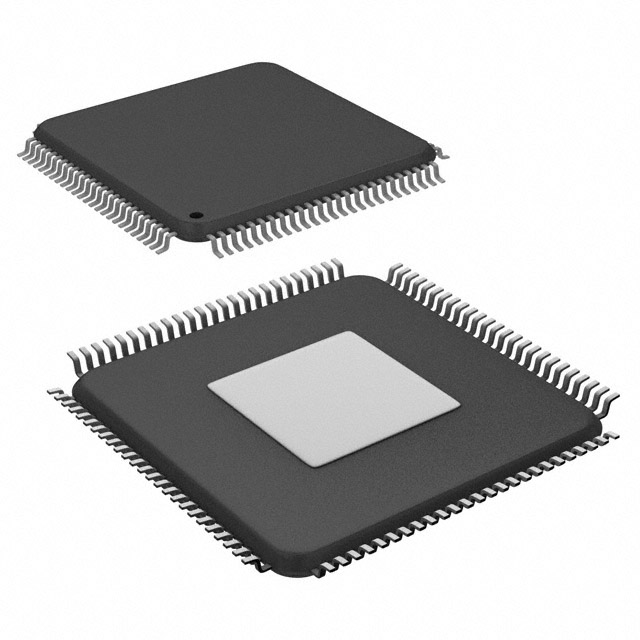
STMicroelectronics L9680TR
- Part No.:
- L9680TR
- Manufacturer:
- STMicroelectronics
- Category:
- Specialized
- Package:
- 100-TQFP Exposed Pad
- Datasheet:
-
 L9680TR.pdf
- Description:
- IC INTERFACE SPECIALIZED 100TQFP
- Quantity:
- Payment:

- Shipping:

Inventory:2,534
Please send an inquiry. Send us your inquiry, and we will respond immediately.
Product details
Overview
L9680TR from STMicroelectronics is an AEC-Q100 qualified automotive airbag system IC integrating 12-channel squib/pyroswitch drivers, four PSI-5 remote sensor interfaces, three configurable GPOs, nine DC sensor inputs, dual boost (ERBOOST/SYNCBOOST) and triple buck (SATBUCK/VCC/VSF) regulators, energy reserve crossover switch (3 Ω, 912 mA), and 32-bit SPI interface - deployed in mid/high-end airbag control units for passenger and driver-side deployment with cut-off battery and pyro-fuse management.
For engineers reviewing the L9680TR datasheet, L9680TR pinout, L9680TR application, or L9680TR equivalent, this device requires precise validation of squib resistance measurement (Rmeasure), STB/STG diagnostics, PSI-5 timing compliance, safing logic configuration, and ER capacitor ESR diagnostics in safety-critical airbag ECU designs.
Technical Context
The L9680TR implements a multi-regulator power architecture: ERBOOST (23 V/33 V ±5%, 1.882 MHz) charges the energy reserve capacitor; SYNCBOOST (12 V/14.75 V) powers PSI-5 SYNC pulses; SATBUCK (7.2 V/9 V ±4%) supplies remote sensors; VCC buck (3.3 V/5.0 V ±3%) powers the MCU; and VSF regulates the safing switch. All switching regulators operate at fixed 1.882 MHz for EMI control and filter size reduction.
Its deployment subsystem features 12 independently controlled HSD/LSD drivers with current monitoring, Rmeasure, leakage (VRCM), STB/STG, and FET integrity tests. Safing logic is user-customizable via SPI-configurable thresholds, arming matrices, and temporal (WD1) and algorithmic (WD2) watchdogs - enabling deterministic, ASIL-B compliant arming decisions per ISO 26262.
Key Specifications
| Parameter | Value and Actual Design Meaning |
|---|---|
| Operating Voltage | 5.5 V minimum at battery pin - ensures reliable startup during cold-crank transients down to 5.5 V. |
| Deployment Drivers | 12-channel HSD/LSD, 25 V max deployment voltage - supports dual-stage squibs and pyro-fuses across front/side/curtain modules. |
| Energy Reserve Switch | 3 Ω RDS(on), 912 mA max current - enables fast, low-loss energy transfer to squib during deployment. |
| Regulator Switching Freq | 1.882 MHz fixed frequency - allows compact external LC filters and reduces audible noise in cabin environments. |
| Remote Sensor Interface | Four-channel PSI-5 + active wheel speed support - enables daisy-chained satellite sensors with CRC-protected data integrity. |
| SPI Interface | 32-bit wide, full-duplex - provides high-bandwidth register access for real-time diagnostics and dynamic safing reconfiguration. |
| Temperature Range | −40 °C to +95 °C ambient - validated for under-hood and dashboard ECU mounting locations. |
| AEC-Q100 Grade | Grade 1 qualification - certifies operation over full automotive temperature range with robust stress testing. |
Pinout & Package
TQFP100 exposed pad down (14 mm × 14 mm × 1.0 mm), thermally enhanced for sustained 12-channel driver operation and regulator thermal dissipation.
| Pin/Terminal | Circuit Role | Design Meaning |
|---|---|---|
| VBAT | Battery supply input | Primary power rail; monitors battery voltage for shutdown/wake-up and powers internal LDOs and regulators. |
| ERBOOST_OUT | Energy reserve boost output | Drives external energy reserve capacitor (23 V/33 V); includes ESR/capacitance diagnostic capability. |
| SYNCBOOST_OUT | PSI-5 SYNC pulse boost output | Generates 12 V/14.75 V regulated SYNC signal for PSI-5 satellite sensors; synchronized to internal clock. |
| SATBUCK_OUT | Remote sensor buck output | Supplies 7.2 V/9 V to PSI-5 or WSS sensors; supports diagnostics including open/short-to-rail detection. |
| VCC_OUT | MCU supply buck output | Configurable 3.3 V or 5.0 V ±3% output; powers connected microcontroller with tight regulation for ADC/SPI stability. |
| COVRACT | Energy reserve crossover switch control | Active-high enable for integrated 3 Ω crossover switch; indicates switch status via dedicated output indicator. |
| DEPx_H / DEPx_L | Squib/pyroswitch driver terminals | 12 pairs (HSD/LSD) supporting bidirectional current monitoring, Rmeasure, and STB/STG diagnostics per channel. |
| PSI5_CHy | PSI-5 sensor interface channel | Four differential inputs with integrated termination, current source, and CRC validation for daisy-chained sensors. |
| DCIN_z | DC sensor input | Nine single-ended inputs for hall-effect, resistive, or switch sensors; configurable thresholds and pull-ups. |
| GPO_a / GPO_b / GPO_c | General-purpose output | Three PWM-controllable (0–100%) outputs configurable as HSD, LSD, or open-drain - used for status signaling or auxiliary actuation. |
Key Features
| Feature | Design Value |
|---|---|
| Integrated energy reserve crossover switch | 3 Ω RDS(on) switch with active output indicator - eliminates need for external MOSFET and gate driver in ER path. |
| Capacitor diagnostics | Simultaneous ER capacitor value and ESR measurement - enables field-deployable health monitoring without external test equipment. |
| User-customizable safing logic | SPI-configurable thresholds, arming matrices, and safing record comparison - supports OEM-specific crash algorithms and passenger inhibit logic. |
| End-of-life disposal interface | Dedicated hardware pin and SPI command for secure device decommissioning - meets automotive recycling and data sanitization requirements. |
| Temporal + algorithmic watchdogs | WD1 (timer-based) and WD2 (challenge-response) - provide layered fault detection for ASIL-B compliance and fail-safe reset behavior. |
| Passenger airbag disarm signal | Dedicated PSINH input with configurable upper/lower thresholds - enables seat occupancy detection integration without MCU intervention. |
Applications
| Frontal Airbag Control Unit | Side-Curtain Airbag Module |
|---|---|
|
Use Scenario: Central airbag ECU managing driver and passenger frontal squibs, seatbelt pretensioners, and occupant classification sensors. IC Role / Device Role / Timing Role: Primary airbag system controller executing safing logic, deploying squibs within ≤30 ms of crash detection, and validating squib continuity pre-deployment. Use Value: Integrated 12-channel drivers and Rmeasure diagnostics eliminate discrete driver ICs and external sense resistors - reducing BOM count and PCB area by >25%. |
Use Scenario: Compact side-curtain module mounted in roof rail, requiring local squib drive, PSI-5 satellite sensor interface, and energy reserve hold-off. IC Role / Device Role / Timing Role: Standalone deployment controller with embedded ERBOOST, COVRACT switch, and four PSI-5 channels - enabling daisy-chained curtain sensors without host ECU dependency. Use Value: Fixed 1.882 MHz regulator switching frequency minimizes EMI coupling into adjacent antenna systems - critical for roof-mounted RF modules. |
| Cut-Off Battery System | Pyro-Fuse Management Unit |
|
Use Scenario: High-voltage battery disconnect system triggered by crash event, using pyro-based fuses to isolate traction battery. IC Role / Device Role / Timing Role: Dedicated pyro-fuse driver with STB/STG diagnostics and leakage monitoring - ensuring fuse integrity before and after activation. Use Value: Dual independent deployment profiles (fast/slow) allow optimized current ramp for different pyro-fuse types - preventing premature rupture or incomplete separation. |
Use Scenario: Redundant pyro-switch control in ADAS domain controllers, where mechanical relay failure must be mitigated with solid-state backup. IC Role / Device Role / Timing Role: High-side safing switch regulator with enable control and FET integrity test - providing fail-safe isolation between MCU and pyro load. Use Value: Integrated VSF regulator delivers stable gate drive voltage independent of main battery fluctuations - ensuring consistent turn-on characteristics across −40 °C to +95 °C. |
Equivalent & Alternatives
The following parts are listed as comparable options for similar airbag system controller applications.
| Alternative Part | Technical Difference | Application Difference | Selection Advice |
|---|---|---|---|
| NXP MC33816 | 8-channel squib drivers; no integrated ERBOOST or PSI-5 interface - requires external boost converter and sensor interface ICs. | Targeted at cost-sensitive entry-level airbag ECUs with simpler sensor counts and no satellite architecture. | Select when BOM cost is prioritized over integration density and PSI-5 scalability. |
| Renesas RAA278812 | 16-channel drivers; supports CAN FD but lacks ER capacitor ESR diagnostics and passenger inhibit threshold registers. | Designed for zonal architectures with centralized power distribution and CAN-based sensor aggregation. | Select when CAN FD connectivity and higher channel count outweigh need for on-chip ER health monitoring. |
Compared with MC33816 and RAA278812, the L9680TR uniquely integrates ER capacitor diagnostics, PSI-5 native support, and configurable passenger inhibit logic - making it optimal for mid/high-end airbag ECUs requiring autonomous satellite sensor management and field-deployable energy reserve validation.
Availability
L9680TR is available at Aetrix Electronics and suitable for mid/high-end airbag systems, cut-off battery systems, and pyro-fuse/switch management requiring stable component supply, long-term automotive lifecycle support, and AEC-Q100 traceability.
Supply support for L9680TR includes scheduled delivery planning, volume procurement assistance, BOM continuity management, traceable sourcing, and lifecycle availability coordination for OEM customers, industrial embedded developers, connected-device designers, and electronics production programs.
Manufacturer
STMicroelectronics is a global semiconductor leader specializing in automotive, power, and embedded solutions, with decades of safety-critical IC development experience.
The L9680TR belongs to ST's automotive airbag system IC product line, engineered specifically for ASIL-B compliant, high-integration airbag ECUs that require consolidated power regulation, multi-sensor interfacing, and deterministic deployment control.
FAQ
What is the maximum continuous current rating of the integrated energy reserve crossover switch?
The L9680TR's integrated energy reserve crossover switch supports up to 912 mA continuous current with a typical RDS(on) of 3 Ω. This rating is validated across the full −40 °C to +95 °C operating temperature range and includes thermal derating curves in Section 17.10 of the datasheet. Peak pulsed current capability exceeds 1.5 A for <100 µs durations during squib firing sequences.
Does the L9680TR support both PSI-5 and active wheel speed sensor protocols on the same interface pins?
Yes - the four remote sensor channels support either PSI-5 (differential, current-loop) or active wheel speed sensor (WSS) modes via SPI-configurable RSCRx registers. Each channel operates independently; PSI-5 uses constant-current sourcing with Manchester-encoded data, while WSS mode applies programmable bias and thresholds for variable-reluctance or Hall-effect signals. Mode selection is per-channel and non-overlapping.
How does the L9680TR perform squib resistance measurement (Rmeasure) without external components?
Rmeasure is executed using internal current sources and ADC paths: a precision 1 mA current is forced through the squib loop, and the resulting voltage drop is measured across dedicated sense nodes (STB/STG). The integrated 12-bit ADC digitizes the result, and the value is reported in DCMTSxy registers. Calibration coefficients are stored in OTP memory to correct for channel-to-channel gain/offset mismatches.
Can the safing logic be reconfigured in-field via SPI, and what safeguards prevent unauthorized changes?
Safing logic parameters - including thresholds, arming matrices, and comparison masks - are fully SPI-reconfigurable during ACTIVE mode. Unauthorized writes are prevented by a two-stage safeguard: (1) SAF_ENABLE register must be set to '1' before any SAF_CONTROL_x write, and (2) all safing record updates require matching seed/key challenge-response handshake via WD2_SEED/WD2_KEY registers - implemented in hardware with tamper-resistant OTP storage.
L9680TR Specifications
- Product attributes
- Attribute value
- Manufacturer:
- STMicroelectronics
- Series:
- -
- Package/Case:
- 100-TQFP Exposed Pad
- Packaging:
- Tape & Reel (TR)
- Product Status:
- Active
- Applications:
- -
- Interface:
- SPI
- Voltage - Supply:
- 5.5V
- Supplier Device Package:
- 100-TQFP (14x14)
- Grade:
- Automotive
- Qualification:
- AEC-Q100
- Mounting Type:
- Surface Mount
L9680TR FAQ
1.How can I place an order for L9680TR through Aetrix?
Please submit a Request for Quotation (RFQ) for L9680TR on Aetrix. Our sales agent will provide a competitive quotation and guide you through the order confirmation once you accept the terms.
2.Are the price and stock information for L9680TR reliable?
The price and inventory of L9680TR are updated periodically and may fluctuate due to market conditions. Stock and pricing data are typically refreshed every 24 hours. Quotation validity for L9680TR is usually 5 days.
3.What payment methods are accepted for L9680TR?
We accept Wire Transfer, PayPal, Credit Card, Western Union, MoneyGram, and Escrow for L9680TR transactions.
Note: Certain payment methods may incur a processing fee.
4.How is shipping managed for L9680TR?
L9680TR orders can be shipped via leading logistics carriers, including DHL, UPS, FedEx, TNT, or Registered Mail.
Once your L9680TR order is processed, you will receive an email with the shipment details and tracking number.
Note: Tracking information may take up to 24 hours to appear. Express delivery typically takes 3–5 business days.
5.How can I obtain technical support or documentation for L9680TR?
For technical support, including L9680TR datasheets, pinout diagrams, or application guidance, please contact our engineering support team. They can provide detailed documentation and assistance for your L9680TR requirements.
6.How does Aetrix verify that L9680TR is sourced from the original manufacturer or authorized distributors?
All L9680TR products on Aetrix are procured from qualified distributors and authorized channels. Our dedicated quality assurance team conducts strict verification, including traceability checks and, if necessary, third-party testing. This ensures that L9680TR meets industry standards.
7.What is the process for return or replacement of L9680TR?
All L9680TR units undergo pre-shipment inspection (PSI). If there is an issue with L9680TR, returns or replacements are accepted under the following conditions:
1.Quantity discrepancies, incorrect items, or visible external defects (such as breakage or corrosion), acknowledged by Aetrix.
2.The issue is reported within 90 days of delivery.
3.The L9680TR part is unused and in its original packaging.
Return procedure for L9680TR:
1.Submit a request within 90 days.
2.Obtain a Return Material Authorization (RMA) from Aetrix.
L9680TR Tags
-
NVT4857UKAZ
NXP Semiconductors
-
TCA8418RTWR
Texas Instruments

-
PCA9546APWR
Texas Instruments
-
MD0100N8-G
Microchip Technology
-
PCA9548APW,118
NXP Semiconductors
-
PCA9540BDP,118
NXP Semiconductors
-
PCA9548APWR
Texas Instruments
-
PCA9546APW,118
NXP Semiconductors
-
PTN3360DBS,518
NXP Semiconductors
-
PCA9546ABS,118
NXP Semiconductors
-
PCA9518PWR
Texas Instruments
-
PCA9545APW,118
NXP Semiconductors
Tech Hub

A practical engineering guide to 3.3V and 5V logic compatibility, input thresholds, resistor dividers, translator ICs, MOSFET level shifting, I2C pull-ups, timing limits and power-sequencing risks.

The 74HC595 uses push-pull logic outputs, while the TPIC6B595 uses 50 V open-drain DMOS sinks for higher-power loads. This guide compares timing, current limits, 3.3 V interfacing, load wiring, thermal…

The 74HC595 converts serial data into eight stable parallel outputs. This guide covers pin functions, shift and storage timing, OE and MR behavior, drive-current limits, cascading, voltage compatibilit…

A technical comparison of level-sensitive latches and edge-triggered flip-flops, covering timing windows, setup and hold limits, master–slave operation, time borrowing, race-through, HDL inference and…

A D latch stores one bit while Enable controls when data can pass. This reference covers gate-level operation, truth tables, transparency, setup and hold timing, LE versus OE, common ICs and practical …

An SR latch stores one bit through cross-coupled feedback. This engineering reference covers NOR and NAND implementations, truth tables, forbidden-state recovery, gated operation, switch debouncing, fa…

Latch circuits retain one bit through feedback. This technical reference covers SR and D latches, truth tables, transparency, timing limits, latch-versus-flip-flop behavior, applications and common log…

An engineering guide to LED driver operation, constant-current and constant-voltage outputs, linear and switching topologies, dimming, IC selection, calculations, replacement compatibility, and fault c…

Operational amplifier guide covering op amp basics, feedback, ideal vs real op amps, common configurations, buffer circuits, offset, bias current, gain-bandwidth, slew rate, rail-to-rail limits and sel…

Jumper cables guide covering safe connection order, red and black clamp placement, final ground connection, cable gauge, length, clamp quality, copper vs CCA cables, jump starter comparison and battery…


