
 My Inquiry
 My Account


Microchip Technology LE79271MQCT
- Part No.:
- LE79271MQCT
- Manufacturer:
- Microchip Technology
- Category:
- Telecom
- Package:
- 28-VFQFN Exposed Pad
- Datasheet:
-
 LE79271MQCT.pdf
- Description:
- IC TELECOM INTERFACE 28QFN
- Quantity:
- Payment:

- Shipping:

Inventory:3,432
Please send an inquiry. Send us your inquiry, and we will respond immediately.
Product details
Overview
LE79271MQCT from Microchip Technology (acquired Microsemi) is a Next Generation Carrier Chipset (NGCC) Subscriber Line Interface Circuit (SLIC) designed for high-density, software-programmable POTS line interfaces in DSL-access systems. It delivers programmable AC/DC feed, 85 Vrms internal ringing, dual-battery operation, and integrated line diagnostics including leakage, loop resistance, capacitance, and foreign voltage sensing.
For engineers reviewing the LE79271MQCT datasheet, LE79271MQCT pinout, LE79271MQCT application, or LE79271MQCT equivalent, key selection criteria include GR-844-equivalent test validation, tip-open ground-start support, 5 REN with DC offset, metering at 12/16 kHz, and compatibility with Le79238 SLAC for full DSL-friendly line interface implementation.
Technical Context
The LE79271MQCT implements a fully programmable two-wire line interface with independent current-limited DC feed decoupled from battery voltage, selectable off-hook/ground-key thresholds, and real-time monitoring of line voltage and current for voice, ringing, and diagnostics. Its integrated test load switch and self-test primitives enable automated fault isolation to line or circuit.
It supports balanced/unbalanced 85 Vrms ringing generation, smooth polarity reversal for metering, and intelligent thermal management during dual-battery switching-enabling high channel density while maintaining GR-844-compliant line testing performance across global telephony standards.
Key Specifications
| Parameter | Value and Actual Design Meaning |
|---|---|
| Ringing Voltage | 85 Vrms internal - eliminates need for external ringing transformers in most deployments |
| REN | 5 with DC offset - meets international subscriber line loading requirements |
| Battery Supplies | Two negative + one positive - enables flexible power architecture and system-level power saving |
| Metering Frequencies | 12 kHz and 16 kHz - supports accurate call accounting in multi-tenant and VoIP gateway applications |
| Line Diagnostics | Leakage, loop resistance, line/bell capacitance, foreign voltage - enables remote line health assessment without field visit |
| GR-844 Compliance | Fully validated test primitives and host routines - ensures carrier-grade reliability and interoperability |
Pinout & Package
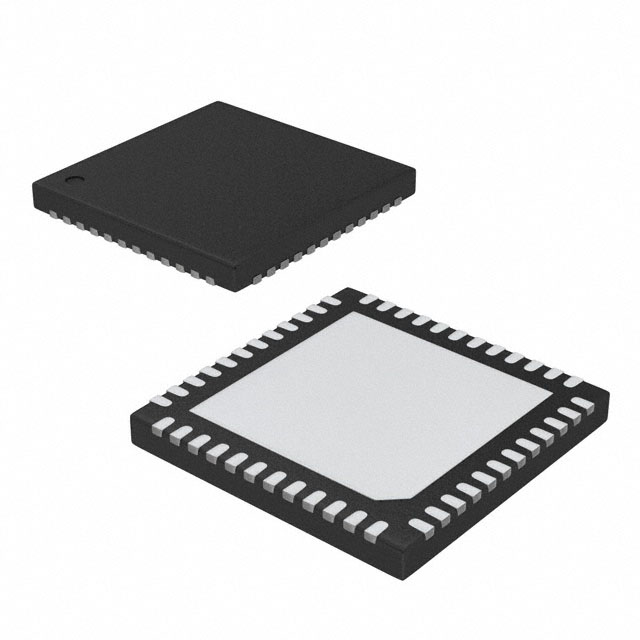
LE79271MQCT is housed in a 64-pin QFN (9 mm × 9 mm, 0.5 mm pitch) package with exposed thermal pad. Pin functions are defined per Microchip's LE79271 Datasheet Rev. 1.3 (2019), supporting differential line interface, battery supply inputs, control I/O, and diagnostic monitoring paths.
| Pin/Terminal | Circuit Role | Design Meaning |
|---|---|---|
| TIP, RING | Differential line interface terminals | Direct connection to telephone line; support bidirectional voice, ringing, and signaling |
| VBAT1–VBAT3 | Battery supply inputs | Accept two negative (−48 V) and one positive (+5 V) supplies for flexible power routing and automatic switching |
| ILIM1, ILIM2 | DC feed current limit controls | Set programmable current limits independent of battery voltage for precise loop feed |
| TESTSW | Integrated test load switch control | Enables on-chip line termination for automated loopback and fault isolation |
| VDIFF, IDIFF | Analog monitor outputs | Provide real-time differential voltage and current for host-based diagnostics and adaptive control |
Key Features
| Feature | Design Value |
|---|---|
| Tip-open mode | Enables ground-start signaling required by legacy PBX and alarm systems |
| Smooth polarity reversal | Prevents audible clicks and relay chatter during metering, improving user experience |
| Dual-battery thermal management | Automatically switches between battery banks based on temperature and load, extending system uptime |
| Programmable off-hook threshold | Allows tuning detection sensitivity to match local line conditions and reduce false disconnects |
| Integrated line-test primitives | Reduces host processor overhead by executing standardized GR-844 tests in hardware |
Applications
| VoIP Gateway Line Card | DSLAM Line Interface Module |
|---|---|
Use Scenario: 24–48 port VoIP gateway serving residential and SMB customers with analog line emulation. IC Role / Device Role / Timing Role: SLIC providing DC feed, ringing, supervision, and diagnostics per line. Use Value: 5 REN loading and GR-844 test compliance ensure seamless interoperation with PSTN and legacy alarm systems. | Use Scenario: High-density DSL access multiplexer supporting simultaneous ADSL/VDSL and POTS services. IC Role / Device Role / Timing Role: NGCC SLIC paired with Le79238 SLAC to deliver DSL-friendly line interface with minimal crosstalk. Use Value: Programmable AC/DC parameters and integrated diagnostics reduce per-line BOM cost and accelerate field troubleshooting. |
| Remote Terminal Unit (RTU) | Emergency Call System Interface |
Use Scenario: Central office-located RTU aggregating analog lines from remote cabinets over fiber backhaul. IC Role / Device Role / Timing Role: High-reliability SLIC with foreign voltage sensing and power cross detection for unattended outdoor deployment. Use Value: Real-time line capacitance and leakage measurement enables predictive maintenance and reduces truck rolls. | Use Scenario: 911/ECS equipment interfacing with analog emergency phone lines in public safety answering points (PSAPs). IC Role / Device Role / Timing Role: SLIC delivering tip-open ground-start signaling and precise off-hook detection for alarm line supervision. Use Value: Guaranteed GR-844 equivalent testing ensures regulatory compliance and call reliability under fault conditions. |
Equivalent & Alternatives
The following parts are listed as comparable options for similar SLIC applications.
| Alternative Part | Technical Difference | Application Difference | Selection Advice |
|---|---|---|---|
| ZL88101EGLG | Single-battery (−48 V only); no integrated test load switch; lower max ringing voltage (75 Vrms) | Lacks dual-battery thermal management and GR-844 host routines; requires external test circuitry | Preferred where cost sensitivity outweighs diagnostic depth and power flexibility |
| Si32260-C-FM | Higher integration (integrated DC-DC); supports 100 Vrms ringing; uses different register map and I²C interface | Requires redesign of control firmware and protection network; not drop-in compatible | Chosen when board space is constrained and higher ringing headroom is critical |
Compared with ZL88101EGLG and Si32260-C-FM, the LE79271MQCT uniquely combines GR-844-validated diagnostics, dual-battery intelligence, and tip-open signaling in a single 64-pin QFN-making it optimal for carrier-grade, high-channel-count DSLAM and VoIP gateway designs requiring field-deployable reliability.
Availability
LE79271MQCT is available at Aetrix Electronics and suitable for VoIP gateways, DSLAM line cards, and emergency call system interfaces requiring stable component supply, long lifecycle support, and carrier-certified line interface performance.
Supply support for LE79271MQCT includes scheduled delivery planning, volume procurement assistance, BOM continuity management, traceable sourcing, and lifecycle availability coordination for OEM customers, industrial embedded developers, connected-device designers, and electronics production programs.
Manufacturer
Microchip Technology acquired Microsemi in 2018 and now owns the LE79271MQCT product line, delivering high-reliability analog and mixed-signal solutions for communications infrastructure.
The LE79271MQCT belongs to Microchip's Next Generation Carrier Chipset (NGCC) family, engineered specifically for software-defined, high-density POTS line interfaces in carrier-class DSL and VoIP access systems.
FAQ
What is the maximum ringing voltage supported by the LE79271MQCT?
The LE79271MQCT supports up to 85 Vrms internal ringing voltage, configurable for both balanced and unbalanced output. This specification eliminates the need for external ringing transformers in most central office and remote terminal deployments, reducing bill-of-materials cost and board area. The LE79271MQCT maintains this rating across its full operating temperature range and battery supply variations.
Does the LE79271MQCT support GR-844 compliant line testing?
Yes, the LE79271MQCT includes fully validated GR-844-equivalent test primitives and host routines, covering leakage, loop resistance, line capacitance, bell capacitance, and foreign voltage detection. These capabilities are implemented in hardware and verified per Telcordia GR-844-CORE, enabling carrier-grade fault isolation without external test equipment. The LE79271MQCT delivers guaranteed performance parameters across all test modes.
How does the LE79271MQCT handle dual-battery operation?
The LE79271MQCT supports two negative (−48 V) and one positive (+5 V) battery supplies, with automatic battery switching logic and intelligent thermal management. During operation, it monitors temperature and load to dynamically select the optimal battery bank, minimizing thermal stress and extending system uptime. This capability is integral to the LE79271MQCT's design for high-density, fanless carrier equipment.
Can the LE79271MQCT be used in ground-start signaling applications?
Yes, the LE79271MQCT includes dedicated tip-open mode functionality to support ground-start signaling, a requirement for legacy PBX systems and emergency alarm circuits. This feature allows controlled tip disconnection prior to ring signal application, ensuring reliable seizure detection. The LE79271MQCT implements this behavior via programmable thresholds and timing control, fully documented in its register map.
What metering frequencies does the LE79271MQCT support?
The LE79271MQCT supports metering at both 12 kHz and 16 kHz, enabling accurate call duration and usage accounting in multi-tenant VoIP gateways and hosted PBX systems. Its smooth polarity reversal feature prevents audible artifacts during metering transitions, preserving audio quality. This dual-frequency capability is built into the LE79271MQCT's analog front-end and requires no external components.
LE79271MQCT Specifications
- Product attributes
- Attribute value
- Manufacturer:
- Microchip Technology
- Series:
- -
- Package/Case:
- 28-VFQFN Exposed Pad
- Packaging:
- Tape & Reel (TR)
- Product Status:
- Active
- Function:
- -
- Interface:
- 2-Wire
- Number of Circuits:
- -
- Voltage - Supply:
- -
- Current - Supply:
- -
- Power (Watts):
- -
- Operating Temperature:
- -
- Grade:
- -
- Qualification:
- -
- Mounting Type:
- Surface Mount
- Supplier Device Package:
- 28-QFN
LE79271MQCT FAQ
1.How can I place an order for LE79271MQCT through Aetrix?
Please submit a Request for Quotation (RFQ) for LE79271MQCT on Aetrix. Our sales agent will provide a competitive quotation and guide you through the order confirmation once you accept the terms.
2.Are the price and stock information for LE79271MQCT reliable?
The price and inventory of LE79271MQCT are updated periodically and may fluctuate due to market conditions. Stock and pricing data are typically refreshed every 24 hours. Quotation validity for LE79271MQCT is usually 5 days.
3.What payment methods are accepted for LE79271MQCT?
We accept Wire Transfer, PayPal, Credit Card, Western Union, MoneyGram, and Escrow for LE79271MQCT transactions.
Note: Certain payment methods may incur a processing fee.
4.How is shipping managed for LE79271MQCT?
LE79271MQCT orders can be shipped via leading logistics carriers, including DHL, UPS, FedEx, TNT, or Registered Mail.
Once your LE79271MQCT order is processed, you will receive an email with the shipment details and tracking number.
Note: Tracking information may take up to 24 hours to appear. Express delivery typically takes 3–5 business days.
5.How can I obtain technical support or documentation for LE79271MQCT?
For technical support, including LE79271MQCT datasheets, pinout diagrams, or application guidance, please contact our engineering support team. They can provide detailed documentation and assistance for your LE79271MQCT requirements.
6.How does Aetrix verify that LE79271MQCT is sourced from the original manufacturer or authorized distributors?
All LE79271MQCT products on Aetrix are procured from qualified distributors and authorized channels. Our dedicated quality assurance team conducts strict verification, including traceability checks and, if necessary, third-party testing. This ensures that LE79271MQCT meets industry standards.
7.What is the process for return or replacement of LE79271MQCT?
All LE79271MQCT units undergo pre-shipment inspection (PSI). If there is an issue with LE79271MQCT, returns or replacements are accepted under the following conditions:
1.Quantity discrepancies, incorrect items, or visible external defects (such as breakage or corrosion), acknowledged by Aetrix.
2.The issue is reported within 90 days of delivery.
3.The LE79271MQCT part is unused and in its original packaging.
Return procedure for LE79271MQCT:
1.Submit a request within 90 days.
2.Obtain a Return Material Authorization (RMA) from Aetrix.
LE79271MQCT Tags

-
LMC567CMX/NOPB
Texas Instruments
-
LM567CMX/NOPB
Texas Instruments
-
LM567CM/NOPB
Texas Instruments
-
VSC8531XMW-02
Microchip Technology
-
VSC8531XMW-05
Microchip Technology

-
GPY115C0VI
MaxLinear, Inc.
-
SI32185-A-FMR
Skyworks Solutions Inc.
-
VSC8541XMV-05
Microchip Technology
-
SI32178-B-FM1R
Skyworks Solutions Inc.
-
GPY215C0VI
MaxLinear, Inc.
-
CPC7514ZTR
Littelfuse Inc.
-
VSC8502XML-03
Microchip Technology
Tech Hub

TTL and CMOS logic families differ in thresholds, loading, output drive, power and timing. This engineering guide compares 74HC and 74HCT, calculates noise margins and checks 3.3 V/5 V compatibility.

A practical engineering guide to 3.3V and 5V logic compatibility, input thresholds, resistor dividers, translator ICs, MOSFET level shifting, I2C pull-ups, timing limits and power-sequencing risks.

The 74HC595 uses push-pull logic outputs, while the TPIC6B595 uses 50 V open-drain DMOS sinks for higher-power loads. This guide compares timing, current limits, 3.3 V interfacing, load wiring, thermal…

The 74HC595 converts serial data into eight stable parallel outputs. This guide covers pin functions, shift and storage timing, OE and MR behavior, drive-current limits, cascading, voltage compatibilit…

A technical comparison of level-sensitive latches and edge-triggered flip-flops, covering timing windows, setup and hold limits, master–slave operation, time borrowing, race-through, HDL inference and…

A D latch stores one bit while Enable controls when data can pass. This reference covers gate-level operation, truth tables, transparency, setup and hold timing, LE versus OE, common ICs and practical …

An SR latch stores one bit through cross-coupled feedback. This engineering reference covers NOR and NAND implementations, truth tables, forbidden-state recovery, gated operation, switch debouncing, fa…

Latch circuits retain one bit through feedback. This technical reference covers SR and D latches, truth tables, transparency, timing limits, latch-versus-flip-flop behavior, applications and common log…

An engineering guide to LED driver operation, constant-current and constant-voltage outputs, linear and switching topologies, dimming, IC selection, calculations, replacement compatibility, and fault c…

Operational amplifier guide covering op amp basics, feedback, ideal vs real op amps, common configurations, buffer circuits, offset, bias current, gain-bandwidth, slew rate, rail-to-rail limits and sel…


