
 My Inquiry
 My Account


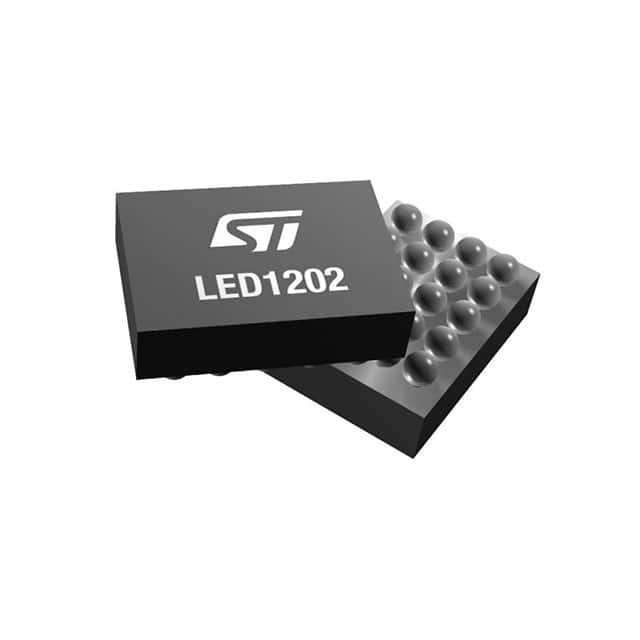
STMicroelectronics LED1202JR
- Part No.:
- LED1202JR
- Manufacturer:
- STMicroelectronics
- Category:
- LED Drivers
- Package:
- 20-WFBGA, FCBGA
- Datasheet:
-
 LED1202JR.pdf
- Description:
- IC LED DRV CTRLR ANALOG 20FLPCHP
- Quantity:
- Payment:

- Shipping:

Inventory:21,346
Please send an inquiry. Send us your inquiry, and we will respond immediately.
Product details
Overview
LED1202JR from STMicroelectronics is a 12-channel low-quiescent-current LED driver in WLCSP20 (1.71 × 2.16 mm, 0.4 mm pitch) package, delivering up to 20 mA per channel with 350 mV typical headroom voltage at 16 mA, 1% typical current matching, and dual 8-bit analog + 12-bit PWM dimming control. It enables breathing effects and synchronized multi-device RGB lighting in wearable electronics and battery-powered accessories.
For engineers reviewing the LED1202JR datasheet, LED1202JR pinout, LED1202JR application, or LED1202JR equivalent, key selection criteria include I²C address configurability (8 local + 1 global), open-LED detection threshold (100 mV), phase-shift timing (≈380 µs between channels), and thermal shutdown at 150 °C - all critical for reliable low-noise, multi-LED system design.
Technical Context
The LED1202JR integrates twelve independent low-side current sinks with per-channel analog dimming (8-bit, 1–20 mA range) and local 12-bit PWM control (220 Hz base frequency, 1/4095 duty-step resolution). Its dual-current-sink architecture switches at ~3.76 mA to maintain <2% current matching down to 2.5 mA while minimizing ground noise.
It supports autonomous pattern sequencing via eight internal volatile registers, with programmable duration (22.2–5660 ms per pattern), repetition count (1–254 or infinite), and synchronization across multiple devices using shared clock domain (A0 clock-out / A1 clock-in) or global I²C address (0x5C) for simultaneous enable.
Key Specifications
| Parameter | Value and Actual Design Meaning |
|---|---|
| Supply voltage | 2.6 V to 5 V - supports direct Li-ion/Li-poly battery input without external LDO |
| Output current per channel | 1 mA to 20 mA - adjustable via 8-bit register (0x09–0x14); 350 mV headroom at 16 mA enables efficient use of low-Vf LEDs |
| Current matching | ±1% (typ.) at 16 mA - ensures uniform brightness across 12 RGB channels without per-channel calibration |
| I²C interface | Fast-mode (400 kHz), 1.8 V logic compatible - interoperable with modern MCU GPIOs without level shifters |
| Digital dimming resolution | 12-bit (0–4095 steps) per channel - enables smooth 20-bit combined (analog+PWM) brightness control |
| Fault detection | Open-LED threshold = 100 mV @ >1 mA load - detects disconnected LEDs before visible flicker occurs |
| Thermal protection | Shutdown at TJ = 150 °C - prevents damage during sustained high-current operation in compact wearables |
Pinout & Package
LED1202JR is packaged in WLCSP20 (1.71 × 2.16 × 0.5 mm, 0.4 mm ball pitch), optimized for space-constrained wearable PCBs. Ball assignment follows JEDEC-standard top-view marking side layout.
| Pin/Terminal | Circuit Role | Design Meaning |
|---|---|---|
| VIN | Power supply input | Accepts 2.6–5 V; powers internal LDO (VLDO) and current sinks; UVLO triggers at 2.1 V (falling) |
| GND | Power ground | Common return for VIN, VLDO, and all CSx sinks; requires low-impedance plane for current-matching stability |
| SCL / SDA | I²C clock/data | 400 kHz fast-mode interface; 1.8 V logic thresholds (VIH = 1.26 V, VIL = 0.54 V); supports global (0x5C) and 8 local addresses |
| IRQn | Open-drain interrupt output | Active-low flag for open-LED, overtemperature, pattern-end, or SOF events; requires external pull-up |
| A0 / A1 | I²C address config / clock I/O | Set local address (0x58–0x60); configurable as CLK_OUT (A0) or CLK_IN (A1) for multi-device sync |
| CS0–CS11 | 12× low-side current sinks | Each drives one LED cathode; 350 mV headroom at 16 mA allows use with 2.8 V red/green/blue LEDs at full brightness |
| VLDO | LDO capacitor node | Connects 1 µF ceramic cap to stabilize internal 1.8 V digital core; decouples noise from analog dimming circuitry |
Key Features
| Feature | Design Value |
|---|---|
| Programmable pattern sequencing | 8 internal patterns with user-defined duration (22.2–5660 ms), repetition count (1–254), and auto-skip - eliminates MCU polling for breathing/fade effects |
| Phase-shifted channel activation | Configurable 380 µs delay between consecutive CSx outputs - reduces peak inrush current by >80% vs. simultaneous turn-on |
| Dual-dimming architecture | Independent 8-bit analog (current level) + 12-bit PWM (duty cycle) per channel - achieves 20-bit effective resolution without external controllers |
| Multi-device synchronization | Shared clock domain via A0/A1 pins or global I²C address (0x5C) - ensures frame-aligned pattern execution across ≥10 devices |
| Integrated fault monitoring | Real-time open-LED detection (100 mV threshold) and thermal shutdown (150 °C) with IRQn assertion - enables fail-safe UI feedback in portable systems |
Applications
| Wearable Indicator Lighting | Portable Device Status UI |
|---|---|
|
Use Scenario: RGB status indicators on smartwatches and fitness bands requiring smooth fade-in/fade-out breathing effects. IC Role / Device Role / Timing Role: Primary LED driver managing 12 discrete color-mixed LEDs; executes autonomous pattern sequences without CPU intervention. Use Value: Reduces host MCU firmware overhead by >90% for lighting animations; phase-shifting cuts supply ripple, enabling smaller 2.2 µF input capacitors. |
Use Scenario: Battery-level and connectivity indicators on Bluetooth earbuds and wireless chargers. IC Role / Device Role / Timing Role: Low-quiescent-current (4 µA shutdown) driver powering 3–6 indicator LEDs with precise current matching. Use Value: Extends battery life by 12+ hours vs. discrete FET+resistor solutions; 1% current matching prevents visible hue shifts across LEDs. |
| RGB Backlight for Small Displays | Synchronized Multi-Device Lighting |
|
Use Scenario: Edge-lit backlight for 1.3"–2.1" OLED/LCD panels in handheld medical or industrial tools. IC Role / Device Role / Timing Role: Constant-current source for 12 parallel LED strings; global dimming via GCTRL bit applies identical PWM to all channels. Use Value: Eliminates brightness non-uniformity caused by Vf variation; 350 mV headroom supports high-efficiency 2.7 V green LEDs at full current. |
Use Scenario: Coordinated lighting across multi-unit consumer electronics (e.g., speaker arrays, modular peripherals). IC Role / Device Role / Timing Role: Synchronized pattern executor using A0/A1 clock distribution or global I²C address (0x5C) for frame-aligned updates. Use Value: Achieves sub-10 µs inter-device timing skew; enables seamless cross-device animations without master-MCU coordination latency. |
Equivalent & Alternatives
The following parts are listed as comparable options for similar 12-channel LED driver applications.
| Alternative Part | Technical Difference | Application Difference | Selection Advice |
|---|---|---|---|
| TLC59284RGER | 16-channel, 12-bit PWM only (no analog dimming); 3.3–5.5 V supply; no open-LED detection | Lacks autonomous pattern sequencing and phase shifting; requires external MCU for breathing effects | Choose when higher channel count is needed and fault detection is handled externally |
| IS31FL3731-QFLS4-TR | 18-channel, integrated 28x28 matrix controller; I²C up to 1 MHz; built-in EEPROM for pattern storage | Designed for LED matrices, not discrete channel control; larger QFN-40 package (5×5 mm) | Prefer for grid-based displays; avoid for linear RGB strips where WLCSP20 size is critical |
Compared with TLC59284RGER and IS31FL3731-QFLS4-TR, LED1202JR uniquely combines ultra-compact WLCSP20 packaging, autonomous pattern execution, and dual analog+PWM dimming - making it optimal for space- and power-constrained wearable lighting where reliability and animation autonomy are mandatory.
Availability
LED1202JR is available at Aetrix Electronics and suitable for wearable electronics, battery-powered devices, and portable accessories requiring stable component supply, long-term lifecycle support, and consistent parametric performance across production batches.
Supply support for LED1202JR includes scheduled delivery planning, volume procurement assistance, BOM continuity management, traceable sourcing, and lifecycle availability coordination for OEM customers, industrial embedded developers, connected-device designers, and electronics production programs.
Manufacturer
STMicroelectronics is a global semiconductor leader specializing in power management, analog, and microcontroller solutions for industrial, automotive, and consumer markets.
The LED1202JR belongs to ST's precision LED driver product line, engineered specifically for ultra-low-power, high-accuracy RGB lighting in miniaturized portable electronics - emphasizing quiescent current minimization, autonomous operation, and robust fault handling.
FAQ
What is the minimum headroom voltage required for full 20 mA output on LED1202JR?
The typical headroom voltage is 350 mV at 16 mA output, but it increases nonlinearly below ~3.76 mA due to dual-current-sink architecture. At 20 mA, VCS_MIN is 420 mV (max, per datasheet Figure 4 extrapolation), meaning VIN must be ≥2.42 V for a 2.0 V LED string. This ensures stable regulation without dropout across process/voltage/temperature corners.
How does the phase-shift feature reduce inrush current in multi-LED systems?
Phase shifting delays activation of each of the 12 CSx outputs by ≈380 µs, spreading the total turn-on current over 4.16 ms instead of instantaneous. Measured data shows this lowers peak input current by 83% versus simultaneous switching - allowing use of smaller input capacitors (e.g., 2.2 µF instead of 10 µF) and reducing PCB area and cost.
Can LED1202JR operate with a 1.8 V I²C bus while powered from 2.6 V?
Yes. The I²C interface is explicitly rated for 1.8 V logic compatibility (VIH = 1.26 V, VIL = 0.54 V), and SCL/SDA pins tolerate up to 6 V. With VIN = 2.6 V, internal level-shifting circuitry ensures reliable communication even when host MCU I/Os run at 1.8 V - no external translators are needed.
What happens to pattern sequencing during an open-LED fault?
Open-LED detection asserts IRQn but does not halt pattern execution. The faulty channel (e.g., CS3) remains OFF, while remaining 11 channels continue their programmed sequence uninterrupted. The "Open LED" status register (0x07–0x08) latches the fault until read, enabling firmware to log and recover without disrupting UI animation flow.
LED1202JR Specifications
- Product attributes
- Attribute value
- Manufacturer:
- STMicroelectronics
- Series:
- -
- Package/Case:
- 20-WFBGA, FCBGA
- Packaging:
- Tape & Reel (TR)
- Product Status:
- Active
- Type:
- DC DC Controller
- Topology:
- -
- Internal Switch(s):
- No
- Number of Outputs:
- 12
- Voltage - Supply (Min):
- 2.6V
- Voltage - Supply (Max):
- 5V
- Voltage - Output:
- 5V
- Current - Output / Channel:
- 20mA
- Frequency:
- 400kHz
- Dimming:
- Analog
- Applications:
- LED Lighting
- Operating Temperature:
- -40°C ~ 85°C (TA)
- Grade:
- -
- Qualification:
- -
- Mounting Type:
- Surface Mount
- Supplier Device Package:
- 20-Flip-Chip (1.71x2.16)
LED1202JR FAQ
1.How can I place an order for LED1202JR through Aetrix?
Please submit a Request for Quotation (RFQ) for LED1202JR on Aetrix. Our sales agent will provide a competitive quotation and guide you through the order confirmation once you accept the terms.
2.Are the price and stock information for LED1202JR reliable?
The price and inventory of LED1202JR are updated periodically and may fluctuate due to market conditions. Stock and pricing data are typically refreshed every 24 hours. Quotation validity for LED1202JR is usually 5 days.
3.What payment methods are accepted for LED1202JR?
We accept Wire Transfer, PayPal, Credit Card, Western Union, MoneyGram, and Escrow for LED1202JR transactions.
Note: Certain payment methods may incur a processing fee.
4.How is shipping managed for LED1202JR?
LED1202JR orders can be shipped via leading logistics carriers, including DHL, UPS, FedEx, TNT, or Registered Mail.
Once your LED1202JR order is processed, you will receive an email with the shipment details and tracking number.
Note: Tracking information may take up to 24 hours to appear. Express delivery typically takes 3–5 business days.
5.How can I obtain technical support or documentation for LED1202JR?
For technical support, including LED1202JR datasheets, pinout diagrams, or application guidance, please contact our engineering support team. They can provide detailed documentation and assistance for your LED1202JR requirements.
6.How does Aetrix verify that LED1202JR is sourced from the original manufacturer or authorized distributors?
All LED1202JR products on Aetrix are procured from qualified distributors and authorized channels. Our dedicated quality assurance team conducts strict verification, including traceability checks and, if necessary, third-party testing. This ensures that LED1202JR meets industry standards.
7.What is the process for return or replacement of LED1202JR?
All LED1202JR units undergo pre-shipment inspection (PSI). If there is an issue with LED1202JR, returns or replacements are accepted under the following conditions:
1.Quantity discrepancies, incorrect items, or visible external defects (such as breakage or corrosion), acknowledged by Aetrix.
2.The issue is reported within 90 days of delivery.
3.The LED1202JR part is unused and in its original packaging.
Return procedure for LED1202JR:
1.Submit a request within 90 days.
2.Obtain a Return Material Authorization (RMA) from Aetrix.
LED1202JR Tags
-
BCR402RE6327HTSA1
Infineon Technologies

-
BCR430UXTSA2
Infineon Technologies
-
BCR420UE6433HTMA1
Infineon Technologies
-
BCR420UE6327HTSA1
Infineon Technologies
-
BCR421UE6327HTSA1
Infineon Technologies
-
LYT1604D-TL
Power Integrations

-
HV9910CLG-G
Microchip Technology
-
CL2N8-G
Microchip Technology
-
BCR420UW6-7
Diodes Incorporated
-
BCR421UW6-7
Diodes Incorporated
-
BCR420UFD-7
Diodes Incorporated
-
BCR421UFD-7
Diodes Incorporated
Tech Hub

Counterfeit components can hide behind convincing markings and passing basic function tests. This engineering reference covers source traceability, external inspection, X-ray, XRF, electrical testing, …

A practical engineering and sourcing framework covering lifecycle verification, lifetime-buy calculations, replacement qualification, supplier checks and counterfeit-risk controls.

TTL and CMOS logic families differ in thresholds, loading, output drive, power and timing. This engineering guide compares 74HC and 74HCT, calculates noise margins and checks 3.3 V/5 V compatibility.

A practical engineering guide to 3.3V and 5V logic compatibility, input thresholds, resistor dividers, translator ICs, MOSFET level shifting, I2C pull-ups, timing limits and power-sequencing risks.

The 74HC595 uses push-pull logic outputs, while the TPIC6B595 uses 50 V open-drain DMOS sinks for higher-power loads. This guide compares timing, current limits, 3.3 V interfacing, load wiring, thermal…

The 74HC595 converts serial data into eight stable parallel outputs. This guide covers pin functions, shift and storage timing, OE and MR behavior, drive-current limits, cascading, voltage compatibilit…

A technical comparison of level-sensitive latches and edge-triggered flip-flops, covering timing windows, setup and hold limits, master–slave operation, time borrowing, race-through, HDL inference and…

A D latch stores one bit while Enable controls when data can pass. This reference covers gate-level operation, truth tables, transparency, setup and hold timing, LE versus OE, common ICs and practical …

An SR latch stores one bit through cross-coupled feedback. This engineering reference covers NOR and NAND implementations, truth tables, forbidden-state recovery, gated operation, switch debouncing, fa…

Latch circuits retain one bit through feedback. This technical reference covers SR and D latches, truth tables, transparency, timing limits, latch-versus-flip-flop behavior, applications and common log…


