
 My Inquiry
 My Account


Vishay Semiconductor Opto Division LH1511BAB
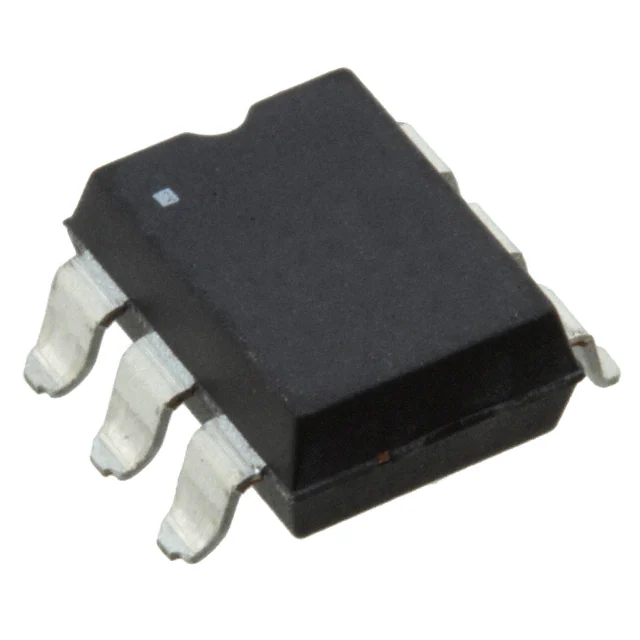
- Part No.:
- LH1511BAB
- Manufacturer:
- Vishay Semiconductor Opto Division
- Category:
- Solid State Relays (SSR)
- Package:
- 6-SMD (0.300", 7.62mm)
- Datasheet:
-
 LH1511BAB.pdf
- Description:
- SSR RELAY SPST-NC 200MA 0-200V
- Quantity:
- Payment:

- Shipping:

Inventory:386
Please send an inquiry. Send us your inquiry, and we will respond immediately.
Product details
Overview
LH1511BAB from Vishay Semiconductors is a solid-state relay (SSR) with SPST normally closed (Form B) configuration, constructed as a multi-chip hybrid device integrating an infrared LED input and photodiode-triggered MOSFET output stage. It supports AC/DC or DC-only load operation, delivers 200 V load voltage rating, exhibits typical on-resistance of 10 Ω at 50 mA, and achieves clean bounce-free switching for telecom and industrial control applications.
For engineers reviewing the LH1511BAB datasheet, LH1511BAB pinout, LH1511BAB application, or LH1511BAB equivalent, key selection considerations include its 3750 VRMS isolation voltage, SMD-6 gullwing package compatibility, bidirectional 200 mA continuous load current capability, and UL/VDE safety certifications.
Technical Context
The LH1511BAB implements optically isolated control using an integrated infrared LED to drive a photodiode array that biases complementary MOSFETs, enabling bidirectional conduction without mechanical contacts. Its output stage is designed for zero-crossing–independent switching with low leakage (≤1 μA at ±200 V) and low output capacitance (50 pF).
Input-to-output isolation is rated at 3750 VRMS per UL and VDE standards, and the device operates across –40 °C to +85 °C ambient temperature. The SMD-6 gullwing footprint supports reflow soldering per J-STD-020, with moisture sensitivity level 1 and unlimited floor life under ≤30 °C / ≤85% RH conditions.
Key Specifications
| Parameter | Value and Actual Design Meaning |
|---|---|
| Load Voltage | 200 V - supports universal AC/DC loads up to mains-referenced 200 V peak or DC bus voltages |
| Continuous Load Current | 200 mA bidirectional - enables reliable switching of moderate-power sensors, solenoids, and indicator circuits |
| On-Resistance | 10 Ω typical at 50 mA - ensures low conduction loss and minimal self-heating in signal-level and low-power control paths |
| Isolation Voltage | 3750 VRMS - meets reinforced insulation requirements for industrial and telecom equipment safety compliance |
| Turn-on/Off Time | 1.2–3 ms / 1–3 ms - provides deterministic timing for programmable logic-controlled sequencing without contact bounce artifacts |
| Output Capacitance | 50 pF - minimizes high-frequency coupling and preserves signal integrity in mixed-signal PCB layouts |
Pinout & Package
SMD-6 gullwing package (JEDEC MS-012AC variant), 7.62 mm pitch, 11.05 mm × 8.01 mm body, lead-free, RoHS-compliant.
| Pin/Terminal | Circuit Role | Design Meaning |
|---|---|---|
| 1 | LED Anode | Input control terminal requiring 0.2–0.9 mA forward current to activate switch |
| 2 | LED Cathode | Ground reference for LED driver circuit; reverse voltage limited to 8 V |
| 4, 6 | Output Source (+) | Common source terminals for bidirectional MOSFET output; tied internally |
| 5 | Output Drain (–) | Drain terminal for load return path; forms complete switch between pins 4/6 and 5 |
| 3 | No Connect | Internally unconnected; must be left floating or grounded per layout best practice |
Key Features
| Feature | Design Value |
|---|---|
| Bounce-free switching | Eliminates mechanical arcing and contact chatter, enabling precise timing in data acquisition and security system triggers |
| Low power LED drive | 0.2–0.9 mA turn-on threshold allows direct interface with microcontroller GPIO without external drivers |
| High off-resistance | 0.1–1.4 GΩ ensures negligible leakage in standby state, critical for battery-powered instrumentation |
| Clean AC/DC compatibility | Internal MOSFET topology supports bidirectional conduction without external polarity management components |
| UL & VDE certified | Validated isolation and construction meet regional safety mandates for commercial and industrial end equipment |
Applications
| Telecom Line Switching | Security System Actuation |
|---|---|
Use Scenario: Routing analog voice signals or DSL line conditioning paths in access concentrators and PBX interfaces. IC Role / Device Role / Timing Role: Solid-state Form B relay providing fail-safe open-circuit default during power loss. Use Value: 200 V load rating and 3750 VRMS isolation enable safe handling of tip/ring voltages while eliminating EMI from mechanical contact noise. | Use Scenario: Triggering door locks, alarm sirens, or motion sensor outputs in monitored premises systems. IC Role / Device Role / Timing Role: Isolated load switch controlled by microcontroller GPIO, with NC default for tamper detection. Use Value: Bounce-free operation prevents false triggering; 200 mA current capacity drives standard 12 V solenoid locks directly. |
| Industrial Sensor Interface | Programmable Logic Controller I/O |
Use Scenario: Isolating and switching analog sensor excitation lines (e.g., RTD bridges or strain gauge supplies) in harsh environments. IC Role / Device Role / Timing Role: Galvanically isolated switch enabling ground-loop-free excitation path control. Use Value: 10 Ω RON ensures minimal voltage drop across excitation paths; 50 pF CO avoids signal distortion in precision measurement circuits. | Use Scenario: Providing isolated digital output channels in PLC backplanes for driving pilot lights, relays, or small actuators. IC Role / Device Role / Timing Role: Output-stage SSR replacing mechanical relay modules to improve cycle life and reduce maintenance. Use Value: 200 mA continuous current and 3 ms max switching time support deterministic scan-cycle timing in real-time control loops. |
Equivalent & Alternatives
The following parts are listed as comparable options for similar solid-state relay applications.
| Alternative Part | Technical Difference | Application Difference | Selection Advice |
|---|---|---|---|
| Vishay LH1511BABTR | Identical electrical specs; DIP-6 through-hole package instead of SMD-6 gullwing | Preferred for prototyping, wave-soldered legacy boards, or manual assembly where reflow is unavailable | Select LH1511BABTR when board assembly uses through-hole processes or requires socket-based testing |
| Toshiba TLP3558A | SPST-NO (Form A), 60 V load rating, 1.2 A load current, 5000 VRMS isolation | Higher current, lower voltage; unsuitable for 200 V telecom or industrial AC loads | Choose TLP3558A only for high-current, low-voltage DC switching where NO default behavior is acceptable |
Compared with LH1511BABTR, the LH1511BAB offers identical performance in a surface-mount package optimized for automated assembly and space-constrained designs; compared with TLP3558A, it provides higher voltage capability and NC default but lower current rating-making it suitable for safety-critical, medium-voltage isolation where fail-open behavior is required.
Availability
LH1511BAB is available at Aetrix Electronics and suitable for telecom line switching, security system actuation, and industrial sensor interface applications requiring stable component supply, long-term lifecycle support, and traceable sourcing.
Supply support for LH1511BAB includes scheduled delivery planning, volume procurement assistance, BOM continuity management, traceable sourcing, and lifecycle availability coordination for OEM customers, industrial embedded developers, connected-device designers, and electronics production programs.
Manufacturer
Vishay Intertechnology is a global semiconductor manufacturer specializing in discrete components, passive elements, and optoelectronics with emphasis on reliability and high-performance analog solutions.
The LH1511 series was developed as a Form B solid-state relay family targeting replacement of electromechanical relays in safety-critical, high-cycle-count applications across telecom, industrial controls, and instrumentation.
FAQ
What is the default state of the LH1511BAB output switch?
The LH1511BAB is a Form B (normally closed) solid-state relay: its output remains conductive (closed) when no LED current is applied. Applying ≥0.2 mA forward current to pins 1–2 opens the switch. This fail-safe behavior ensures continuity in power-loss scenarios, making LH1511BAB ideal for security and telecom fail-open protection circuits.
Can the LH1511BAB switch AC loads, and what is its maximum RMS voltage rating?
Yes, the LH1511BAB supports AC/DC operation with a maximum load voltage of 200 V - applicable to both DC and peak AC values. Its bidirectional MOSFET output enables true AC switching without polarity constraints. For sinusoidal AC, this corresponds to ≈141 VRMS; therefore, LH1511BAB is suitable for 120 VAC line-switching but not 230 VAC mains.
What is the recommended LED drive current range for reliable operation of the LH1511BAB?
The LH1511BAB requires 0.2–0.9 mA forward current to guarantee turn-on across temperature and unit variation, and 1–2 mA to ensure robust turn-off. A typical design uses 5–10 mA for margin, but the low-threshold drive enables direct connection to MCU GPIO pins without buffer transistors - a key advantage of LH1511BAB in space- and power-constrained systems.
Does the LH1511BAB require external snubber circuits when switching inductive loads?
No, the LH1511BAB integrates internal protection circuitry and does not require external snubbers for typical inductive loads within its 200 mA/200 V ratings. Its MOSFET output inherently suppresses voltage spikes better than mechanical relays, and the 50 pF output capacitance helps dampen ringing. However, for highly reactive loads exceeding 100 mJ energy, consult Vishay's application note AN-91000 before final LH1511BAB implementation.
How does the LH1511BAB compare to mechanical relays in terms of lifetime and switching speed?
The LH1511BAB offers >10⁹ cycles versus ~10⁵–10⁶ for electromechanical relays, with no contact wear or oxidation degradation. Its 1.2–3 ms turn-on and 1–3 ms turn-off times are significantly faster and more consistent than mechanical counterparts (typically 5–15 ms with bounce). This makes LH1511BAB especially valuable in high-frequency control loops and mission-critical LH1511BAB deployments where reliability and repeatability are paramount.
LH1511BAB Specifications
- Product attributes
- Attribute value
- Manufacturer:
- Vishay Semiconductor Opto Division
- Series:
- LH1511
- Packaging:
- Tube
- Product Status:
- Active
- Mounting Type:
- Surface Mount
- Circuit:
- SPST-NC (1 Form B)
- Output Type:
- AC, DC
- Voltage - Input:
- 1.26VDC
- Voltage - Load:
- 0 V ~ 200 V
- Load Current:
- 200 mA
- On-State Resistance (Max):
- 10 Ohms
- Termination Style:
- Gull Wing
- Operating Temperature:
- -40°C ~ 85°C
- Supplier Device Package:
- 6-SMD
- Approval Agency:
- UL, VDE
- Grade:
- -
- Qualification:
- -
LH1511BAB FAQ
1.How can I place an order for LH1511BAB through Aetrix?
Please submit a Request for Quotation (RFQ) for LH1511BAB on Aetrix. Our sales agent will provide a competitive quotation and guide you through the order confirmation once you accept the terms.
2.Are the price and stock information for LH1511BAB reliable?
The price and inventory of LH1511BAB are updated periodically and may fluctuate due to market conditions. Stock and pricing data are typically refreshed every 24 hours. Quotation validity for LH1511BAB is usually 5 days.
3.What payment methods are accepted for LH1511BAB?
We accept Wire Transfer, PayPal, Credit Card, Western Union, MoneyGram, and Escrow for LH1511BAB transactions.
Note: Certain payment methods may incur a processing fee.
4.How is shipping managed for LH1511BAB?
LH1511BAB orders can be shipped via leading logistics carriers, including DHL, UPS, FedEx, TNT, or Registered Mail.
Once your LH1511BAB order is processed, you will receive an email with the shipment details and tracking number.
Note: Tracking information may take up to 24 hours to appear. Express delivery typically takes 3–5 business days.
5.How can I obtain technical support or documentation for LH1511BAB?
For technical support, including LH1511BAB datasheets, pinout diagrams, or application guidance, please contact our engineering support team. They can provide detailed documentation and assistance for your LH1511BAB requirements.
6.How does Aetrix verify that LH1511BAB is sourced from the original manufacturer or authorized distributors?
All LH1511BAB products on Aetrix are procured from qualified distributors and authorized channels. Our dedicated quality assurance team conducts strict verification, including traceability checks and, if necessary, third-party testing. This ensures that LH1511BAB meets industry standards.
7.What is the process for return or replacement of LH1511BAB?
All LH1511BAB units undergo pre-shipment inspection (PSI). If there is an issue with LH1511BAB, returns or replacements are accepted under the following conditions:
1.Quantity discrepancies, incorrect items, or visible external defects (such as breakage or corrosion), acknowledged by Aetrix.
2.The issue is reported within 90 days of delivery.
3.The LH1511BAB part is unused and in its original packaging.
Return procedure for LH1511BAB:
1.Submit a request within 90 days.
2.Obtain a Return Material Authorization (RMA) from Aetrix.
LH1511BAB Tags
.jpg)
-
G3VM-21UR11(TR05)
Omron Electronics Inc-EMC Div
-
G3VM-61VY3(TR05)
Omron Electronics Inc-EMC Div
-
CPC1017NTR
Littelfuse Inc.
-
CPC1017N
Littelfuse Inc.
-
CPC1006N
Littelfuse Inc.
-
VO1400AEFTR
Vishay Semiconductor Opto Division
-
CPC1006NTR
Littelfuse Inc.
-
TLP175A(TPL,E
Toshiba Semiconductor and Storage
-
CPC1002NTR
Littelfuse Inc.
-
AQY280S
Panasonic Electric Works
-
CPC1117NTR
Littelfuse Inc.
-
CPC1106NTR
Littelfuse Inc.
Tech Hub
Counterfeit components can hide behind convincing markings and passing basic function tests. This engineering reference covers source traceability, external inspection, X-ray, XRF, electrical testing, …

A practical engineering and sourcing framework covering lifecycle verification, lifetime-buy calculations, replacement qualification, supplier checks and counterfeit-risk controls.

TTL and CMOS logic families differ in thresholds, loading, output drive, power and timing. This engineering guide compares 74HC and 74HCT, calculates noise margins and checks 3.3 V/5 V compatibility.

A practical engineering guide to 3.3V and 5V logic compatibility, input thresholds, resistor dividers, translator ICs, MOSFET level shifting, I2C pull-ups, timing limits and power-sequencing risks.

The 74HC595 uses push-pull logic outputs, while the TPIC6B595 uses 50 V open-drain DMOS sinks for higher-power loads. This guide compares timing, current limits, 3.3 V interfacing, load wiring, thermal…

The 74HC595 converts serial data into eight stable parallel outputs. This guide covers pin functions, shift and storage timing, OE and MR behavior, drive-current limits, cascading, voltage compatibilit…

A technical comparison of level-sensitive latches and edge-triggered flip-flops, covering timing windows, setup and hold limits, master–slave operation, time borrowing, race-through, HDL inference and…

A D latch stores one bit while Enable controls when data can pass. This reference covers gate-level operation, truth tables, transparency, setup and hold timing, LE versus OE, common ICs and practical …

An SR latch stores one bit through cross-coupled feedback. This engineering reference covers NOR and NAND implementations, truth tables, forbidden-state recovery, gated operation, switch debouncing, fa…

Latch circuits retain one bit through feedback. This technical reference covers SR and D latches, truth tables, transparency, timing limits, latch-versus-flip-flop behavior, applications and common log…


