
 My Inquiry
 My Account


Texas Instruments LM1246AAC/NA/NOPB
- Part No.:
- LM1246AAC/NA/NOPB
- Manufacturer:
- Texas Instruments
- Category:
- Video Processing
- Package:
- 24-DIP (0.300", 7.62mm)
- Datasheet:
-
 LM1246AAC/NA/NOPB.pdf
- Description:
- IC VIDEO PREAMPLIFIER 24DIP
- Quantity:
- Payment:

- Shipping:

Inventory:3,293
Please send an inquiry. Send us your inquiry, and we will respond immediately.
Product details
Overview
LM1246AAC/NA/NOPB from Texas Instruments (formerly National Semiconductor) is a 150 MHz RGB preamplifier IC for CRT monitor signal conditioning, integrating I²C-compatible control, 512-character OSD ROM/RAM, and four 8-bit DACs for CRT bias and brightness. It delivers 4.3 V max video output, ±0.5 dB gain matching across RGB channels, and supports 1024×768 @ 85 Hz with vertical/horizontal blanking synchronization. Used in low-cost bus-controlled monitors with integrated clamp functionality.
For engineers reviewing the LM1246AAC/NA/NOPB datasheet, LM1246AAC/NA/NOPB pinout, LM1246AAC/NA/NOPB application, or LM1246AAC/NA/NOPB equivalent, key selection considerations include its 150 MHz bandwidth, register-programmable vertical blanking width (3–127 lines), spot killer threshold (3.4–4.3 V), I²C interface timing compliance, and compatibility with LM246x driver and LM2479/80 bias ICs.
Technical Context
The LM1246AAC/NA/NOPB implements a fully addressable on-screen display engine with dual-mode character addressing (2-byte or bank-select), supporting up to 640 two-color characters or mixed 2-/4-color configurations. Its video path features AC-coupled high-impedance inputs with internal black-level clamping-eliminating external clamp capacitors-and programmable horizontal blank start position (0–64 pixels ahead of flyback edge).
It integrates a PLL-based OSD timing generator supporting 704–1152 pixels per line (max 111 MHz pixel clock), with auto-calibrating PLL Auto mode that dynamically selects optimal frequency range based on horizontal scan rate. The four DACs operate in two voltage modes (Mode 00: 0.7–4.2 V; Mode 01: 0.7–2.35 V), each with ±0.5 LSB monotonicity and 5% linearity error over temperature.
Key Specifications
| Parameter | Value and Actual Design Meaning |
|---|---|
| Bandwidth | 150 MHz (−3 dB), enabling full support for 1024×768 @ 85 Hz analog video signals without high-frequency roll-off. |
| Video Output Voltage | 4.3 V max (typ), sufficient to drive LM246x cathode drivers to 40 V peak-to-peak cathode swing. |
| Gain Matching | ±0.5 dB between RGB channels, ensuring consistent color balance without manual trim calibration. |
| DAC Resolution | 8-bit (256 steps), providing fine-grained control of CRT cutoff and brightness with <3% output variation across channels. |
| OSD Memory | 512-character ROM + 512-character RAM, configurable as single or dual independent windows for layered UI elements. |
| Supply Current | 250 mA (typ) active; 95 mA (typ) in Power Save Mode - 65% reduction enabling thermal management in compact monitor designs. |
| Spot Killer Threshold | 3.4–4.3 V (spec), automatically blanks outputs when VCC drops below safe operating level to prevent CRT damage. |
Pinout & Package
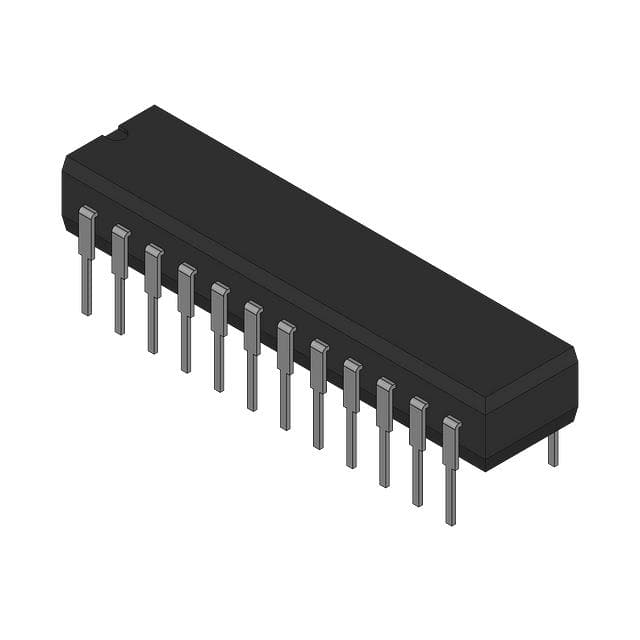
LM1246AAC/NA/NOPB is housed in a 24-lead molded plastic DIP package (NS package N24D), with 0.3-inch body width and standard through-hole mounting footprint.
| Pin/Terminal | Circuit Role | Design Meaning |
|---|---|---|
| 1 (V Flyback) | Vertical blanking & OSD sync input | Accepts logic-level or deflection-derived flyback pulses; triggers vertical blanking and initiates OSD frame timing. |
| 5–7 (Blue/Red/Green In) | AC-coupled RGB video inputs | High-impedance (>20 MΩ) inputs with internal DC restoration - no external clamp caps required. |
| 11 (SDA), 12 (SCL) | I²C bidirectional interface | Compatible with standard 100 kHz/400 kHz I²C buses; supports full register access including Page RAM and OSD configuration. |
| 13–16 (DAC 4–DAC 1) | Programmable analog outputs | DAC 4 acts as master brightness control modulating DAC 1–3 (Blue/Green/Red bias); all four are software-configurable via I²C. |
| 19–21 (Green/Red/Blue Out) | RGB video outputs | Drive LM246x cathode drivers directly; output swing up to 4.3 V with 3.1 ns rise time and <2% overshoot. |
| 22 (ABL) | Automatic Beam Limiter input | Analog feedback node for beam current regulation; gain reduction from −2 dB to −12 dB as ABL voltage drops from 4.8 V to 2.0 V. |
| 23 (CLAMP) | Clamp pulse input | Accepts TTL/CMOS logic; synchronizes internal black-level restoration to horizontal retrace timing. |
| 24 (H Flyback) | Horizontal blanking & OSD sync input | Current-reversal input; enables precise horizontal blank positioning and programmable start offset (0–64 pixels). |
Key Features
| Feature | Design Value |
|---|---|
| OSD Window Fade In/Fade Out | Hardware-accelerated transition control reduces visual flicker during menu navigation without MCU intervention. |
| OSD Half-Tone Transparency | Enables semi-transparent overlay rendering by blending OSD pixels with underlying video using programmable alpha weighting. |
| Video Data Detection | Auto-centering and auto-sizing logic detects active video region boundaries to align OSD windows without manual geometry setup. |
| OSD Override Mode | Disables video path entirely while displaying burn-in test patterns or diagnostic messages - zero video leakage during testing. |
| Power Saving Mode | Reduces supply current from 250 mA to 95 mA (65% drop) during standby, lowering thermal load and power supply requirements. |
Applications
| Low-Cost CRT Monitor OSD | 1024×768 @ 85 Hz Display System |
|---|---|
|
Use Scenario: Entry-level 15" and 17" CRT monitors requiring on-screen menus, geometry controls, and factory calibration overlays. IC Role / Device Role / Timing Role: Central RGB preamplifier and OSD controller; handles video amplification, black-level clamping, and real-time text/graphic overlay generation synchronized to H/V flyback. Use Value: Eliminates need for discrete clamp circuitry and external character ROM, reducing BOM count by ≥7 components versus discrete solutions. |
Use Scenario: High-refresh-rate CRT displays targeting 85 Hz vertical scan for reduced flicker in professional and medical imaging applications. IC Role / Device Role / Timing Role: Bandwidth-optimized video conditioner with 150 MHz channel response and auto-synchronized OSD rendering aligned to exact pixel timing. Use Value: Maintains full 1024×768 resolution fidelity at 85 Hz without chroma smearing or OSD jitter due to PLL Auto mode's adaptive lock range. |
| LM246x-Compatible CRT Driver Interface | Integrated CRT Bias Control System |
|
Use Scenario: Monitor designs using LM2467/LM2468 cathode drivers where precise gain matching and fast video slew are critical. IC Role / Device Role / Timing Role: Pre-driver stage delivering matched 2.0 VP-P outputs with ±0.5 dB inter-channel tracking and 3.1 ns rise time to LM246x inputs. Use Value: Enables direct interface with LM246x family without external level-shifting or gain compensation networks. |
Use Scenario: Systems requiring software-tunable CRT cutoff, screen brightness, and automatic beam limiting without analog potentiometers. IC Role / Device Role / Timing Role: Four-channel DAC subsystem with dedicated Blue/Green/Red bias and global brightness control, plus ABL feedback loop. Use Value: Replaces 4 discrete DACs + 1 ABL comparator + associated op-amps, reducing layout area and calibration complexity. |
Equivalent & Alternatives
The following parts are listed as comparable options for similar RGB preamplifier with OSD applications.
| Alternative Part | Technical Difference | Application Difference | Selection Advice |
|---|---|---|---|
| LM1247ACX/NOPB | Same 24-pin DIP package and pinout; identical OSD ROM/RAM architecture but lower 100 MHz bandwidth and no PLL Auto mode. | Limited to ≤1024×768 @ 75 Hz; requires manual PLL register tuning; lacks fade-in/fade-out and half-tone transparency features. | Select when cost sensitivity outweighs bandwidth and advanced OSD feature requirements. |
| LM1237N/NOPB | 28-pin DIP; no integrated DACs; only 256-character OSD ROM; no ABL input or spot killer; 80 MHz bandwidth. | Suitable for basic OSD-only applications without CRT bias control; requires external DACs and beam limiter circuitry. | Choose for legacy designs where pin compatibility with older LM1237-based layouts is mandatory. |
Compared with LM1247ACX/NOPB and LM1237N/NOPB, LM1246AAC/NA/NOPB provides higher bandwidth (150 MHz vs. 100/80 MHz), integrated DAC-based bias control (reducing external component count), and autonomous PLL Auto mode - making it optimal for new 85 Hz CRT monitor designs requiring minimal firmware overhead and robust thermal protection.
Availability
LM1246AAC/NA/NOPB is available at Aetrix Electronics and suitable for low-cost CRT monitor manufacturing, 1024×768 display systems, and industrial embedded CRT interfaces requiring stable component supply and long-term obsolescence mitigation.
Supply support for LM1246AAC/NA/NOPB includes scheduled delivery planning, volume procurement assistance, BOM continuity management, traceable sourcing, and lifecycle availability coordination for OEM customers, industrial embedded developers, connected-device designers, and electronics production programs.
Manufacturer
Texas Instruments acquired National Semiconductor in 2011 and maintains full technical documentation, legacy support, and authorized distribution for the LM1246 series.
The LM1246AAC/NA/NOPB belongs to TI's legacy CRT interface product line, engineered specifically for cost-sensitive analog monitor systems requiring integrated video amplification, OSD, and programmable CRT bias control in a single IC.
FAQ
What is the maximum horizontal scan frequency supported by LM1246AAC/NA/NOPB?
The LM1246AAC/NA/NOPB supports horizontal frequencies from 25 kHz to 110 kHz depending on PLL configuration (PPL register setting). At PPL = 4, the upper limit is 110 kHz; at PPL = 7, it drops to 96 kHz. The PLL Auto mode automatically selects the optimal range to ensure stable OSD locking across variable input rates.
Does LM1246AAC/NA/NOPB require external clamp capacitors?
No. LM1246AAC/NA/NOPB performs black-level clamping directly on the AC-coupled video inputs using internal circuitry. This eliminates the need for external clamp capacitors at pins 5–7, simplifying PCB layout and improving reliability in high-vibration CRT environments.
How does the spot killer function protect the CRT in LM1246AAC/NA/NOPB?
The spot killer in LM1246AAC/NA/NOPB monitors VCC and blanks all RGB outputs when supply voltage falls below 3.4 V (typ). Once triggered, the IC remains in off-state until VCC is cycled below 0.5 V and restored - preventing phosphor burn-in during brownout conditions.
Can LM1246AAC/NA/NOPB drive LM246x cathode drivers directly?
Yes. LM1246AAC/NA/NOPB outputs deliver up to 4.3 V peak-to-peak into 8 pF loads with 3.1 ns rise time, matching the input requirements of LM2467/LM2468 drivers. Its gain-matched RGB channels (±0.5 dB) ensure uniform cathode drive without external trimming.
What is the purpose of DAC 4 in LM1246AAC/NA/NOPB?
In LM1246AAC/NA/NOPB, DAC 4 serves as a master brightness control that scales the output levels of DACs 1–3 (assigned to Blue, Green, Red bias). When DAC 4 is enabled in Mode 00, its value modulates the amplitude of the other three DACs - enabling unified brightness adjustment without recalculating individual bias values.
LM1246AAC/NA/NOPB Specifications
- Product attributes
- Attribute value
- Manufacturer:
- Texas Instruments
- Series:
- -
- Package/Case:
- 24-DIP (0.300", 7.62mm)
- Packaging:
- Tube
- Product Status:
- Obsolete
- Function:
- Preamplifier
- Applications:
- Video Display
- Standards:
- -
- Control Interface:
- I2C
- Voltage - Supply:
- 4.75V ~ 5.25V
- Mounting Type:
- Through Hole
- Grade:
- -
- Qualification:
- -
- Supplier Device Package:
- 24-DIP
LM1246AAC/NA/NOPB FAQ
1.How can I place an order for LM1246AAC/NA/NOPB through Aetrix?
Please submit a Request for Quotation (RFQ) for LM1246AAC/NA/NOPB on Aetrix. Our sales agent will provide a competitive quotation and guide you through the order confirmation once you accept the terms.
2.Are the price and stock information for LM1246AAC/NA/NOPB reliable?
The price and inventory of LM1246AAC/NA/NOPB are updated periodically and may fluctuate due to market conditions. Stock and pricing data are typically refreshed every 24 hours. Quotation validity for LM1246AAC/NA/NOPB is usually 5 days.
3.What payment methods are accepted for LM1246AAC/NA/NOPB?
We accept Wire Transfer, PayPal, Credit Card, Western Union, MoneyGram, and Escrow for LM1246AAC/NA/NOPB transactions.
Note: Certain payment methods may incur a processing fee.
4.How is shipping managed for LM1246AAC/NA/NOPB?
LM1246AAC/NA/NOPB orders can be shipped via leading logistics carriers, including DHL, UPS, FedEx, TNT, or Registered Mail.
Once your LM1246AAC/NA/NOPB order is processed, you will receive an email with the shipment details and tracking number.
Note: Tracking information may take up to 24 hours to appear. Express delivery typically takes 3–5 business days.
5.How can I obtain technical support or documentation for LM1246AAC/NA/NOPB?
For technical support, including LM1246AAC/NA/NOPB datasheets, pinout diagrams, or application guidance, please contact our engineering support team. They can provide detailed documentation and assistance for your LM1246AAC/NA/NOPB requirements.
6.How does Aetrix verify that LM1246AAC/NA/NOPB is sourced from the original manufacturer or authorized distributors?
All LM1246AAC/NA/NOPB products on Aetrix are procured from qualified distributors and authorized channels. Our dedicated quality assurance team conducts strict verification, including traceability checks and, if necessary, third-party testing. This ensures that LM1246AAC/NA/NOPB meets industry standards.
7.What is the process for return or replacement of LM1246AAC/NA/NOPB?
All LM1246AAC/NA/NOPB units undergo pre-shipment inspection (PSI). If there is an issue with LM1246AAC/NA/NOPB, returns or replacements are accepted under the following conditions:
1.Quantity discrepancies, incorrect items, or visible external defects (such as breakage or corrosion), acknowledged by Aetrix.
2.The issue is reported within 90 days of delivery.
3.The LM1246AAC/NA/NOPB part is unused and in its original packaging.
Return procedure for LM1246AAC/NA/NOPB:
1.Submit a request within 90 days.
2.Obtain a Return Material Authorization (RMA) from Aetrix.
LM1246AAC/NA/NOPB Tags
-
HDMI2C1-6C1
STMicroelectronics
-
ADA4430-1YKSZ-R7
Analog Devices Inc.

-
LM1881MX/NOPB
Texas Instruments
-
SN75DP130SSRGZR
Texas Instruments
-
EQCO30T5.2
Microchip Technology
-
LMH1980MM/NOPB
Texas Instruments
-
EQCO30R5.D
Microchip Technology

-
SII9022ACNU
Lattice Semiconductor Corporation
-
SN65DP159RGZR
Texas Instruments
-
SN65DP159RSBR
Texas Instruments
-
SN65DP141RLJR
Texas Instruments
-
LMH0303SQ/NOPB
Texas Instruments
Tech Hub

A practical engineering guide to 3.3V and 5V logic compatibility, input thresholds, resistor dividers, translator ICs, MOSFET level shifting, I2C pull-ups, timing limits and power-sequencing risks.

The 74HC595 uses push-pull logic outputs, while the TPIC6B595 uses 50 V open-drain DMOS sinks for higher-power loads. This guide compares timing, current limits, 3.3 V interfacing, load wiring, thermal…

The 74HC595 converts serial data into eight stable parallel outputs. This guide covers pin functions, shift and storage timing, OE and MR behavior, drive-current limits, cascading, voltage compatibilit…

A technical comparison of level-sensitive latches and edge-triggered flip-flops, covering timing windows, setup and hold limits, master–slave operation, time borrowing, race-through, HDL inference and…

A D latch stores one bit while Enable controls when data can pass. This reference covers gate-level operation, truth tables, transparency, setup and hold timing, LE versus OE, common ICs and practical …

An SR latch stores one bit through cross-coupled feedback. This engineering reference covers NOR and NAND implementations, truth tables, forbidden-state recovery, gated operation, switch debouncing, fa…

Latch circuits retain one bit through feedback. This technical reference covers SR and D latches, truth tables, transparency, timing limits, latch-versus-flip-flop behavior, applications and common log…

An engineering guide to LED driver operation, constant-current and constant-voltage outputs, linear and switching topologies, dimming, IC selection, calculations, replacement compatibility, and fault c…

Operational amplifier guide covering op amp basics, feedback, ideal vs real op amps, common configurations, buffer circuits, offset, bias current, gain-bandwidth, slew rate, rail-to-rail limits and sel…

Jumper cables guide covering safe connection order, red and black clamp placement, final ground connection, cable gauge, length, clamp quality, copper vs CCA cables, jump starter comparison and battery…


