
 My Inquiry
 My Account


Texas Instruments LM2577T-ADJ/LF03
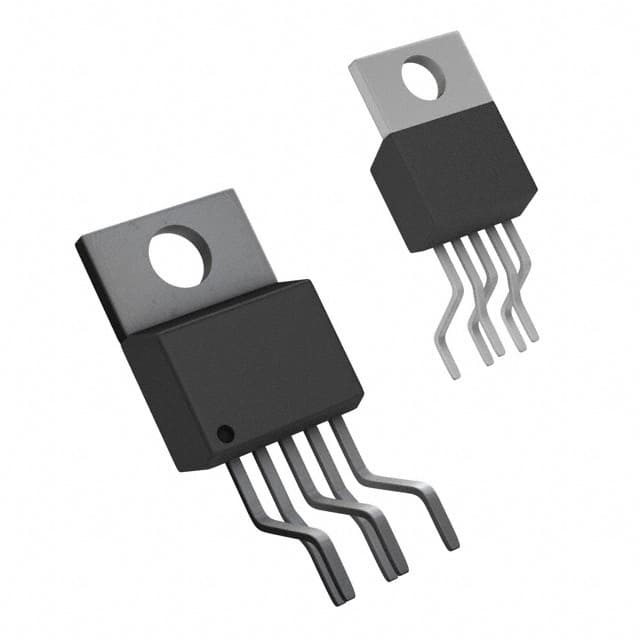
- Part No.:
- LM2577T-ADJ/LF03
- Manufacturer:
- Texas Instruments
- Package:
- TO-220-5 Formed Leads
- Datasheet:
-
 LM2577T-ADJ/LF03.pdf
- Description:
- IC REG BST FLYBCK ADJ 3A TO220-5
- Quantity:
- Payment:

- Shipping:

Inventory:272
Please send an inquiry. Send us your inquiry, and we will respond immediately.
Product details
Overview
LM2577T-ADJ/LF03 from Texas Instruments (formerly National Semiconductor) is a monolithic step-up (boost) switching voltage regulator IC featuring an integrated 3.0A NPN power switch, 52 kHz fixed-frequency oscillator, and adjustable output via external resistor divider. It operates from 3.5V to 40V input and delivers up to 60V output with internal current limiting, thermal shutdown, and undervoltage lockout. It is used in compact DC-DC boost converters for industrial sensors and battery-powered instrumentation.
For engineers reviewing the LM2577T-ADJ/LF03 datasheet, LM2577T-ADJ/LF03 pinout, LM2577T-ADJ/LF03 application, or LM2577T-ADJ/LF03 equivalent, key selection criteria include its TO-220-5 package, 1.230 V reference voltage tolerance (±1.3%), soft-start function, current-mode control architecture, and compatibility with standard off-the-shelf flyback inductors per NS Application Note DS011468.
Technical Context
The LM2577T-ADJ/LF03 implements current-mode PWM control using an internal error amplifier with 800 V/V gain and 3700 µmho transconductance, comparing feedback voltage against a precision 1.230 V reference. Its 52 kHz oscillator drives the NPN switch with duty cycle modulated by peak inductor current sensing.
It integrates protection functions including undervoltage lockout (2.70–3.15 V), thermal shutdown at 150°C junction temperature, and current limit (3.7–6.0 A). The device requires no external timing components and supports stable operation with minimal external parts: one inductor, one diode, two capacitors, and two resistors for output adjustment.
Key Specifications
| Parameter | Value and Actual Design Meaning |
|---|---|
| Output Voltage | Adjustable: 1.23 V × (1 + R1/R2); supports outputs up to 60 V - enables flexible rail generation without fixed-voltage constraints. |
| Input Voltage Range | 3.5 V to 40 V - accommodates wide-range unregulated sources such as automotive batteries or multi-cell Li-ion packs. |
| Switch Current Limit | 3.7 A min / 6.0 A max - defines maximum sustainable inductor peak current; requires external current limiting in boost topology per datasheet Note 2. |
| Oscillator Frequency | 52 kHz ±8% (42–62 kHz) - fixed frequency simplifies EMI filtering and allows use of low-cost, high-saturation inductors. |
| Reference Voltage | 1.230 V ±1.3% (1.214–1.254 V) - sets output accuracy baseline; line regulation ≤0.5 mV over 3.5–40 V input. |
| Soft-Start Current | 5.0 µA typical - controls ramp rate of duty cycle at startup to limit inrush into output capacitor and prevent input droop. |
| Junction Temperature | −40°C to +125°C - specifies operating range for LM2577 (not LM1577); TO-220 package has θJA = 65°C/W with standard PCB copper. |
Pinout & Package
LM2577T-ADJ/LF03 uses a 5-lead TO-220 (T05A) package with straight leads and electrically isolated tab. Thermal performance relies on mounting the tab to a heatsink or large copper pour.
| Pin/Terminal | Circuit Role | Design Meaning |
|---|---|---|
| 1 - Input | Power input supply connection | Accepts 3.5–40 V DC; must be bypassed with ≥0.1 µF low-ESR ceramic capacitor near pin. |
| 2 - Ground | Circuit common reference | Return path for internal bias, error amp, and switch emitter; connects to power ground plane. |
| 3 - Feedback | Output voltage sense input | Compares divided output against 1.230 V reference; sets regulation point via R1/R2 divider. |
| 4 - Output Switch | Collector of internal NPN transistor | Drives external inductor; switches at 52 kHz; withstands up to 65 V when off. |
| 5 - Compensation | Error amplifier output & soft-start node | Connects RC/CC network for loop stability; also integrates soft-start capacitor (≥0.22 µF). |
Key Features
| Feature | Design Value |
|---|---|
| Integrated 3.0 A NPN switch | Eliminates need for external power transistor; reduces BOM count and layout area in boost/flyback designs. |
| Current-mode PWM control | Provides inherent cycle-by-cycle current limiting and improves transient response to load/input changes. |
| 52 kHz fixed-frequency oscillator | Enables predictable EMI spectrum and simplifies filter design; no external timing components required. |
| Soft-start function | Prevents input surge during power-up by gradually increasing duty cycle; avoids tripping upstream current limits. |
| Thermal shutdown & UVLO | Protects device under overload or low-input conditions; automatically recovers when fault clears. |
Applications
| Industrial Sensor Power Supply | Portable Instrumentation Boost Converter |
|---|---|
|
Use Scenario: Powering 5 V or 12 V analog front-ends from single 3.7 V Li-ion cell in handheld test equipment. IC Role / Device Role / Timing Role: Step-up regulator generating stable output rail; 52 kHz switching provides deterministic ripple for low-noise signal conditioning. Use Value: Enables compact, low-component-count DC-DC stage with <1.3% reference voltage drift over temperature and input range. |
Use Scenario: Generating 24 V bias for industrial pressure transducers from 12 V vehicle battery with wide cold-crank voltage sag. IC Role / Device Role / Timing Role: Adjustable boost controller maintaining regulation down to 3.5 V input; current-mode control rejects line transients during engine cranking. Use Value: Delivers regulated 24 V output across −40°C to +125°C ambient with integrated UVLO preventing erratic behavior below 2.7 V. |
| Multi-Rail Embedded System | Legacy Equipment Voltage Upgrade |
|
Use Scenario: Adding isolated 15 V auxiliary rail to existing 5 V microcontroller board for op-amp biasing or gate driving. IC Role / Device Role / Timing Role: Compact boost converter using TO-220 footprint; leverages existing PCB space and thermal mass. Use Value: Achieves >80% efficiency at 600 mA load with only five external components - inductor, diode, input/output caps, and feedback resistors. |
Use Scenario: Replacing obsolete linear regulators in aging telecom hardware requiring +12 V from 5 V backplane. IC Role / Device Role / Timing Role: High-efficiency switching alternative reducing heat dissipation and enabling fanless enclosure redesign. Use Value: Cuts power loss by >65% vs. linear solution; TO-220 package allows direct mechanical replacement with minimal board rework. |
Equivalent & Alternatives
The following parts are listed as comparable options for similar step-up regulator applications.
| Alternative Part | Technical Difference | Application Difference | Selection Advice |
|---|---|---|---|
| LM2577T-12 | Fixed 12 V output; no feedback resistor network required; identical pinout and thermal specs. | Eliminates R1/R2 design effort but lacks output flexibility; unsuitable where variable or non-12 V rails are needed. | Select when system requires only 12 V and seeks lowest external component count. |
| LM2577S-ADJ | Same electrical specs but in TO-263-5 surface-mount package; θJA = 37°C/W with 1 sq-in copper vs. 65°C/W for TO-220. | Enables automated assembly and higher power density; requires PCB thermal relief design for heatsinking. | Select for space-constrained or SMT-only production; verify thermal margin with actual board layout. |
Compared with LM2577T-12 and LM2577S-ADJ, the LM2577T-ADJ/LF03 uniquely balances through-hole manufacturability, adjustable output, and proven thermal performance in legacy industrial platforms - making it optimal for retrofit and long-lifecycle designs where flexibility and serviceability matter.
Availability
LM2577T-ADJ/LF03 is available at Aetrix Electronics and suitable for industrial sensor power supplies, portable instrumentation boost converters, multi-rail embedded systems, and legacy equipment voltage upgrades requiring stable component supply and long-term sourcing continuity.
Supply support for LM2577T-ADJ/LF03 includes scheduled delivery planning, volume procurement assistance, BOM continuity management, traceable sourcing, and lifecycle availability coordination for OEM customers, industrial embedded developers, connected-device designers, and electronics production programs.
Manufacturer
Texas Instruments acquired National Semiconductor in 2011 and maintains full technical support, datasheets, and application notes for the LM2577 family. TI is a global semiconductor leader focused on analog and embedded processing solutions.
The LM2577 series belongs to TI's SIMPLE SWITCHER® portfolio - designed specifically for cost-sensitive, low-to-medium power DC-DC conversion where ease of use, reliability, and minimal external component count are critical.
FAQ
What is the reference voltage accuracy of LM2577T-ADJ/LF03 over temperature and input voltage?
The LM2577T-ADJ/LF03 features a precision 1.230 V internal reference with ±1.3% tolerance (1.214 V to 1.254 V) over the full −40°C to +125°C junction temperature range and 3.5 V to 40 V input voltage. Line regulation is specified at ≤0.5 mV, ensuring stable output setpoint regardless of input variation - critical for accurate adjustable rail generation in the LM2577T-ADJ/LF03.
Can LM2577T-ADJ/LF03 be used in flyback or forward converter topologies?
Yes, the LM2577T-ADJ/LF03 is explicitly qualified for flyback and forward converter configurations per its datasheet General Description and Application Hints. In those topologies, the internal current limit becomes active and protects the NPN switch - unlike in boost mode where external current limiting is required. The LM2577T-ADJ/LF03 maintains the same 52 kHz oscillator, feedback architecture, and protection features across all supported configurations.
What is the maximum output voltage achievable with LM2577T-ADJ/LF03?
The LM2577T-ADJ/LF03 supports output voltages up to 60 V, as defined by its absolute maximum switch voltage rating of 65 V and recommended operating limit of 60 V. This ceiling applies regardless of input voltage, provided the external diode and output capacitor are rated accordingly. The LM2577T-ADJ/LF03 achieves this via its adjustable feedback network and robust 3.0 A NPN switch capable of withstanding high off-state voltage.
How does the soft-start function operate in LM2577T-ADJ/LF03?
The LM2577T-ADJ/LF03 implements soft-start by charging an external capacitor (≥0.22 µF) connected to the Compensation pin using a 5.0 µA internal current source. This linearly ramps the error amplifier output, limiting initial duty cycle and preventing inrush current into the output capacitor. The soft-start duration is determined by CC × 1 V / 5 µA - e.g., 10 µF yields ~2 s ramp - ensuring controlled startup in the LM2577T-ADJ/LF03 without external circuitry.
Is LM2577T-ADJ/LF03 pin-compatible with other LM2577 variants like LM2577T-15?
Yes, all TO-220 packaged LM2577 variants - including LM2577T-12, LM2577T-15, and LM2577T-ADJ/LF03 - share identical pinout (Input, Ground, Feedback, Output Switch, Compensation), mechanical dimensions, and thermal characteristics. The only functional difference is the feedback configuration: fixed-output versions tie Feedback internally to output, while the LM2577T-ADJ/LF03 requires external R1/R2 for adjustment - enabling drop-in substitution where output flexibility is acceptable.
LM2577T-ADJ/LF03 Specifications
- Product attributes
- Attribute value
- Manufacturer:
- Texas Instruments
- Series:
- SIMPLE SWITCHER®
- Package/Case:
- TO-220-5 Formed Leads
- Packaging:
- Tube
- Product Status:
- Active
- Function:
- Step-Up, Step-Up/Step-Down
- Output Configuration:
- Positive
- Topology:
- Boost, Flyback, Forward Converter
- Output Type:
- Adjustable
- Number of Outputs:
- 1
- Voltage - Input (Min):
- 3.5V
- Voltage - Input (Max):
- 40V
- Voltage - Output (Min/Fixed):
- 1.23V
- Voltage - Output (Max):
- 60V (Switch)
- Current - Output:
- 3A (Switch)
- Frequency - Switching:
- 52kHz
- Synchronous Rectifier:
- No
- Operating Temperature:
- -40°C ~ 125°C (TJ)
- Grade:
- -
- Qualification:
- -
- Mounting Type:
- Through Hole
- Supplier Device Package:
- TO-220-5
LM2577T-ADJ/LF03 FAQ
1.How can I place an order for LM2577T-ADJ/LF03 through Aetrix?
Please submit a Request for Quotation (RFQ) for LM2577T-ADJ/LF03 on Aetrix. Our sales agent will provide a competitive quotation and guide you through the order confirmation once you accept the terms.
2.Are the price and stock information for LM2577T-ADJ/LF03 reliable?
The price and inventory of LM2577T-ADJ/LF03 are updated periodically and may fluctuate due to market conditions. Stock and pricing data are typically refreshed every 24 hours. Quotation validity for LM2577T-ADJ/LF03 is usually 5 days.
3.What payment methods are accepted for LM2577T-ADJ/LF03?
We accept Wire Transfer, PayPal, Credit Card, Western Union, MoneyGram, and Escrow for LM2577T-ADJ/LF03 transactions.
Note: Certain payment methods may incur a processing fee.
4.How is shipping managed for LM2577T-ADJ/LF03?
LM2577T-ADJ/LF03 orders can be shipped via leading logistics carriers, including DHL, UPS, FedEx, TNT, or Registered Mail.
Once your LM2577T-ADJ/LF03 order is processed, you will receive an email with the shipment details and tracking number.
Note: Tracking information may take up to 24 hours to appear. Express delivery typically takes 3–5 business days.
5.How can I obtain technical support or documentation for LM2577T-ADJ/LF03?
For technical support, including LM2577T-ADJ/LF03 datasheets, pinout diagrams, or application guidance, please contact our engineering support team. They can provide detailed documentation and assistance for your LM2577T-ADJ/LF03 requirements.
6.How does Aetrix verify that LM2577T-ADJ/LF03 is sourced from the original manufacturer or authorized distributors?
All LM2577T-ADJ/LF03 products on Aetrix are procured from qualified distributors and authorized channels. Our dedicated quality assurance team conducts strict verification, including traceability checks and, if necessary, third-party testing. This ensures that LM2577T-ADJ/LF03 meets industry standards.
7.What is the process for return or replacement of LM2577T-ADJ/LF03?
All LM2577T-ADJ/LF03 units undergo pre-shipment inspection (PSI). If there is an issue with LM2577T-ADJ/LF03, returns or replacements are accepted under the following conditions:
1.Quantity discrepancies, incorrect items, or visible external defects (such as breakage or corrosion), acknowledged by Aetrix.
2.The issue is reported within 90 days of delivery.
3.The LM2577T-ADJ/LF03 part is unused and in its original packaging.
Return procedure for LM2577T-ADJ/LF03:
1.Submit a request within 90 days.
2.Obtain a Return Material Authorization (RMA) from Aetrix.
LM2577T-ADJ/LF03 Tags
-
TPS562201DDCR
Texas Instruments

-
MC34063ABD-TR
STMicroelectronics
-
TPS561201DDCR
Texas Instruments

-
MC33063ADR
Texas Instruments
-
MC34063ADR
Texas Instruments
-
TPS560200DBVR
Texas Instruments
-
AP3012KTR-G1
Diodes Incorporated
-
TLV61048DBVR
Texas Instruments
-
AZ34063UMTR-G1
Diodes Incorporated
-
TPS562200DDCR
Texas Instruments
-
AP62300TWU-7
Diodes Incorporated
-
MC34063EBD-TR
STMicroelectronics
Tech Hub

A practical engineering guide to 3.3V and 5V logic compatibility, input thresholds, resistor dividers, translator ICs, MOSFET level shifting, I2C pull-ups, timing limits and power-sequencing risks.

The 74HC595 uses push-pull logic outputs, while the TPIC6B595 uses 50 V open-drain DMOS sinks for higher-power loads. This guide compares timing, current limits, 3.3 V interfacing, load wiring, thermal…

The 74HC595 converts serial data into eight stable parallel outputs. This guide covers pin functions, shift and storage timing, OE and MR behavior, drive-current limits, cascading, voltage compatibilit…

A technical comparison of level-sensitive latches and edge-triggered flip-flops, covering timing windows, setup and hold limits, master–slave operation, time borrowing, race-through, HDL inference and…

A D latch stores one bit while Enable controls when data can pass. This reference covers gate-level operation, truth tables, transparency, setup and hold timing, LE versus OE, common ICs and practical …

An SR latch stores one bit through cross-coupled feedback. This engineering reference covers NOR and NAND implementations, truth tables, forbidden-state recovery, gated operation, switch debouncing, fa…

Latch circuits retain one bit through feedback. This technical reference covers SR and D latches, truth tables, transparency, timing limits, latch-versus-flip-flop behavior, applications and common log…

An engineering guide to LED driver operation, constant-current and constant-voltage outputs, linear and switching topologies, dimming, IC selection, calculations, replacement compatibility, and fault c…

Operational amplifier guide covering op amp basics, feedback, ideal vs real op amps, common configurations, buffer circuits, offset, bias current, gain-bandwidth, slew rate, rail-to-rail limits and sel…

Jumper cables guide covering safe connection order, red and black clamp placement, final ground connection, cable gauge, length, clamp quality, copper vs CCA cables, jump starter comparison and battery…


