
 My Inquiry
 My Account


Texas Instruments LM4734TABD
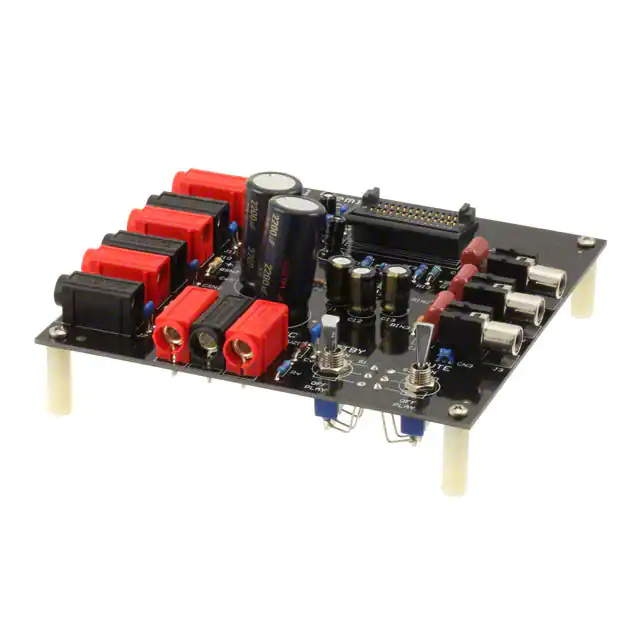
- Part No.:
- LM4734TABD
- Manufacturer:
- Texas Instruments
- Category:
- Audio Amplifier Evaluation Boards
- Package:
- Datasheet:
-
 LM4734TABD.pdf
- Description:
- EVAL BOARD FOR LM4734
- Quantity:
- Payment:

- Shipping:

Inventory:4,596
Please send an inquiry. Send us your inquiry, and we will respond immediately.
Product details
Overview
LM4734TABD from Texas Instruments is a 3-channel audio power amplifier IC delivering 20W per channel into 4Ω or 8Ω loads at ≤10% THD+N (20Hz–20kHz), featuring independent mute and standby control per channel, wide ±10V to ±30V supply range, and integrated thermal shutdown at 150°C. It targets multi-channel consumer audio systems requiring high-fidelity output with low external component count.
For engineers reviewing the LM4734TABD datasheet, LM4734TABD pinout, LM4734TABD application, or LM4734TABD equivalent, key selection criteria include per-channel mute/standby logic interface compatibility, TO-220-27 thermal performance (θJC = 1.0°C/W), 110dB typical mute attenuation, and bridged/parallel configuration support for HTIB and high-end TV designs.
Technical Context
The LM4734TABD integrates three fully independent Class-AB amplifier channels on a single die, each with dedicated MUTE and STANDBY input pins enabling selective channel disabling without affecting others. Its under-voltage lockout prevents click/pop during power-up/down, while over-voltage protection limits output current via transistor-based clamping-not internal diodes.
Thermal protection operates as a Schmitt-triggered shutdown: activation at 150°C and recovery at ~145°C to minimize cycling stress. The device supports bridge-tied load (BTL) and parallel configurations-BTL doubles voltage swing (theoretically ×4 power), while parallel operation increases current drive for ≤4Ω loads using external 0.1Ω balancing resistors.
Key Specifications
| Parameter | Value and Actual Design Meaning |
|---|---|
| Output Power/Channel | 20W RMS into 4Ω or 8Ω at 10% THD+N, 1kHz - enables full-range speaker drive in compact stereo and HTIB without forced cooling. |
| THD+N | 0.03% typ at 1W/8Ω, 1kHz - meets high-fidelity requirements for critical listening applications. |
| Mute Attenuation | 110dB typ - ensures complete signal blocking during mute, eliminating residual noise in sensitive audio paths. |
| Slew Rate | 18V/μs - supports transient-rich program material (e.g., percussion, orchestral peaks) without slew-induced distortion. |
| PSRR | 64dB typ - allows use with unregulated supplies by rejecting ripple-induced modulation in audio band. |
| Supply Range | ±10V to ±30V (20V–60V total) - accommodates cost-effective transformer-based supplies while maintaining headroom for dynamic peaks. |
| Quiescent Current (Standby) | 8mA max per V− rail in standby - reduces idle power to <100mW per channel, critical for energy-certified consumer devices. |
Pinout & Package
LM4734TABD uses a 27-lead TO-220 package (NDM0027A) with electrically isolated backplate when mica washer is used; metal tab connects to V− when only thermal compound is applied. Thermal resistance θJC = 1.0°C/W enables high-power dissipation with minimal junction-to-case delta.
| Pin/Terminal | Circuit Role | Design Meaning |
|---|---|---|
| V+ | Positive supply rail | Accepts +10V to +30V; must exceed −9.5V relative to GND to disable UVLO. |
| V− | Negative supply rail | Accepts −10V to −30V; ties to heatsink potential unless isolated with mica. |
| GND | Analog/digital ground reference | Common return for inputs, logic controls, and bypass capacitors; star-point grounding required. |
| IN1–IN3 | Differential input terminals (per channel) | High-impedance (600Ω recommended source Z); require Ci/Ri high-pass filtering to block DC offset. |
| OUT1–OUT3 | Amplified output terminals (per channel) | Capable of ±25V swing into 4Ω; require RSN/CSN snubber network to suppress HF instability. |
| MUTE1–MUTE3 | Active-high mute control (per channel) | Logic-high ≥2.0V disables output; 110dB attenuation achieved with proper voltage threshold. |
| STBY1–STBY3 | Active-high standby control (per channel) | Logic-high ≥2.0V reduces V− current to 8mA; V+ current drops to <30μA for ultra-low idle draw. |
Key Features
| Feature | Design Value |
|---|---|
| Per-channel mute control | Enables independent channel silencing (e.g., center channel mute in HTIB) without disrupting L/R signal path integrity. |
| Quiet fade-in/out mute transition | Eliminates turn-on/turn-off transients by ramping gain smoothly-no audible clicks or pops in consumer audio systems. |
| Low-power standby mode | Reduces total supply current to <10mA per channel, meeting Energy Star and EU ErP Lot 6 standby power mandates. |
| Bridged (BTL) & parallel configuration support | Allows 2× voltage swing (BTL) or 2× current drive (parallel) using same IC-enables flexible power scaling without redesign. |
| Integrated thermal shutdown with hysteresis | Shuts down at 150°C and recovers at 145°C-prevents thermal cycling fatigue and extends lifetime under sustained overload. |
Applications
| Audio Amplifier for Home Theater in a Box (HTIB) | Audio Amplifier for High-End and HD TVs |
|---|---|
|
Use Scenario: Driving left/right/center speakers in space-constrained HTIB enclosures with shared unregulated ±24V supply. IC Role / Device Role / Timing Role: Three-channel analog power stage with independent mute per channel for dialog enhancement and speaker management. Use Value: 20W/channel into 8Ω eliminates need for external boost stages; BTL mode on L/R channels delivers 80W effective for immersive front soundstage. |
Use Scenario: Integrated audio subsystem in 4K/UHD smart TVs requiring low-EMI, low-heat amplification for built-in speakers. IC Role / Device Role / Timing Role: Primary audio power driver with fast mute response (<10ms) synchronized to video frame timing for lip-sync accuracy. Use Value: 0.03% THD+N at 1W ensures clean dialogue reproduction; standby current <10mA meets TV platform sleep-mode requirements. |
| Audio Amplifier for Component Stereo | Audio Amplifier for Compact Stereo |
|
Use Scenario: High-fidelity preamp/power amp separation in audiophile-grade component systems with discrete power supplies. IC Role / Device Role / Timing Role: Final-stage power amplifier with precise gain matching across channels for balanced stereo imaging. Use Value: 18V/μs slew rate preserves transient fidelity of acoustic instruments; channel separation >55dB at 10kHz minimizes crosstalk artifacts. |
Use Scenario: All-in-one bookshelf speaker with integrated DAC and Class-AB amplification in <1U enclosure. IC Role / Device Role / Timing Role: Space-optimized 3-channel solution replacing three discrete op-amp + MOSFET stages. Use Value: TO-220-27 package fits standard heatsinks; low external part count (≤12 passives per channel) reduces BOM cost and layout area. |
Equivalent & Alternatives
The following parts are listed as comparable options for similar 3-channel audio amplifier applications.
| Alternative Part | Technical Difference | Application Difference | Selection Advice |
|---|---|---|---|
| TAS5630PHDR | Class-D, 3×125W into 4Ω, 90% efficiency; requires external LC filter; no analog inputs. | Better suited for battery-powered or thermally constrained designs; lacks analog mute/standby logic interface. | Select TAS5630PHDR only if efficiency >85% and digital input (I²S) are mandatory; LM4734TABD preferred for analog signal chain simplicity. |
| TPA3116D2PWPR | Dual-channel Class-D (2×50W), requires external channel duplication for 3-channel; no per-channel mute. | Lower cost for dual-L/R but adds complexity for center channel; higher THD+N (0.1%) at full power. | Choose TPA3116D2PWPR only for cost-driven dual-channel systems; LM4734TABD provides native 3-channel integration and superior linearity. |
Compared with TAS5630PHDR and TPA3116D2PWPR, LM4734TABD offers native 3-channel analog amplification with per-channel logic control, lower THD+N at mid-power levels, and simpler thermal management-making it optimal for analog-centric, high-fidelity consumer audio where signal purity and design simplicity are prioritized over peak efficiency.
Availability
LM4734TABD is available at Aetrix Electronics and suitable for home theater in a box (HTIB), high-end TV audio subsystems, and compact stereo amplifiers requiring stable component supply, long-lifecycle support, and consistent parametric performance across production batches.
Supply support for LM4734TABD includes scheduled delivery planning, volume procurement assistance, BOM continuity management, traceable sourcing, and lifecycle availability coordination for OEM customers, industrial embedded developers, connected-device designers, and electronics production programs.
Manufacturer
Texas Instruments is a global semiconductor leader specializing in analog and embedded processing technologies, with decades of expertise in high-performance audio IC design and manufacturing.
The LM4734 product line was engineered specifically for cost-sensitive, high-fidelity 3-channel consumer audio applications-including HTIB, premium TVs, and compact stereo-balancing output power, thermal robustness, and minimal external component count.
FAQ
What is the maximum safe operating temperature for LM4734TABD?
The LM4734TABD has a maximum junction temperature (TJMAX) of 150°C, at which its thermal shutdown circuit activates. Recovery occurs at approximately 145°C. To ensure reliable operation, the heatsink must maintain junction temperature below 150°C under worst-case load conditions-verified using θJA = 30°C/W and ambient temperature derating per TI's DETERMINING THE CORRECT HEAT SINK guidelines. LM4734TABD thermal performance is validated in the SNAS239B datasheet.
Does LM4734TABD support single-supply operation?
Yes, LM4734TABD supports single-supply operation using external biasing components (RA, CA, RE, RINP, RBI) as shown in Figure 5 of the SNAS239B datasheet. This configuration establishes a virtual ground at half-supply, enabling AC-coupled input and output. However, split-supply (±V) operation is the default and recommended mode for optimal PSRR, THD+N, and output swing. LM4734TABD single-supply implementation requires careful attention to DC bias stability and ripple rejection.
How does the mute function work on LM4734TABD?
LM4734TABD implements active-high mute: applying ≥2.0V to any MUTE1–MUTE3 pin attenuates that channel's output by 110dB typical. Mute transitions are smooth (fade-in/out) to prevent clicks. Each channel's mute is fully independent-e.g., MUTE1 can silence the left channel while MUTE2/MUTE3 remain low for active right/center output. LM4734TABD mute behavior is characterized in Figure 25 and detailed in the APPLICATION INFORMATION section of SNAS239B.
Can LM4734TABD be used in bridged (BTL) mode?
Yes, LM4734TABD supports bridged-tied load (BTL) configuration using two of its three channels-e.g., Channel 1 drives one side of the load while Channel 3 (inverted signal) drives the other. This doubles output voltage swing, theoretically quadrupling power into the same load. Figure 3 in SNAS239B shows the BTL schematic. LM4734TABD BTL operation requires matched gain-setting resistors and careful thermal management due to doubled power dissipation per bridged channel.
What is the purpose of the under-voltage lockout (UVLO) in LM4734TABD?
The UVLO circuit in LM4734TABD prevents amplifier turn-on until both V+ and V− reach safe thresholds (V− ≥ −9.5V relative to GND, and |V+| + |V−| > 14V). This eliminates DC output spikes during power-up and forces outputs to ground before supplies decay during power-down-ensuring click- and pop-free operation. UVLO behavior is integral to LM4734TABD's robustness in consumer audio systems with unregulated supplies.
LM4734TABD Specifications
- Product attributes
- Attribute value
- Manufacturer:
- Texas Instruments
- Series:
- -
- Packaging:
- Box
- Product Status:
- Obsolete
- Amplifier Type:
- Class AB
- Output Type:
- 3-Channel
- Max Output Power x Channels @ Load:
- 20W x 3 @ 8Ohm
- Voltage - Supply:
- 20V ~ 60V, ±10V ~ 30V
- Utilized IC / Part:
- LM4734
- Contents:
- Board(s)
LM4734TABD FAQ
1.How can I place an order for LM4734TABD through Aetrix?
Please submit a Request for Quotation (RFQ) for LM4734TABD on Aetrix. Our sales agent will provide a competitive quotation and guide you through the order confirmation once you accept the terms.
2.Are the price and stock information for LM4734TABD reliable?
The price and inventory of LM4734TABD are updated periodically and may fluctuate due to market conditions. Stock and pricing data are typically refreshed every 24 hours. Quotation validity for LM4734TABD is usually 5 days.
3.What payment methods are accepted for LM4734TABD?
We accept Wire Transfer, PayPal, Credit Card, Western Union, MoneyGram, and Escrow for LM4734TABD transactions.
Note: Certain payment methods may incur a processing fee.
4.How is shipping managed for LM4734TABD?
LM4734TABD orders can be shipped via leading logistics carriers, including DHL, UPS, FedEx, TNT, or Registered Mail.
Once your LM4734TABD order is processed, you will receive an email with the shipment details and tracking number.
Note: Tracking information may take up to 24 hours to appear. Express delivery typically takes 3–5 business days.
5.How can I obtain technical support or documentation for LM4734TABD?
For technical support, including LM4734TABD datasheets, pinout diagrams, or application guidance, please contact our engineering support team. They can provide detailed documentation and assistance for your LM4734TABD requirements.
6.How does Aetrix verify that LM4734TABD is sourced from the original manufacturer or authorized distributors?
All LM4734TABD products on Aetrix are procured from qualified distributors and authorized channels. Our dedicated quality assurance team conducts strict verification, including traceability checks and, if necessary, third-party testing. This ensures that LM4734TABD meets industry standards.
7.What is the process for return or replacement of LM4734TABD?
All LM4734TABD units undergo pre-shipment inspection (PSI). If there is an issue with LM4734TABD, returns or replacements are accepted under the following conditions:
1.Quantity discrepancies, incorrect items, or visible external defects (such as breakage or corrosion), acknowledged by Aetrix.
2.The issue is reported within 90 days of delivery.
3.The LM4734TABD part is unused and in its original packaging.
Return procedure for LM4734TABD:
1.Submit a request within 90 days.
2.Obtain a Return Material Authorization (RMA) from Aetrix.
LM4734TABD Tags

-
2130
Adafruit Industries LLC
-
3006
Adafruit Industries LLC
-
XPCB-12BT
Soberton Inc.
-
AMP2X15
PUI Audio, Inc.
-
EPC9192KIT
EPC
-
987
Adafruit Industries LLC
-
STEVAL-CCA044V1
STMicroelectronics
-
93105
MISCO
-
93103
MISCO
-
1752
Adafruit Industries LLC
-
TPA3116D2EVM
Texas Instruments
-
TPA3255EVM
Texas Instruments
Tech Hub

A practical engineering guide to 3.3V and 5V logic compatibility, input thresholds, resistor dividers, translator ICs, MOSFET level shifting, I2C pull-ups, timing limits and power-sequencing risks.

The 74HC595 uses push-pull logic outputs, while the TPIC6B595 uses 50 V open-drain DMOS sinks for higher-power loads. This guide compares timing, current limits, 3.3 V interfacing, load wiring, thermal…

The 74HC595 converts serial data into eight stable parallel outputs. This guide covers pin functions, shift and storage timing, OE and MR behavior, drive-current limits, cascading, voltage compatibilit…

A technical comparison of level-sensitive latches and edge-triggered flip-flops, covering timing windows, setup and hold limits, master–slave operation, time borrowing, race-through, HDL inference and…

A D latch stores one bit while Enable controls when data can pass. This reference covers gate-level operation, truth tables, transparency, setup and hold timing, LE versus OE, common ICs and practical …

An SR latch stores one bit through cross-coupled feedback. This engineering reference covers NOR and NAND implementations, truth tables, forbidden-state recovery, gated operation, switch debouncing, fa…

Latch circuits retain one bit through feedback. This technical reference covers SR and D latches, truth tables, transparency, timing limits, latch-versus-flip-flop behavior, applications and common log…

An engineering guide to LED driver operation, constant-current and constant-voltage outputs, linear and switching topologies, dimming, IC selection, calculations, replacement compatibility, and fault c…

Operational amplifier guide covering op amp basics, feedback, ideal vs real op amps, common configurations, buffer circuits, offset, bias current, gain-bandwidth, slew rate, rail-to-rail limits and sel…

Jumper cables guide covering safe connection order, red and black clamp placement, final ground connection, cable gauge, length, clamp quality, copper vs CCA cables, jump starter comparison and battery…


