
 My Inquiry
 My Account


Texas Instruments LM828M5/NOPB
- Part No.:
- LM828M5/NOPB
- Manufacturer:
- Texas Instruments
- Package:
- SC-74A, SOT-753
- Datasheet:
-
 LM828M5/NOPB.pdf
- Description:
- IC REG CHARGE PUMP INV SOT23-5
- Quantity:
- Payment:

- Shipping:

Inventory:1,214
Please send an inquiry. Send us your inquiry, and we will respond immediately.
Product details
Overview
LM828M5/NOPB from Texas Instruments is a CMOS switched-capacitor voltage inverter IC that converts +1.8V to +5.5V input into corresponding −1.8V to −5.5V negative output, delivers up to 25 mA, features 20 Ω typical output impedance, operates at 12 kHz switching frequency, and targets low-power portable systems requiring dual-rail analog supplies.
For engineers reviewing the LM828M5/NOPB datasheet, LM828M5/NOPB pinout, LM828M5/NOPB application, or LM828M5/NOPB equivalent, this device is evaluated for battery-powered instrumentation, op-amp dual-supply generation, and interface power where ultra-low quiescent current (40 µA) and SOT-23 footprint are critical selection criteria.
Technical Context
The LM828M5/NOPB implements a four-switch charge-pump topology with internal CMOS switches sequenced to invert V+ across two external capacitors. Its oscillator runs at 12 kHz (typ), producing a 6 kHz effective switching frequency at CAP+, enabling predictable ripple and low ESR-dependent output resistance.
Output regulation is unregulated by design: output voltage equals −V+ under no load, dropping linearly with load current per ROUT ≈ 20 Ω (typ). Efficiency remains ≥97% at 5 mA due to low RDS(on) switches and minimal quiescent loss - making it suitable for intermittent-load applications like sensor biasing and LCD contrast control.
Key Specifications
| Parameter | Value and Actual Design Meaning |
|---|---|
| Input Voltage Range | +1.8V to +5.5V - supports single-cell Li-ion, alkaline, or regulated 3.3V/5V rails without external LDO pre-regulation. |
| Output Voltage | −V+ (no load); e.g., −5.0V from +5.0V input - fixed inversion ratio, no feedback loop or adjustment pins. |
| Max Output Current | 25 mA - limited by thermal dissipation and output impedance; derates above 85°C ambient. |
| Quiescent Current | 40 µA (typ) - enables >1-year battery life in always-on handheld instruments with 200 mAh coin cells. |
| Switching Frequency | 6 kHz (at CAP+) - balances capacitor size, ESR impact, and output ripple; lower than typical boost converters for reduced EMI. |
| Output Impedance | 20 Ω (typ at 5 mA) - defines load-induced voltage drop (e.g., 100 mV drop at 5 mA); dominated by switch RDS(on) and capacitor ESR. |
| Conversion Efficiency | 97% (typ at 5 mA) - high efficiency achieved via synchronous switching and minimal gate drive loss in CMOS architecture. |
Pinout & Package
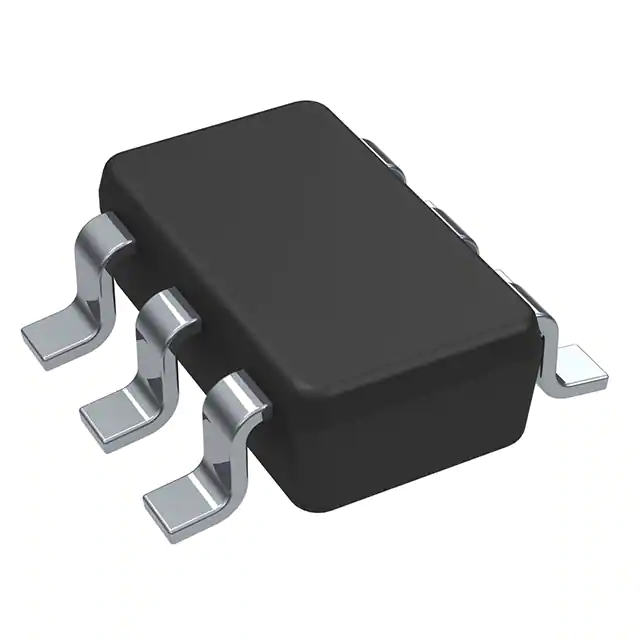
SOT-23-5 (DBV) package: 2.9 mm × 1.6 mm × 1.45 mm body, gull-wing leads, RoHS-compliant matte tin lead finish, MSL Level-1.
| Pin/Terminal | Circuit Role | Design Meaning |
|---|---|---|
| 1 (OUT) | Negative output terminal | Delivers inverted voltage; connects to load return path and output capacitor cathode; must not be shorted to V+. |
| 2 (V+) | Positive supply input | Accepts 1.8V–5.5V input; bypass capacitor recommended near pin; maximum absolute rating 5.8V. |
| 3 (CAP−) | Charge-pump capacitor negative node | Connects to negative terminal of flying capacitor C1; forms half of charge-transfer path during pump cycle. |
| 4 (GND) | Ground reference | System ground return; shared with output capacitor anode; requires low-inductance connection to minimize noise. |
| 5 (CAP+) | Charge-pump capacitor positive node | Connects to positive terminal of flying capacitor C1; switching node toggled at 6 kHz; sensitive to layout parasitics. |
Key Features
| Feature | Design Value |
|---|---|
| Fixed-ratio voltage inversion | No external resistors or feedback required - simplifies BOM and eliminates trimming for ±VCC generation. |
| Ultra-low quiescent current | 40 µA operation enables use in energy-harvesting or wake-on-event systems where standby power dominates lifetime. |
| SOT-23-5 footprint | Minimizes PCB area vs. discrete inverter solutions; compatible with standard pick-and-place and reflow processes. |
| Internal 12 kHz oscillator | Eliminates need for external timing components; ensures consistent switching behavior across temperature and voltage. |
| 2 kV HBM ESD rating | Enables safe handling in standard assembly environments without special ESD protocols beyond basic grounding. |
Applications
| Operational Amplifier Power Supplies | Handheld Instrumentation |
|---|---|
|
Use Scenario: Dual-supply op-amps in portable multimeters or signal conditioners require symmetric ±2.5V or ±5V rails from a single 5V battery. IC Role / Device Role / Timing Role: LM828M5/NOPB generates clean negative rail; no clock input or synchronization needed - autonomous charge-pump operation. Use Value: Eliminates need for bulky inductors or second battery; 20 Ω output impedance supports ≤10 mA op-amp quiescent loads with <200 mV dropout. |
Use Scenario: Portable gas analyzers or pH meters use low-noise analog front-ends requiring isolated negative bias for sensor excitation. IC Role / Device Role / Timing Role: LM828M5/NOPB serves as compact, low-power negative bias source; operates continuously during measurement cycles. Use Value: 40 µA quiescent current extends AA/AAA battery life to >18 months in devices drawing <100 µA average system current. |
| Interface Power Supplies | Cellular Phone Peripherals |
|
Use Scenario: RS-232 or MAX232-compatible level shifters in industrial IoT gateways need −3V to −5.5V for driver stages. IC Role / Device Role / Timing Role: LM828M5/NOPB provides dedicated negative rail; decoupled from main system regulator to reduce noise coupling. Use Value: 97% efficiency at 5 mA minimizes heat rise in sealed enclosures; SOT-23 placement avoids routing high-frequency CAP+ traces near analog sections. |
Use Scenario: Feature phones or legacy mobile accessories (e.g., FM transmitters) require −2.7V for RF amplifier bias from 3.6V Li-ion. IC Role / Device Role / Timing Role: LM828M5/NOPB acts as dedicated inverter for RF subsystem; enabled only during transmission bursts. Use Value: Fast turn-on (<10 µs) and no startup sequencing allow immediate rail availability; 50 mA absolute max rating protects against transient overloads. |
Equivalent & Alternatives
The following parts are listed as comparable options for similar voltage inverter applications.
| Alternative Part | Technical Difference | Application Difference | Selection Advice |
|---|---|---|---|
| MAX680ESA+ | Higher 100 kHz switching frequency; 3.5 mA quiescent current; ±5V output from +5V input only. | Better ripple performance with smaller capacitors; unsuitable for 1.8V–3.3V input range. | Select when low-ESR ceramic caps are preferred and input is fixed at 5V. |
| ICL7660ACPA+ | Wider −1.5V to −10V output range; 170 µA quiescent current; 35 Ω output impedance. | Supports higher voltage inversion but consumes >4× more quiescent power and delivers lower output current. | Select when input exceeds 5.5V or cost sensitivity outweighs efficiency and size constraints. |
Compared with MAX680ESA+ and ICL7660ACPA+, the LM828M5/NOPB offers optimal balance of ultra-low IQ, wide 1.8V–5.5V input compatibility, and SOT-23 footprint - making it the preferred choice for space-constrained, battery-critical designs needing reliable −V+ inversion without external timing or feedback components.
Availability
LM828M5/NOPB is available at Aetrix Electronics and suitable for cellular phone peripherals, handheld instrumentation, operational amplifier power supplies, and interface power supplies requiring stable component supply across long-lifecycle consumer and industrial programs.
Supply support for LM828M5/NOPB includes scheduled delivery planning, volume procurement assistance, BOM continuity management, traceable sourcing, and lifecycle availability coordination for OEM customers, industrial embedded developers, connected-device designers, and electronics production programs.
Manufacturer
Texas Instruments is a global semiconductor leader delivering analog, embedded processing, and connectivity solutions with emphasis on reliability, scalability, and broad technical support.
The LM828M5/NOPB belongs to TI's legacy precision analog power management portfolio, designed specifically for compact, low-quiescent-current DC/DC voltage inversion in portable and battery-operated systems.
FAQ
What is the minimum input voltage supported by the LM828M5/NOPB?
The LM828M5/NOPB supports a minimum input voltage of +1.8V, enabling operation directly from single-cell lithium polymer or alkaline batteries without pre-regulation. Below 1.8V, the internal oscillator fails to sustain switching, and output collapses. This specification is confirmed in the Electrical Characteristics table under "Supply Voltage" with Min = 1.8V at TJ = 25°C.
Can the LM828M5/NOPB generate regulated output voltage?
No, the LM828M5/NOPB is an unregulated charge-pump inverter - its output voltage equals −V+ under no load and drops linearly with load current per its 20 Ω typical output impedance. To achieve regulation, TI recommends cascading with an LDO such as the LP2980, as documented in Figure 16 of the LM828M5/NOPB datasheet.
What capacitor types are recommended for use with the LM828M5/NOPB?
Texas Instruments recommends low-ESR capacitors: ceramic (Murata, Taiyo Yuden), tantalum (AVX TPS, Sprague 593D), or OS-CON aluminum (Sanyo). High-ESR electrolytics increase output impedance and ripple; the datasheet specifies 10 µF/0.3Ω max ESR for C1 and C2 in test conditions, and Equation (1) shows ESR contributes directly to ROUT.
Is the LM828M5/NOPB pin-compatible with other SOT-23-5 voltage inverters?
No documented pin compatibility exists between LM828M5/NOPB and other SOT-23-5 inverters (e.g., MAX680, ICL7660). Pin 3 (CAP−) and Pin 5 (CAP+) have unique charge-pump node assignments; swapping devices without verifying pin function mapping risks circuit malfunction or damage.
What is the maximum continuous output current of the LM828M5/NOPB?
The LM828M5/NOPB delivers up to 25 mA of continuous output current under typical conditions (TA = 25°C, V+ = 5V). At higher temperatures or lower input voltages, output current must be derated per thermal limits - the Absolute Maximum Rating specifies 50 mA peak, but sustained operation above 25 mA risks exceeding 150°C junction temperature.
LM828M5/NOPB Specifications
- Product attributes
- Attribute value
- Manufacturer:
- Texas Instruments
- Series:
- -
- Package/Case:
- SC-74A, SOT-753
- Packaging:
- Tape & Reel (TR)
- Product Status:
- Active
- Function:
- Ratiometric
- Output Configuration:
- Positive or Negative
- Topology:
- Charge Pump
- Output Type:
- Fixed
- Number of Outputs:
- 1
- Voltage - Input (Min):
- 1.8V
- Voltage - Input (Max):
- 5.5V
- Voltage - Output (Min/Fixed):
- -Vin, 2Vin
- Voltage - Output (Max):
- -
- Current - Output:
- 25mA
- Frequency - Switching:
- 12kHz
- Synchronous Rectifier:
- No
- Operating Temperature:
- -40°C ~ 85°C (TJ)
- Grade:
- -
- Qualification:
- -
- Mounting Type:
- Surface Mount
- Supplier Device Package:
- SOT-23-5
LM828M5/NOPB FAQ
1.How can I place an order for LM828M5/NOPB through Aetrix?
Please submit a Request for Quotation (RFQ) for LM828M5/NOPB on Aetrix. Our sales agent will provide a competitive quotation and guide you through the order confirmation once you accept the terms.
2.Are the price and stock information for LM828M5/NOPB reliable?
The price and inventory of LM828M5/NOPB are updated periodically and may fluctuate due to market conditions. Stock and pricing data are typically refreshed every 24 hours. Quotation validity for LM828M5/NOPB is usually 5 days.
3.What payment methods are accepted for LM828M5/NOPB?
We accept Wire Transfer, PayPal, Credit Card, Western Union, MoneyGram, and Escrow for LM828M5/NOPB transactions.
Note: Certain payment methods may incur a processing fee.
4.How is shipping managed for LM828M5/NOPB?
LM828M5/NOPB orders can be shipped via leading logistics carriers, including DHL, UPS, FedEx, TNT, or Registered Mail.
Once your LM828M5/NOPB order is processed, you will receive an email with the shipment details and tracking number.
Note: Tracking information may take up to 24 hours to appear. Express delivery typically takes 3–5 business days.
5.How can I obtain technical support or documentation for LM828M5/NOPB?
For technical support, including LM828M5/NOPB datasheets, pinout diagrams, or application guidance, please contact our engineering support team. They can provide detailed documentation and assistance for your LM828M5/NOPB requirements.
6.How does Aetrix verify that LM828M5/NOPB is sourced from the original manufacturer or authorized distributors?
All LM828M5/NOPB products on Aetrix are procured from qualified distributors and authorized channels. Our dedicated quality assurance team conducts strict verification, including traceability checks and, if necessary, third-party testing. This ensures that LM828M5/NOPB meets industry standards.
7.What is the process for return or replacement of LM828M5/NOPB?
All LM828M5/NOPB units undergo pre-shipment inspection (PSI). If there is an issue with LM828M5/NOPB, returns or replacements are accepted under the following conditions:
1.Quantity discrepancies, incorrect items, or visible external defects (such as breakage or corrosion), acknowledged by Aetrix.
2.The issue is reported within 90 days of delivery.
3.The LM828M5/NOPB part is unused and in its original packaging.
Return procedure for LM828M5/NOPB:
1.Submit a request within 90 days.
2.Obtain a Return Material Authorization (RMA) from Aetrix.
LM828M5/NOPB Tags
-
TPS562201DDCR
Texas Instruments
-
MC34063ABD-TR
STMicroelectronics
-
TPS561201DDCR
Texas Instruments

-
MC33063ADR
Texas Instruments
-
MC34063ADR
Texas Instruments
-
TPS560200DBVR
Texas Instruments
-
AP3012KTR-G1
Diodes Incorporated
-
TLV61048DBVR
Texas Instruments
-
AZ34063UMTR-G1
Diodes Incorporated
-
TPS562200DDCR
Texas Instruments
-
AP62300TWU-7
Diodes Incorporated
-
MC34063EBD-TR
STMicroelectronics
Tech Hub

A practical engineering guide to 3.3V and 5V logic compatibility, input thresholds, resistor dividers, translator ICs, MOSFET level shifting, I2C pull-ups, timing limits and power-sequencing risks.

The 74HC595 uses push-pull logic outputs, while the TPIC6B595 uses 50 V open-drain DMOS sinks for higher-power loads. This guide compares timing, current limits, 3.3 V interfacing, load wiring, thermal…

The 74HC595 converts serial data into eight stable parallel outputs. This guide covers pin functions, shift and storage timing, OE and MR behavior, drive-current limits, cascading, voltage compatibilit…

A technical comparison of level-sensitive latches and edge-triggered flip-flops, covering timing windows, setup and hold limits, master–slave operation, time borrowing, race-through, HDL inference and…

A D latch stores one bit while Enable controls when data can pass. This reference covers gate-level operation, truth tables, transparency, setup and hold timing, LE versus OE, common ICs and practical …

An SR latch stores one bit through cross-coupled feedback. This engineering reference covers NOR and NAND implementations, truth tables, forbidden-state recovery, gated operation, switch debouncing, fa…

Latch circuits retain one bit through feedback. This technical reference covers SR and D latches, truth tables, transparency, timing limits, latch-versus-flip-flop behavior, applications and common log…

An engineering guide to LED driver operation, constant-current and constant-voltage outputs, linear and switching topologies, dimming, IC selection, calculations, replacement compatibility, and fault c…

Operational amplifier guide covering op amp basics, feedback, ideal vs real op amps, common configurations, buffer circuits, offset, bias current, gain-bandwidth, slew rate, rail-to-rail limits and sel…

Jumper cables guide covering safe connection order, red and black clamp placement, final ground connection, cable gauge, length, clamp quality, copper vs CCA cables, jump starter comparison and battery…


