
 My Inquiry
 My Account


Texas Instruments LM8330TME/NOPB
- Part No.:
- LM8330TME/NOPB
- Manufacturer:
- Texas Instruments
- Category:
- Specialized
- Package:
- 25-WFBGA, DSBGA
- Datasheet:
-
 LM8330TME/NOPB.pdf
- Description:
- IC INTFACE SPECIALIZED 25DSBGA
- Quantity:
- Payment:

- Shipping:

Inventory:596
Please send an inquiry. Send us your inquiry, and we will respond immediately.
Product details
Overview
LM8330TME/NOPB from Texas Instruments is an I²C-compatible keypad controller and I/O expander with integrated 8×12 keypad scan, three programmable PWM outputs, 1.8V operation, ±8 kV IEC61000-4-2 ESD protection on KPX/KPY pins, and ultra-low-power HALT mode (1.5 µA typ). It serves as a dedicated host-offload device in compact portable electronics requiring robust key event handling and dynamic LED brightness control.
For engineers reviewing the LM8330TME/NOPB datasheet, LM8330TME/NOPB pinout, LM8330TME/NOPB application, or LM8330TME/NOPB equivalent, this page delivers verified technical context, exact pin functions, real-world use cases, and validated alternative options for mobile keypad and GPIO expansion designs.
Technical Context
The LM8330TME/NOPB implements a register-based command interpreter communicating exclusively in I²C-compatible ACCESS.bus slave mode (100 kHz/400 kHz), with fixed 7-bit default address 0x88 and 10-bit address 0x088. Its internal 32 kHz oscillator eliminates external clock requirements.
Keypad scanning operates at 4 ms intervals with configurable debounce (12 ms typical) and settle time, supporting up to four simultaneous key presses stored in dedicated KBDCODE[3:0] registers and a 16-event FIFO. Three independent PWM timers-each with 31-command script buffer, auto-incrementing/decrementing duty cycle, and trigger chaining-run off the same 32 kHz reference.
Key Specifications
| Parameter | Value and Actual Design Meaning |
|---|---|
| Supply Voltage | 1.62 V to 1.98 V - Enables direct interface with 1.8 V system rails without level-shifting. |
| Operating Temperature | −30°C to +85°C - Qualified for consumer and industrial handheld environments. |
| Keypad Support | Up to 8×12 matrix + 8 SF keys - Provides full 104-key capability with flexible row/column assignment. |
| PWM Outputs | Three independent channels (PWM0–PWM2) - Enables synchronized RGB LED dimming or multi-zone backlight control. |
| ESD Protection | ±8 kV IEC61000-4-2 direct contact on KPX[7:0]/KPY[10:0] - Eliminates need for external TVS diodes on keypad lines. |
| HALT Current | 1.5 µA (typ) - Achieves battery-friendly idle state during keypad inactivity (default timeout: 1020 ms). |
| I²C Interface | Standard (100 kHz) and Fast Mode (400 kHz), 7-/10-bit addressing - Compatible with legacy and high-speed host controllers. |
Pinout & Package
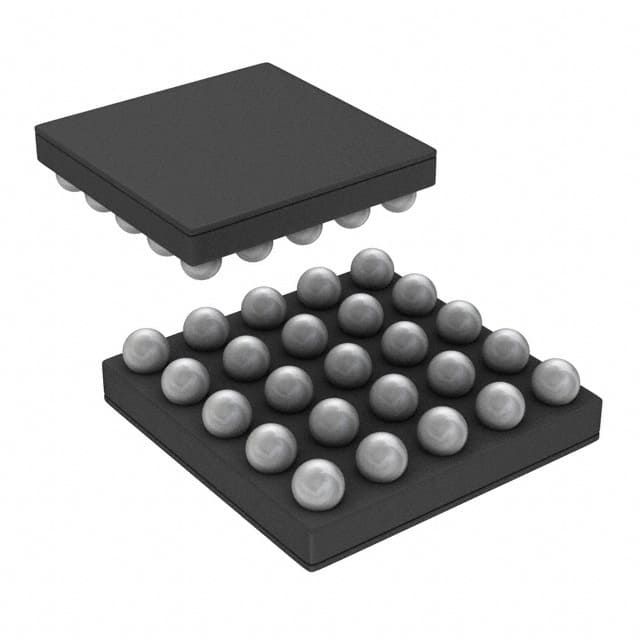
LM8330TME/NOPB uses a 25-ball DSBGA package measuring 2.0 mm × 2.0 mm × 0.6 mm with 0.4 mm pitch. All balls are lead-free and RoHS-compliant.
| Pin/Terminal | Circuit Role | Design Meaning |
|---|---|---|
| RESETN | Active-low reset input | Asynchronous system-level reset; includes 50–100 ns glitch filter for noise immunity. |
| VCC | Core supply | 1.8 V ±10% single supply powering all logic, keypad scan, and PWM blocks. |
| SCL / SDA | I²C clock/data | Open-drain, 1.8 V-tolerant interface supporting standard/fast-mode timing and auto-increment register access. |
| KPX0–KPX7 | Keypad X-lines / GPIO0–7 | Configurable as row drivers or general-purpose inputs/outputs with programmable pullup/pulldown. |
| KPY0–KPY10 | Keypad Y-lines / GPIO8–18 / PWM0–2 | Column sense lines with dual GPIO/PWM function; KPY8/KPY11 share PWM2 (mutually exclusive). |
| IRQN | Interrupt output | Open-drain active-low signal asserting on key events, errors, or hardware interrupts per IRQST register status. |
| GND | Ground reference | Single ground ball providing return path for all internal circuits and I/Os. |
Key Features
| Feature | Design Value |
|---|---|
| 16-event keycode FIFO + 4-key multi-press storage | Enables reliable detection and buffering of rapid or concurrent key actions without host polling overhead. |
| 31-command PWM script buffer per channel | Allows autonomous LED fade, blink, or color-transition sequences without CPU intervention or timer interrupts. |
| On-chip power-on reset (POR) | Guarantees known initial pin states and register configuration after power-up or brownout recovery. |
| ASIP-integrated ESD protection | Provides certified ±8 kV contact discharge tolerance on all keypad I/Os, reducing BOM count and PCB area. |
| Configurable HALT wake-up sources | Permits selective wake-up from sleep via key press, IRQN edge, or I²C address match-no external wake signal needed. |
Applications
| Mobile Keypad Interface | QWERTY Keyboard Controller |
|---|---|
Use Scenario: Compact smartphone or feature phone with physical numeric keypad and soft-function keys. IC Role / Device Role / Timing Role: Dedicated keypad scanner and interrupt generator; replaces host CPU polling with event-driven IRQN signaling. Use Value: Reduces host processor load by >90% during idle, extends battery life via 1.5 µA HALT current, and ensures ESD-immune key detection in handheld drop environments. | Use Scenario: Handheld PDA or ruggedized terminal requiring alphanumeric QWERTY input with backlight control. IC Role / Device Role / Timing Role: Matrix scanner + GPIO expander + triple PWM driver; manages 8×12 key grid while modulating RGB LED backlight intensity. Use Value: Integrates three critical functions into one 2 mm × 2 mm package, eliminating discrete GPIO expanders and LED drivers while maintaining ±8 kV ESD robustness on all key lines. |
| Universal Remote Control | Industrial Keypad Terminal |
Use Scenario: Multi-protocol IR remote with customizable button layout and status LEDs. IC Role / Device Role / Timing Role: Keypad event processor and LED brightness controller; executes preloaded PWM scripts for smooth LED transitions during mode changes. Use Value: Enables visually responsive UI with zero host CPU cycles spent on LED timing-scripted fades and blinks run autonomously from 32 kHz internal clock. | Use Scenario: Factory-floor HMI panel exposed to electrostatic discharge and wide ambient temperature swings. IC Role / Device Role / Timing Role: Ruggedized I/O expander and key scanner; provides certified IEC61000-4-2 Level 4 ESD protection and −30°C to +85°C operation. Use Value: Eliminates field failures due to ESD-induced keypad lockup; guarantees reliable key registration even after repeated 8 kV contact discharges on KPX/KPY pins. |
Equivalent & Alternatives
The following parts are listed as comparable options for similar keypad controller and I/O expansion applications.
| Alternative Part | Technical Difference | Application Difference | Selection Advice |
|---|---|---|---|
| TCA6424A | 24-bit I²C GPIO expander only; no keypad scan engine, no PWM, no ESD hardening on I/Os. | Requires external firmware for key scanning; lacks integrated debounce, FIFO, or interrupt prioritization. | Select when only general-purpose I/O expansion is needed and keypad functionality is handled elsewhere. |
| MAX7359 | 8×10 keypad controller with 8 GPIOs and 2 PWMs; supports 2.5–5.5 V supply; ±4 kV IEC61000-4-2 ESD rating. | Higher voltage range enables direct 3.3 V/5 V integration but requires external level shifters for 1.8 V hosts. | Select for mixed-voltage systems where 1.8 V operation is not mandatory and lower ESD margin is acceptable. |
Compared with TCA6424A and MAX7359, LM8330TME/NOPB uniquely integrates keypad scanning, triple PWM, and ±8 kV IEC-rated ESD protection in a 2 mm × 2 mm package optimized for 1.8 V battery-powered devices-offering the highest functional density and environmental robustness for space-constrained portable interfaces.
Availability
LM8330TME/NOPB is available at Aetrix Electronics and suitable for mobile phones, QWERTY keyboards, universal remotes, and industrial keypad terminals requiring stable component supply, long-term lifecycle support, and guaranteed RoHS-compliant sourcing.
Supply support for LM8330TME/NOPB includes scheduled delivery planning, volume procurement assistance, BOM continuity management, traceable sourcing, and lifecycle availability coordination for OEM customers, industrial embedded developers, connected-device designers, and electronics production programs.
Manufacturer
Texas Instruments is a global semiconductor leader delivering analog, embedded processing, and connectivity solutions for industrial, automotive, and personal electronics markets.
The LM8330TME/NOPB belongs to TI's precision human-interface IC portfolio, engineered specifically to reduce host processor burden in portable devices through integrated keypad scanning, GPIO expansion, and autonomous LED control.
FAQ
What is the default I²C slave address for LM8330TME/NOPB?
The LM8330TME/NOPB defaults to a 7-bit I²C slave address of 0x88 and a 10-bit address of 0x088. These addresses are programmable via configuration registers, but the device powers up using these factory-set values. The upper three bits of the 10-bit address are hard-tied to zero, ensuring deterministic initialization without external strapping.
Does LM8330TME/NOPB require an external crystal or clock source?
No, LM8330TME/NOPB does not require an external clock source. It contains a fully integrated 32 kHz internal oscillator used for keypad scanning, PWM timing, and HALT mode control. This eliminates BOM cost and PCB footprint associated with crystals, capacitors, or clock generators-confirmed in the datasheet's "Internal Oscillator, No External Clock Required" feature list.
How many keys can LM8330TME/NOPB scan simultaneously, and how are multiple presses handled?
LM8330TME/NOPB supports up to four simultaneous key presses. Each press is stored in dedicated KBDCODE0–KBDCODE3 registers, with the MULTIKEY flag set in KBDCODE0 indicating additional presses. All events-including press/release sequences-are also captured in a 16-event FIFO accessible via the EVTCODE register, enabling lossless capture of rapid key activity without host polling.
What is the purpose of the ASIP technology on LM8330TME/NOPB's KPX and KPY pins?
The ASIP (Application Specific Integrated Passives) on LM8330TME/NOPB's KPX[7:0] and KPY[10:0] pins integrates robust ESD protection circuitry directly into the silicon, achieving ±8 kV IEC61000-4-2 contact discharge rating. This eliminates the need for external TVS diodes on keypad lines, reduces PCB area, improves reliability, and ensures consistent ESD performance across manufacturing lots-explicitly documented in the "ASIP ESD Protection" section of the datasheet.
Can LM8330TME/NOPB wake from HALT mode without external hardware intervention?
Yes, LM8330TME/NOPB can autonomously wake from HALT mode using internally generated events: key press/release on configured KPX/KPY lines, IRQN edge detection, or I²C address match. The wake-up source is configurable via registers such as WAKECFG, and no external wake pin or circuit is required-enabling true self-contained low-power operation as confirmed in the "Configurable Wake-Up from HALT Operation" feature list and HALT MODE section.
LM8330TME/NOPB Specifications
- Product attributes
- Attribute value
- Manufacturer:
- Texas Instruments
- Series:
- -
- Package/Case:
- 25-WFBGA, DSBGA
- Packaging:
- Tape & Reel (TR)
- Product Status:
- Active
- Applications:
- Cell Phone
- Interface:
- I2C
- Voltage - Supply:
- 1.62V ~ 1.98V
- Supplier Device Package:
- 25-DSBGA
- Grade:
- -
- Qualification:
- -
- Mounting Type:
- Surface Mount
LM8330TME/NOPB FAQ
1.How can I place an order for LM8330TME/NOPB through Aetrix?
Please submit a Request for Quotation (RFQ) for LM8330TME/NOPB on Aetrix. Our sales agent will provide a competitive quotation and guide you through the order confirmation once you accept the terms.
2.Are the price and stock information for LM8330TME/NOPB reliable?
The price and inventory of LM8330TME/NOPB are updated periodically and may fluctuate due to market conditions. Stock and pricing data are typically refreshed every 24 hours. Quotation validity for LM8330TME/NOPB is usually 5 days.
3.What payment methods are accepted for LM8330TME/NOPB?
We accept Wire Transfer, PayPal, Credit Card, Western Union, MoneyGram, and Escrow for LM8330TME/NOPB transactions.
Note: Certain payment methods may incur a processing fee.
4.How is shipping managed for LM8330TME/NOPB?
LM8330TME/NOPB orders can be shipped via leading logistics carriers, including DHL, UPS, FedEx, TNT, or Registered Mail.
Once your LM8330TME/NOPB order is processed, you will receive an email with the shipment details and tracking number.
Note: Tracking information may take up to 24 hours to appear. Express delivery typically takes 3–5 business days.
5.How can I obtain technical support or documentation for LM8330TME/NOPB?
For technical support, including LM8330TME/NOPB datasheets, pinout diagrams, or application guidance, please contact our engineering support team. They can provide detailed documentation and assistance for your LM8330TME/NOPB requirements.
6.How does Aetrix verify that LM8330TME/NOPB is sourced from the original manufacturer or authorized distributors?
All LM8330TME/NOPB products on Aetrix are procured from qualified distributors and authorized channels. Our dedicated quality assurance team conducts strict verification, including traceability checks and, if necessary, third-party testing. This ensures that LM8330TME/NOPB meets industry standards.
7.What is the process for return or replacement of LM8330TME/NOPB?
All LM8330TME/NOPB units undergo pre-shipment inspection (PSI). If there is an issue with LM8330TME/NOPB, returns or replacements are accepted under the following conditions:
1.Quantity discrepancies, incorrect items, or visible external defects (such as breakage or corrosion), acknowledged by Aetrix.
2.The issue is reported within 90 days of delivery.
3.The LM8330TME/NOPB part is unused and in its original packaging.
Return procedure for LM8330TME/NOPB:
1.Submit a request within 90 days.
2.Obtain a Return Material Authorization (RMA) from Aetrix.
LM8330TME/NOPB Tags
-
NVT4857UKAZ
NXP Semiconductors
-
TCA8418RTWR
Texas Instruments
-
PCA9546APWR
Texas Instruments
-
MD0100N8-G
Microchip Technology
-
PCA9548APW,118
NXP Semiconductors
-
PCA9540BDP,118
NXP Semiconductors
-
PCA9548APWR
Texas Instruments
-
PCA9546APW,118
NXP Semiconductors
-
PTN3360DBS,518
NXP Semiconductors
-
PCA9546ABS,118
NXP Semiconductors
-
PCA9518PWR
Texas Instruments
-
PCA9545APW,118
NXP Semiconductors
Tech Hub

A practical engineering guide to 3.3V and 5V logic compatibility, input thresholds, resistor dividers, translator ICs, MOSFET level shifting, I2C pull-ups, timing limits and power-sequencing risks.

The 74HC595 uses push-pull logic outputs, while the TPIC6B595 uses 50 V open-drain DMOS sinks for higher-power loads. This guide compares timing, current limits, 3.3 V interfacing, load wiring, thermal…

The 74HC595 converts serial data into eight stable parallel outputs. This guide covers pin functions, shift and storage timing, OE and MR behavior, drive-current limits, cascading, voltage compatibilit…

A technical comparison of level-sensitive latches and edge-triggered flip-flops, covering timing windows, setup and hold limits, master–slave operation, time borrowing, race-through, HDL inference and…

A D latch stores one bit while Enable controls when data can pass. This reference covers gate-level operation, truth tables, transparency, setup and hold timing, LE versus OE, common ICs and practical …

An SR latch stores one bit through cross-coupled feedback. This engineering reference covers NOR and NAND implementations, truth tables, forbidden-state recovery, gated operation, switch debouncing, fa…

Latch circuits retain one bit through feedback. This technical reference covers SR and D latches, truth tables, transparency, timing limits, latch-versus-flip-flop behavior, applications and common log…

An engineering guide to LED driver operation, constant-current and constant-voltage outputs, linear and switching topologies, dimming, IC selection, calculations, replacement compatibility, and fault c…

Operational amplifier guide covering op amp basics, feedback, ideal vs real op amps, common configurations, buffer circuits, offset, bias current, gain-bandwidth, slew rate, rail-to-rail limits and sel…

Jumper cables guide covering safe connection order, red and black clamp placement, final ground connection, cable gauge, length, clamp quality, copper vs CCA cables, jump starter comparison and battery…


