
 My Inquiry
 My Account


Texas Instruments LM95221CIMM/NOPB
- Part No.:
- LM95221CIMM/NOPB
- Manufacturer:
- Texas Instruments
- Category:
- Analog and Digital Output
- Package:
- 8-TSSOP, 8-MSOP (0.118", 3.00mm Width)
- Datasheet:
-
 LM95221CIMM/NOPB.pdf
- Description:
- SENSOR DIGITAL 0C-85C 8VSSOP
- Quantity:
- Payment:

- Shipping:

Inventory:783
Please send an inquiry. Send us your inquiry, and we will respond immediately.
Product details
Overview
LM95221CIMM/NOPB from Texas Instruments is a dual remote diode digital temperature sensor with SMBus 2.0 interface in an 8-pin VSSOP package. It measures local die temperature and two external diode-connected transistors (e.g., MMBT3904 or processor thermal diodes), delivering ±1.0°C remote accuracy (TA=30–50°C, TD=45–85°C) and 0.125°C LSB resolution for remote readings. It supports unsigned 11-bit mode for temperatures above 127°C and is used in laptop/desktop thermal management systems.
For engineers reviewing the LM95221CIMM/NOPB datasheet, LM95221CIMM/NOPB pinout, LM95221CIMM/NOPB application, or LM95221CIMM/NOPB equivalent, key selection considerations include remote diode fault detection capability, programmable 10-/11-bit resolution, SMBus timeout support, ±3.0°C remote accuracy over 0–85°C ambient, and compatibility with Pentium/AMD thermal diodes.
Technical Context
The LM95221CIMM/NOPB uses ΔVBE sensing with sigma-delta ADC to measure three thermal zones: its own die and two remote diodes. Its internal diode current sources (188–315 µA) are factory trimmed for 1.008 ideality factor and 2.7 Ω series resistance, ensuring ±1.0°C accuracy under specified conditions.
It implements SMBus 2.0 slave protocol with fixed 7-bit address (0x2B), no clock stretching, and tTIMEOUT reset (25–35 ms low on SMBDAT/SMBCLK). Conversion sequence takes 66 ms total (26 ms per remote + 14 ms local), with programmable rates (15 Hz to 1 Hz) via Configuration Register bits CR1:CR0.
Key Specifications
| Parameter | Value and Actual Design Meaning |
|---|---|
| Remote Temp Accuracy | ±1.0°C max (TA=30–50°C, TD=45–85°C); ensures reliable CPU/GPU junction monitoring in laptops |
| Local Temp Accuracy | ±3.0°C max (TA=0–85°C); sufficient for board-level ambient tracking near ICs |
| Remote Resolution | 0.125°C LSB (11-bit unsigned or 10-bit plus sign); enables sub-degree precision and >127°C range |
| Supply Voltage | 3.0 V to 3.6 V; compatible with standard 3.3 V logic rails and bypassed by 0.1 µF + 100 pF |
| Quiescent Current | 2.0 mA typical (15 Hz continuous); drops to 335 µA in shutdown for power-sensitive systems |
| SMBus Clock Range | 10 kHz to 100 kHz; meets SMBus 2.0 timing with tLOW ≥4.7 µs and tTIMEOUT ≥25 ms |
| Operating Temp | 0°C to +85°C ambient (LM95221CIMM grade); validated for commercial computing environments |
Pinout & Package
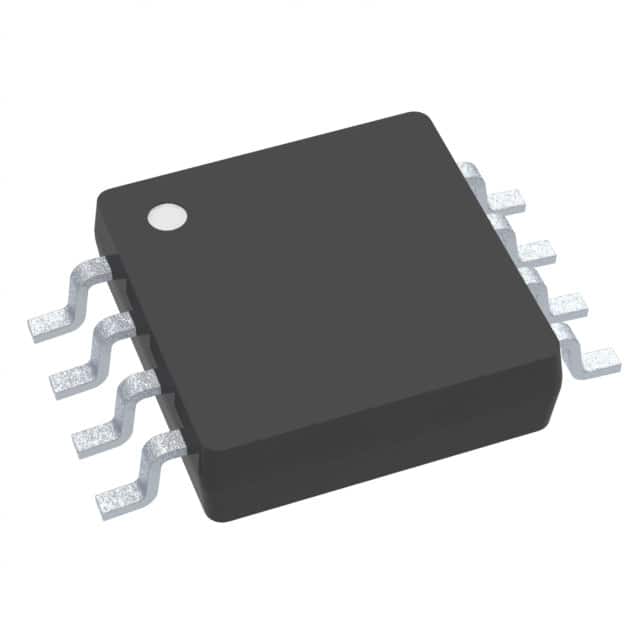
LM95221CIMM/NOPB is housed in an 8-pin VSSOP (Very Small Outline Package) with 0.5 mm pitch, 3.0 mm × 3.0 mm body, and exposed thermal pad (not electrically connected). Thermal resistance θJA = 210°C/W on 2 oz. copper PCB.
| Pin/Terminal | Circuit Role | Design Meaning |
|---|---|---|
| D1+ | Diode current source | Drives 188–315 µA into remote diode anode; requires 2.2 nF bypass capacitor to D1− for noise rejection |
| D1− | Diode return sink | Completes remote diode 1 current path; must be routed with matched trace length to D1+ for accuracy |
| D2+ | Diode current source | Independent current source for second remote diode; identical specs and layout rules as D1+ |
| D2− | Diode return sink | Completes remote diode 2 current path; grounding unused D2+/D2− disables channel |
| GND | Power ground | Reference for all analog and digital circuitry; must connect to low-impedance system ground plane |
| VDD | Positive supply | 3.0–3.6 V input; requires 0.1 µF ceramic + 100 pF capacitor placed adjacent to pin |
| SMBDAT | SMBus bidirectional data | Open-drain I/O; needs external pull-up (≤82 kΩ at 3.0 V) to meet VOL ≤0.4 V @ 4 mA |
| SMBCLK | SMBus clock input | Asynchronous clock input; no internal pull-up; accepts 10–100 kHz square wave with 4.0 µs tHIGH min |
Key Features
| Feature | Design Value |
|---|---|
| Remote diode fault detection | Identifies D1+/D2+ short-to-rail or floating conditions and sets RD1M/RD2M status bits; reports –128.000°C (signed) or +255.875°C (unsigned) |
| Programmable resolution mode | Selects 11-bit unsigned (for >127°C) or 10-bit plus sign (for signed range) via Configuration Register; same 0.125°C LSB weight |
| One-shot conversion control | Writing any value to 0xFh register triggers single full-cycle conversion (local + both remotes) then returns to standby-no firmware polling needed |
| SMBus 2.0 timeout recovery | Holding SMBDAT or SMBCLK low >35 ms resets internal state machine, restoring communication without power cycle |
| On-board local sensing | Integrated die temperature sensor with 9-bit plus sign resolution (0.25°C LSB); independent of remote channels |
Applications
| Laptop CPU Thermal Monitoring | Desktop GPU Junction Sensing |
|---|---|
Use Scenario: Real-time die temperature tracking of Intel Core or AMD Ryzen processors during load transitions in thin-and-light notebooks. IC Role / Device Role / Timing Role: Dual remote diode sensor interfacing directly to CPU's integrated thermal diode and discrete MMBT3904 on VRM heatsink. Use Value: Enables dynamic fan speed control and thermal throttling with ±1.0°C accuracy, reducing acoustic noise while preventing thermal shutdown. | Use Scenario: Simultaneous monitoring of GPU die and memory module junction temperatures in high-performance desktop graphics cards. IC Role / Device Role / Timing Role: Remote channel 1 reads GPU thermal diode; channel 2 reads GDDR6 memory die diode; local channel monitors PCB hotspot near VRM. Use Value: Supports per-component thermal capping and adaptive voltage/frequency scaling, extending component lifetime under sustained compute loads. |
| Server Processor Thermal Management | Workstation ASIC Temperature Control |
Use Scenario: Multi-socket server motherboard measuring CPU, memory controller, and chipset junction temperatures for intelligent cooling orchestration. IC Role / Device Role / Timing Role: One LM95221CIMM/NOPB per CPU socket; remote diodes track processor die and memory buffer chip; SMBus daisy-chain enables centralized readout. Use Value: Delivers coordinated thermal response across multi-core, multi-die packages with <66 ms update latency and fault-aware reporting. | Use Scenario: Precision thermal feedback for FPGA or AI accelerator modules where junction temperature must stay within ±2°C of setpoint during inference workloads. IC Role / Device Role / Timing Role: Local sensor tracks ASIC package temperature; remote channels monitor two on-die thermal diodes embedded in different logic blocks. Use Value: Enables closed-loop thermal regulation with 0.125°C resolution, supporting high-reliability operation in industrial workstations. |
Equivalent & Alternatives
The following parts are listed as comparable options for similar dual remote diode temperature sensing applications.
| Alternative Part | Technical Difference | Application Difference | Selection Advice |
|---|---|---|---|
| LM95231CIMM/NOPB | Same pinout and SMBus interface; adds local temperature offset calibration register and improved remote accuracy (±0.75°C) | Requires software support for offset register; better suited for high-accuracy server BIOS implementations | Choose when tighter local accuracy (±1.5°C) and per-device calibration are required; otherwise LM95221CIMM/NOPB offers cost-effective baseline performance |
| MAX6642AESA+ | 8-pin SOIC package; 2-wire interface compatible with SMBus/I²C; ±1.5°C remote accuracy; no unsigned 11-bit mode | Larger footprint; lacks >127°C remote range and diode fault flag bits in status register | Select for legacy SOIC layouts or when SMBus timeout recovery is not critical; avoid if unsigned mode or VSSOP space constraints apply |
Compared with LM95221CIMM/NOPB, LM95231CIMM/NOPB improves accuracy and adds calibration flexibility but increases firmware complexity, while MAX6642AESA+ trades compact VSSOP packaging and extended temperature range for SOIC compatibility and simpler register map.
Availability
LM95221CIMM/NOPB is available at Aetrix Electronics and suitable for laptop thermal management, desktop GPU monitoring, and server processor cooling applications requiring stable component supply and long-term industrial availability.
Supply support for LM95221CIMM/NOPB includes scheduled delivery planning, volume procurement assistance, BOM continuity management, traceable sourcing, and lifecycle availability coordination for OEM customers, industrial embedded developers, connected-device designers, and electronics production programs.
Manufacturer
Texas Instruments is a global semiconductor company headquartered in Dallas, Texas, designing analog and embedded processing products for industrial, automotive, and computing markets.
The LM952xx family was developed specifically for high-accuracy, multi-zone thermal monitoring in space-constrained computing platforms, with emphasis on SMBus integration, diode fault resilience, and low-power operation.
FAQ
What is the remote temperature accuracy specification for LM95221CIMM/NOPB under typical operating conditions?
The LM95221CIMM/NOPB achieves ±1.0°C maximum remote diode temperature accuracy when ambient temperature (TA) is between 30°C and 50°C and remote diode junction temperature (TD) is between 45°C and 85°C. This specification assumes use of a thermal diode with 1.008 ideality factor and 2.7 Ω series resistance-matching Pentium 4 or AMD processor diodes. Over the full 0–85°C ambient range, remote accuracy degrades to ±3.0°C max.
Does LM95221CIMM/NOPB support temperatures above 127°C on its remote channels?
Yes, LM95221CIMM/NOPB supports remote temperatures above 127°C by configuring the resolution mode to 11-bit unsigned binary via the Configuration Register. In this mode, the 0.125°C LSB yields a full-scale range up to +255.875°C. The default 10-bit plus sign mode caps at +127.875°C and rolls over to negative values beyond that point.
How does LM95221CIMM/NOPB detect a missing or faulty remote diode?
LM95221CIMM/NOPB detects missing or faulty remote diodes (D1+ or D2+) through dedicated circuitry that identifies shorts to VDD, GND, or D−, or open/floating conditions. When triggered, it sets the RD1M or RD2M bit in the Status Register (02h) and outputs FFE0h (255.875°C) in unsigned mode or 8000h (–128.000°C) in signed mode for the affected channel.
What is the conversion time for LM95221CIMM/NOPB to measure all three temperature zones?
The LM95221CIMM/NOPB requires approximately 66 ms to complete one full conversion cycle measuring local die temperature, remote diode 1, and remote diode 2. This time is fixed regardless of programmable conversion rate setting-the rate only inserts delay between cycles. During conversion, the BUSY bit (D7) in the Status Register remains high.
Can LM95221CIMM/NOPB operate on a standard I²C bus, or is SMBus 2.0 mandatory?
LM95221CIMM/NOPB is fully compatible with both SMBus 2.0 and standard I²C buses. Its 2-wire serial interface meets SMBus timing requirements-including tTIMEOUT reset-and functions as a standard I²C slave device with fixed 7-bit address 0x2B. No clock stretching is supported, aligning with SMBus constraints, but standard I²C masters can communicate without modification.
LM95221CIMM/NOPB Specifications
- Product attributes
- Attribute value
- Manufacturer:
- Texas Instruments
- Series:
- -
- Package/Case:
- 8-TSSOP, 8-MSOP (0.118", 3.00mm Width)
- Packaging:
- Tape & Reel (TR)
- Product Status:
- Obsolete
- Sensor Type:
- Digital, Local/Remote
- Sensing Temperature - Local:
- 0°C ~ 85°C
- Sensing Temperature - Remote:
- 0°C ~ 85°C
- Output Type:
- SMBus
- Voltage - Supply:
- 3V ~ 3.6V
- Resolution:
- 9 b (Local), 10 b (Remote)
- Features:
- One-Shot, Programmable Resolution, Shutdown Mode, Standby Mode
- Accuracy - Highest (Lowest):
- ±3°C
- Test Condition:
- 0°C ~ 85°C
- Operating Temperature:
- 0°C ~ 115°C
- Mounting Type:
- Surface Mount
- Grade:
- -
- Qualification:
- -
- Supplier Device Package:
- 8-VSSOP
LM95221CIMM/NOPB FAQ
1.How can I place an order for LM95221CIMM/NOPB through Aetrix?
Please submit a Request for Quotation (RFQ) for LM95221CIMM/NOPB on Aetrix. Our sales agent will provide a competitive quotation and guide you through the order confirmation once you accept the terms.
2.Are the price and stock information for LM95221CIMM/NOPB reliable?
The price and inventory of LM95221CIMM/NOPB are updated periodically and may fluctuate due to market conditions. Stock and pricing data are typically refreshed every 24 hours. Quotation validity for LM95221CIMM/NOPB is usually 5 days.
3.What payment methods are accepted for LM95221CIMM/NOPB?
We accept Wire Transfer, PayPal, Credit Card, Western Union, MoneyGram, and Escrow for LM95221CIMM/NOPB transactions.
Note: Certain payment methods may incur a processing fee.
4.How is shipping managed for LM95221CIMM/NOPB?
LM95221CIMM/NOPB orders can be shipped via leading logistics carriers, including DHL, UPS, FedEx, TNT, or Registered Mail.
Once your LM95221CIMM/NOPB order is processed, you will receive an email with the shipment details and tracking number.
Note: Tracking information may take up to 24 hours to appear. Express delivery typically takes 3–5 business days.
5.How can I obtain technical support or documentation for LM95221CIMM/NOPB?
For technical support, including LM95221CIMM/NOPB datasheets, pinout diagrams, or application guidance, please contact our engineering support team. They can provide detailed documentation and assistance for your LM95221CIMM/NOPB requirements.
6.How does Aetrix verify that LM95221CIMM/NOPB is sourced from the original manufacturer or authorized distributors?
All LM95221CIMM/NOPB products on Aetrix are procured from qualified distributors and authorized channels. Our dedicated quality assurance team conducts strict verification, including traceability checks and, if necessary, third-party testing. This ensures that LM95221CIMM/NOPB meets industry standards.
7.What is the process for return or replacement of LM95221CIMM/NOPB?
All LM95221CIMM/NOPB units undergo pre-shipment inspection (PSI). If there is an issue with LM95221CIMM/NOPB, returns or replacements are accepted under the following conditions:
1.Quantity discrepancies, incorrect items, or visible external defects (such as breakage or corrosion), acknowledged by Aetrix.
2.The issue is reported within 90 days of delivery.
3.The LM95221CIMM/NOPB part is unused and in its original packaging.
Return procedure for LM95221CIMM/NOPB:
1.Submit a request within 90 days.
2.Obtain a Return Material Authorization (RMA) from Aetrix.
LM95221CIMM/NOPB Tags
-
MCP9700T-E/TT
Microchip Technology
-
MCP9700T-E/LT
Microchip Technology
-
MCP9701T-E/TT
Microchip Technology
-
MCP9701T-E/LT
Microchip Technology
-
TMP235A4DBZR
Texas Instruments
-
MCP9700AT-E/TT
Microchip Technology
-
MCP9700AT-E/LT
Microchip Technology
-
MCP9701AT-E/LT
Microchip Technology
-
MCP9701AT-E/TT
Microchip Technology
,TO-226_straightlead.jpg)
-
LM335Z
STMicroelectronics
-
TMP1075NDRLR
Texas Instruments
-
TMP1075DGKR
Texas Instruments
Tech Hub

A practical engineering guide to 3.3V and 5V logic compatibility, input thresholds, resistor dividers, translator ICs, MOSFET level shifting, I2C pull-ups, timing limits and power-sequencing risks.

The 74HC595 uses push-pull logic outputs, while the TPIC6B595 uses 50 V open-drain DMOS sinks for higher-power loads. This guide compares timing, current limits, 3.3 V interfacing, load wiring, thermal…

The 74HC595 converts serial data into eight stable parallel outputs. This guide covers pin functions, shift and storage timing, OE and MR behavior, drive-current limits, cascading, voltage compatibilit…

A technical comparison of level-sensitive latches and edge-triggered flip-flops, covering timing windows, setup and hold limits, master–slave operation, time borrowing, race-through, HDL inference and…

A D latch stores one bit while Enable controls when data can pass. This reference covers gate-level operation, truth tables, transparency, setup and hold timing, LE versus OE, common ICs and practical …

An SR latch stores one bit through cross-coupled feedback. This engineering reference covers NOR and NAND implementations, truth tables, forbidden-state recovery, gated operation, switch debouncing, fa…

Latch circuits retain one bit through feedback. This technical reference covers SR and D latches, truth tables, transparency, timing limits, latch-versus-flip-flop behavior, applications and common log…

An engineering guide to LED driver operation, constant-current and constant-voltage outputs, linear and switching topologies, dimming, IC selection, calculations, replacement compatibility, and fault c…

Operational amplifier guide covering op amp basics, feedback, ideal vs real op amps, common configurations, buffer circuits, offset, bias current, gain-bandwidth, slew rate, rail-to-rail limits and sel…

Jumper cables guide covering safe connection order, red and black clamp placement, final ground connection, cable gauge, length, clamp quality, copper vs CCA cables, jump starter comparison and battery…


