
 My Inquiry
 My Account


Texas Instruments LM99CIMM/NOPB
- Part No.:
- LM99CIMM/NOPB
- Manufacturer:
- Texas Instruments
- Category:
- Analog and Digital Output
- Package:
- 8-TSSOP, 8-MSOP (0.118", 3.00mm Width)
- Datasheet:
-
 LM99CIMM/NOPB.pdf
- Description:
- SENSOR DIGITAL 0C-85C 8VSSOP
- Quantity:
- Payment:

- Shipping:

Inventory:303
Please send an inquiry. Send us your inquiry, and we will respond immediately.
Product details
Overview
LM99CIMM/NOPB from Texas Instruments is an 11-bit remote diode temperature sensor IC with SMBus 2.0 interface, measuring local die temperature (±3.0°C max error over 0°C–85°C) and remote diode junction temperature (±1.0°C max error at TD = 120°C–140°C, TA = 30°C–50°C), used for GPU/CPU thermal shutdown control in graphics cards and server motherboards.
For engineers reviewing the LM99CIMM/NOPB datasheet, LM99CIMM/NOPB pinout, LM99CIMM/NOPB application, or LM99CIMM/NOPB equivalent, this page delivers verified specifications, validated SMBus timing compliance, confirmed 8-pin VSSOP package mapping, and two documented alternative sensors with explicit functional and register-level differences.
Technical Context
The LM99CIMM/NOPB implements a ΔΣ ADC with dual-sensing path: local on-die thermal diode and remote external diode (e.g., 2N3904 or GPU-integrated diode), applying fixed +16°C offset to reported remote values (TACTUAL = TLM99 + 16°C). Its digital comparator block independently monitors local/remote temperatures against programmable HIGH, LOW, and T_CRIT registers.
SMBus 2.0 interface supports timeout reset (25–35 ms low on SMBCLK/SMBData), ALERT active-low open-drain interrupt with three operating modes (comparator, dedicated interrupt, ARA protocol), and T_CRIT_A output with hysteresis controlled by TH register - both outputs update after each local/remote conversion cycle (31.25 ms typical).
Key Specifications
| Parameter | Value and Actual Design Meaning |
|---|---|
| Remote Temp Accuracy | ±1.0°C max (TA = 30°C–50°C, TD = 120°C–140°C): enables precise GPU junction monitoring without calibration. |
| Local Temp Accuracy | ±3.0°C max (TA = 0°C–85°C): sufficient for ambient or package-level thermal management decisions. |
| Remote Resolution | 0.125°C (11-bit plus sign): supports fine-grained fan speed ramping and throttling thresholds. |
| Supply Voltage | 3.0 V–3.6 V: compatible with standard 3.3 V system rails; POR threshold 1.8 V–2.4 V ensures reliable startup. |
| Quiescent Current | 0.8 mA typ (16 Hz conversion rate): low power for continuous thermal surveillance in always-on systems. |
| SMBus Clock Freq | 10 kHz–100 kHz: interoperable with legacy and modern SMBus masters without clock stretching. |
| Conversion Time | 31.25 ms per full local+remote cycle: deterministic timing for real-time thermal response planning. |
Pinout & Package
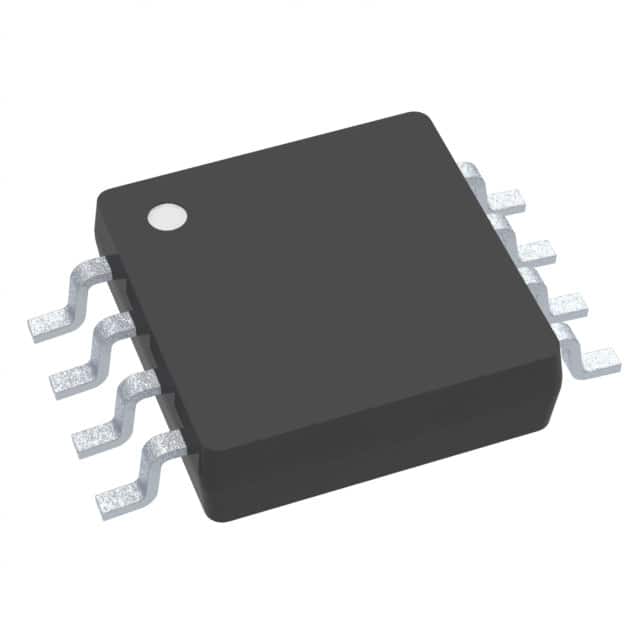
LM99CIMM/NOPB uses an 8-pin VSSOP (DGK) package, 3.0 mm × 3.0 mm, 0.65 mm pitch, thermally enhanced with exposed pad (not electrically connected). Pin 1 is marked with dot; orientation matches TI standard top-view diagram.
| Pin/Terminal | Circuit Role | Design Meaning |
|---|---|---|
| VDD (Pin 1) | Positive supply input | Requires 0.1 µF + 100 pF bypass capacitors; bulk 10 µF nearby - insufficient decoupling causes self-heating errors. |
| D+ (Pin 2) | Diode current source | Drives remote diode anode; must pair with 2.2 nF capacitor to D− - missing cap induces measurement drift. |
| D− (Pin 3) | Diode return sink | Connects to remote diode cathode/emitter; 2.2 nF cap to D+ forms noise filter critical for ±1°C accuracy. |
| T_CRIT_A (Pin 4) | Critical temp alarm output | Open-drain, active-low; asserts when any temp exceeds T_CRIT register - directly drives PSU shutdown logic. |
| GND (Pin 5) | Power ground | Common reference for all analog/digital circuits; separate analog/digital ground routing not required. |
| ALERT (Pin 6) | General alert interrupt | Open-drain, active-low; configurable as comparator, interrupt flag, or SMBus ARA responder via FILTER register. |
| SMBData (Pin 7) | SMBus bidirectional data | Open-drain I/O; requires external pull-up; supports SMBus 2.0 packet error checking and timeout reset. |
| SMBCLK (Pin 8) | SMBus clock input | Asynchronous input; no clock stretching - master controls all timing; low >25 ms resets interface state machine. |
Key Features
| Feature | Design Value |
|---|---|
| Remote diode offset register | Two 8-bit registers (RTOLB/RTOHB) allow hardware-specific calibration to match non-ideal diodes (e.g., GPU-integrated diodes with β variation). |
| T_CRIT_A with hysteresis | Hysteresis value set via TH register prevents chatter during thermal transients - T_CRIT_A stays asserted until temp falls below (T_CRIT − TH). |
| Three-mode ALERT output | Configurable via FILTER register bit D0: comparator mode (auto-clear), interrupt mode (mask-bit controlled), or SMBus ARA mode (address-response protocol). |
| Diode fault detection | Monitors D+ for short-to-VDD or floating condition; sets OPEN bit (D2) in Status Register - enables fail-safe thermal system design. |
| Power-on defaults | Factory-set registers include 85°C local T_CRIT, 110°C remote T_CRIT (126°C actual), 70°C HIGH limits - allows immediate operation without configuration. |
Applications
| Graphics Processor Thermal Management | Computer Processor Thermal Management |
|---|---|
|
Use Scenario: Real-time monitoring of GPU die temperature using integrated thermal diode during gaming or AI workloads. IC Role / Device Role / Timing Role: Remote diode sensor with +16°C offset correction; reads every 31.25 ms; triggers T_CRIT_A at 126°C junction to initiate immediate GPU throttling or power-off. Use Value: Achieves ±1.0°C accuracy at high junction temps (120°C–140°C), enabling tighter thermal margins and higher sustained clock frequencies. |
Use Scenario: Dual-point thermal supervision of CPU package and motherboard VRM hotspots in servers. IC Role / Device Role / Timing Role: Simultaneously measures local ambient (via on-chip diode) and remote CPU diode; updates both values in round-robin sequence every 31.25 ms. Use Value: Eliminates need for separate local/remote sensors - single IC reduces BOM count and PCB footprint while maintaining independent alarm paths. |
| Electronic Test Equipment | Office Electronics |
|
Use Scenario: Temperature stabilization of precision analog circuitry (e.g., DAC references, oscillator modules) inside automated test systems. IC Role / Device Role / Timing Role: Local temperature sensor with ±3.0°C accuracy over 0°C–85°C; uses LOW/HIGH limit registers to maintain chamber setpoints within ±2°C window. Use Value: On-board 8-bit local sensing avoids external sensor routing noise; SMBus interface enables centralized calibration logging across multi-channel instruments. |
Use Scenario: Fan speed control and overtemperature protection in laser printers and multifunction copiers. IC Role / Device Role / Timing Role: Monitors print head and fuser assembly temperatures via discrete 2N3904 diode; ALERT output drives microcontroller interrupt for dynamic PWM adjustment. Use Value: 0.125°C remote resolution enables granular fan curve definition; 0.8 mA quiescent current minimizes standby power in energy-efficient office devices. |
Equivalent & Alternatives
The following parts are listed as comparable options for similar remote diode temperature sensing applications.
| Alternative Part | Technical Difference | Application Difference | Selection Advice |
|---|---|---|---|
| LM94CIMM/NOPB | 12-bit remote resolution (0.0625°C), wider remote accuracy (±0.75°C at 100°C–125°C), but no T_CRIT_A output - only ALERT pin. | Lacks dedicated critical-alarm output; requires MCU firmware to interpret STATUS register for shutdown decisions. | Select when higher remote resolution is prioritized over hardware T_CRIT_A assertion; verify MCU can handle interrupt-driven shutdown logic. |
| MAX6642AESA+ | Same 8-pin SO package, SMBus 2.0, ±1.0°C remote accuracy, but uses different diode bias scheme - no +16°C offset; reports true junction temp directly. | Eliminates need for software offset correction; however, MAX6642A's default T_CRIT is 125°C (vs. LM99's 126°C), requiring register reprogramming for identical behavior. | Choose when direct junction reporting simplifies firmware; confirm compatibility with existing D+/D− RC network (2.2 nF cap required for both). |
Compared with LM99CIMM/NOPB, LM94CIMM/NOPB trades critical-alarm hardware simplicity for finer resolution, while MAX6642AESA+ removes offset compensation overhead but shifts shutdown logic burden to firmware - both require validation of SMBus timing and diode bias stability under target thermal profiles.
Availability
LM99CIMM/NOPB is available at Aetrix Electronics and suitable for graphics processor thermal management, computer processor thermal management, and electronic test equipment requiring stable component supply, long-term lifecycle support, and guaranteed traceability.
Supply support for LM99CIMM/NOPB includes scheduled delivery planning, volume procurement assistance, BOM continuity management, traceable sourcing, and lifecycle availability coordination for OEM customers, industrial embedded developers, connected-device designers, and electronics production programs.
Manufacturer
Texas Instruments is a global semiconductor leader specializing in analog, embedded processing, and connectivity technologies, with decades of expertise in precision analog sensing and industrial-grade interface solutions.
The LM99CIMM/NOPB belongs to TI's high-accuracy thermal sensor product line, designed specifically for demanding thermal management in computing, graphics, and instrumentation where remote diode junction monitoring must meet ±1°C accuracy at elevated temperatures.
FAQ
What is the remote diode temperature offset applied by the LM99CIMM/NOPB?
The LM99CIMM/NOPB applies a fixed +16°C offset to its remote diode temperature reading: TACTUAL DIODE JUNCTION = TLM99CIMM/NOPB + 16°C. This offset is hard-coded in silicon and cannot be disabled. The local temperature reading has no offset. This behavior is explicitly defined in the Functional Description section of the SNIS129D datasheet and confirmed in Table 1 (Actual vs. LM99 Remote Temperature Conversion).
Does the LM99CIMM/NOPB support SMBus 2.0 timeout reset functionality?
Yes, the LM99CIMM/NOPB fully supports SMBus 2.0 timeout reset: holding SMBData or SMBCLK low for 25–35 ms resets the internal SMBus state machine and places both pins in high-impedance mode. This feature is documented in the SMBus Digital Switching Characteristics table (tTIMEOUT parameter) and the Functional Description section, ensuring robust bus recovery after communication faults.
How does the LM99CIMM/NOPB detect remote diode faults?
The LM99CIMM/NOPB detects remote diode faults by monitoring the D+ pin for short-to-VDD or floating conditions. When detected, it sets the OPEN bit (D2) in the Status Register (02h). This fault detection is independent of temperature conversion and operates continuously - enabling early warning before thermal misreading occurs. The mechanism is detailed in the "DIODE FAULT DETECTION" subsection of the datasheet.
What is the default SMBus slave address of the LM99CIMM/NOPB?
The LM99CIMM/NOPB has a fixed 7-bit SMBus slave address of 0x4C (1001100b), with A6–A0 bits internally programmed. This is distinct from the LM99-1 variant (0x4D). The address is read-only and cannot be changed via hardware or software. It is specified in the SMBus INTERFACE section and confirmed in the "SMBus Slave Addresses" table of the SNIS129D datasheet.
Can the LM99CIMM/NOPB measure local and remote temperatures simultaneously?
No, the LM99CIMM/NOPB performs sequential conversions: it measures local temperature first, then remote temperature, completing both in one 31.25 ms cycle. The Status Register busy bit (D7) is high only during active conversion. While readings are not simultaneous, the fixed 31.25 ms cycle time ensures deterministic timing for system-level thermal response - a design choice confirmed in the "CONVERSION SEQUENCE" section of the datasheet.
LM99CIMM/NOPB Specifications
- Product attributes
- Attribute value
- Manufacturer:
- Texas Instruments
- Series:
- -
- Package/Case:
- 8-TSSOP, 8-MSOP (0.118", 3.00mm Width)
- Packaging:
- Tape & Reel (TR)
- Product Status:
- Obsolete
- Sensor Type:
- Digital, Local/Remote
- Sensing Temperature - Local:
- 0°C ~ 85°C
- Sensing Temperature - Remote:
- 0°C ~ 85°C
- Output Type:
- SMBus
- Voltage - Supply:
- 3V ~ 3.6V
- Resolution:
- 7 b (Local), 11 b (Remote)
- Features:
- One-Shot, Output Switch, Programmable Limit, Shutdown Mode, Standby Mode
- Accuracy - Highest (Lowest):
- ±3°C
- Test Condition:
- 25°C ~ 125°C
- Operating Temperature:
- 0°C ~ 125°C
- Mounting Type:
- Surface Mount
- Grade:
- -
- Qualification:
- -
- Supplier Device Package:
- 8-VSSOP
LM99CIMM/NOPB FAQ
1.How can I place an order for LM99CIMM/NOPB through Aetrix?
Please submit a Request for Quotation (RFQ) for LM99CIMM/NOPB on Aetrix. Our sales agent will provide a competitive quotation and guide you through the order confirmation once you accept the terms.
2.Are the price and stock information for LM99CIMM/NOPB reliable?
The price and inventory of LM99CIMM/NOPB are updated periodically and may fluctuate due to market conditions. Stock and pricing data are typically refreshed every 24 hours. Quotation validity for LM99CIMM/NOPB is usually 5 days.
3.What payment methods are accepted for LM99CIMM/NOPB?
We accept Wire Transfer, PayPal, Credit Card, Western Union, MoneyGram, and Escrow for LM99CIMM/NOPB transactions.
Note: Certain payment methods may incur a processing fee.
4.How is shipping managed for LM99CIMM/NOPB?
LM99CIMM/NOPB orders can be shipped via leading logistics carriers, including DHL, UPS, FedEx, TNT, or Registered Mail.
Once your LM99CIMM/NOPB order is processed, you will receive an email with the shipment details and tracking number.
Note: Tracking information may take up to 24 hours to appear. Express delivery typically takes 3–5 business days.
5.How can I obtain technical support or documentation for LM99CIMM/NOPB?
For technical support, including LM99CIMM/NOPB datasheets, pinout diagrams, or application guidance, please contact our engineering support team. They can provide detailed documentation and assistance for your LM99CIMM/NOPB requirements.
6.How does Aetrix verify that LM99CIMM/NOPB is sourced from the original manufacturer or authorized distributors?
All LM99CIMM/NOPB products on Aetrix are procured from qualified distributors and authorized channels. Our dedicated quality assurance team conducts strict verification, including traceability checks and, if necessary, third-party testing. This ensures that LM99CIMM/NOPB meets industry standards.
7.What is the process for return or replacement of LM99CIMM/NOPB?
All LM99CIMM/NOPB units undergo pre-shipment inspection (PSI). If there is an issue with LM99CIMM/NOPB, returns or replacements are accepted under the following conditions:
1.Quantity discrepancies, incorrect items, or visible external defects (such as breakage or corrosion), acknowledged by Aetrix.
2.The issue is reported within 90 days of delivery.
3.The LM99CIMM/NOPB part is unused and in its original packaging.
Return procedure for LM99CIMM/NOPB:
1.Submit a request within 90 days.
2.Obtain a Return Material Authorization (RMA) from Aetrix.
LM99CIMM/NOPB Tags
-
MCP9700T-E/TT
Microchip Technology
-
MCP9700T-E/LT
Microchip Technology
-
MCP9701T-E/TT
Microchip Technology
-
MCP9701T-E/LT
Microchip Technology
-
TMP235A4DBZR
Texas Instruments
-
MCP9700AT-E/TT
Microchip Technology
-
MCP9700AT-E/LT
Microchip Technology
-
MCP9701AT-E/LT
Microchip Technology
-
MCP9701AT-E/TT
Microchip Technology
,TO-226_straightlead.jpg)
-
LM335Z
STMicroelectronics
-
TMP1075NDRLR
Texas Instruments
-
TMP1075DGKR
Texas Instruments
Tech Hub

A practical engineering guide to 3.3V and 5V logic compatibility, input thresholds, resistor dividers, translator ICs, MOSFET level shifting, I2C pull-ups, timing limits and power-sequencing risks.

The 74HC595 uses push-pull logic outputs, while the TPIC6B595 uses 50 V open-drain DMOS sinks for higher-power loads. This guide compares timing, current limits, 3.3 V interfacing, load wiring, thermal…

The 74HC595 converts serial data into eight stable parallel outputs. This guide covers pin functions, shift and storage timing, OE and MR behavior, drive-current limits, cascading, voltage compatibilit…

A technical comparison of level-sensitive latches and edge-triggered flip-flops, covering timing windows, setup and hold limits, master–slave operation, time borrowing, race-through, HDL inference and…

A D latch stores one bit while Enable controls when data can pass. This reference covers gate-level operation, truth tables, transparency, setup and hold timing, LE versus OE, common ICs and practical …

An SR latch stores one bit through cross-coupled feedback. This engineering reference covers NOR and NAND implementations, truth tables, forbidden-state recovery, gated operation, switch debouncing, fa…

Latch circuits retain one bit through feedback. This technical reference covers SR and D latches, truth tables, transparency, timing limits, latch-versus-flip-flop behavior, applications and common log…

An engineering guide to LED driver operation, constant-current and constant-voltage outputs, linear and switching topologies, dimming, IC selection, calculations, replacement compatibility, and fault c…

Operational amplifier guide covering op amp basics, feedback, ideal vs real op amps, common configurations, buffer circuits, offset, bias current, gain-bandwidth, slew rate, rail-to-rail limits and sel…

Jumper cables guide covering safe connection order, red and black clamp placement, final ground connection, cable gauge, length, clamp quality, copper vs CCA cables, jump starter comparison and battery…


