
 My Inquiry
 My Account


Texas Instruments LMH0202MT
- Part No.:
- LMH0202MT
- Manufacturer:
- Texas Instruments
- Category:
- Specialized
- Package:
- 16-TSSOP (0.173", 4.40mm Width)
- Datasheet:
-
 LMH0202MT.pdf
- Description:
- IC INTERFACE SPECIALIZED 16TSSOP
- Quantity:
- Payment:

- Shipping:

Inventory:2,478
Please send an inquiry. Send us your inquiry, and we will respond immediately.
Product details
Overview
LMH0202MT from Texas Instruments is a dual SMPTE 292M/259M serial digital cable driver IC with two independent 75Ω differential outputs, selectable slew rates for SD/HD compliance, and adjustable output amplitude via external RREF resistors. It operates from a single 3.3V supply and delivers up to 1.485 Gbps data rates into coaxial cable in broadcast video routing and DVB-ASI transmission systems.
For engineers reviewing the LMH0202MT datasheet, LMH0202MT pinout, LMH0202MT application, or LMH0202MT equivalent, key selection criteria include SMPTE 292M/259M compliance mode control via SD/HD pins, differential input common-mode range (1.6 V + VSDI/2), output swing adjustability (750–1100 mVP–P), and TSSOP-16 thermal performance (θJA = 125°C/W).
Technical Context
The LMH0202MT implements two independent current-mode cable drivers, each with differential inputs self-biased at ~2.1 V under 3.3 V supply and configurable output rise/fall times via dedicated SD/HD control pins. Each channel supports either dual-differential input or externally routed single-differential input for DVB-ASI use cases.
Output voltage swing is set by resistor values on RREF1/RREF2 pins (750 Ω for 750–850 mVP–P, 590 Ω for 900–1100 mVP–P), while additive jitter remains ≤26 psP–P at 1.485 Gbps and return loss exceeds 15 dB across 5 MHz–1.5 GHz on validated board layouts.
Key Specifications
| Parameter | Value and Actual Design Meaning |
|---|---|
| Data Rate | Up to 1.485 Gbps - supports full SMPTE 292M HD-SDI and SMPTE 344M operation. |
| Output Impedance | 75 Ω differential - matches standard broadcast coaxial cabling (Belden 1694A/8281). |
| Supply Voltage | 3.3 V ±5% - single-rail operation simplifies power design in video infrastructure equipment. |
| Output Swing Range | 750–1100 mVP–P - adjusted per channel via discrete RREF resistor (750 Ω or 590 Ω to VCC). |
| Additive Jitter | 26 psP–P @ 1.485 Gbps - ensures signal integrity margin for SMPTE-compliant eye diagrams. |
| Operating Temperature | 0°C to +70°C - commercial-grade thermal range suitable for studio routers and distribution amplifiers. |
| Power Consumption | 76–98 mA total ICC - scales with SD/HD mode selection (lower current in HD mode). |
Pinout & Package
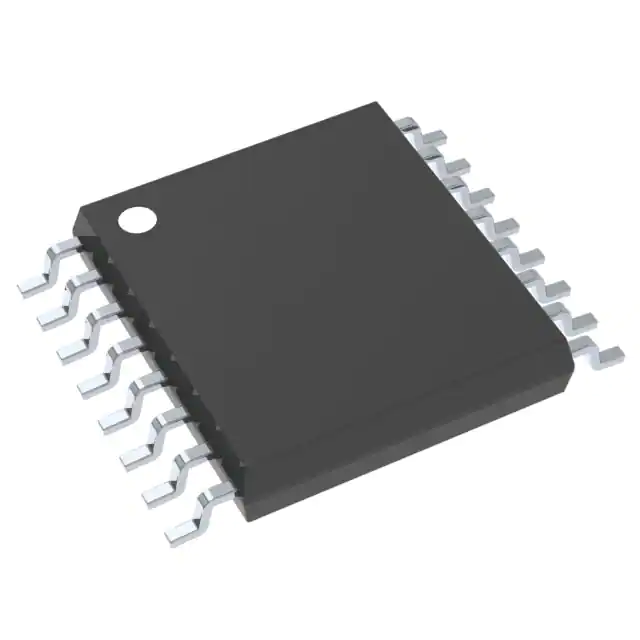
LMH0202MT is housed in a 16-pin TSSOP (PW package), 4.4 mm × 5.0 mm body, 1.2 mm max height, with exposed thermal pad and JEDEC MO-153 compliance. Pin pitch is 0.65 mm; recommended land pattern uses non-solder-mask-defined pads for optimal thermal and electrical performance.
| Pin/Terminal | Circuit Role | Design Meaning |
|---|---|---|
| SDI1 / SDI1 | Differential serial data input (Channel 1) | Self-biased true/complement pair accepting AC/DC-coupled SMPTE signals; common-mode range 1.6 V + VSDI/2. |
| RREF1 | Output amplitude reference | Resistor-to-VCC sets Channel 1 output swing (750 Ω → 750–850 mVP–P; 590 Ω → 900–1100 mVP–P). |
| SD/HD1 | Slew rate control (Channel 1) | Low = SMPTE 292M fast edge (120–220 ps); high = SMPTE 259M slow edge (400–560 ps). |
| SDO1 / SDO1 | Differential serial data output (Channel 1) | Current-mode 75 Ω outputs; require AC coupling and 75 Ω termination at receiver end. |
| VCC1 / VCC2 | Positive supply rails | Separate 3.3 V inputs per channel reduce crosstalk; decoupling required near each VCC pin. |
| VEE1 / VEE2 | Ground reference | Common ground for both channels; low-inductance connection critical for jitter performance. |
Key Features
| Feature | Design Value |
|---|---|
| Dual independent SMPTE-compliant drivers | Enables simultaneous HD-SDI and SD-SDI signal distribution without shared timing path degradation. |
| Selectably compliant slew rates | Per-channel SD/HD pin control allows mixed-mode operation-e.g., one channel in SMPTE 292M, another in SMPTE 259M. |
| Adjustable output amplitude | Two RREF pins allow fine-tuned swing matching to downstream receiver sensitivity or cable loss compensation. |
| Single 3.3 V supply operation | Eliminates need for negative rail or LDO sequencing, reducing BOM count and layout complexity in video gear. |
| Self-biased differential inputs | Supports direct AC coupling or DC coupling within specified common-mode range-no external bias network required. |
Applications
| Broadcast Video Routing | DVB-ASI Transmission |
|---|---|
Use Scenario: Digital video signal distribution across multi-input/output routers in broadcast studios. IC Role / Device Role / Timing Role: Dual-channel cable driver providing SMPTE 292M/259M-compliant outputs to feed multiple destinations over 75 Ω coax. Use Value: Maintains signal integrity at 1.485 Gbps with <26 ps additive jitter, enabling reliable frame-accurate switching in real-time production environments. | Use Scenario: ASI stream transmission from encoders to modulators in digital terrestrial TV headends. IC Role / Device Role / Timing Role: Configured with externally routed single differential input to generate two identical non-inverted ASI outputs. Use Value: Eliminates need for external splitters or repeaters-reduces insertion loss, skew, and component count in ASI fanout paths. |
| Distribution Amplifiers | Professional Video Cameras |
Use Scenario: Signal regeneration and fanout in rack-mounted SDI distribution amplifiers for OB vans and control rooms. IC Role / Device Role / Timing Role: Dual driver stage restoring signal amplitude and edge fidelity after long cable runs or splitting losses. Use Value: Adjustable output swing compensates for varying cable lengths and connector losses, ensuring consistent eye opening at all outputs. | Use Scenario: Embedded HD-SDI output interface in professional cinema and ENG cameras. IC Role / Device Role / Timing Role: Final-stage driver delivering SMPTE 292M-compliant signal directly to BNC connectors with minimal PCB trace length. Use Value: Low 300 mW HD-mode power consumption enables thermally constrained camera housing integration without forced cooling. |
Equivalent & Alternatives
The following parts are listed as comparable options for similar serial digital cable driver applications.
| Alternative Part | Technical Difference | Application Difference | Selection Advice |
|---|---|---|---|
| LMH0302MT | Higher drive strength (1.5 VP–P max), extended temp range (–40°C to +85°C), same pinout and function. | Required for industrial or outdoor broadcast enclosures where ambient exceeds +70°C. | Select LMH0302MT when extended temperature operation or higher output swing is needed; otherwise LMH0202MT suffices for commercial studio use. |
| THS8200IPHP | Triple-channel SDI driver with integrated reclocker; 3.3 V supply; different pinout and feature set (reclocking, equalization). | Used where input signal reconditioning (jitter cleanup, equalization) is required before driving long cables. | Choose THS8200IPHP only if reclocking capability is mandatory; LMH0202MT is simpler, lower-power, and sufficient for clean-source fanout. |
Compared with LMH0302MT and THS8200IPHP, the LMH0202MT offers optimal balance of SMPTE compliance, power efficiency (250–300 mW), and cost for fixed-temperature studio infrastructure-without overengineering for reclocking or extended thermal margins.
Availability
LMH0202MT is available at Aetrix Electronics and suitable for broadcast video routing, DVB-ASI transmission, and professional camera interfaces requiring stable component supply and SMPTE 292M/259M compliance.
Supply support for LMH0202MT includes scheduled delivery planning, volume procurement assistance, BOM continuity management, traceable sourcing, and lifecycle availability coordination for OEM customers, industrial embedded developers, connected-device designers, and electronics production programs.
Manufacturer
Texas Instruments is a global semiconductor company specializing in analog, embedded processing, and connectivity technologies for industrial, automotive, and communications markets.
The LMH0202MT belongs to TI's high-speed interface product line, engineered specifically for robust, low-jitter serial digital video transport in broadcast and professional AV equipment.
FAQ
What is the maximum data rate supported by the LMH0202MT?
The LMH0202MT supports data rates up to 1.485 Gbps, fully compliant with SMPTE 292M HD-SDI standards. This is verified across operating conditions (0°C to +70°C, 3.3 V ±5%) and confirmed in the AC Electrical Characteristics table of the SNLS212C datasheet. The LMH0202MT maintains sub-26 ps additive jitter at this rate, ensuring reliable eye opening in real-world coaxial deployments.
How do I configure the LMH0202MT for SMPTE 259M versus SMPTE 292M operation?
Configure the LMH0202MT for SMPTE 259M by setting the SD/HD1 and SD/HD2 pins high (≥2.4 V), resulting in slower rise/fall times (400–800 ps). For SMPTE 292M, set those pins low (≤0.8 V) to achieve faster edges (120–220 ps). These settings are explicitly defined in the Pin Descriptions table and DEVICE OPERATION section of the LMH0202MT datasheet.
Can the LMH0202MT accept single-ended input signals?
The LMH0202MT is designed for differential input but can accept single-ended signals with appropriate AC coupling and biasing-though this degrades common-mode rejection and may impact jitter. The datasheet specifies self-biased differential inputs (SDI1/SDI1, SDI2/SDI2) and recommends differential drive for full SMPTE compliance. For guaranteed performance, use differential sources or add an external transformer/balun.
What is the purpose of the RREF1 and RREF2 pins on the LMH0202MT?
The RREF1 and RREF2 pins on the LMH0202MT set output voltage swing amplitude per channel by connecting a precision resistor (e.g., 750 Ω or 590 Ω, 1%) between each RREF pin and VCC. This adjusts the LMH0202MT's single-ended output level from 750–850 mVP–P (750 Ω) to 900–1100 mVP–P (590 Ω), enabling optimization for cable loss or receiver sensitivity without redesigning the driver stage.
Is the LMH0202MT RoHS-compliant and lead-free?
Yes, the LMH0202MT/NOPB is RoHS-compliant and lead-free, with "Green (RoHS & no Sb/Br)" eco plan designation per TI's packaging addendum. It meets JEDEC MSL Level-1 moisture sensitivity rating and is qualified for reflow soldering at peak temperatures up to 260°C. The device marking "L202" and TSSOP-PW package confirm full compliance with current EU RoHS substance restrictions.
LMH0202MT Specifications
- Product attributes
- Attribute value
- Manufacturer:
- Texas Instruments
- Series:
- -
- Package/Case:
- 16-TSSOP (0.173", 4.40mm Width)
- Packaging:
- Tube
- Product Status:
- Obsolete
- Applications:
- Displays
- Interface:
- Serial
- Voltage - Supply:
- 3.135V ~ 3.465V
- Supplier Device Package:
- 16-TSSOP
- Grade:
- -
- Qualification:
- -
- Mounting Type:
- Surface Mount
LMH0202MT FAQ
1.How can I place an order for LMH0202MT through Aetrix?
Please submit a Request for Quotation (RFQ) for LMH0202MT on Aetrix. Our sales agent will provide a competitive quotation and guide you through the order confirmation once you accept the terms.
2.Are the price and stock information for LMH0202MT reliable?
The price and inventory of LMH0202MT are updated periodically and may fluctuate due to market conditions. Stock and pricing data are typically refreshed every 24 hours. Quotation validity for LMH0202MT is usually 5 days.
3.What payment methods are accepted for LMH0202MT?
We accept Wire Transfer, PayPal, Credit Card, Western Union, MoneyGram, and Escrow for LMH0202MT transactions.
Note: Certain payment methods may incur a processing fee.
4.How is shipping managed for LMH0202MT?
LMH0202MT orders can be shipped via leading logistics carriers, including DHL, UPS, FedEx, TNT, or Registered Mail.
Once your LMH0202MT order is processed, you will receive an email with the shipment details and tracking number.
Note: Tracking information may take up to 24 hours to appear. Express delivery typically takes 3–5 business days.
5.How can I obtain technical support or documentation for LMH0202MT?
For technical support, including LMH0202MT datasheets, pinout diagrams, or application guidance, please contact our engineering support team. They can provide detailed documentation and assistance for your LMH0202MT requirements.
6.How does Aetrix verify that LMH0202MT is sourced from the original manufacturer or authorized distributors?
All LMH0202MT products on Aetrix are procured from qualified distributors and authorized channels. Our dedicated quality assurance team conducts strict verification, including traceability checks and, if necessary, third-party testing. This ensures that LMH0202MT meets industry standards.
7.What is the process for return or replacement of LMH0202MT?
All LMH0202MT units undergo pre-shipment inspection (PSI). If there is an issue with LMH0202MT, returns or replacements are accepted under the following conditions:
1.Quantity discrepancies, incorrect items, or visible external defects (such as breakage or corrosion), acknowledged by Aetrix.
2.The issue is reported within 90 days of delivery.
3.The LMH0202MT part is unused and in its original packaging.
Return procedure for LMH0202MT:
1.Submit a request within 90 days.
2.Obtain a Return Material Authorization (RMA) from Aetrix.
LMH0202MT Tags
-
NVT4857UKAZ
NXP Semiconductors
-
TCA8418RTWR
Texas Instruments
-
PCA9546APWR
Texas Instruments

-
MD0100N8-G
Microchip Technology
-
PCA9548APW,118
NXP Semiconductors
-
PCA9540BDP,118
NXP Semiconductors
-
PCA9548APWR
Texas Instruments
-
PCA9546APW,118
NXP Semiconductors
-
PTN3360DBS,518
NXP Semiconductors
-
PCA9546ABS,118
NXP Semiconductors
-
PCA9518PWR
Texas Instruments
-
PCA9545APW,118
NXP Semiconductors
Tech Hub

A practical engineering guide to 3.3V and 5V logic compatibility, input thresholds, resistor dividers, translator ICs, MOSFET level shifting, I2C pull-ups, timing limits and power-sequencing risks.

The 74HC595 uses push-pull logic outputs, while the TPIC6B595 uses 50 V open-drain DMOS sinks for higher-power loads. This guide compares timing, current limits, 3.3 V interfacing, load wiring, thermal…

The 74HC595 converts serial data into eight stable parallel outputs. This guide covers pin functions, shift and storage timing, OE and MR behavior, drive-current limits, cascading, voltage compatibilit…

A technical comparison of level-sensitive latches and edge-triggered flip-flops, covering timing windows, setup and hold limits, master–slave operation, time borrowing, race-through, HDL inference and…

A D latch stores one bit while Enable controls when data can pass. This reference covers gate-level operation, truth tables, transparency, setup and hold timing, LE versus OE, common ICs and practical …

An SR latch stores one bit through cross-coupled feedback. This engineering reference covers NOR and NAND implementations, truth tables, forbidden-state recovery, gated operation, switch debouncing, fa…

Latch circuits retain one bit through feedback. This technical reference covers SR and D latches, truth tables, transparency, timing limits, latch-versus-flip-flop behavior, applications and common log…

An engineering guide to LED driver operation, constant-current and constant-voltage outputs, linear and switching topologies, dimming, IC selection, calculations, replacement compatibility, and fault c…

Operational amplifier guide covering op amp basics, feedback, ideal vs real op amps, common configurations, buffer circuits, offset, bias current, gain-bandwidth, slew rate, rail-to-rail limits and sel…

Jumper cables guide covering safe connection order, red and black clamp placement, final ground connection, cable gauge, length, clamp quality, copper vs CCA cables, jump starter comparison and battery…


