
 My Inquiry
 My Account


Texas Instruments LMK60E2-125M00SIAT
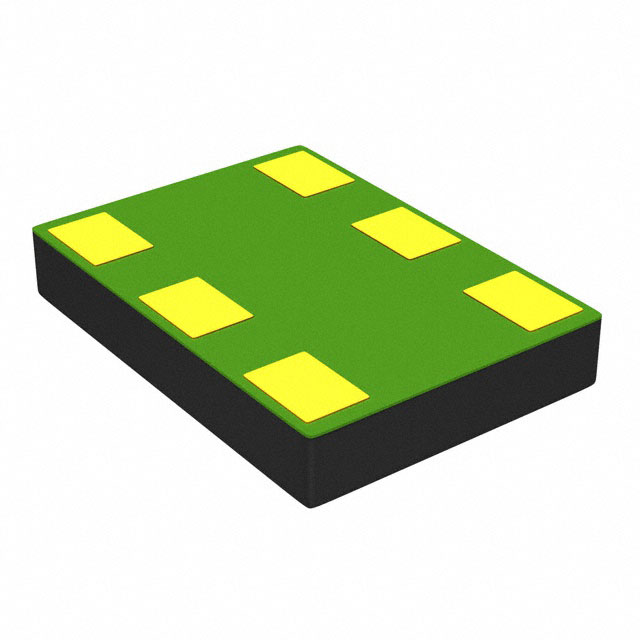
- Part No.:
- LMK60E2-125M00SIAT
- Manufacturer:
- Texas Instruments
- Category:
- Oscillators
- Package:
- 6-SMD Module
- Datasheet:
-
 LMK60E2-125M00SIAT.pdf
- Description:
- SILIC OSC XO 125.0000MHZ LVPECL
- Quantity:
- Payment:

- Shipping:

Inventory:142
Please send an inquiry. Send us your inquiry, and we will respond immediately.
Product details
Overview
LMK60E2-125M00SIAT from Texas Instruments is a factory-programmed, low-jitter LVPECL oscillator delivering 125 MHz output with ±50 ppm total frequency stability over –40°C to +85°C, 3.3-V supply, and 150 fs RMS phase jitter (12 kHz–20 MHz). It serves as a high-performance clock reference in FPGA and processor timing systems requiring robust PSRR (–60 dBc) and differential signal integrity.
For engineers reviewing the LMK60E2-125M00SIAT datasheet, LMK60E2-125M00SIAT pinout, LMK60E2-125M00SIAT application, or LMK60E2-125M00SIAT equivalent, this page provides verified package mapping (6-pin QFM), confirmed LVPECL output behavior, thermal derating guidance, and validated alternatives for industrial-grade clocking designs.
Technical Context
The LMK60E2-125M00SIAT integrates a high-stability PLL-based oscillator core with internal power conditioning to achieve –60 dBc PSRR across 50 kHz–1 MHz supply ripple frequencies. Its output stage is configured exclusively for LVPECL signaling, supporting 700–1200 mV differential swing and 260–350 ps rise/fall times at 125 MHz.
Operation requires only a single 3.3-V ±5% supply, with OE pin enabling/disabling the differential output pair (OUTP/OUTN) in <50 µs. The device uses no external crystal or loop filter - all timing generation is self-contained and factory-trimmed.
Key Specifications
| Parameter | Value and Actual Design Meaning |
|---|---|
| Output frequency | 125 MHz - fixed factory-programmed value, no reconfiguration possible |
| Output format | LVPECL - requires 50-Ω termination to VDD–2 V; not compatible with LVDS or HCSL loads |
| Total frequency tolerance | ±50 ppm - includes initial calibration, temperature drift (–40°C to +85°C), supply variation, solder reflow shift, and 5-year aging at 40°C |
| RMS phase jitter | 150 fs (typ.) - measured over 12 kHz–20 MHz integration bandwidth, critical for SerDes and ADC sampling clocks |
| Supply voltage | 3.3 V ±5% - mandates tight regulation; current draw is 95–110 mA under LVPECL load |
| PSRR | –60 dBc - suppresses 50-mVpp supply noise at 100 kHz and 1 MHz, reducing need for ultra-low-noise LDOs |
| Startup time | 10 ms - elapsed from VDD reaching 3.135 V to stable output enable, independent of OE control |
Pinout & Package
LMK60E2-125M00SIAT is housed in a 7.0 mm × 5.0 mm × 1.15 mm QFM (SIA) 6-pin package, pin-compatible with industry-standard 7050 XO footprints. The package features an exposed thermal pad connected internally to GND for enhanced heat dissipation.
| Pin/Terminal | Circuit Role | Design Meaning |
|---|---|---|
| 1 (OE) | Digital control input | LVCMOS-compatible enable with internal pullup; drives output to high-Z when pulled low (VIH ≥1.4 V, VIL ≤0.6 V) |
| 2 (NC) | No-connect | Unbonded die pad; must remain floating - no routing or grounding permitted |
| 3 (GND) | Power ground | Primary return path for analog and digital currents; requires ≥3 thermal vias to inner ground plane |
| 4 (OUTN) | Differential output | Inverted LVPECL output; paired with OUTP to deliver 125 MHz differential clock with 700–1200 mV swing |
| 5 (OUTP) | Differential output | Non-inverted LVPECL output; must be routed as matched-length, controlled-impedance pair to 100 Ω differential load |
| 6 (VDD) | Analog power supply | 3.3-V ±5% supply input; requires local 10 µF / 1 µF / 0.1 µF decoupling network with short, low-inductance paths |
Key Features
| Feature | Design Value |
|---|---|
| Ultra-low phase jitter | 150 fs RMS (12 kHz–20 MHz) enables compliance with PCIe Gen4/Gen5 and 10G/25G Ethernet clocking requirements |
| High PSRR | –60 dBc rejection of 50-mVpp supply ripple up to 1 MHz reduces sensitivity to switching regulator noise |
| Single-supply operation | 3.3-V only - eliminates need for dual-rail supplies or level-shifting circuitry in host systems |
| Industrial temperature range | –40°C to +85°C ambient - qualified per JEDEC JESD22-A104, suitable for base station and networking equipment |
| Pin-compatible footprint | 7.0 mm × 5.0 mm QFM matches standard 7050 XO packages - enables drop-in replacement without PCB redesign |
Applications
| 5G Baseband Unit (BBU) | Enterprise Storage Controller |
|---|---|
Use Scenario: Synchronizing multi-channel ADC/DAC converters and FPGA fabric in distributed radio units. IC Role / Device Role / Timing Role: Primary system clock generator providing 125 MHz LVPECL reference to FPGA transceivers and data converters. Use Value: 150 fs jitter ensures <0.5 UI eye margin degradation at 10 Gbps serial links, meeting CPRI/eCPRI timing budgets. | Use Scenario: Clocking SAS/SATA PHY layers and RAID controller logic in enterprise SSD enclosures. IC Role / Device Role / Timing Role: Low-noise clock source for PCIe Gen3 root complex and NVMe controller timing domains. Use Value: ±50 ppm stability over temperature and aging guarantees sustained link training success across 5-year product lifecycle. |
| Medical Ultrasound Beamformer | Industrial PLC CPU Module |
Use Scenario: Driving high-speed digital-to-analog front-end for phased-array transmit beam synthesis. IC Role / Device Role / Timing Role: Master clock for 125 MHz sampling clocks feeding 16-bit DACs and interpolation filters. Use Value: –60 dBc PSRR prevents switching noise from DC-DC converters from modulating DAC output spectra. | Use Scenario: Providing deterministic real-time clock to ARM Cortex-A series MPU and EtherCAT slave controllers. IC Role / Device Role / Timing Role: System reference oscillator for CPU core, DDR3/4 memory interface, and industrial Ethernet MAC timing. Use Value: 7.0 mm × 5.0 mm QFM package supports compact, convection-cooled module layouts without thermal throttling. |
Equivalent & Alternatives
The following parts are listed as comparable options for similar oscillator applications.
| Alternative Part | Technical Difference | Application Difference | Selection Advice |
|---|---|---|---|
| LMK60E2-125M00SIAR | Same electrical specs and pinout; differs only in tape-and-reel quantity (2500 pcs vs. 250 pcs) | No functional difference - identical performance, qualification, and thermal behavior | Select SIAR for high-volume production; SIAT for prototyping, validation, or low-MOQ builds |
| Si510-125.000M-AG | 125 MHz LVPECL output, ±20 ppm stability, 200 fs RMS jitter, 3.3-V supply, same 7×5 mm package but different pinout (OE on Pin 1, GND on Pin 4) | Higher stability and lower aging drift, but requires board-level redesign due to non-pin-compatible layout | Choose Si510 only if ±20 ppm tolerance and <200 fs jitter are mandatory and PCB revision is feasible |
Compared with LMK60E2-125M00SIAT, the SIAR variant offers identical performance at higher volume efficiency, while the Si510 delivers tighter stability and slightly higher jitter at the cost of layout incompatibility - making SIAT optimal for drop-in industrial timing upgrades.
Availability
LMK60E2-125M00SIAT is available at Aetrix Electronics and suitable for 5G baseband units, enterprise storage controllers, medical ultrasound systems, and industrial PLC CPU modules requiring stable component supply across extended temperature ranges and long production lifecycles.
Supply support for LMK60E2-125M00SIAT includes scheduled delivery planning, volume procurement assistance, BOM continuity management, traceable sourcing, and lifecycle availability coordination for OEM customers, industrial embedded developers, connected-device designers, and electronics production programs.
Manufacturer
Texas Instruments is a global semiconductor company headquartered in Dallas, Texas, specializing in analog, embedded processing, and clock solutions for industrial, automotive, and communications markets.
The LMK60XX family is designed specifically for high-performance, low-jitter clock generation in FPGA, processor, and networking applications where crystal oscillators lack sufficient phase noise performance or supply immunity.
FAQ
Is the LMK60E2-125M00SIAT programmable in-system?
No. The LMK60E2-125M00SIAT is factory-programmed with fixed 125 MHz LVPECL output and cannot be reconfigured via I²C, SPI, or any other interface. Frequency, output format, and stability grade are set during manufacturing and immutable in the field.
What is the recommended termination for the LVPECL outputs?
Each LVPECL output (OUTP and OUTN) must be terminated to VDD–2 V using two 50-Ω resistors - one from OUTP to VDD–2 V, and one from OUTN to VDD–2 V - establishing a 100-Ω differential load. AC-coupling capacitors (e.g., 100 nF) are required if interfacing with AC-coupled receivers.
Does the NC pin require any PCB layout treatment?
Yes. Pin 2 (NC) is an unconnected die pad with no internal bond wire. It must remain electrically floating - no trace, copper pour, or solder mask opening should contact it. Routing or grounding this pin risks internal shorting or ESD path disruption.
Can the LMK60E2-125M00SIAT operate at 2.5 V?
No. The device is specified only for 3.3 V ±5% (3.135 V to 3.465 V). Operation below 3.135 V violates recommended conditions and may cause startup failure, increased jitter, or undefined OE behavior. A dedicated 3.3-V LDO or regulator is mandatory.
LMK60E2-125M00SIAT Specifications
- Product attributes
- Attribute value
- Manufacturer:
- Texas Instruments
- Series:
- LMK60XX
- Package/Case:
- 6-SMD Module
- Packaging:
- Tape & Reel (TR)
- Product Status:
- Not For New Designs
- Base Resonator:
- Silicon
- Type:
- XO (Standard)
- Frequency:
- 125 MHz
- Function:
- Enable/Disable
- Output:
- LVPECL
- Voltage - Supply:
- 3.3V
- Frequency Stability:
- ±50ppm
- Absolute Pull Range (APR):
- -
- Operating Temperature:
- -40°C ~ 85°C
- Spread Spectrum Bandwidth:
- -
- Current - Supply (Max):
- 110mA
- Ratings:
- -
- Mounting Type:
- Surface Mount
- Supplier Device Package:
- 6-QFM (7x5)
- Size / Dimension:
- 0.276" L x 0.197" W (7.00mm x 5.00mm)
- Height - Seated (Max):
- 0.045" (1.15mm)
LMK60E2-125M00SIAT FAQ
1.How can I place an order for LMK60E2-125M00SIAT through Aetrix?
Please submit a Request for Quotation (RFQ) for LMK60E2-125M00SIAT on Aetrix. Our sales agent will provide a competitive quotation and guide you through the order confirmation once you accept the terms.
2.Are the price and stock information for LMK60E2-125M00SIAT reliable?
The price and inventory of LMK60E2-125M00SIAT are updated periodically and may fluctuate due to market conditions. Stock and pricing data are typically refreshed every 24 hours. Quotation validity for LMK60E2-125M00SIAT is usually 5 days.
3.What payment methods are accepted for LMK60E2-125M00SIAT?
We accept Wire Transfer, PayPal, Credit Card, Western Union, MoneyGram, and Escrow for LMK60E2-125M00SIAT transactions.
Note: Certain payment methods may incur a processing fee.
4.How is shipping managed for LMK60E2-125M00SIAT?
LMK60E2-125M00SIAT orders can be shipped via leading logistics carriers, including DHL, UPS, FedEx, TNT, or Registered Mail.
Once your LMK60E2-125M00SIAT order is processed, you will receive an email with the shipment details and tracking number.
Note: Tracking information may take up to 24 hours to appear. Express delivery typically takes 3–5 business days.
5.How can I obtain technical support or documentation for LMK60E2-125M00SIAT?
For technical support, including LMK60E2-125M00SIAT datasheets, pinout diagrams, or application guidance, please contact our engineering support team. They can provide detailed documentation and assistance for your LMK60E2-125M00SIAT requirements.
6.How does Aetrix verify that LMK60E2-125M00SIAT is sourced from the original manufacturer or authorized distributors?
All LMK60E2-125M00SIAT products on Aetrix are procured from qualified distributors and authorized channels. Our dedicated quality assurance team conducts strict verification, including traceability checks and, if necessary, third-party testing. This ensures that LMK60E2-125M00SIAT meets industry standards.
7.What is the process for return or replacement of LMK60E2-125M00SIAT?
All LMK60E2-125M00SIAT units undergo pre-shipment inspection (PSI). If there is an issue with LMK60E2-125M00SIAT, returns or replacements are accepted under the following conditions:
1.Quantity discrepancies, incorrect items, or visible external defects (such as breakage or corrosion), acknowledged by Aetrix.
2.The issue is reported within 90 days of delivery.
3.The LMK60E2-125M00SIAT part is unused and in its original packaging.
Return procedure for LMK60E2-125M00SIAT:
1.Submit a request within 90 days.
2.Obtain a Return Material Authorization (RMA) from Aetrix.
LMK60E2-125M00SIAT Tags
-
ECS-2333-160-BN-TR
ECS Inc.
-
ECS-2333-240-BN-TR
ECS Inc.
-
KC2016Z25.0000C1KX00
KYOCERA AVX
-0.035-Thick.jpg)
-
ECS-2033-250-BN
ECS Inc.
-
O 25,0-JO32-B-1V3-1-T1-LF
Jauch Quartz
-
SIT1533AI-H4-DCC-32.768E
SiTime
-
ECS-2333-500-BN-TR
ECS Inc.
-
COM1305-50.000-EXT-T-TR
Raltron Electronics
-
SG-210STF 24.0000ML0
EPSON
-
ECS-3225MV-320-CN-TR
ECS Inc.
-
ECS-2033-240-BN
ECS Inc.
-
ECS-2333-120-BN-TR
ECS Inc.
Tech Hub

Jumper cables guide covering safe connection order, red and black clamp placement, final ground connection, cable gauge, length, clamp quality, copper vs CCA cables, jump starter comparison and battery…

LDO regulator guide covering low dropout voltage, power dissipation, thermal design, PSRR, output noise, capacitor stability, adjustable LDO circuits, LDO vs buck converter and datasheet selection chec…

Conditional Access Module guide covering CAM meaning, CI/CI+ interface, smart card authorization, DVB security workflow, TV and set-top box compatibility, internal electronics, ESD protection, connecto…

Guide to electronic component obsolescence covering EOL risk, PCN/PDN notices, last-time buy planning, replacement options, form-fit-function validation, counterfeit risk and BOM lifecycle management.

18650 battery guide covering lithium-ion cell basics, 3.6V/3.7V voltage, 4.2V charging, mAh and Wh capacity, protected cells, chargers, BMS, series-parallel packs, holders, welding and sourcing checks.…

Hall effect sensor guide covering working principle, linear and digital sensors, Arduino circuits, current sensing, speed detection, automotive applications, A3144 examples, signal filtering and datash…

Product Change Notification guide for electronic components, covering PCN meaning, PCN vs PDN/EOL, common change types, risk levels, form-fit-function review, engineering validation, BOM control, LTB/L…

A practical guide to blend door actuators, covering HVAC function, symptoms, location, AC and heater issues, reset and calibration, replacement cost, electrical diagnosis, compatibility checks, and rep…

Engineering guide to Raspberry Pi alternatives, covering chip-level differences, Orange Pi, ROCK, Jetson, Banana Pi, NanoPi, Compute Module, Pico, GPIO, camera, HAT compatibility, and replacement risks…

Engineering guide to dynamic load response testing for high-current buck converters, covering load step setup, slew rate, Vcore undershoot, overshoot, recovery time, probe location, output capacitors a…


