
 My Inquiry
 My Account


Texas Instruments LMK60I2-322M26SIAT
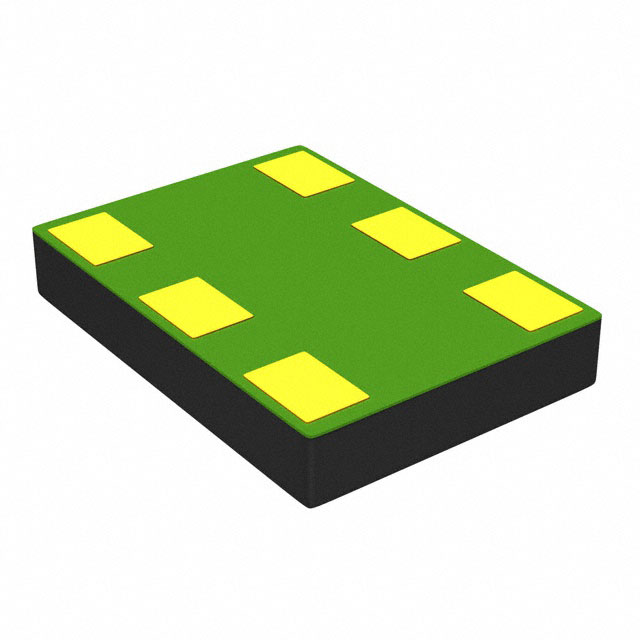
- Part No.:
- LMK60I2-322M26SIAT
- Manufacturer:
- Texas Instruments
- Category:
- Oscillators
- Package:
- 6-SMD Module
- Datasheet:
-
 LMK60I2-322M26SIAT.pdf
- Description:
- SILIC OSC XO 322.2656MHZ HCSL
- Quantity:
- Payment:

- Shipping:

Inventory:350
Please send an inquiry. Send us your inquiry, and we will respond immediately.
Product details
Overview
LMK60I2-322M26SIAT from Texas Instruments is a factory-programmed, high-performance HCSL-output oscillator delivering 322.265625 MHz with ±50 ppm total frequency tolerance, 150 fs RMS phase jitter (12 kHz–20 MHz), and robust –60 dBc PSRR across 50 kHz–1 MHz supply ripple. It operates from a single 3.3-V supply in industrial temperature range (–40°C to +85°C) and serves as a low-jitter clock source for FPGA transceivers and high-speed serial interfaces.
For engineers reviewing the LMK60I2-322M26SIAT datasheet, LMK60I2-322M26SIAT pinout, LMK60I2-322M26SIAT application, or LMK60I2-322M26SIAT equivalent, key selection criteria include HCSL output compatibility with Intel/Altera FPGA reference clocks, 7 mm × 5 mm QFM package footprint alignment with industry-standard 7050 XO footprints, and verified startup time ≤10 ms under 3.135 V VDD.
Technical Context
The LMK60I2-322M26SIAT integrates a high-stability PLL-based core with internal power conditioning to suppress supply noise, enabling clean clock generation without external regulators. Its HCSL output stage is optimized for 50 Ω differential termination and delivers 660–900 mV VOH and –100–100 mV VOL into 50 Ω loads.
It features an LVCMOS OE input with internal pull-up, enabling hardware-controlled output disable with 50 µs enable/disable timing. The device uses a fixed-frequency architecture-no I²C or SPI interface-and is pre-configured at manufacture for its exact 322.265625 MHz output.
Key Specifications
| Parameter | Value and Actual Design Meaning |
|---|---|
| Output Frequency | 322.265625 MHz - precisely matches PCIe Gen4/Gen5 reference clock requirements for SerDes lanes. |
| Output Format | HCSL - compatible with Intel Stratix 10, Agilex, and Xilinx Versal FPGA reference clock inputs. |
| Frequency Tolerance | ±50 ppm - includes initial calibration, temperature drift (–40°C to +85°C), voltage variation, solder reflow shift, and 5-year aging. |
| RMS Phase Jitter | 150 fs (12 kHz–20 MHz) - meets stringent jitter budgets for 25+ Gbps serial links. |
| PSRR | –60 dBc @ 50 kHz–1 MHz - rejects board-level switching noise without additional LDO filtering. |
| Supply Voltage | 3.3 V ±5% - compatible with standard FPGA/ASIC I/O rail; no separate analog supply required. |
| Startup Time | ≤10 ms - ensures reliable clock availability after power-on reset in embedded systems. |
Pinout & Package
The LMK60I2-322M26SIAT is housed in a 7.0 mm × 5.0 mm × 1.15 mm QFM (SIA) 6-pin package, pin-compatible with industry-standard 7050 XO footprints and designed for surface-mount reflow assembly per J-STD-20 Level-3 (260°C peak).
| Pin/Terminal | Circuit Role | Design Meaning |
|---|---|---|
| 1 (OE) | Digital control input | LVCMOS output enable with internal pull-up; drives output pair to high-Z when low. |
| 2 (NC) | No-connect | Unbonded die pad; must remain floating-no PCB trace or via connection. |
| 3 (GND) | Power ground | Primary return path for oscillator core and output driver; requires ≥3 thermal vias to inner ground plane. |
| 4 (OUTN) | Differential output (negative) | HCSL-compliant negative leg; routed as controlled-impedance 50 Ω differential pair with OUTP. |
| 5 (OUTP) | Differential output (positive) | HCSL-compliant positive leg; matched length and spacing to OUTN critical for skew & jitter performance. |
| 6 (VDD) | Analog power supply | 3.3-V supply for PLL and output buffer; requires local 10 µF / 1 µF / 0.1 µF decoupling per TI layout guidelines. |
Key Features
| Feature | Design Value |
|---|---|
| Low-jitter PLL core | 150 fs RMS phase jitter enables compliance with PCIe Gen5 and USB4 timing margins. |
| HCSL output drive | Delivers 660–900 mV VOH into 50 Ω load-matches FPGA reference clock receiver thresholds without external termination. |
| High PSRR | –60 dBc rejection of 50 kHz–1 MHz supply noise eliminates need for dedicated low-noise LDO in power delivery network. |
| Industrial temp range | Guaranteed operation from –40°C to +85°C ambient-validated for telecom line cards and industrial edge compute. |
| Pin-compatible footprint | 7 mm × 5 mm QFM matches legacy 7050 XO packages-enables drop-in replacement without PCB redesign. |
Applications
| PCIe Gen4/Gen5 Reference Clocking | FPGA Transceiver Reference |
|---|---|
Use Scenario: Providing reference clock to PCIe root complex or endpoint controllers in servers and accelerators. IC Role / Device Role / Timing Role: Primary low-jitter system clock source synchronizing 16 GT/s (Gen4) or 32 GT/s (Gen5) data lanes. Use Value: 150 fs jitter ensures <0.5 UI eye opening degradation at 32 GT/s, meeting PCIe CEM 5.0 spec. | Use Scenario: Driving reference clock inputs of Intel Stratix 10 or Xilinx Versal GTY/GTM transceivers. IC Role / Device Role / Timing Role: Dedicated HCSL clock generator aligned to FPGA transceiver clocking architecture. Use Value: Pin- and format-matched HCSL output eliminates level-shifting components and reduces BOM count. |
| Optical Transport Line Cards | High-Speed Data Acquisition Systems |
Use Scenario: Clocking SERDES in OTN framer/demux ICs for 100G/400G coherent optical modules. IC Role / Device Role / Timing Role: Stable 322.265625 MHz reference for OTU4 (111.81 Gbps) framing and FEC processing. Use Value: ±50 ppm stability over temperature and aging maintains frame sync integrity across 10-year field deployment. | Use Scenario: Synchronizing multi-channel ADC/DAC sampling in radar or medical ultrasound front-ends. IC Role / Device Role / Timing Role: Low-phase-noise master clock feeding clock distribution ICs (e.g., LMK04832) for sub-100 fs jitter distribution. Use Value: 150 fs RMS jitter directly translates to <0.2 LSB noise floor degradation in 16-bit, 1 GSPS ADCs. |
Equivalent & Alternatives
The following parts are listed as comparable options for similar high-frequency HCSL oscillator applications.
| Alternative Part | Technical Difference | Application Difference | Selection Advice |
|---|---|---|---|
| LMK60E2-322M26SIAT | Same 322.265625 MHz output but LVPECL format; higher power (110 mA vs. 105 mA); 700–1200 mV swing. | Requires AC-coupled 50 Ω termination and level-shifting for FPGA HCSL inputs; not pin-compatible. | Select only if existing design uses LVPECL routing or supports external termination networks. |
| Si510-322M265625 | 322.265625 MHz HCSL output; ±20 ppm stability; programmable via I²C; 125 fs jitter; 6-pin 7×5 mm QFN. | Requires firmware initialization and I²C bus access; lacks OE pin; different pinout (OE replaced by SCL/SDA). | Choose when programmability or tighter stability is required and system has I²C resources and boot-time margin. |
Compared with LMK60E2-322M26SIAT, the LMK60I2-322M26SIAT saves board space and cost by eliminating external AC coupling and level-shifting components; versus Si510-322M265625, it offers simpler integration with zero firmware overhead and guaranteed startup timing, at the expense of programmability.
Availability
LMK60I2-322M26SIAT is available at Aetrix Electronics and suitable for PCIe Gen5 server designs, FPGA-based AI accelerators, optical transport line cards, and high-speed data acquisition systems requiring stable component supply and long-term production continuity.
Supply support for LMK60I2-322M26SIAT includes scheduled delivery planning, volume procurement assistance, BOM continuity management, traceable sourcing, and lifecycle availability coordination for OEM customers, industrial embedded developers, connected-device designers, and electronics production programs.
Manufacturer
Texas Instruments is a global semiconductor company specializing in analog, embedded processing, and clock solutions, with leadership in high-performance timing devices for datacenter, communications, and industrial markets.
The LMK60XX family is designed specifically for replacing quartz, SAW, and silicon oscillators in high-speed digital systems where ultra-low jitter, supply noise immunity, and drop-in package compatibility are critical.
FAQ
What is the recommended power supply decoupling for LMK60I2-322M26SIAT?
TI specifies a three-capacitor decoupling network on VDD: 10 µF (bulk), 1 µF (mid-frequency), and 0.1 µF (high-frequency), all placed as close as possible to the VDD pin using 0201 or 0402 case sizes. Ground connections must use low-inductance paths with multiple vias to the inner ground plane to maintain PSRR performance and minimize jitter.
Does LMK60I2-322M26SIAT require configuration or programming after soldering?
No. The LMK60I2-322M26SIAT is factory-programmed for its exact 322.265625 MHz HCSL output and requires no post-soldering configuration. It powers up and begins generating a valid clock within ≤10 ms of VDD reaching 3.135 V, with no I²C, SPI, or other interface needed.
Can the OE pin be left unconnected or tied to VDD permanently?
Yes. The OE pin has an internal pull-up resistor, so leaving it open or tying it to VDD enables the output continuously. To disable the output, OE must be actively driven low (≤0.6 V). Floating OE is safe and functionally equivalent to OE = VDD in normal operation.
Is the 7 mm × 5 mm QFM package of LMK60I2-322M26SIAT compatible with automated optical inspection (AOI)?
Yes. The SIA package uses exposed pad construction with defined solder mask openings and land pattern geometry compliant with IPC-7351B. Its 1.15 mm max height and 0.5 mm pitch allow reliable AOI detection of solder joint quality, bridging, and coplanarity-provided stencil design follows TI's recommended 86% area coverage and trapezoidal aperture profile.
LMK60I2-322M26SIAT Specifications
- Product attributes
- Attribute value
- Manufacturer:
- Texas Instruments
- Series:
- LMK60XX
- Package/Case:
- 6-SMD Module
- Packaging:
- Tape & Reel (TR)
- Product Status:
- Not For New Designs
- Base Resonator:
- Silicon
- Type:
- XO (Standard)
- Frequency:
- 322.265625 MHz
- Function:
- Enable/Disable
- Output:
- HCSL
- Voltage - Supply:
- 3.3V
- Frequency Stability:
- ±50ppm
- Absolute Pull Range (APR):
- -
- Operating Temperature:
- -40°C ~ 85°C
- Spread Spectrum Bandwidth:
- -
- Current - Supply (Max):
- 105mA
- Ratings:
- -
- Mounting Type:
- Surface Mount
- Supplier Device Package:
- 6-QFM (7x5)
- Size / Dimension:
- 0.276" L x 0.197" W (7.00mm x 5.00mm)
- Height - Seated (Max):
- 0.045" (1.15mm)
LMK60I2-322M26SIAT FAQ
1.How can I place an order for LMK60I2-322M26SIAT through Aetrix?
Please submit a Request for Quotation (RFQ) for LMK60I2-322M26SIAT on Aetrix. Our sales agent will provide a competitive quotation and guide you through the order confirmation once you accept the terms.
2.Are the price and stock information for LMK60I2-322M26SIAT reliable?
The price and inventory of LMK60I2-322M26SIAT are updated periodically and may fluctuate due to market conditions. Stock and pricing data are typically refreshed every 24 hours. Quotation validity for LMK60I2-322M26SIAT is usually 5 days.
3.What payment methods are accepted for LMK60I2-322M26SIAT?
We accept Wire Transfer, PayPal, Credit Card, Western Union, MoneyGram, and Escrow for LMK60I2-322M26SIAT transactions.
Note: Certain payment methods may incur a processing fee.
4.How is shipping managed for LMK60I2-322M26SIAT?
LMK60I2-322M26SIAT orders can be shipped via leading logistics carriers, including DHL, UPS, FedEx, TNT, or Registered Mail.
Once your LMK60I2-322M26SIAT order is processed, you will receive an email with the shipment details and tracking number.
Note: Tracking information may take up to 24 hours to appear. Express delivery typically takes 3–5 business days.
5.How can I obtain technical support or documentation for LMK60I2-322M26SIAT?
For technical support, including LMK60I2-322M26SIAT datasheets, pinout diagrams, or application guidance, please contact our engineering support team. They can provide detailed documentation and assistance for your LMK60I2-322M26SIAT requirements.
6.How does Aetrix verify that LMK60I2-322M26SIAT is sourced from the original manufacturer or authorized distributors?
All LMK60I2-322M26SIAT products on Aetrix are procured from qualified distributors and authorized channels. Our dedicated quality assurance team conducts strict verification, including traceability checks and, if necessary, third-party testing. This ensures that LMK60I2-322M26SIAT meets industry standards.
7.What is the process for return or replacement of LMK60I2-322M26SIAT?
All LMK60I2-322M26SIAT units undergo pre-shipment inspection (PSI). If there is an issue with LMK60I2-322M26SIAT, returns or replacements are accepted under the following conditions:
1.Quantity discrepancies, incorrect items, or visible external defects (such as breakage or corrosion), acknowledged by Aetrix.
2.The issue is reported within 90 days of delivery.
3.The LMK60I2-322M26SIAT part is unused and in its original packaging.
Return procedure for LMK60I2-322M26SIAT:
1.Submit a request within 90 days.
2.Obtain a Return Material Authorization (RMA) from Aetrix.
LMK60I2-322M26SIAT Tags
-
ECS-2333-160-BN-TR
ECS Inc.
-
ECS-2333-240-BN-TR
ECS Inc.
-
KC2016Z25.0000C1KX00
KYOCERA AVX
-0.035-Thick.jpg)
-
ECS-2033-250-BN
ECS Inc.
-
O 25,0-JO32-B-1V3-1-T1-LF
Jauch Quartz
-
SIT1533AI-H4-DCC-32.768E
SiTime
-
ECS-2333-500-BN-TR
ECS Inc.
-
COM1305-50.000-EXT-T-TR
Raltron Electronics
-
SG-210STF 24.0000ML0
EPSON
-
ECS-3225MV-320-CN-TR
ECS Inc.
-
ECS-2033-240-BN
ECS Inc.
-
ECS-2333-120-BN-TR
ECS Inc.
Tech Hub

Jumper cables guide covering safe connection order, red and black clamp placement, final ground connection, cable gauge, length, clamp quality, copper vs CCA cables, jump starter comparison and battery…

LDO regulator guide covering low dropout voltage, power dissipation, thermal design, PSRR, output noise, capacitor stability, adjustable LDO circuits, LDO vs buck converter and datasheet selection chec…

Conditional Access Module guide covering CAM meaning, CI/CI+ interface, smart card authorization, DVB security workflow, TV and set-top box compatibility, internal electronics, ESD protection, connecto…

Guide to electronic component obsolescence covering EOL risk, PCN/PDN notices, last-time buy planning, replacement options, form-fit-function validation, counterfeit risk and BOM lifecycle management.

18650 battery guide covering lithium-ion cell basics, 3.6V/3.7V voltage, 4.2V charging, mAh and Wh capacity, protected cells, chargers, BMS, series-parallel packs, holders, welding and sourcing checks.…

Hall effect sensor guide covering working principle, linear and digital sensors, Arduino circuits, current sensing, speed detection, automotive applications, A3144 examples, signal filtering and datash…

Product Change Notification guide for electronic components, covering PCN meaning, PCN vs PDN/EOL, common change types, risk levels, form-fit-function review, engineering validation, BOM control, LTB/L…

A practical guide to blend door actuators, covering HVAC function, symptoms, location, AC and heater issues, reset and calibration, replacement cost, electrical diagnosis, compatibility checks, and rep…

Engineering guide to Raspberry Pi alternatives, covering chip-level differences, Orange Pi, ROCK, Jetson, Banana Pi, NanoPi, Compute Module, Pico, GPIO, camera, HAT compatibility, and replacement risks…
Engineering guide to dynamic load response testing for high-current buck converters, covering load step setup, slew rate, Vcore undershoot, overshoot, recovery time, probe location, output capacitors a…


