
 My Inquiry
 My Account


Texas Instruments LMK61E2-125M00SIAR
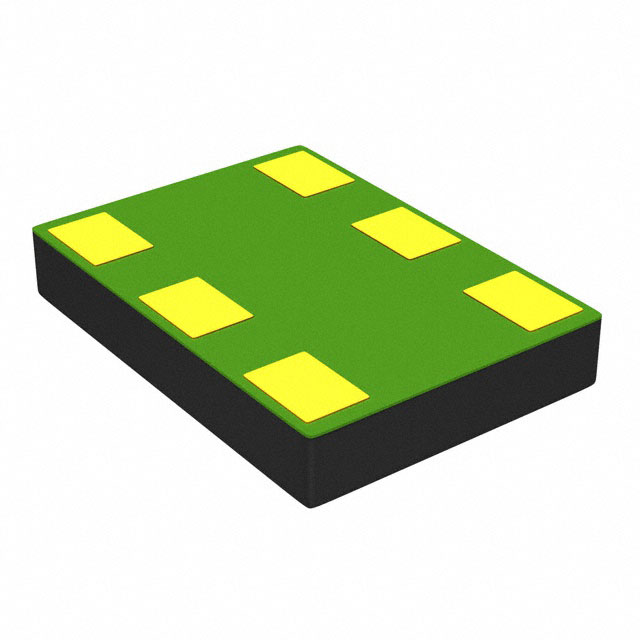
- Part No.:
- LMK61E2-125M00SIAR
- Manufacturer:
- Texas Instruments
- Category:
- Oscillators
- Package:
- 6-SMD Module
- Datasheet:
-
 LMK61E2-125M00SIAR.pdf
- Description:
- SILIC OSC XO 125.0000MHZ LVPECL
- Quantity:
- Payment:

- Shipping:

Inventory:8,918
Please send an inquiry. Send us your inquiry, and we will respond immediately.
Product details
Overview
LMK61E2-125M00SIAR from Texas Instruments is an ultra-low-jitter LVPECL oscillator generating a precise 125 MHz reference clock for high-speed serial interfaces. It delivers 90 fs RMS jitter (typical, >100 MHz), ±50 ppm total frequency tolerance, and operates from a single 3.3 V supply across –40°C to +85°C. Its primary role is timing reference generation in FPGA/ASIC clock trees requiring sub-100-fs jitter performance.
For engineers reviewing the LMK61E2-125M00SIAR datasheet, LMK61E2-125M00SIAR pinout, LMK61E2-125M00SIAR application, or LMK61E2-125M00SIAR equivalent, key selection criteria include differential output format compatibility (LVPECL), PSRR (–70 dBc), startup time (10 ms), OE control latency (50 µs), and 7 mm × 5 mm QFM package footprint alignment with industry-standard 7050 XO footprints.
Technical Context
The LMK61E2-125M00SIAR integrates a high-stability PLL-based core with internal power conditioning to achieve robust supply noise immunity. Its LVPECL output stage supports up to 1 GHz operation with 700–1200 mV differential swing and 120–200 ps rise/fall times (20%–80%).
It features an LVCMOS OE input with internal pull-up, enabling hardware-controlled output disable into high-impedance state. The device is factory-programmed for fixed 125 MHz LVPECL output and does not support frequency reconfiguration in-system.
Key Specifications
| Parameter | Value and Actual Design Meaning |
|---|---|
| Output Frequency | 125 MHz - Factory-programmed fixed frequency; no tuning capability. |
| RMS Phase Jitter (12 kHz–20 MHz) | 90 fs typical - Enables compliance with PCIe Gen4/Gen5, SATA III, and 10G/25G Ethernet jitter budgets. |
| Output Format | LVPECL - Requires 50-Ω termination to VDD − 2 V; compatible with TI's SN65LVDS31, DS90LV047A receivers. |
| Total Frequency Tolerance | ±50 ppm - Includes initial calibration, temperature drift (–40°C to +85°C), voltage variation (±5%), solder reflow, and 10-year aging. |
| Supply Voltage | 3.3 V ± 5% - Single-rail operation; decoupling requires 10 µF/1 µF/0.1 µF capacitor network per TI layout guidelines. |
| PSRR | –70 dBc at 50–1000 kHz - Reduces need for ultra-clean LDOs; allows direct connection to switched-mode power supply rails. |
| Startup Time | 10 ms - Time from VDD ≥ 3.135 V to stable output; critical for power-on sequencing in server BIOS initialization. |
Pinout & Package
LMK61E2-125M00SIAR uses a 6-pin QFM (7.0 mm × 5.0 mm) surface-mount package, pin-compatible with standard 7050 XO footprints. Thermal vias under the GND pad are required for junction temperature control.
| Pin/Terminal | Circuit Role | Design Meaning |
|---|---|---|
| 1 - OE | LVCMOS Input | Active-low output enable; internal pull-up ensures output active on power-up unless externally pulled low. |
| 2 - NC | No Connect | Unbonded die pad; must remain floating - no routing or stitching to GND/VDD. |
| 3 - GND | Ground Reference | Primary analog/digital ground; requires ≥3 thermal vias (0.3 mm) to inner ground plane for thermal dissipation. |
| 4 - OUTN | Differential Output (−) | LVPECL complementary output; routed as controlled-impedance pair with OUTP (Z₀ = 100 Ω differential). |
| 5 - OUTP | Differential Output (+) | LVPECL true output; matched length and spacing to OUTN essential for skew & EMI control. |
| 6 - VDD | Power Supply | 3.3 V analog supply; bypassed locally with 0.1 µF (0201) + 1 µF (0402) + 10 µF (0805) capacitors. |
Key Features
| Feature | Design Value |
|---|---|
| Ultra-low jitter (90 fs RMS) | Meets stringent phase noise requirements for SerDes clocking in 25G+ optical modules and AI accelerator interconnects. |
| –70 dBc PSRR | Enables direct integration into noisy SoC power domains without dedicated low-noise LDOs, reducing BOM count. |
| LVPECL output (1 GHz max) | Supports legacy and high-speed logic families including ECL, PECL, and TI's SN65LVDS series without level-shifting. |
| 6-pin 7×5 mm QFM package | Drop-in replacement for quartz oscillators in space-constrained telecom line cards and embedded networking gear. |
| Industrial temp range (–40°C to +85°C) | Validated for continuous operation in uncontrolled ambient environments such as base station cabinets and industrial gateways. |
Applications
| 10G/25G Ethernet PHY Clocking | FPGA High-Speed Transceiver Reference |
|---|---|
Use Scenario: Providing clean reference clock to Marvell Alaska X 88X3310 or Broadcom BCM54294 PHYs in SFP28 line cards. IC Role / Device Role / Timing Role: Primary low-jitter clock source for PMA/PMD layers; directly drives CDR circuitry. Use Value: 90 fs RMS jitter ensures <0.5 UI total jitter at 25.78125 Gbps, meeting IEEE 802.3by specification margins. |
Use Scenario: Feeding transceiver reference inputs (e.g., Xilinx UltraScale+ GTY or Intel Stratix 10 H-Tile) in high-bandwidth data acquisition systems. IC Role / Device Role / Timing Role: System-level timing reference for multi-gigabit serial I/O banks; synchronized to FPGA fabric clocks via MMCM. Use Value: ±50 ppm stability over temperature and voltage eliminates need for dynamic frequency calibration in production test. |
| PCIe Gen4/Gen5 Root Complex Timing | Medical Ultrasound Beamformer Clock |
Use Scenario: Delivering 100 MHz or 125 MHz reference to AMD EPYC or Intel Xeon W-3300 platform controllers in diagnostic imaging servers. IC Role / Device Role / Timing Role: PCIe REFCLK source meeting PCI-SIG Gen4/Gen5 jitter mask (1.0 ps RMS) with margin. Use Value: –70 dBc PSRR allows shared 3.3 V rail with PCIe switch logic, simplifying power delivery architecture. |
Use Scenario: Generating 125 MHz sampling clock for 128-channel digital beamformers in portable ultrasound systems. IC Role / Device Role / Timing Role: Master clock for ADC/DAC sample rate conversion and channel synchronization. Use Value: 125 MHz LVPECL output drives multiple high-speed ADCs (e.g., AD9689) with <100 fs additive jitter contribution. |
Equivalent & Alternatives
The following parts are listed as comparable options for similar ultra-low-jitter oscillator applications.
| Alternative Part | Technical Difference | Application Difference | Selection Advice |
|---|---|---|---|
| LMK61E2-125M00SIAT | Same silicon, tape-and-reel packaging (vs. LMK61E2-125M00SIAR's cut-tape); identical electrical specs. | No functional difference; selected for automated SMT placement volume production. | Choose SIAT for high-volume manufacturing; SIAR for prototyping or low-MOQ orders. |
| Si510-125.000M-AG | 125 MHz LVDS output (not LVPECL); ±20 ppm stability; 80 fs RMS jitter; 5×3.2 mm package. | Limited to LVDS-receiving devices; smaller footprint but incompatible pinout and voltage levels. | Select only if system uses LVDS inputs and board layout accommodates 5×3.2 mm footprint and different pin assignment. |
Compared with LMK61E2-125M00SIAR, the SIAT variant offers identical performance in tape-and-reel form for production lines, while the Si510 provides tighter stability and lower jitter but requires LVDS interface redesign and PCB rework due to non-pin-compatible 5×3.2 mm QFN.
Availability
LMK61E2-125M00SIAR is available at Aetrix Electronics and suitable for 10G/25G Ethernet PHY clocking, FPGA transceiver reference, and PCIe Gen4/Gen5 root complex timing requiring stable component supply, long-term lifecycle assurance, and traceable sourcing.
Supply support for LMK61E2-125M00SIAR includes scheduled delivery planning, volume procurement assistance, BOM continuity management, traceable sourcing, and lifecycle availability coordination for OEM customers, industrial embedded developers, connected-device designers, and electronics production programs.
Manufacturer
Texas Instruments is a global semiconductor company specializing in analog, embedded processing, and clock solutions, with leadership in high-performance timing ICs and signal chain components.
The LMK61XX family was designed specifically for replacing quartz oscillators in high-speed digital systems where ultra-low jitter, supply noise immunity, and programmable output formats are critical - targeting networking, computing, and test equipment markets.
FAQ
What output format does the LMK61E2-125M00SIAR support?
The LMK61E2-125M00SIAR is factory-programmed for LVPECL output only. It does not support LVDS or HCSL modes. Its differential LVPECL outputs (OUTP/OUTN) require termination to VDD − 2 V and deliver 700–1200 mV swing at 125 MHz. This fixed configuration is confirmed in TI's SNAS676D datasheet Table "Device Information" and Pin Functions section.
Is the LMK61E2-125M00SIAR pin-compatible with standard 7050 crystal oscillator footprints?
Yes, the LMK61E2-125M00SIAR uses a 6-pin QFM package measuring 7.0 mm × 5.0 mm, explicitly stated as pin-compatible with industry-standard 7050 XO packages. Pin 1 (OE) maps to the same location as typical XO ST/EN pins, and GND (pin 3) and VDD (pin 6) align with common power pin placements - enabling drop-in replacement without PCB redesign.
What is the maximum allowable power supply ripple for the LMK61E2-125M00SIAR?
The LMK61E2-125M00SIAR maintains –70 dBc PSRR across 50 kHz to 1 MHz, meaning it suppresses 50 mVpp sinusoidal ripple on VDD to <50 µVpp at the output. This allows operation with switching regulator outputs without additional filtering, provided ripple amplitude stays below 50 mVpp - verified in Section 6.12 of the SNAS676D datasheet.
Does the LMK61E2-125M00SIAR support frequency adjustment after programming?
No, the LMK61E2-125M00SIAR is factory-programmed for fixed 125 MHz LVPECL output and contains no I²C, SPI, or pin-strapping interface for reconfiguration. Unlike programmable variants (e.g., LMK61E0 series), it lacks internal NVM or external control for frequency tuning - confirmed by its "E2" suffix denoting fixed-frequency, ±50 ppm grade in TI's LMK61XX family documentation.
How does the OE pin function on the LMK61E2-125M00SIAR?
The OE (Output Enable) pin on the LMK61E2-125M00SIAR is an LVCMOS input with internal pull-up. When held high or floating, outputs are active; when pulled low (<0.6 V), both OUTP and OUTN enter high-impedance state within 50 µs. This enables dynamic clock gating in power-managed systems - detailed in Section 6.9 (OE Input Characteristics) of the SNAS676D datasheet.
LMK61E2-125M00SIAR Specifications
- Product attributes
- Attribute value
- Manufacturer:
- Texas Instruments
- Series:
- LMK61XX
- Package/Case:
- 6-SMD Module
- Packaging:
- Tape & Reel (TR)
- Product Status:
- Active
- Base Resonator:
- Silicon
- Type:
- XO (Standard)
- Frequency:
- 125 MHz
- Function:
- Enable/Disable
- Output:
- LVPECL
- Voltage - Supply:
- 3.3V
- Frequency Stability:
- ±50ppm
- Absolute Pull Range (APR):
- -
- Operating Temperature:
- -40°C ~ 85°C
- Spread Spectrum Bandwidth:
- -
- Current - Supply (Max):
- 208mA
- Ratings:
- -
- Mounting Type:
- Surface Mount
- Supplier Device Package:
- 6-QFM (7x5)
- Size / Dimension:
- 0.276" L x 0.197" W (7.00mm x 5.00mm)
- Height - Seated (Max):
- 0.045" (1.15mm)
LMK61E2-125M00SIAR FAQ
1.How can I place an order for LMK61E2-125M00SIAR through Aetrix?
Please submit a Request for Quotation (RFQ) for LMK61E2-125M00SIAR on Aetrix. Our sales agent will provide a competitive quotation and guide you through the order confirmation once you accept the terms.
2.Are the price and stock information for LMK61E2-125M00SIAR reliable?
The price and inventory of LMK61E2-125M00SIAR are updated periodically and may fluctuate due to market conditions. Stock and pricing data are typically refreshed every 24 hours. Quotation validity for LMK61E2-125M00SIAR is usually 5 days.
3.What payment methods are accepted for LMK61E2-125M00SIAR?
We accept Wire Transfer, PayPal, Credit Card, Western Union, MoneyGram, and Escrow for LMK61E2-125M00SIAR transactions.
Note: Certain payment methods may incur a processing fee.
4.How is shipping managed for LMK61E2-125M00SIAR?
LMK61E2-125M00SIAR orders can be shipped via leading logistics carriers, including DHL, UPS, FedEx, TNT, or Registered Mail.
Once your LMK61E2-125M00SIAR order is processed, you will receive an email with the shipment details and tracking number.
Note: Tracking information may take up to 24 hours to appear. Express delivery typically takes 3–5 business days.
5.How can I obtain technical support or documentation for LMK61E2-125M00SIAR?
For technical support, including LMK61E2-125M00SIAR datasheets, pinout diagrams, or application guidance, please contact our engineering support team. They can provide detailed documentation and assistance for your LMK61E2-125M00SIAR requirements.
6.How does Aetrix verify that LMK61E2-125M00SIAR is sourced from the original manufacturer or authorized distributors?
All LMK61E2-125M00SIAR products on Aetrix are procured from qualified distributors and authorized channels. Our dedicated quality assurance team conducts strict verification, including traceability checks and, if necessary, third-party testing. This ensures that LMK61E2-125M00SIAR meets industry standards.
7.What is the process for return or replacement of LMK61E2-125M00SIAR?
All LMK61E2-125M00SIAR units undergo pre-shipment inspection (PSI). If there is an issue with LMK61E2-125M00SIAR, returns or replacements are accepted under the following conditions:
1.Quantity discrepancies, incorrect items, or visible external defects (such as breakage or corrosion), acknowledged by Aetrix.
2.The issue is reported within 90 days of delivery.
3.The LMK61E2-125M00SIAR part is unused and in its original packaging.
Return procedure for LMK61E2-125M00SIAR:
1.Submit a request within 90 days.
2.Obtain a Return Material Authorization (RMA) from Aetrix.
LMK61E2-125M00SIAR Tags
-
ECS-2333-160-BN-TR
ECS Inc.
-
ECS-2333-240-BN-TR
ECS Inc.
-
KC2016Z25.0000C1KX00
KYOCERA AVX
-0.035-Thick.jpg)
-
ECS-2033-250-BN
ECS Inc.
-
O 25,0-JO32-B-1V3-1-T1-LF
Jauch Quartz
-
SIT1533AI-H4-DCC-32.768E
SiTime
-
ECS-2333-500-BN-TR
ECS Inc.
-
COM1305-50.000-EXT-T-TR
Raltron Electronics
-
SG-210STF 24.0000ML0
EPSON
-
ECS-3225MV-320-CN-TR
ECS Inc.
-
ECS-2033-240-BN
ECS Inc.
-
ECS-2333-120-BN-TR
ECS Inc.
Tech Hub

A practical engineering guide to 3.3V and 5V logic compatibility, input thresholds, resistor dividers, translator ICs, MOSFET level shifting, I2C pull-ups, timing limits and power-sequencing risks.

The 74HC595 uses push-pull logic outputs, while the TPIC6B595 uses 50 V open-drain DMOS sinks for higher-power loads. This guide compares timing, current limits, 3.3 V interfacing, load wiring, thermal…

The 74HC595 converts serial data into eight stable parallel outputs. This guide covers pin functions, shift and storage timing, OE and MR behavior, drive-current limits, cascading, voltage compatibilit…

A technical comparison of level-sensitive latches and edge-triggered flip-flops, covering timing windows, setup and hold limits, master–slave operation, time borrowing, race-through, HDL inference and…

A D latch stores one bit while Enable controls when data can pass. This reference covers gate-level operation, truth tables, transparency, setup and hold timing, LE versus OE, common ICs and practical …

An SR latch stores one bit through cross-coupled feedback. This engineering reference covers NOR and NAND implementations, truth tables, forbidden-state recovery, gated operation, switch debouncing, fa…

Latch circuits retain one bit through feedback. This technical reference covers SR and D latches, truth tables, transparency, timing limits, latch-versus-flip-flop behavior, applications and common log…

An engineering guide to LED driver operation, constant-current and constant-voltage outputs, linear and switching topologies, dimming, IC selection, calculations, replacement compatibility, and fault c…

Operational amplifier guide covering op amp basics, feedback, ideal vs real op amps, common configurations, buffer circuits, offset, bias current, gain-bandwidth, slew rate, rail-to-rail limits and sel…

Jumper cables guide covering safe connection order, red and black clamp placement, final ground connection, cable gauge, length, clamp quality, copper vs CCA cables, jump starter comparison and battery…


