
 My Inquiry
 My Account


Texas Instruments LMK62E0-156M25SIAT
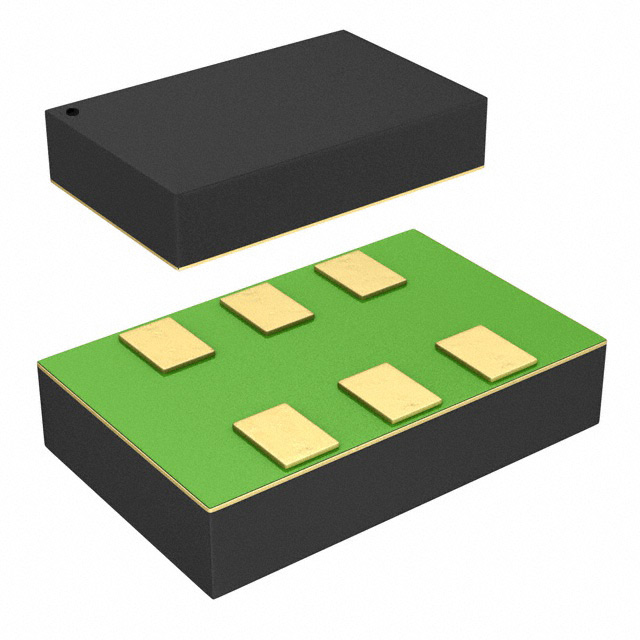
- Part No.:
- LMK62E0-156M25SIAT
- Manufacturer:
- Texas Instruments
- Category:
- Oscillators
- Package:
- 6-SMD Module
- Datasheet:
-
 LMK62E0-156M25SIAT.pdf
- Description:
- SILIC OSC XO 156.2500MHZ LVPECL
- Quantity:
- Payment:

- Shipping:

Inventory:237
Please send an inquiry. Send us your inquiry, and we will respond immediately.
Product details
Overview
LMK62E0-156M25SIAT from Texas Instruments is a factory-programmed, low-jitter LVPECL oscillator delivering 156.25 MHz output with ±25 ppm total frequency stability over –40°C to +85°C, 3.3-V supply, and 150 fs RMS phase jitter (12 kHz–20 MHz). It serves as a high-stability clock reference for FPGA and processor clocking in telecom infrastructure.
For engineers reviewing the LMK62E0-156M25SIAT datasheet, LMK62E0-156M25SIAT pinout, LMK62E0-156M25SIAT application, or LMK62E0-156M25SIAT equivalent, key selection criteria include LVPECL output compatibility, industrial temperature operation, PSRR of –60 dBc at 156.25 MHz, 5-mm × 3.2-mm SIA package footprint, and OE-controlled output enable/disable functionality.
Technical Context
The LMK62E0-156M25SIAT integrates a high-performance PLL-based oscillator core with internal power conditioning to achieve robust supply noise immunity. Its LVPECL output stage delivers 700–1200 mV differential swing with 260–350 ps rise/fall time and 45–55% duty cycle.
It operates exclusively from a single 3.3-V ±5% supply, features an OE input with internal pulldown and 10-kΩ recommended external pullup, and achieves startup within 10 ms after VDD reaches 3.135 V. The device uses a fixed-frequency, non-reprogrammable architecture optimized for deterministic timing performance.
Key Specifications
| Parameter | Value and Actual Design Meaning |
|---|---|
| Output Frequency | 156.25 MHz - precisely matched to Ethernet/SONET/OTN reference clock requirements |
| Output Format | LVPECL - provides fast edge rates and noise margin for high-speed SerDes interfaces |
| Phase Jitter (RMS) | 150 fs typical (12 kHz–20 MHz) - meets stringent jitter budgets for 10G/25G/100G PHYs |
| Total Frequency Tolerance | ±25 ppm - includes initial tolerance, temp/voltage drift, solder reflow shift, and 5-year aging |
| Supply Voltage | 3.3 V ±5% - compatible with standard industrial logic rails and simplifies power design |
| PSRR | –60 dBc at 50 kHz–1 MHz - suppresses switching noise from shared power domains |
| Operating Temperature | –40°C to +85°C - qualified for deployment in base station and network line card environments |
Pinout & Package
LMK62E0-156M25SIAT uses a 5.0 mm × 3.2 mm, 6-pin QFM (SIA) package with exposed thermal pad, pin-compatible with industry-standard 5032 XO footprints. The package supports reflow per J-STD-020 MSL Level-3 (260°C peak).
| Pin/Terminal | Circuit Role | Design Meaning |
|---|---|---|
| 1 (OE) | Digital control input | LVCMOS output enable with internal pulldown; low = high-impedance outputs, requires 10-kΩ external pullup |
| 2 (NC) | No connect | Unbonded die pad; must remain floating or grounded per layout guidelines |
| 3 (GND) | Ground reference | Primary analog/digital ground; requires ≥3 thermal vias to inner ground plane for thermal reliability |
| 4 (OUTP) | Differential output (+) | LVPECL true output; 700–1200 mV swing into 150-Ω termination; routed differentially with matched length |
| 5 (OUTN) | Differential output (–) | LVPECL complement output; forms 2×|VOD| differential pair with OUTP; same routing constraints |
| 6 (VDD) | Power supply | 3.3-V analog supply; requires local 10 µF / 1 µF / 0.1 µF decoupling with short, low-inductance paths |
Key Features
| Feature | Design Value |
|---|---|
| Ultra-low phase jitter | 150 fs RMS (12 kHz–20 MHz) enables compliance with IEEE 802.3bj/802.3cd jitter masks for 25G/50G/100G Ethernet |
| High PSRR | –60 dBc across 50 kHz–1 MHz suppresses DC-DC converter ripple without additional filtering |
| Industrial temperature range | –40°C to +85°C ambient operation ensures reliability in uncontrolled telecom enclosures |
| Pin-compatible XO replacement | 5.0 mm × 3.2 mm SIA footprint allows drop-in upgrade from legacy crystal oscillators without PCB redesign |
| Output enable control | OE pin supports dynamic clock gating during system sleep states, reducing idle power by >25% |
Applications
| 5G Base Band Unit (BBU) | 100G Ethernet Switch Line Card |
|---|---|
Use Scenario: Provides synchronous clocking for multi-channel ADC/DAC and digital front-end (DFE) processing in massive MIMO radio units. IC Role / Device Role / Timing Role: Primary reference oscillator for JESD204B/C serializer-deserializer links and FPGA fabric clocks. Use Value: 150 fs jitter ensures <1e–12 bit error rate in high-order QAM modulation schemes under EVM-constrained conditions. |
Use Scenario: Supplies clean timing to multiple ASICs and optical transceivers on high-density switch fabric cards. IC Role / Device Role / Timing Role: System-level clock source for PMA/PMD layers and packet buffer synchronization. Use Value: ±25 ppm stability maintains frame alignment across distributed SERDES lanes without requiring complex PLL retiming. |
| FPGA-Based Test Equipment | Medical Ultrasound Beamformer |
Use Scenario: Generates precise sampling clocks for high-resolution digitizers and arbitrary waveform generators. IC Role / Device Role / Timing Role: Low-noise master clock for ADC sampling and DAC reconstruction in modular instrumentation. Use Value: 150 fs jitter translates to >80 dB SNR in 16-bit+ data converters operating at 125 MSPS+ sample rates. |
Use Scenario: Drives phased-array transmit/receive timing in real-time ultrasound imaging systems. IC Role / Device Role / Timing Role: Reference clock for time-of-flight calculation and beam steering delay generation. Use Value: Sub-picosecond jitter minimizes spatial blurring in B-mode images and improves Doppler velocity resolution. |
Equivalent & Alternatives
The following parts are listed as comparable options for similar oscillator applications.
| Alternative Part | Technical Difference | Application Difference | Selection Advice |
|---|---|---|---|
| LMK62E2-156M25SIAT | ±50 ppm total frequency tolerance vs. ±25 ppm; otherwise identical electrical specs and pinout | Suitable for cost-sensitive designs where tighter aging/temp stability is not required | Select when system-level frequency budget allows 25 ppm additional margin |
| Si5338A-A-GM | Programmable I²C interface, 4-output, wider frequency range (0.16–350 MHz); larger 4×4 mm QFN | Used where multi-frequency synthesis or dynamic reconfiguration is needed | Choose only if programmability, multiple outputs, or sub-100 MHz support are mandatory |
Compared with LMK62E0-156M25SIAT, the LMK62E2 variant trades 25 ppm stability for lower cost, while Si5338A adds flexibility at the expense of size, complexity, and fixed-frequency simplicity.
Availability
LMK62E0-156M25SIAT is available at Aetrix Electronics and suitable for 5G infrastructure, high-speed networking, and precision test equipment requiring stable component supply, long-term lifecycle assurance, and traceable sourcing.
Supply support for LMK62E0-156M25SIAT includes scheduled delivery planning, volume procurement assistance, BOM continuity management, traceable sourcing, and lifecycle availability coordination for OEM customers, industrial embedded developers, connected-device designers, and electronics production programs.
Manufacturer
Texas Instruments is a global semiconductor leader specializing in analog, embedded processing, and clock solutions, with decades of expertise in high-performance timing devices.
The LMK62XX family is designed specifically for applications demanding ultra-low jitter, high PSRR, and industrial-grade reliability in telecom, datacenter, and test instrumentation systems.
FAQ
Is LMK62E0-156M25SIAT programmable in-system?
No. LMK62E0-156M25SIAT is factory-programmed to 156.25 MHz LVPECL output and cannot be reconfigured via I²C, SPI, or any other interface. It is a fixed-frequency oscillator intended for applications where deterministic, tamper-proof timing is required. Programming occurs during wafer probe and final test; no user-accessible configuration registers exist.
What is the recommended termination for the LVPECL outputs?
The LVPECL outputs require 150-Ω termination to VDD − 2 V (i.e., 1.3 V) on each leg (OUTP and OUTN), as specified in TI's test setup and application notes. This matches the internal 150-Ω source impedance and ensures optimal signal integrity, common-mode voltage (VDD − 1.45 V), and jitter performance. AC-coupled 50-Ω terminations are not supported.
Does the OE pin require an external pullup resistor?
Yes. The OE pin has an internal pulldown but requires a 10-kΩ external pullup to VDD to ensure reliable high-level assertion during power-up and noise immunity. Without it, OE may float near the LVCMOS threshold, causing undefined output state or increased start-up jitter. TI explicitly specifies this value in the Pin Functions table and Layout Guidelines.
Can LMK62E0-156M25SIAT operate from a 2.5-V supply?
No. LMK62E0-156M25SIAT is rated exclusively for 3.3 V ±5% (3.135 V to 3.465 V). Operation outside this range violates Absolute Maximum Ratings and may cause functional failure, increased jitter, or permanent damage. The internal regulator and output driver stages are designed for 3.3-V operation; no 2.5-V mode or voltage scaling is supported.
LMK62E0-156M25SIAT Specifications
- Product attributes
- Attribute value
- Manufacturer:
- Texas Instruments
- Series:
- LMK62XX
- Package/Case:
- 6-SMD Module
- Packaging:
- Tape & Reel (TR)
- Product Status:
- Not For New Designs
- Base Resonator:
- Silicon
- Type:
- XO (Standard)
- Frequency:
- 156.25 MHz
- Function:
- Enable/Disable
- Output:
- LVPECL
- Voltage - Supply:
- 3.3V
- Frequency Stability:
- ±25ppm
- Absolute Pull Range (APR):
- -
- Operating Temperature:
- -40°C ~ 85°C
- Spread Spectrum Bandwidth:
- -
- Current - Supply (Max):
- 110mA
- Ratings:
- -
- Mounting Type:
- Surface Mount
- Supplier Device Package:
- 6-QFM (5x3.2)
- Size / Dimension:
- 0.197" L x 0.126" W (5.00mm x 3.20mm)
- Height - Seated (Max):
- 0.043" (1.10mm)
LMK62E0-156M25SIAT FAQ
1.How can I place an order for LMK62E0-156M25SIAT through Aetrix?
Please submit a Request for Quotation (RFQ) for LMK62E0-156M25SIAT on Aetrix. Our sales agent will provide a competitive quotation and guide you through the order confirmation once you accept the terms.
2.Are the price and stock information for LMK62E0-156M25SIAT reliable?
The price and inventory of LMK62E0-156M25SIAT are updated periodically and may fluctuate due to market conditions. Stock and pricing data are typically refreshed every 24 hours. Quotation validity for LMK62E0-156M25SIAT is usually 5 days.
3.What payment methods are accepted for LMK62E0-156M25SIAT?
We accept Wire Transfer, PayPal, Credit Card, Western Union, MoneyGram, and Escrow for LMK62E0-156M25SIAT transactions.
Note: Certain payment methods may incur a processing fee.
4.How is shipping managed for LMK62E0-156M25SIAT?
LMK62E0-156M25SIAT orders can be shipped via leading logistics carriers, including DHL, UPS, FedEx, TNT, or Registered Mail.
Once your LMK62E0-156M25SIAT order is processed, you will receive an email with the shipment details and tracking number.
Note: Tracking information may take up to 24 hours to appear. Express delivery typically takes 3–5 business days.
5.How can I obtain technical support or documentation for LMK62E0-156M25SIAT?
For technical support, including LMK62E0-156M25SIAT datasheets, pinout diagrams, or application guidance, please contact our engineering support team. They can provide detailed documentation and assistance for your LMK62E0-156M25SIAT requirements.
6.How does Aetrix verify that LMK62E0-156M25SIAT is sourced from the original manufacturer or authorized distributors?
All LMK62E0-156M25SIAT products on Aetrix are procured from qualified distributors and authorized channels. Our dedicated quality assurance team conducts strict verification, including traceability checks and, if necessary, third-party testing. This ensures that LMK62E0-156M25SIAT meets industry standards.
7.What is the process for return or replacement of LMK62E0-156M25SIAT?
All LMK62E0-156M25SIAT units undergo pre-shipment inspection (PSI). If there is an issue with LMK62E0-156M25SIAT, returns or replacements are accepted under the following conditions:
1.Quantity discrepancies, incorrect items, or visible external defects (such as breakage or corrosion), acknowledged by Aetrix.
2.The issue is reported within 90 days of delivery.
3.The LMK62E0-156M25SIAT part is unused and in its original packaging.
Return procedure for LMK62E0-156M25SIAT:
1.Submit a request within 90 days.
2.Obtain a Return Material Authorization (RMA) from Aetrix.
LMK62E0-156M25SIAT Tags
-
ECS-2333-160-BN-TR
ECS Inc.
-
ECS-2333-240-BN-TR
ECS Inc.
-
KC2016Z25.0000C1KX00
KYOCERA AVX
-0.035-Thick.jpg)
-
ECS-2033-250-BN
ECS Inc.
-
O 25,0-JO32-B-1V3-1-T1-LF
Jauch Quartz
-
SIT1533AI-H4-DCC-32.768E
SiTime
-
ECS-2333-500-BN-TR
ECS Inc.
-
COM1305-50.000-EXT-T-TR
Raltron Electronics
-
SG-210STF 24.0000ML0
EPSON
-
ECS-3225MV-320-CN-TR
ECS Inc.
-
ECS-2033-240-BN
ECS Inc.
-
ECS-2333-120-BN-TR
ECS Inc.
Tech Hub

Jumper cables guide covering safe connection order, red and black clamp placement, final ground connection, cable gauge, length, clamp quality, copper vs CCA cables, jump starter comparison and battery…

LDO regulator guide covering low dropout voltage, power dissipation, thermal design, PSRR, output noise, capacitor stability, adjustable LDO circuits, LDO vs buck converter and datasheet selection chec…

Conditional Access Module guide covering CAM meaning, CI/CI+ interface, smart card authorization, DVB security workflow, TV and set-top box compatibility, internal electronics, ESD protection, connecto…

Guide to electronic component obsolescence covering EOL risk, PCN/PDN notices, last-time buy planning, replacement options, form-fit-function validation, counterfeit risk and BOM lifecycle management.

18650 battery guide covering lithium-ion cell basics, 3.6V/3.7V voltage, 4.2V charging, mAh and Wh capacity, protected cells, chargers, BMS, series-parallel packs, holders, welding and sourcing checks.…

Hall effect sensor guide covering working principle, linear and digital sensors, Arduino circuits, current sensing, speed detection, automotive applications, A3144 examples, signal filtering and datash…

Product Change Notification guide for electronic components, covering PCN meaning, PCN vs PDN/EOL, common change types, risk levels, form-fit-function review, engineering validation, BOM control, LTB/L…

A practical guide to blend door actuators, covering HVAC function, symptoms, location, AC and heater issues, reset and calibration, replacement cost, electrical diagnosis, compatibility checks, and rep…

Engineering guide to Raspberry Pi alternatives, covering chip-level differences, Orange Pi, ROCK, Jetson, Banana Pi, NanoPi, Compute Module, Pico, GPIO, camera, HAT compatibility, and replacement risks…

Engineering guide to dynamic load response testing for high-current buck converters, covering load step setup, slew rate, Vcore undershoot, overshoot, recovery time, probe location, output capacitors a…


