
 My Inquiry
 My Account


Texas Instruments LMT86LPGM
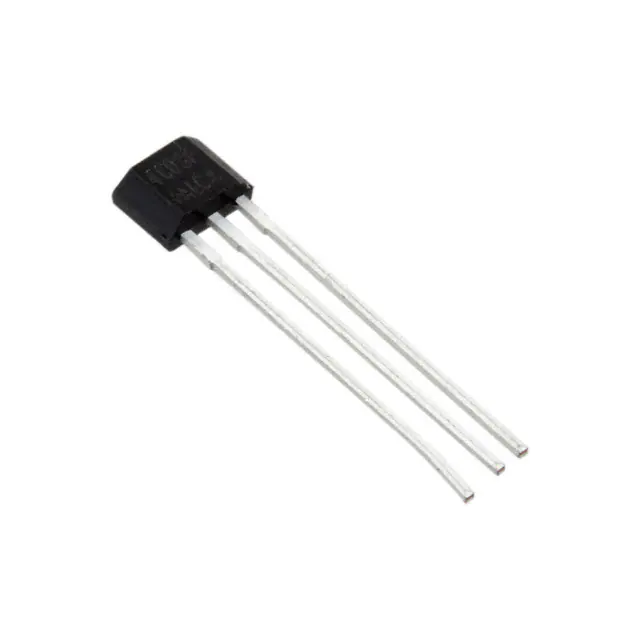
- Part No.:
- LMT86LPGM
- Manufacturer:
- Texas Instruments
- Category:
- Analog and Digital Output
- Package:
- TO-226-3, TO-92-3 Short Body
- Datasheet:
-
 LMT86LPGM.pdf
- Description:
- SENSOR ANALOG -50C-150C TO92-3
- Quantity:
- Payment:

- Shipping:

Inventory:12,601
Please send an inquiry. Send us your inquiry, and we will respond immediately.
Product details
Overview
LMT86LPGM from Texas Instruments is a precision analog CMOS temperature sensor in TO-92S through-hole package, delivering ±0.4°C typical accuracy over –50°C to 150°C, –10.9 mV/°C output slope, 2.2 V minimum supply voltage, and 5.4 µA quiescent current - deployed in smoke detectors, automotive infotainment, and drone thermal monitoring.
For engineers reviewing the LMT86LPGM datasheet, LMT86LPGM pinout, LMT86LPGM application, or LMT86LPGM equivalent, key selection criteria include its fast 10 s thermal time constant (1.2 m/s airflow), push-pull output with ±50 µA drive, short-circuit protection, and footprint compatibility with LM20/LM35 for drop-in analog temperature sensing upgrades.
Technical Context
The LMT86LPGM uses a forward-biased base-emitter junction as its sensing element, buffered by a rail-to-rail CMOS amplifier with push-pull output stage - enabling low-impedance sourcing and sinking without external components. Its transfer function follows a parabolic model (–10.888 mV/°C slope + –0.00347 mV/°C² curvature) centered at 30°C, reflected precisely in the published 151-point transfer table.
Thermal response is optimized via direct die-to-GND thermal path: the GND pin serves as both electrical reference and primary heat conduction path, yielding RθJA = 130.4°C/W (TO-92S) and self-heating error <0.014°C at 5 V/30°C - critical for off-board mounting in heat detectors and engine bay sensors.
Key Specifications
| Parameter | Value and Actual Design Meaning |
|---|---|
| Accuracy (TA = 40–150°C) | ±0.4°C typical - enables high-fidelity thermal feedback in closed-loop powertrain control without calibration |
| Supply Voltage Range | 2.2 V to 5.5 V - supports direct connection to Li-ion battery rails or 3.3 V/5 V MCU domains |
| Output Slope | –10.9 mV/°C - provides 1.09 V full-scale swing across 100°C range, simplifying 10-bit ADC resolution mapping |
| Quiescent Current | 5.4 µA - allows >1-year operation on 200 mAh coin cell in periodic-sampling sensor nodes |
| Thermal Time Constant | 10 s (1.2 m/s airflow) - ensures rapid ambient tracking in HVAC and fire alarm response |
| Output Drive | ±50 µA - directly drives SAR ADC input capacitors without buffer op-amp |
| Operating Temperature | –50°C to +150°C - qualified for under-hood automotive and industrial motor winding monitoring |
Pinout & Package
TO-92S (LPG) through-hole package: 4.00 mm × 3.15 mm body, straight leads, GND pin thermally bonded to die backside for optimal thermal conduction.
| Pin/Terminal | Circuit Role | Design Meaning |
|---|---|---|
| VDD (Pin 1) | Positive Supply Input | Accepts 2.2–5.5 V; powers internal biasing and amplifier; no external decoupling required unless system noise >10 mVpp |
| OUT (Pin 2) | Analog Output | Push-pull voltage output inversely proportional to temperature; drives ≤1100 pF load directly; short-circuit protected |
| GND (Pin 3) | Power & Thermal Reference | Electrical ground return and primary thermal conduction path to PCB; must be connected to large copper area for minimal self-heating |
Key Features
| Feature | Design Value |
|---|---|
| Fast thermal response | 10 s time constant (1.2 m/s airflow) - enables real-time detection of rapid temperature rise in smoke/heat alarms |
| Low-voltage operation | 2.2 V minimum supply - eliminates need for LDO in energy-harvesting or single-cell battery systems |
| Footprint compatibility | Pinout and outline match LM20/LM35 - allows legacy board reuse without layout revision |
| Short-circuit protection | Output survives indefinite GND or VDD shorts - improves field reliability in unshielded wiring environments |
| Cost-effective thermistor alternative | Linear output + factory calibration eliminates NTC lookup tables and beta compensation firmware overhead |
Applications
| Smoke and Heat Detectors | Automotive Infotainment Systems |
|---|---|
Use Scenario: Mounted externally on detector housing to monitor ambient air temperature rise during fire events. IC Role / Device Role / Timing Role: Analog temperature sensor providing continuous voltage output proportional to ambient temperature. Use Value: 10 s thermal time constant ensures detection of 10°C/min ramp rates per UL 217 standards; ±0.4°C accuracy enables precise alarm threshold discrimination. | Use Scenario: Embedded inside center console to monitor processor and display thermal margins during extended multimedia playback. IC Role / Device Role / Timing Role: System-level thermal monitor interfacing directly with MCU ADC for fan speed and display brightness control. Use Value: 5.4 µA quiescent current minimizes parasitic drain on vehicle battery during ignition-off; TO-92S allows secure mechanical mounting near heat sources. |
| Drone Flight Controllers | Industrial Motor Drives |
Use Scenario: Soldered onto flight controller PCB to track ESC and IMU temperature during high-thrust maneuvers. IC Role / Device Role / Timing Role: Battery-powered thermal guardrail sensor feeding real-time data to flight safety logic. Use Value: 2.2 V operation enables direct connection to 2S LiPo (7.4 V nominal, ~6 V max) via resistive divider; fast power-on time (0.7 ms) supports rapid pre-flight checks. | Use Scenario: Screw-mounted into motor frame near windings to detect insulation degradation via hotspot tracking. IC Role / Device Role / Timing Role: Off-board temperature probe interfaced via twisted-pair cable to drive control unit. Use Value: GND-pin thermal conduction path ensures accurate junction-to-frame measurement; –50°C to +150°C range covers cold-start to overload conditions. |
Equivalent & Alternatives
The following parts are listed as comparable options for similar analog temperature sensing applications.
| Alternative Part | Technical Difference | Application Difference | Selection Advice |
|---|---|---|---|
| LMT85LP | –8.2 mV/°C output slope; 1.8 V min supply; ±0.7°C accuracy (0–40°C) | Better low-voltage headroom but lower sensitivity and reduced accuracy at extremes | Select when operating below 2.2 V or requiring tighter low-temp accuracy at 0–40°C |
| LM35DMX/NOPB | +10 mV/°C slope; 4 V min supply; ±0.5°C accuracy; TO-92 package | Positive slope simplifies ADC interpretation but requires higher supply and lacks short-circuit protection | Select when system uses positive-slope convention and supply ≥4 V is guaranteed |
Compared with LMT86LPGM, LMT85LP offers lower supply voltage flexibility but sacrifices sensitivity and wide-range accuracy; LM35DMX/NOPB provides industry-standard positive output but demands higher supply and lacks robustness against wiring faults.
Availability
LMT86LPGM is available at Aetrix Electronics and suitable for smoke detectors, automotive infotainment systems, and drone thermal monitoring requiring stable component supply across long production lifecycles.
Supply support for LMT86LPGM includes scheduled delivery planning, volume procurement assistance, BOM continuity management, traceable sourcing, and lifecycle availability coordination for OEM customers, industrial embedded developers, connected-device designers, and electronics production programs.
Manufacturer
Texas Instruments is a global semiconductor company headquartered in Dallas, Texas, designing analog and embedded processing chips for industrial, automotive, and consumer applications.
The LMT86 family was engineered specifically for high-accuracy, low-power analog temperature sensing in space-constrained and thermally dynamic environments - emphasizing fast response, wide operating range, and direct ADC interface capability.
FAQ
What is the thermal time constant of the LMT86LPGM, and how does it impact smoke detector response?
The LMT86LPGM has a thermal time constant of 10 seconds under 1.2 m/s airflow, measured in its TO-92S package. This enables detection of rapid temperature rises per UL 217 fire alarm standards - for example, a 10°C/min ramp is tracked with <2°C lag. The GND pin's direct thermal coupling to the die ensures this performance is maintained when mounted on metal detector housings or heat sinks. LMT86LPGM achieves this without external thermal mass, unlike thermistors requiring epoxy encapsulation.
Can the LMT86LPGM operate directly from a 2.2 V lithium battery without regulation?
Yes, the LMT86LPGM is fully specified down to 2.2 V supply voltage and draws only 5.4 µA quiescent current - making it ideal for direct connection to aging or partially discharged 2.2–3.6 V lithium primary cells. Its output remains monotonic and accurate across this range, with line regulation of 200 µV/V. No LDO or charge pump is needed, reducing bill-of-materials cost and PCB area. LMT86LPGM maintains ±0.4°C accuracy even at minimum VDD.
How does the LMT86LPGM's push-pull output interface with a microcontroller ADC input?
The LMT86LPGM's push-pull output delivers ±50 µA drive strength, enabling direct charging of typical SAR ADC sampling capacitors (e.g., 10–30 pF) without an op-amp buffer. It supports capacitive loads up to 1100 pF; for larger loads, a series resistor (e.g., 800 Ω for 1 µF) is recommended. LMT86LPGM's 0.7 ms power-on time ensures stable output before ADC sampling begins - critical for low-duty-cycle battery-powered systems.
Is the LMT86LPGM pin-compatible with the LM35, and what design changes are needed?
Yes, the LMT86LPGM in TO-92S package shares identical pinout (VDD–OUT–GND), outline dimensions, and lead spacing with the LM35, enabling direct replacement on existing boards. Key differences: LMT86LPGM has inverted output polarity (–10.9 mV/°C vs. +10 mV/°C), operates down to 2.2 V (vs. 4 V), and includes short-circuit protection. Firmware must invert ADC readings or adjust scaling; no hardware changes are required. LMT86LPGM retains LM35's mechanical fit while improving performance.
What is the maximum allowable capacitive load on the LMT86LPGM output without signal integrity degradation?
The LMT86LPGM is characterized to drive up to 1100 pF capacitively without added series resistance - sufficient for most MCU ADC inputs and RC filtering networks. For loads exceeding 1100 pF (e.g., long cables or high-C filters), TI recommends adding a series resistor: 800 Ω for 1 µF, 1.5 kΩ for 100–999 nF, or 3 kΩ for 1.1–99 nF. This prevents ringing and ensures monotonic settling. LMT86LPGM's push-pull architecture maintains stability across this full range without external compensation.
LMT86LPGM Specifications
- Product attributes
- Attribute value
- Manufacturer:
- Texas Instruments
- Series:
- -
- Package/Case:
- TO-226-3, TO-92-3 Short Body
- Packaging:
- Cut Tape (CT)
- Product Status:
- Active
- Sensor Type:
- Analog, Local
- Sensing Temperature - Local:
- -50°C ~ 150°C
- Sensing Temperature - Remote:
- -
- Output Type:
- Analog Voltage
- Voltage - Supply:
- 2.2V ~ 5.5V
- Resolution:
- 10.9mV/°C
- Features:
- -
- Accuracy - Highest (Lowest):
- ±2.7°C
- Test Condition:
- 40°C ~ 150°C
- Operating Temperature:
- -50°C ~ 150°C
- Mounting Type:
- Through Hole
- Grade:
- Automotive
- Qualification:
- AEC-Q100
- Supplier Device Package:
- TO-92-3
LMT86LPGM FAQ
1.How can I place an order for LMT86LPGM through Aetrix?
Please submit a Request for Quotation (RFQ) for LMT86LPGM on Aetrix. Our sales agent will provide a competitive quotation and guide you through the order confirmation once you accept the terms.
2.Are the price and stock information for LMT86LPGM reliable?
The price and inventory of LMT86LPGM are updated periodically and may fluctuate due to market conditions. Stock and pricing data are typically refreshed every 24 hours. Quotation validity for LMT86LPGM is usually 5 days.
3.What payment methods are accepted for LMT86LPGM?
We accept Wire Transfer, PayPal, Credit Card, Western Union, MoneyGram, and Escrow for LMT86LPGM transactions.
Note: Certain payment methods may incur a processing fee.
4.How is shipping managed for LMT86LPGM?
LMT86LPGM orders can be shipped via leading logistics carriers, including DHL, UPS, FedEx, TNT, or Registered Mail.
Once your LMT86LPGM order is processed, you will receive an email with the shipment details and tracking number.
Note: Tracking information may take up to 24 hours to appear. Express delivery typically takes 3–5 business days.
5.How can I obtain technical support or documentation for LMT86LPGM?
For technical support, including LMT86LPGM datasheets, pinout diagrams, or application guidance, please contact our engineering support team. They can provide detailed documentation and assistance for your LMT86LPGM requirements.
6.How does Aetrix verify that LMT86LPGM is sourced from the original manufacturer or authorized distributors?
All LMT86LPGM products on Aetrix are procured from qualified distributors and authorized channels. Our dedicated quality assurance team conducts strict verification, including traceability checks and, if necessary, third-party testing. This ensures that LMT86LPGM meets industry standards.
7.What is the process for return or replacement of LMT86LPGM?
All LMT86LPGM units undergo pre-shipment inspection (PSI). If there is an issue with LMT86LPGM, returns or replacements are accepted under the following conditions:
1.Quantity discrepancies, incorrect items, or visible external defects (such as breakage or corrosion), acknowledged by Aetrix.
2.The issue is reported within 90 days of delivery.
3.The LMT86LPGM part is unused and in its original packaging.
Return procedure for LMT86LPGM:
1.Submit a request within 90 days.
2.Obtain a Return Material Authorization (RMA) from Aetrix.
LMT86LPGM Tags
-
MCP9700T-E/TT
Microchip Technology
-
MCP9700T-E/LT
Microchip Technology
-
MCP9701T-E/TT
Microchip Technology
-
MCP9701T-E/LT
Microchip Technology
-
TMP235A4DBZR
Texas Instruments
-
MCP9700AT-E/TT
Microchip Technology
-
MCP9700AT-E/LT
Microchip Technology
-
MCP9701AT-E/LT
Microchip Technology
-
MCP9701AT-E/TT
Microchip Technology
,TO-226_straightlead.jpg)
-
LM335Z
STMicroelectronics
-
TMP1075NDRLR
Texas Instruments
-
TMP1075DGKR
Texas Instruments
Tech Hub

A practical engineering guide to 3.3V and 5V logic compatibility, input thresholds, resistor dividers, translator ICs, MOSFET level shifting, I2C pull-ups, timing limits and power-sequencing risks.

The 74HC595 uses push-pull logic outputs, while the TPIC6B595 uses 50 V open-drain DMOS sinks for higher-power loads. This guide compares timing, current limits, 3.3 V interfacing, load wiring, thermal…

The 74HC595 converts serial data into eight stable parallel outputs. This guide covers pin functions, shift and storage timing, OE and MR behavior, drive-current limits, cascading, voltage compatibilit…

A technical comparison of level-sensitive latches and edge-triggered flip-flops, covering timing windows, setup and hold limits, master–slave operation, time borrowing, race-through, HDL inference and…

A D latch stores one bit while Enable controls when data can pass. This reference covers gate-level operation, truth tables, transparency, setup and hold timing, LE versus OE, common ICs and practical …

An SR latch stores one bit through cross-coupled feedback. This engineering reference covers NOR and NAND implementations, truth tables, forbidden-state recovery, gated operation, switch debouncing, fa…

Latch circuits retain one bit through feedback. This technical reference covers SR and D latches, truth tables, transparency, timing limits, latch-versus-flip-flop behavior, applications and common log…

An engineering guide to LED driver operation, constant-current and constant-voltage outputs, linear and switching topologies, dimming, IC selection, calculations, replacement compatibility, and fault c…

Operational amplifier guide covering op amp basics, feedback, ideal vs real op amps, common configurations, buffer circuits, offset, bias current, gain-bandwidth, slew rate, rail-to-rail limits and sel…

Jumper cables guide covering safe connection order, red and black clamp placement, final ground connection, cable gauge, length, clamp quality, copper vs CCA cables, jump starter comparison and battery…


