
 My Inquiry
 My Account


Analog Devices Inc. LTC2937HUHE#TRPBF
- Part No.:
- LTC2937HUHE#TRPBF
- Manufacturer:
- Analog Devices Inc.
- Category:
- Power Supply Controllers, Monitors
- Package:
- 28-WFQFN Exposed Pad
- Datasheet:
-
 LTC2937HUHE#TRPBF.pdf
- Description:
- IC SEQUENCER/SUPERVISOR 6CH 28QF
- Quantity:
- Payment:

- Shipping:

Inventory:3,788
Please send an inquiry. Send us your inquiry, and we will respond immediately.
Product details
Overview
LTC2937HUHE#TRPBF from Analog Devices is a six-channel programmable power supply sequencer and voltage supervisor with EEPROM configuration and fault logging. It enables precise time- and event-based sequencing of up to six supplies, monitors ±0.75% accurate UV/OV thresholds across all channels, supports I²C/SMBus interface, and operates over –40°C to 125°C. It is used in telecom equipment for controlled multi-rail power-up of FPGAs and ASICs.
For engineers reviewing the LTC2937HUHE#TRPBF datasheet, LTC2937HUHE#TRPBF pinout, LTC2937HUHE#TRPBF application, or LTC2937HUHE#TRPBF equivalent, key selection criteria include sequencer channel count, EEPROM retention at 125°C, programmable reset delay (0–1900 ms), single-wire synchronization scalability to 300 supplies, and integrated active discharge capability per monitored rail.
Technical Context
The LTC2937HUHE#TRPBF implements dual-mode sequencing-time-based (with ton_delay/toff_delay timers) and event-based (triggered by voltage threshold crossings)-using independent UV/OV comparators per channel. Its internal 3.3V LDO regulator powers logic and I²C interface while accepting VPWR input from 4.5V to 16.5V.
Configuration and fault history are stored in on-chip EEPROM rated for 10k write cycles and 20-year data retention across the full –40°C to 125°C operating range. Synchronization between multiple devices uses two dedicated one-wire interfaces: SHARE_CLK for global timing alignment and SPCLK for coordinated sequence position handoff.
Key Specifications
| Parameter | Value and Actual Design Meaning |
|---|---|
| Channels | 6 independent voltage monitoring and enable control channels |
| UV/OV Accuracy | ±0.75% over temperature for codes 155–255, enabling tight margin testing |
| Reset Delay Range | Programmable from 0 ms to 1900 ms in 8 steps, supporting staggered processor initialization |
| EEPROM Retention | 20 years at TJ ≤ 85°C; derated above 85°C per Analog Devices specification |
| Operating Temp | –40°C to +125°C junction temperature, qualified for high-reliability industrial/telecom systems |
| Supply Voltage | VPWR = 4.5 V to 16.5 V; VDD regulated output = 3.3 V ±2% with 5 mA max load |
| I²C Interface | SMBus-compatible, 10 kHz to 400 kHz clock, supports Alert Response Protocol for fault identification |
Pinout & Package
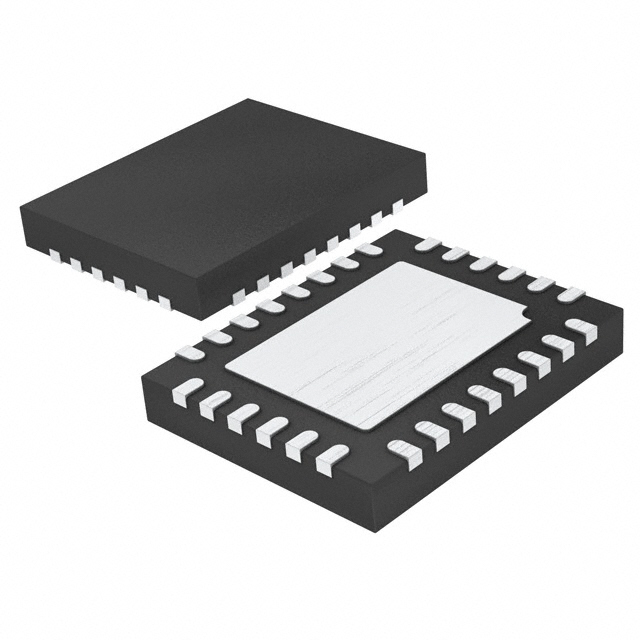
28-lead (5 mm × 6 mm) plastic QFN package with exposed thermal pad (optional GND connection). Pin functions validated per Analog Devices LTC2937 Rev. B datasheet.
| Pin/Terminal | Circuit Role | Design Meaning |
|---|---|---|
| V1–V6 | Monitor Inputs | Accept 0.2–6 V adjustable/low/high-range inputs; each includes UV/OV comparators and discharge current source |
| EN1–EN6 | Open-Drain Enable Outputs | Drive external DC/DC enable pins or N-MOSFET gates; require external pull-up to ≤15 V |
| RSTB | Open-Drain Reset Output | Asserts low on UV/OV fault; releases high after programmable delay when thresholds satisfied |
| ALERTB / FAULTB | Dedicated Fault Outputs | ALERTB follows SMBus Alert protocol; FAULTB supports wired-OR fault signaling and external initiation |
| SDA / SCL | I²C Bidirectional Data/Clock | Support standard-mode (100 kHz) and fast-mode (400 kHz); require external pull-ups |
| SHARE_CLK / SPCLK | Synchronization Nodes | SHARE_CLK establishes common timing base across devices; SPCLK coordinates sequence position handoff |
| ASEL1–ASEL3 | Address Select Inputs | Encode 1 of 27 I²C addresses via GND/VDD/open; real-time configurable without reset |
| ON / MARGB / WP | Control Inputs | ON initiates sequencing; MARGB disables RSTB during margin testing; WP enables/disables EEPROM writes |
Key Features
| Feature | Design Value |
|---|---|
| Autonomous Sequencing | Configurable via EEPROM without host software; supports unattended power-up in headless systems |
| Stalled Supply Detection | Identifies rails failing to cross thresholds within programmed time windows, preventing system hang |
| Active Discharge Control | Integrated current sources (up to 45 mA per channel) accelerate decay of slow-discharging rails post-shutdown |
| Fault Root-Cause Logging | First-fault event (e.g., V3 UV at t=142 ms) stored in EEPROM with timestamp and channel context |
| Multi-Device Scalability | Single-wire SHARE_CLK synchronizes timing; SPCLK enables daisy-chained sequencing across up to 50 devices (300 rails) |
Applications
| Network Servers | Data Storage Systems |
|---|---|
Use Scenario: Powering multi-rail server motherboards with CPU, memory, PCIe, and management controllers. IC Role / Device Role / Timing Role: Six-channel sequencer enforcing strict turn-on order (e.g., 12 V → 5 V → 3.3 V → 1.8 V → 1.2 V → 0.9 V) with inter-rail delays. Use Value: Prevents latch-up and inrush current conflicts during cold start; EEPROM stores field-proven timing profiles. | Use Scenario: Controlling power sequencing for enterprise SSDs with NAND flash, DRAM cache, and PCIe controller rails. IC Role / Device Role / Timing Role: Supervisor detecting undervoltage on 1.2 V VCCQ rail during hot-plug events and asserting RSTB to halt firmware execution. Use Value: Eliminates data corruption risk by halting operation before supply collapse; fault log enables post-mortem analysis. |
| Telecom Equipment | High Availability Computer Systems |
Use Scenario: Managing redundant power modules and FPGA configuration in 5G baseband units. IC Role / Device Role / Timing Role: Coordinating sequencing across dual LTC2937HUHE#TRPBF devices via SHARE_CLK and SPCLK to synchronize 12-rail startup. Use Value: Ensures deterministic timing across distributed power domains; eliminates race conditions in failover paths. | Use Scenario: Enabling graceful shutdown and restart sequences in mission-critical industrial controllers. IC Role / Device Role / Timing Role: Monitoring 2.5 V and 3.3 V I/O rails; triggering automatic restart (0–6 attempts) after UV fault clears. Use Value: Maintains system uptime without operator intervention; EEPROM retains fault history across power cycles. |
Equivalent & Alternatives
The following parts are listed as comparable options for similar power supply sequencing and supervision applications.
| Alternative Part | Technical Difference | Application Difference | Selection Advice |
|---|---|---|---|
| LTC2935CUHE#TRPBF | 4-channel sequencer; no EEPROM; -40°C to 85°C rating; lacks SHARE_CLK/SPCLK sync | Suitable only for simpler, lower-channel-count designs without fault logging or multi-device coordination | Select when cost sensitivity outweighs need for EEPROM, extended temp, or scalability beyond 4 rails |
| TPS65988DHAR | USB-C PD controller with integrated 3-channel sequencer; 0°C to 70°C; no standalone UV/OV supervision per rail | Targeted at USB-C powered devices; lacks independent rail monitoring and discharge capability | Choose only for USB-C host/port applications requiring PD negotiation alongside basic sequencing |
Compared with LTC2937HUHE#TRPBF, LTC2935CUHE#TRPBF offers reduced channel count and no nonvolatile fault storage, while TPS65988DHAR embeds sequencing within a USB-C protocol stack-neither provides the same combination of 6-channel autonomous supervision, 125°C operation, EEPROM logging, and scalable synchronization.
Availability
LTC2937HUHE#TRPBF is available at Aetrix Electronics and suitable for network servers, telecom equipment, and high-availability computer systems requiring stable component supply across extended temperature ranges and long product lifecycles.
Supply support for LTC2937HUHE#TRPBF includes scheduled delivery planning, volume procurement assistance, BOM continuity management, traceable sourcing, and lifecycle availability coordination for OEM customers, industrial embedded developers, connected-device designers, and electronics production programs.
Manufacturer
Analog Devices, Inc. is a global semiconductor company specializing in high-performance analog, mixed-signal, and digital signal processing technologies.
The LTC2937HUHE#TRPBF belongs to Analog Devices' Power Management portfolio, designed specifically for robust, autonomous power sequencing and fault-aware supervision in mission-critical infrastructure equipment.
FAQ
What is the maximum number of power supplies that can be sequenced using LTC2937HUHE#TRPBF?
The LTC2937HUHE#TRPBF supports up to six power supplies directly. When multiple LTC2937HUHE#TRPBF devices are interconnected via the SHARE_CLK and SPCLK lines, sequencing can scale to 300 supplies across up to 50 devices. This expansion relies on synchronized timing and daisy-chained sequence position handoff, not additional channels per device.
Does LTC2937HUHE#TRPBF support negative voltage monitoring?
Yes, the LTC2937HUHE#TRPBF supports negative voltage monitoring by referencing V1–V6 inputs to VDD (3.3 V) instead of GND. Using an external resistor divider biased from VDD, negative rails such as –1.2 V or –5 V can be scaled into the device's 0.2 V to 6 V input range. The datasheet confirms this capability in the Applications Information section under "Monitor Negative Power Supplies."
How does the EEPROM fault logging work in LTC2937HUHE#TRPBF?
The LTC2937HUHE#TRPBF logs the first detected fault-including channel number, fault type (UV/OV/sequence timeout), timestamp relative to ON assertion, and threshold values-to on-chip EEPROM. This occurs automatically upon fault detection and survives power cycles. The MONITOR_STATUS_HISTORY register allows retrieval, and the CLEAR command resets the log. EEPROM endurance is rated for 10,000 writes with 20-year retention at ≤85°C.
What is the purpose of the MARGB pin on LTC2937HUHE#TRPBF?
The MARGB (Margin) pin on LTC2937HUHE#TRPBF disables the RSTB output and suppresses SUPERVISOR faults during voltage margin testing. Pulling MARGB low prevents false resets when supplies are intentionally driven outside nominal limits (e.g., +5% or –5%). This allows safe validation of system stability under stressed conditions without interrupting operation.
Can LTC2937HUHE#TRPBF operate without an external microcontroller?
Yes, the LTC2937HUHE#TRPBF is designed for autonomous operation. Its configuration-including sequencing order, timing parameters, UV/OV thresholds, and fault responses-is stored in internal EEPROM. Once programmed, it performs full power-up, supervision, and fault response without any host processor or software. The ON pin serves as a simple hardware trigger, making it ideal for headless or firmware-light systems.
LTC2937HUHE#TRPBF Specifications
- Product attributes
- Attribute value
- Manufacturer:
- Analog Devices Inc.
- Series:
- -
- Package/Case:
- 28-WFQFN Exposed Pad
- Packaging:
- Tape & Reel (TR)
- Product Status:
- Active
- Programmable:
- Not Verified
- Applications:
- Power Supply Monitor, Sequencer
- Voltage - Input:
- 4.5V ~ 16.5V
- Voltage - Supply:
- 2.9V ~ 5.5V
- Current - Supply:
- 1 mA
- Operating Temperature:
- -40°C ~ 125°C
- Grade:
- -
- Qualification:
- -
- Mounting Type:
- Surface Mount
- Supplier Device Package:
- 28-QFN (5x6)
LTC2937HUHE#TRPBF FAQ
1.How can I place an order for LTC2937HUHE#TRPBF through Aetrix?
Please submit a Request for Quotation (RFQ) for LTC2937HUHE#TRPBF on Aetrix. Our sales agent will provide a competitive quotation and guide you through the order confirmation once you accept the terms.
2.Are the price and stock information for LTC2937HUHE#TRPBF reliable?
The price and inventory of LTC2937HUHE#TRPBF are updated periodically and may fluctuate due to market conditions. Stock and pricing data are typically refreshed every 24 hours. Quotation validity for LTC2937HUHE#TRPBF is usually 5 days.
3.What payment methods are accepted for LTC2937HUHE#TRPBF?
We accept Wire Transfer, PayPal, Credit Card, Western Union, MoneyGram, and Escrow for LTC2937HUHE#TRPBF transactions.
Note: Certain payment methods may incur a processing fee.
4.How is shipping managed for LTC2937HUHE#TRPBF?
LTC2937HUHE#TRPBF orders can be shipped via leading logistics carriers, including DHL, UPS, FedEx, TNT, or Registered Mail.
Once your LTC2937HUHE#TRPBF order is processed, you will receive an email with the shipment details and tracking number.
Note: Tracking information may take up to 24 hours to appear. Express delivery typically takes 3–5 business days.
5.How can I obtain technical support or documentation for LTC2937HUHE#TRPBF?
For technical support, including LTC2937HUHE#TRPBF datasheets, pinout diagrams, or application guidance, please contact our engineering support team. They can provide detailed documentation and assistance for your LTC2937HUHE#TRPBF requirements.
6.How does Aetrix verify that LTC2937HUHE#TRPBF is sourced from the original manufacturer or authorized distributors?
All LTC2937HUHE#TRPBF products on Aetrix are procured from qualified distributors and authorized channels. Our dedicated quality assurance team conducts strict verification, including traceability checks and, if necessary, third-party testing. This ensures that LTC2937HUHE#TRPBF meets industry standards.
7.What is the process for return or replacement of LTC2937HUHE#TRPBF?
All LTC2937HUHE#TRPBF units undergo pre-shipment inspection (PSI). If there is an issue with LTC2937HUHE#TRPBF, returns or replacements are accepted under the following conditions:
1.Quantity discrepancies, incorrect items, or visible external defects (such as breakage or corrosion), acknowledged by Aetrix.
2.The issue is reported within 90 days of delivery.
3.The LTC2937HUHE#TRPBF part is unused and in its original packaging.
Return procedure for LTC2937HUHE#TRPBF:
1.Submit a request within 90 days.
2.Obtain a Return Material Authorization (RMA) from Aetrix.
LTC2937HUHE#TRPBF Tags

-
UC3845AD8TR
Texas Instruments
-
UC2843AD8TR
Texas Instruments

-
LM3880MFX-1AE/NOPB
Texas Instruments
-
LM3880MFX-1AA/NOPB
Texas Instruments
-
INA234AIYBJR
Texas Instruments

-
INA700AYWFR
Texas Instruments
-
LM3880MF-1AE/NOPB
Texas Instruments
-
LM3880MF-1AA/NOPB
Texas Instruments
-
LM3881MM/NOPB
Texas Instruments
-
UCC2802DTR
Texas Instruments
-
NCP4305DMTTWG
onsemi
-
INA237AIDGSR
Texas Instruments
Tech Hub

A practical engineering guide to 3.3V and 5V logic compatibility, input thresholds, resistor dividers, translator ICs, MOSFET level shifting, I2C pull-ups, timing limits and power-sequencing risks.

The 74HC595 uses push-pull logic outputs, while the TPIC6B595 uses 50 V open-drain DMOS sinks for higher-power loads. This guide compares timing, current limits, 3.3 V interfacing, load wiring, thermal…

The 74HC595 converts serial data into eight stable parallel outputs. This guide covers pin functions, shift and storage timing, OE and MR behavior, drive-current limits, cascading, voltage compatibilit…

A technical comparison of level-sensitive latches and edge-triggered flip-flops, covering timing windows, setup and hold limits, master–slave operation, time borrowing, race-through, HDL inference and…

A D latch stores one bit while Enable controls when data can pass. This reference covers gate-level operation, truth tables, transparency, setup and hold timing, LE versus OE, common ICs and practical …

An SR latch stores one bit through cross-coupled feedback. This engineering reference covers NOR and NAND implementations, truth tables, forbidden-state recovery, gated operation, switch debouncing, fa…

Latch circuits retain one bit through feedback. This technical reference covers SR and D latches, truth tables, transparency, timing limits, latch-versus-flip-flop behavior, applications and common log…

An engineering guide to LED driver operation, constant-current and constant-voltage outputs, linear and switching topologies, dimming, IC selection, calculations, replacement compatibility, and fault c…

Operational amplifier guide covering op amp basics, feedback, ideal vs real op amps, common configurations, buffer circuits, offset, bias current, gain-bandwidth, slew rate, rail-to-rail limits and sel…

Jumper cables guide covering safe connection order, red and black clamp placement, final ground connection, cable gauge, length, clamp quality, copper vs CCA cables, jump starter comparison and battery…


