
 My Inquiry
 My Account


Analog Devices Inc. LTC4123EDC#TRMPBF
- Part No.:
- LTC4123EDC#TRMPBF
- Manufacturer:
- Analog Devices Inc.
- Category:
- Battery Chargers
- Package:
- 6-WFDFN Exposed Pad
- Datasheet:
-
 LTC4123EDC#TRMPBF.pdf
- Description:
- IC BATT CHG NIMH 1CELL 6DFN
- Quantity:
- Payment:

- Shipping:

Inventory:1,882
Please send an inquiry. Send us your inquiry, and we will respond immediately.
Product details
Overview
LTC4123EDC#TRMPBF from Analog Devices (formerly Linear Technology) is a low-power wireless NiMH battery charger IC with integrated AC rectification, constant-current/constant-voltage regulation, and temperature-compensated 1.5V charge voltage. It delivers up to 25mA charge current, operates down to 2.2V input, and features Zinc-Air detection, reverse polarity protection, and thermal fault management - designed specifically for sealed hearing aid enclosures.
For engineers reviewing the LTC4123EDC#TRMPBF datasheet, LTC4123EDC#TRMPBF pinout, LTC4123EDC#TRMPBF application, or LTC4123EDC#TRMPBF equivalent, key selection criteria include its 2mm × 2mm DFN-6 package, 6-hour programmable charge timer, ±15mV battery voltage accuracy over –5°C to 70°C, and compatibility with resonant 244kHz wireless power transfer systems using external LC tanks.
Technical Context
The LTC4123EDC#TRMPBF integrates a synchronous rectifier and linear charging controller optimized for single-cell NiMH batteries in space-constrained wireless applications. Its ACIN pin accepts resonant AC input (e.g., from a 13µH receive coil), rectifies it internally, and regulates VCC to ≤5V while limiting peak voltage to 5V and minimum to 3V.
Charge control uses dual-stage CC/CV algorithm with PROG-pin-based current programming (ICHG = 24V/RPROG), temperature-compensated BAT voltage (–2.5mV/°C), and hardware-enforced safety: UVLO (1.95V threshold), UVCL (2.2V activation), die thermal monitoring (–5°C to 70°C fault range), and 80-second Zinc-Air detection window.
Key Specifications
| Parameter | Value and Actual Design Meaning |
|---|---|
| Charge Voltage | 1.5075V at 25°C, ±15mV over –5°C to 70°C - ensures precise NiMH state-of-charge without overvoltage stress |
| Max Charge Current | 25mA (with 953Ω RPROG) - supports full charge of typical hearing aid batteries in ~6 hours |
| Input Voltage Range | 2.2V to 5V on VCC; ACIN accepts resonant AC up to VCC+1V - enables operation from weak wireless coupling or DC backup supply |
| Quiescent Current | 125–200µA (charging terminated) - minimizes standby drain in always-on wearable devices |
| Battery Leakage | ≤100nA at VBAT = 2V - preserves charge during long idle periods in sealed hearing aids |
| Charge Timer | 4.8–7.2 hours - provides time-based termination independent of voltage/current thresholds |
| Thermal Fault Range | Cold fault at –5°C (±5°C hysteresis); hot fault at 70°C (±5°C hysteresis) - pauses charging to protect battery and IC |
Pinout & Package
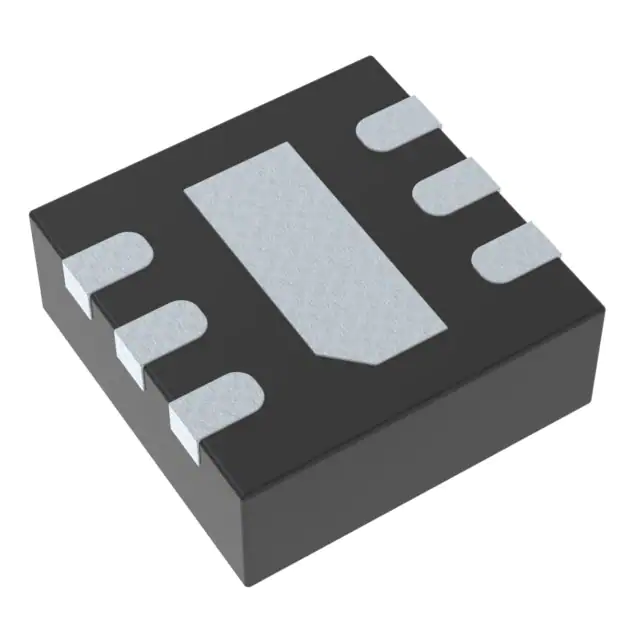
Package: 6-lead (2mm × 2mm) plastic DFN with exposed pad (Pin 7 = GND). Requires soldering of exposed pad to PCB ground plane for thermal performance (θJA = 80.6°C/W).
| Pin/Terminal | Circuit Role | Design Meaning |
|---|---|---|
| ACIN (Pin 1) | AC input node for resonant tank | Connects to receive coil + capacitor; internal diode rectifies AC to VCC; short to GND if unused |
| VCC (Pin 2) | DC power rail output | Regulated rectified output (≤5V); requires 4.7µF bypass capacitor; powers internal circuitry and battery charging path |
| CHRG (Pin 3) | Open-drain status indicator | 340µA pull-down current source; blinks slow (0.8Hz) during charge, fast (6Hz) on faults, pulls low at completion |
| PROG (Pin 4) | Current programming reference | 0.25V servo point; ICHG = 96 × VPROG / RPROG = 24V / RPROG - sets charge current via external resistor |
| BAT (Pin 5) | NiMH battery connection | Regulated 1.5V output with –2.5mV/°C tempco; high-impedance when fault detected or charge complete |
| GND (Pin 6 + Exposed Pad 7) | Reference and thermal path | Primary ground return; exposed pad must be soldered to PCB copper for thermal dissipation and electrical stability |
Key Features
| Feature | Design Value |
|---|---|
| Zinc-Air battery detection | Identifies non-rechargeable batteries within 80 seconds by monitoring BAT voltage rise >1.65V - prevents hazardous charging |
| Reverse polarity protection | Halts charging if BAT < –50mV - avoids damage from incorrectly inserted NiMH cells |
| Integrated rectifier with overvoltage limit | Clamps VCC to 5V max and 3V min - eliminates need for external TVS or LDO in wireless receiver stage |
| Temperature-compensated charge voltage | Adjusts BAT setpoint –2.5mV/°C - maintains optimal NiMH charge profile across operating ambient (–20°C to 85°C) |
| Low minimum input voltage | Operates down to 2.2V on VCC - sustains charging under marginal wireless coupling or low-battery transmitter conditions |
Applications
| Hearing Aids | Smart Cards |
|---|---|
Use Scenario: Sealed, miniaturized hearing aids requiring maintenance-free charging through plastic housing without physical connectors. IC Role / Device Role / Timing Role: Wireless receiver and linear NiMH charger - converts magnetic field energy into regulated 1.5V/25mA charge current with thermal and chemistry safeguards. Use Value: Enables IP67-rated, tamper-proof enclosure design while delivering full charge in ≤6 hours with ±15mV voltage accuracy. | Use Scenario: Contactless smart cards with embedded rechargeable NiMH battery for extended active RFID functionality. IC Role / Device Role / Timing Role: Low-quiescent (125µA) wireless charging front-end - powers card electronics during proximity to reader field and recharges battery between sessions. Use Value: Eliminates battery replacement logistics; supports >1000 charge cycles with Zinc-Air detection preventing accidental charging of primary cells. |
| Fitness Trackers | Moving Equipment Sensors |
Use Scenario: Wearable fitness bands with rotating bezels or waterproof housings where traditional charging ports compromise ergonomics or sealing. IC Role / Device Role / Timing Role: Compact (2mm × 2mm) wireless charging manager - handles intermittent coil coupling during motion and maintains safe charge termination. Use Value: Reduces solution footprint by >40% vs discrete rectifier + charger; thermal fault pause prevents overheating during dynamic use. | Use Scenario: Rotating industrial sensors (e.g., motor shaft monitors) that cannot accommodate wired charging due to continuous rotation. IC Role / Device Role / Timing Role: Self-contained wireless power receiver - charges NiMH battery during brief dwell periods near fixed transmitter coils. Use Value: Enables maintenance-free operation for >2 years; UVCL (2.2V threshold) ensures stable charging even with variable coupling efficiency. |
Equivalent & Alternatives
The following parts are listed as comparable options for similar low-power wireless NiMH charging applications.
| Alternative Part | Technical Difference | Application Difference | Selection Advice |
|---|---|---|---|
| BQ51013BRGER | Qi-compliant 5W receiver; supports Li-ion only; no NiMH voltage regulation or Zinc-Air detection | Designed for smartphones/tablets; lacks hearing aid–grade low-power modes and battery chemistry safeguards | Choose only if migrating to Li-ion and requiring Qi certification - not suitable for NiMH or sealed medical devices |
| MAX17710G+ | Energy harvesting PMIC with 100mA Li-ion charger; no integrated rectifier or NiMH-specific algorithms | Targets ultra-low-power IoT sensors; requires external AC-DC conversion and battery management firmware | Select when combining RF/thermal/solar harvesting with Li-ion; does not replace LTC4123EDC#TRMPBF's all-in-one NiMH wireless function |
Compared with BQ51013BRGER and MAX17710G+, the LTC4123EDC#TRMPBF uniquely integrates resonant AC rectification, NiMH-specific CC/CV control, Zinc-Air detection, and 2mm × 2mm DFN packaging - making it the only drop-in solution for certified hearing aid wireless charging without redesigning safety-critical battery management logic.
Availability
LTC4123EDC#TRMPBF is available at Aetrix Electronics and suitable for hearing aids, smart cards, fitness trackers, and rotating equipment sensors requiring stable component supply and long-term lifecycle support.
Supply support for LTC4123EDC#TRMPBF includes scheduled delivery planning, volume procurement assistance, BOM continuity management, traceable sourcing, and lifecycle availability coordination for OEM customers, industrial embedded developers, connected-device designers, and electronics production programs.
Manufacturer
Analog Devices acquired Linear Technology in 2017 and maintains its precision analog IC portfolio, including high-reliability power management solutions for medical, industrial, and portable applications.
The LTC4123EDC#TRMPBF belongs to Linear's wireless power receiver product line, engineered specifically for ultra-low-power, safety-critical NiMH charging in hermetically sealed, size-constrained devices like hearing aids and implantable peripherals.
FAQ
What is the maximum charge current supported by the LTC4123EDC#TRMPBF?
The LTC4123EDC#TRMPBF supports a maximum charge current of 25mA when configured with a 953Ω resistor on the PROG pin. This value is confirmed in the Electrical Characteristics table (ICHG = 22–28mA range at RPROG = 953Ω, TYP = 25mA). The device uses ICHG = 24V / RPROG, so lower resistance yields higher current - but 953Ω is the standard 1% value selected to achieve nominal 25mA within tolerance.
Does the LTC4123EDC#TRMPBF require an external rectifier diode?
No, the LTC4123EDC#TRMPBF does not require an external rectifier diode. It integrates a built-in rectifier between ACIN and VCC, as confirmed in the Pin Functions section ("An internal diode is connected from the ACIN pin (anode) to this pin [VCC] (cathode)") and Block Diagram (Rectification and Input Power Control block). This eliminates external components and reduces solution size - critical for hearing aid applications.
How does the LTC4123EDC#TRMPBF detect Zinc-Air batteries?
The LTC4123EDC#TRMPBF detects Zinc-Air batteries by monitoring the BAT pin voltage during the first 80 seconds of charging. If BAT rises above 1.65V (typical) within that window, the device halts charging and signals a fault via fast-blinking CHRG. This behavior is documented in the Electrical Characteristics table (VZn-AIR = 1.60–1.65V) and Operation section, ensuring safe rejection of non-rechargeable chemistries.
What is the operating temperature range for the LTC4123EDC#TRMPBF?
The LTC4123EDC#TRMPBF is specified for an operating junction temperature range of –20°C to 85°C, with guaranteed performance over –20°C to 85°C per the Order Information table. Thermal fault protection activates at –5°C (cold) and 70°C (hot), pausing charging to protect battery and IC - a feature validated in the Electrical Characteristics section (Cold/Hot Temperature Fault Thresholds).
Can the LTC4123EDC#TRMPBF be used with lithium-ion batteries?
No, the LTC4123EDC#TRMPBF is not designed for lithium-ion batteries. Its charge voltage is fixed at ~1.5V with NiMH-specific temperature compensation (–2.5mV/°C), and its safety features - including Zinc-Air detection and reverse polarity protection - target NiMH chemistry. The datasheet explicitly states it is "a constant-current/constant-voltage linear charger for NiMH batteries" and provides no Li-ion voltage profiles or termination methods.
LTC4123EDC#TRMPBF Specifications
- Product attributes
- Attribute value
- Manufacturer:
- Analog Devices Inc.
- Series:
- -
- Package/Case:
- 6-WFDFN Exposed Pad
- Packaging:
- Tape & Reel (TR)
- Product Status:
- Active
- Battery Chemistry:
- Nickel Metal Hydride
- Number of Cells:
- 1
- Current - Charging:
- Constant - Programmable
- Programmable Features:
- -
- Fault Protection:
- Over Voltage
- Charge Current - Max:
- 25mA
- Battery Pack Voltage:
- 1.5075V
- Voltage - Supply (Max):
- 5V
- Interface:
- -
- Operating Temperature:
- -20°C ~ 85°C (TA)
- Grade:
- -
- Qualification:
- -
- Mounting Type:
- Surface Mount
- Supplier Device Package:
- 6-DFN (2x2)
LTC4123EDC#TRMPBF FAQ
1.How can I place an order for LTC4123EDC#TRMPBF through Aetrix?
Please submit a Request for Quotation (RFQ) for LTC4123EDC#TRMPBF on Aetrix. Our sales agent will provide a competitive quotation and guide you through the order confirmation once you accept the terms.
2.Are the price and stock information for LTC4123EDC#TRMPBF reliable?
The price and inventory of LTC4123EDC#TRMPBF are updated periodically and may fluctuate due to market conditions. Stock and pricing data are typically refreshed every 24 hours. Quotation validity for LTC4123EDC#TRMPBF is usually 5 days.
3.What payment methods are accepted for LTC4123EDC#TRMPBF?
We accept Wire Transfer, PayPal, Credit Card, Western Union, MoneyGram, and Escrow for LTC4123EDC#TRMPBF transactions.
Note: Certain payment methods may incur a processing fee.
4.How is shipping managed for LTC4123EDC#TRMPBF?
LTC4123EDC#TRMPBF orders can be shipped via leading logistics carriers, including DHL, UPS, FedEx, TNT, or Registered Mail.
Once your LTC4123EDC#TRMPBF order is processed, you will receive an email with the shipment details and tracking number.
Note: Tracking information may take up to 24 hours to appear. Express delivery typically takes 3–5 business days.
5.How can I obtain technical support or documentation for LTC4123EDC#TRMPBF?
For technical support, including LTC4123EDC#TRMPBF datasheets, pinout diagrams, or application guidance, please contact our engineering support team. They can provide detailed documentation and assistance for your LTC4123EDC#TRMPBF requirements.
6.How does Aetrix verify that LTC4123EDC#TRMPBF is sourced from the original manufacturer or authorized distributors?
All LTC4123EDC#TRMPBF products on Aetrix are procured from qualified distributors and authorized channels. Our dedicated quality assurance team conducts strict verification, including traceability checks and, if necessary, third-party testing. This ensures that LTC4123EDC#TRMPBF meets industry standards.
7.What is the process for return or replacement of LTC4123EDC#TRMPBF?
All LTC4123EDC#TRMPBF units undergo pre-shipment inspection (PSI). If there is an issue with LTC4123EDC#TRMPBF, returns or replacements are accepted under the following conditions:
1.Quantity discrepancies, incorrect items, or visible external defects (such as breakage or corrosion), acknowledged by Aetrix.
2.The issue is reported within 90 days of delivery.
3.The LTC4123EDC#TRMPBF part is unused and in its original packaging.
Return procedure for LTC4123EDC#TRMPBF:
1.Submit a request within 90 days.
2.Obtain a Return Material Authorization (RMA) from Aetrix.
LTC4123EDC#TRMPBF Tags

-
BQ21040DBVR
Texas Instruments
-
MCP73812T-420I/OT
Microchip Technology
-
MCP73831T-2ACI/OT
Microchip Technology
-
MCP73832T-2ACI/OT
Microchip Technology
-
MCP73831T-2DCI/OT
Microchip Technology
-
MCP73832T-2DCI/OT
Microchip Technology
-
MCP73831T-2ATI/OT
Microchip Technology
-
MCP73832T-2ATI/OT
Microchip Technology
-
MCP73831T-5ACI/OT
Microchip Technology
-
MCP73832T-2ACI/MC
Microchip Technology
-
MCP73831T-2ACI/MC
Microchip Technology
-
MCP73831T-2ATI/MC
Microchip Technology
Tech Hub

A practical engineering guide to 3.3V and 5V logic compatibility, input thresholds, resistor dividers, translator ICs, MOSFET level shifting, I2C pull-ups, timing limits and power-sequencing risks.

The 74HC595 uses push-pull logic outputs, while the TPIC6B595 uses 50 V open-drain DMOS sinks for higher-power loads. This guide compares timing, current limits, 3.3 V interfacing, load wiring, thermal…

The 74HC595 converts serial data into eight stable parallel outputs. This guide covers pin functions, shift and storage timing, OE and MR behavior, drive-current limits, cascading, voltage compatibilit…

A technical comparison of level-sensitive latches and edge-triggered flip-flops, covering timing windows, setup and hold limits, master–slave operation, time borrowing, race-through, HDL inference and…

A D latch stores one bit while Enable controls when data can pass. This reference covers gate-level operation, truth tables, transparency, setup and hold timing, LE versus OE, common ICs and practical …

An SR latch stores one bit through cross-coupled feedback. This engineering reference covers NOR and NAND implementations, truth tables, forbidden-state recovery, gated operation, switch debouncing, fa…

Latch circuits retain one bit through feedback. This technical reference covers SR and D latches, truth tables, transparency, timing limits, latch-versus-flip-flop behavior, applications and common log…

An engineering guide to LED driver operation, constant-current and constant-voltage outputs, linear and switching topologies, dimming, IC selection, calculations, replacement compatibility, and fault c…

Operational amplifier guide covering op amp basics, feedback, ideal vs real op amps, common configurations, buffer circuits, offset, bias current, gain-bandwidth, slew rate, rail-to-rail limits and sel…

Jumper cables guide covering safe connection order, red and black clamp placement, final ground connection, cable gauge, length, clamp quality, copper vs CCA cables, jump starter comparison and battery…


