
 My Inquiry
 My Account


STMicroelectronics M48T02-70PC1
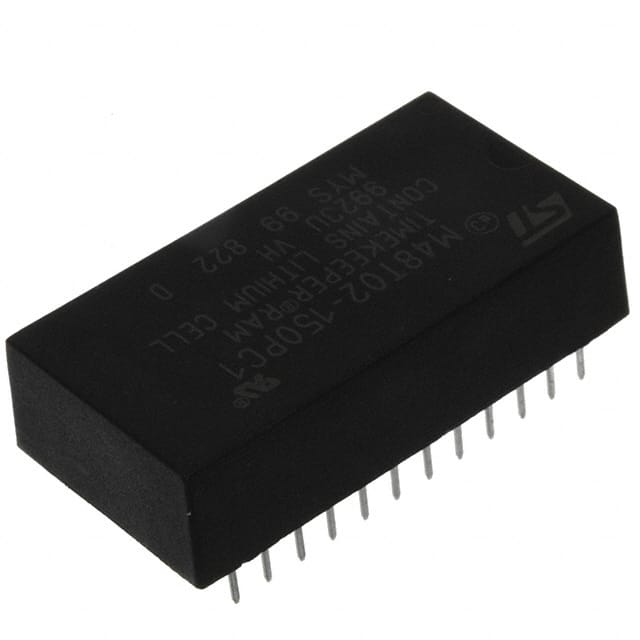
- Part No.:
- M48T02-70PC1
- Manufacturer:
- STMicroelectronics
- Category:
- Real Time Clocks
- Package:
- 24-DIP Module (0.600", 15.24mm)
- Datasheet:
-
 M48T02-70PC1.pdf
- Description:
- IC RTC CLK/CALENDAR PAR 24DIP
- Quantity:
- Payment:

- Shipping:

Inventory:1,001
Please send an inquiry. Send us your inquiry, and we will respond immediately.
Product details
Overview
M48T02-70PC1 from STMicroelectronics is a 5.0 V, 16 Kbit (2 Kb × 8) non-volatile TIMEKEEPER® SRAM integrating ultra-low-power static RAM, real-time clock, and power-fail control circuitry in a single CAPHAT™ DIP package. It delivers BCD-coded timekeeping (year/month/day/hour/minute/second), ±1 minute/month accuracy at 25 °C, and automatic leap-year correction - used in industrial control panels, embedded data loggers, and legacy system RTC upgrades requiring battery-backed time and memory.
For engineers reviewing the M48T02-70PC1 datasheet, M48T02-70PC1 pinout, M48T02-70PC1 application, or M48T02-70PC1 equivalent, key selection considerations include VPFD voltage window (4.5–4.75 V), BYTEWIDE™ SRAM access compatibility with JEDEC 2K×8 SRAMs, self-contained crystal/battery integration, and software-controllable clock calibration for long-term timing stability.
Technical Context
The M48T02-70PC1 integrates a 32.768 kHz quartz oscillator, BiPORT™ SRAM array (2048 × 8), and voltage-sensing power-fail circuit on a single die. Clock registers (7F8h–7FFh) reside in upper SRAM addresses and are updated once per second by dedicated clock logic - not direct counter reads - enabling atomic time reads via standard memory access.
Its power management includes VPFD-triggered write protection, automatic battery switchover below ~3 V, and a battery-OK (BOK) flag that blocks writes until cleared after low-battery detection. Calibration occurs via five-bit register-controlled pulse blanking/splitting at the ÷256 stage, delivering ±5.5 to ±2.75 min/month adjustment range.
Key Specifications
| Parameter | Value and Actual Design Meaning |
|---|---|
| Memory Size | 2 Kb × 8 (16 Kbit) SRAM with non-volatile retention via integrated lithium battery |
| Clock Accuracy | ±1 minute/month at 25 °C; calibrated range ±5.5 to ±2.75 minutes/month via 5-bit register |
| VPFD Range | 4.5 V ≤ VPFD ≤ 4.75 V - defines precise voltage window for automatic write-protection during brownout |
| Access Time | 70 ns (–70 speed grade) - enables drop-in replacement for fast 2K×8 SRAM sockets without timing redesign |
| Supply Voltage | 4.75 V to 5.5 V - compatible with standard +5 V TTL/CMOS systems and tolerant of nominal rail variation |
| Package | PCDIP24 - 24-pin plastic DIP with integrated CAPHAT™ lithium cell and 32.768 kHz crystal |
| Temperature Range | 0 °C to +70 °C - validated for commercial/industrial ambient operation with full AC/DC specs |
Pinout & Package
Package: PCDIP24 (24-pin plastic dual in-line, 600 mil width), featuring integrated lithium button cell and 32.768 kHz quartz crystal in CAPHAT™ configuration.
| Pin/Terminal | Circuit Role | Design Meaning |
|---|---|---|
| A0–A10 | Address Inputs | 11-bit address bus for accessing all 2048 SRAM locations (000h–7FFh), including clock registers at 7F8h–7FFh |
| DQ0–DQ7 | Data I/O | 8-bit bidirectional data bus supporting BYTEWIDE™ read/write; high-impedance during power-fail deselect |
| E | Chip Enable | Active-low chip select; initiates READ/WRITE when low and W/G satisfy timing; forces Hi-Z during VPFD violation |
| G | Output Enable | Active-low output control; enables DQ outputs only during valid READ cycles; must be high during WRITE |
| W | WRITE Enable | Active-low write strobe; falling edge (with E low) starts WRITE cycle; controls internal write gating and BOK flag behavior |
| VCC | Power Supply | +5 V supply input; monitored continuously for VPFD detection; powers SRAM/clock when ≥ VSO (~3 V) |
| VSS | Ground | Reference return for all digital and analog circuitry; shared between SRAM, clock, and power-sense circuits |
Key Features
| Feature | Design Value |
|---|---|
| Self-contained CAPHAT™ package | Eliminates external crystal, backup battery, and load capacitors - reduces BOM count and PCB footprint by 4+ components |
| BYTEWIDE™ clock access | Time registers mapped to standard SRAM addresses (7F8h–7FFh), enabling read/write using existing memory interface logic - no custom I²C/SPI driver needed |
| Automatic leap-year correction | Hardware handles 28/29/30/31-day month logic up to year 2100 - removes firmware date-validation burden from host MCU |
| VPFD-triggered write protection | Guaranteed hardware-level write disable within defined 4.5–4.75 V window - prevents corruption during uncontrolled power collapse |
| Calibration via SRAM register | 5-bit calibration byte (bits 0–4 of 7F8h) adjusts clock rate in ±4.068/–2.034 ppm steps - enables field calibration without hardware modification |
Applications
| Industrial PLC HMI | Legacy System RTC Upgrade |
|---|---|
|
Use Scenario: Human-machine interface in programmable logic controllers retains timestamped alarm logs and operator session history across power cycles. IC Role / Device Role / Timing Role: Non-volatile timekeeper and data buffer - provides accurate UTC timestamps and stores critical event records without external battery or RTC IC. Use Value: Eliminates need for separate RTC + EEPROM combo; ensures deterministic time continuity during brownouts via VPFD-triggered write protect and seamless battery switchover. |
Use Scenario: Retrofitting aging test equipment with modern time-stamped data capture capability while preserving original SRAM socket layout. IC Role / Device Role / Timing Role: Pin-compatible JEDEC 2K×8 SRAM replacement with embedded RTC - occupies same footprint as obsolete DS1642 or generic SRAM. Use Value: Enables immediate time-aware logging without PCB redesign; leverages existing address/data/control routing and requires only minor firmware adaptation for clock register access. |
| Embedded Data Logger | Medical Device Power Backup |
|
Use Scenario: Portable environmental sensor node records temperature/humidity readings at fixed intervals and timestamps each entry for regulatory traceability. IC Role / Device Role / Timing Role: Primary time source and local storage buffer - maintains monotonic, BCD-formatted time across years of intermittent operation powered by primary battery. Use Value: Integrated lithium cell supports ≥10 years of data retention; software-calibratable clock meets FDA 21 CFR Part 11 audit trail accuracy requirements (±1 min/month). |
Use Scenario: Infusion pump controller preserves therapy start time, dose history, and error logs during AC power loss or battery swap. IC Role / Device Role / Timing Role: Fail-safe timekeeper and volatile parameter store - guarantees uninterrupted clock operation and prevents loss of critical treatment metadata. Use Value: Hardware-enforced write protection during VCC decay prevents corrupted therapy logs; BOK flag alerts firmware to degraded battery before data integrity is compromised. |
Equivalent & Alternatives
The following parts are listed as comparable options for similar non-volatile RTC+SRAM applications.
| Alternative Part | Technical Difference | Application Difference | Selection Advice |
|---|---|---|---|
| DS1642-120IND+ | Same pinout/function but uses external crystal and battery; no integrated CAPHAT™; 120 ns access time vs. 70 ns | Lacks self-contained timing solution - requires board-level crystal placement, capacitor tuning, and battery holder | Select if CAPHAT™ integration is unnecessary and legacy DS1642 sourcing is preferred; verify 120 ns timing fits system margin |
| M48T35Y-70PC1 | Successor with 64 Kbit SRAM (8 Kb × 8); identical CAPHAT™ package, VPFD, and clock architecture; adds century byte and extended calendar | Supports Y2K+/2100+ rollover and larger data buffers - suitable for next-gen designs needing longer retention or richer time metadata | Choose for new designs requiring >2 Kb memory or century-aware timekeeping; maintains full pin/software compatibility with M48T02-70PC1 |
Compared with DS1642-120IND+, M48T02-70PC1 reduces component count and layout risk via integrated crystal/battery, while its 70 ns speed enables tighter timing margins. Against M48T35Y-70PC1, it offers cost-optimized 16 Kbit capacity where extended memory or century support isn't required.
Availability
M48T02-70PC1 is available at Aetrix Electronics and suitable for industrial control panels, embedded data loggers, and legacy system RTC upgrades requiring stable component supply, long-life battery-backed timekeeping, and JEDEC-compliant SRAM compatibility.
Supply support for M48T02-70PC1 includes scheduled delivery planning, volume procurement assistance, BOM continuity management, traceable sourcing, and lifecycle availability coordination for OEM customers, industrial embedded developers, connected-device designers, and electronics production programs.
Manufacturer
STMicroelectronics is a global semiconductor leader headquartered in Geneva, Switzerland, specializing in microcontrollers, power management, sensors, and analog/mixed-signal ICs for industrial, automotive, and consumer markets.
The M48T02-70PC1 belongs to ST's TIMEKEEPER® family - designed specifically to merge real-time clock functionality with non-volatile SRAM in self-contained packages for systems demanding guaranteed time continuity and data retention during power loss.
FAQ
What is the battery lifetime specification for M48T02-70PC1?
The integrated lithium button cell in the CAPHAT™ package supports ≥10 years of data and clock retention at temperatures from 0 °C to +70 °C, assuming no external power is applied. Battery life is verified under worst-case conditions including continuous timekeeping and periodic SRAM access during backup mode. The BOK (battery not OK) flag signals degradation before functional failure.
How does the M48T02-70PC1 handle leap years and month-end date rollovers?
Hardware logic automatically corrects for 28-, 29- (leap year), 30-, and 31-day months through year 2100. This is implemented in silicon - no firmware intervention is required. The calendar engine updates the day/date fields atomically once per second, ensuring consistent transitions (e.g., Jan 31 → Feb 1, Feb 28/29 → Mar 1) without race conditions or manual calculation.
Can the M48T02-70PC1 be used as a direct replacement for standard 2K×8 SRAMs?
Yes - it is pin- and function-compatible with JEDEC-standard 2K×8 SRAMs (e.g., 2114, 6116). All control signals (E, G, W), address (A0–A10), and data (DQ0–DQ7) behave identically during normal operation. The only behavioral difference is automatic VPFD-triggered write protection and presence of time registers at 7F8h–7FFh, which remain transparent unless accessed.
What happens during a power failure while writing to the SRAM?
If VCC drops into the VPFD window (4.5–4.75 V), the device immediately disables writes and places all outputs in high-impedance state - protecting data integrity. A write in progress may corrupt the currently addressed location, but all other memory contents remain intact. Once VCC falls below ~3 V, the battery takes over, preserving both SRAM and clock operation without interruption.
M48T02-70PC1 Specifications
- Product attributes
- Attribute value
- Manufacturer:
- STMicroelectronics
- Series:
- Timekeeper®
- Package/Case:
- 24-DIP Module (0.600", 15.24mm)
- Packaging:
- Tube
- Product Status:
- Active
- Programmable:
- Not Verified
- Type:
- Clock/Calendar
- Features:
- Leap Year
- Memory Size:
- -
- Time Format:
- HH:MM:SS (24 hr)
- Date Format:
- YY-MM-DD-dd
- Interface:
- Parallel
- Voltage - Supply:
- 4.75V ~ 5.5V
- Voltage - Supply, Battery:
- -
- Current - Timekeeping (Max):
- 3mA @ 4.7V ~ 5.5V
- Operating Temperature:
- 0°C ~ 70°C
- Mounting Type:
- Through Hole
- Grade:
- -
- Qualification:
- -
- Supplier Device Package:
- 24-PCDIP, CAPHAT®
M48T02-70PC1 FAQ
1.How can I place an order for M48T02-70PC1 through Aetrix?
Please submit a Request for Quotation (RFQ) for M48T02-70PC1 on Aetrix. Our sales agent will provide a competitive quotation and guide you through the order confirmation once you accept the terms.
2.Are the price and stock information for M48T02-70PC1 reliable?
The price and inventory of M48T02-70PC1 are updated periodically and may fluctuate due to market conditions. Stock and pricing data are typically refreshed every 24 hours. Quotation validity for M48T02-70PC1 is usually 5 days.
3.What payment methods are accepted for M48T02-70PC1?
We accept Wire Transfer, PayPal, Credit Card, Western Union, MoneyGram, and Escrow for M48T02-70PC1 transactions.
Note: Certain payment methods may incur a processing fee.
4.How is shipping managed for M48T02-70PC1?
M48T02-70PC1 orders can be shipped via leading logistics carriers, including DHL, UPS, FedEx, TNT, or Registered Mail.
Once your M48T02-70PC1 order is processed, you will receive an email with the shipment details and tracking number.
Note: Tracking information may take up to 24 hours to appear. Express delivery typically takes 3–5 business days.
5.How can I obtain technical support or documentation for M48T02-70PC1?
For technical support, including M48T02-70PC1 datasheets, pinout diagrams, or application guidance, please contact our engineering support team. They can provide detailed documentation and assistance for your M48T02-70PC1 requirements.
6.How does Aetrix verify that M48T02-70PC1 is sourced from the original manufacturer or authorized distributors?
All M48T02-70PC1 products on Aetrix are procured from qualified distributors and authorized channels. Our dedicated quality assurance team conducts strict verification, including traceability checks and, if necessary, third-party testing. This ensures that M48T02-70PC1 meets industry standards.
7.What is the process for return or replacement of M48T02-70PC1?
All M48T02-70PC1 units undergo pre-shipment inspection (PSI). If there is an issue with M48T02-70PC1, returns or replacements are accepted under the following conditions:
1.Quantity discrepancies, incorrect items, or visible external defects (such as breakage or corrosion), acknowledged by Aetrix.
2.The issue is reported within 90 days of delivery.
3.The M48T02-70PC1 part is unused and in its original packaging.
Return procedure for M48T02-70PC1:
1.Submit a request within 90 days.
2.Obtain a Return Material Authorization (RMA) from Aetrix.
M48T02-70PC1 Tags

-
MCP7940N-I/SN
Microchip Technology
-
MCP7940MT-I/MNY
Microchip Technology
-
PCF85063ATL/1,118
NXP USA Inc.
-
MCP7940NT-I/SN
Microchip Technology
-
MCP7940NT-I/MS
Microchip Technology
-
MCP7940N-I/MS
Microchip Technology
-
PCF85063AT/AY
NXP USA Inc.
-
PCF85063TP/1Z
NXP Semiconductors
-
PCF85063ATT/AJ
NXP USA Inc.
-
MCP7940NT-E/SN
Microchip Technology
-
MCP7940NT-I/MNY
Microchip Technology
-
MCP79400T-I/SN
Microchip Technology
Tech Hub

A practical engineering and sourcing framework covering lifecycle verification, lifetime-buy calculations, replacement qualification, supplier checks and counterfeit-risk controls.

TTL and CMOS logic families differ in thresholds, loading, output drive, power and timing. This engineering guide compares 74HC and 74HCT, calculates noise margins and checks 3.3 V/5 V compatibility.

A practical engineering guide to 3.3V and 5V logic compatibility, input thresholds, resistor dividers, translator ICs, MOSFET level shifting, I2C pull-ups, timing limits and power-sequencing risks.

The 74HC595 uses push-pull logic outputs, while the TPIC6B595 uses 50 V open-drain DMOS sinks for higher-power loads. This guide compares timing, current limits, 3.3 V interfacing, load wiring, thermal…

The 74HC595 converts serial data into eight stable parallel outputs. This guide covers pin functions, shift and storage timing, OE and MR behavior, drive-current limits, cascading, voltage compatibilit…

A technical comparison of level-sensitive latches and edge-triggered flip-flops, covering timing windows, setup and hold limits, master–slave operation, time borrowing, race-through, HDL inference and…

A D latch stores one bit while Enable controls when data can pass. This reference covers gate-level operation, truth tables, transparency, setup and hold timing, LE versus OE, common ICs and practical …

An SR latch stores one bit through cross-coupled feedback. This engineering reference covers NOR and NAND implementations, truth tables, forbidden-state recovery, gated operation, switch debouncing, fa…

Latch circuits retain one bit through feedback. This technical reference covers SR and D latches, truth tables, transparency, timing limits, latch-versus-flip-flop behavior, applications and common log…

An engineering guide to LED driver operation, constant-current and constant-voltage outputs, linear and switching topologies, dimming, IC selection, calculations, replacement compatibility, and fault c…


