
 My Inquiry
 My Account


STMicroelectronics M74HC14B1R
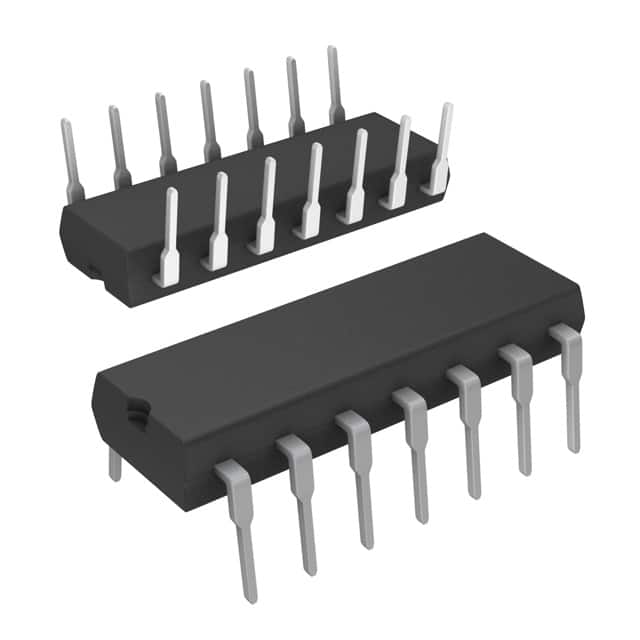
- Part No.:
- M74HC14B1R
- Manufacturer:
- STMicroelectronics
- Category:
- Gates and Inverters
- Package:
- 14-DIP (0.300", 7.62mm)
- Datasheet:
-
 M74HC14B1R.pdf
- Description:
- IC INVERT SCHMITT 6CH 1INP 14DIP
- Quantity:
- Payment:

- Shipping:

Inventory:1,472
Please send an inquiry. Send us your inquiry, and we will respond immediately.
Product details
Overview
M74HC14B1R from STMicroelectronics is a high-speed CMOS hex Schmitt trigger inverter in 14-pin DIP package, featuring 2V–6V operation, 12ns typical propagation delay at 6V, 1µA max quiescent current at 25°C, and 20% VCC input hysteresis. It serves as a noise-immune signal conditioner for slow-rising clock or sensor inputs in industrial control interfaces.
For engineers reviewing the M74HC14B1R datasheet, M74HC14B1R pinout, M74HC14B1R application, or M74HC14B1R equivalent, key selection criteria include hysteresis voltage (0.54–1.7V), symmetrical output drive (±4mA min), wide temperature range (–55°C to +125°C), and DIP-14 mechanical compatibility with legacy 74-series layouts.
Technical Context
The M74HC14B1R implements six independent Schmitt-trigger inverters using silicon gate C2MOS technology, each with fixed hysteresis thresholds (Vt+/Vt−) defined as percentages of VCC. Its input protection includes ESD and transient voltage clamping circuits.
Propagation delays are balanced (tPLH ≅ tPHL), and output impedance is symmetrical (|IOH| = IOL ≥ 4mA), enabling clean waveform shaping of slow or noisy digital signals without external components.
Key Specifications
| Parameter | Value and Actual Design Meaning |
|---|---|
| VCC Range | 2V to 6V - supports battery-powered and mixed-voltage logic systems |
| Propagation Delay | 12ns (typ.) at VCC = 6V - enables reliable timing in sub-50MHz edge-detection paths |
| Hysteresis Voltage | 0.54V (min) at 2V, up to 1.7V (max) at 6V - rejects noise spikes ≤500mV on slow edges |
| Output Drive | ±4mA (min) - sufficient to directly drive TTL loads or small capacitive buses |
| ICC Quiescent Current | 1µA (max) at 25°C - enables ultra-low-power standby in always-on monitoring circuits |
| Operating Temp | –55°C to +125°C - qualified for under-hood automotive and industrial ambient environments |
| Input Capacitance | 5pF (typ.) - minimizes loading on high-impedance sensor or crystal oscillator outputs |
Pinout & Package
Package: Plastic Dual In-line Package (DIP-14), 0.3" wide, through-hole mount, JEDEC MS-001 compliant.
| Pin/Terminal | Circuit Role | Design Meaning |
|---|---|---|
| 1, 3, 5, 9, 11, 13 | Input A1–A6 | Schmitt-triggered logic inputs with hysteresis; tolerate slow rise/fall times ≥100ns |
| 2, 4, 6, 8, 10, 12 | Output Y1–Y6 | Inverted, buffered outputs with symmetrical sourcing/sinking capability |
| 7 | GND | Logic ground reference; must be low-impedance connection for noise immunity |
| 14 | VCC | Positive supply rail; decoupling capacitor (100nF) required within 1cm |
Key Features
| Feature | Design Value |
|---|---|
| 20% VCC Input Hysteresis | Enables robust switching on noisy or slowly transitioning analog-like signals (e.g., thermistor comparators) |
| Pin-Compatible with 74HC04 | Direct drop-in replacement where Schmitt functionality is added without board redesign |
| ESD Protection Circuits | Withstands ±2kV HBM - eliminates need for external TVS diodes in moderate-noise environments |
| Low-Power CMOS Design | 1µA max ICC allows use in energy-harvesting nodes with microamp-level budget constraints |
Applications
| Industrial Sensor Interface | Legacy System Clock Conditioning |
|---|---|
Use Scenario: Converting slow-rising analog comparator outputs from temperature or pressure sensors into clean digital edges. IC Role / Device Role / Timing Role: Schmitt-trigger inverter acting as a noise-immune level shifter and edge former. Use Value: Eliminates multiple external RC filters; reduces BOM count by 3–4 passive components per channel. | Use Scenario: Cleaning up degraded clock signals from aging crystal oscillators or long PCB traces in PLC backplanes. IC Role / Device Role / Timing Role: Signal integrity conditioner restoring fast, monotonic edges for synchronous logic sampling. Use Value: Enables continued use of legacy 1–10MHz clock sources without redesigning timing paths. |
| Motor Control Feedback Debouncing | Automotive Wake-Up Signal Detection |
Use Scenario: Debouncing mechanical limit switch or encoder quadrature signals subject to contact bounce and EMI. IC Role / Device Role / Timing Role: Digital input conditioner with built-in hysteresis preventing false triggering during transients. Use Value: Achieves >10ms effective debounce without software polling or external RC networks. | Use Scenario: Detecting low-frequency wake-up pulses (e.g., LIN bus activity or door handle sensor events) in vehicle body controllers. IC Role / Device Role / Timing Role: Ultra-low-power input detector operating from 3.3V or 5V always-on rails. Use Value: Draws only 1µA quiescent current while maintaining full hysteresis sensitivity across –40°C to +125°C. |
Equivalent & Alternatives
The following parts are listed as comparable options for similar Schmitt inverter applications.
| Alternative Part | Technical Difference | Application Difference | Selection Advice |
|---|---|---|---|
| SN74HC14N | Same logic function and pinout; TI version rated for –40°C to +85°C only (not –55°C to +125°C) | Limited to commercial/industrial ambient; unsuitable for extended-temperature automotive or aerospace use | Select when cost sensitivity outweighs extended temperature requirement |
| 74LVC14APW | Lower VCC range (1.65–5.5V); higher speed (tPD = 5.2ns typ. at 3.3V); TSSOP-14 only | Requires PCB rework for surface-mount layout; incompatible with through-hole DIP footprints | Select for space-constrained, 3.3V-only designs requiring faster edge rates |
Compared with SN74HC14N and 74LVC14APW, M74HC14B1R uniquely combines extended temperature operation, DIP-14 through-hole compatibility, and ultra-low quiescent current - making it optimal for legacy-replacement and harsh-environment signal conditioning where footprint and power matter.
Availability
M74HC14B1R is available at Aetrix Electronics and suitable for industrial sensor interfaces, motor control feedback paths, automotive wake-up detection, and legacy system clock conditioning requiring stable component supply and long-term obsolescence management.
Supply support for M74HC14B1R includes scheduled delivery planning, volume procurement assistance, BOM continuity management, traceable sourcing, and lifecycle availability coordination for OEM customers, industrial embedded developers, connected-device designers, and electronics production programs.
Manufacturer
STMicroelectronics is a global semiconductor leader headquartered in Geneva, designing and manufacturing microcontrollers, power ICs, sensors, and analog/mixed-signal devices for industrial, automotive, and consumer markets.
The M74HC14 belongs to ST's high-speed CMOS logic family, engineered specifically for noise-immune digital interfacing in electrically hostile environments where signal integrity cannot be compromised.
FAQ
Is M74HC14B1R compatible with 5V TTL logic levels?
Yes - at VCC = 5V, its VOH is ≥4.4V and VOL is ≤0.26V under 4mA load, meeting TTL output swing requirements. Inputs accept TTL-high (≥2.0V) and TTL-low (≤0.8V) thresholds within hysteresis margins, ensuring interoperability without level shifters.
Can M74HC14B1R operate reliably at 2.0V supply?
Yes - it is fully specified down to 2.0V, with guaranteed Vt+ = 1.0V (min), Vt− = 0.3V (max), and propagation delay ≤190ns over –55°C to +125°C. This makes it suitable for single-cell Li-ion or 2xAA battery-powered systems.
What is the maximum capacitive load this device can drive?
Driving CL = 50pF is validated in AC specs (tPLH/tPHL measured at CL = 50pF). With symmetrical 4mA output drive, it can reliably drive up to ~100pF while maintaining <25ns additional delay - verified via typical CPD = 28pF and ICC(opr) modeling.
Does M74HC14B1R require external pull-up or pull-down resistors on unused inputs?
No - all six inputs have internal protection diodes and defined hysteresis thresholds. However, floating inputs must be avoided: unused channels should be tied to VCC or GND to prevent increased ICC and potential oscillation due to noise coupling into high-impedance Schmitt inputs.
M74HC14B1R Specifications
- Product attributes
- Attribute value
- Manufacturer:
- STMicroelectronics
- Series:
- 74HC
- Package/Case:
- 14-DIP (0.300", 7.62mm)
- Packaging:
- Tube
- Product Status:
- Obsolete
- Logic Type:
- Inverter
- Number of Circuits:
- 6
- Number of Inputs:
- 1
- Features:
- Schmitt Trigger
- Voltage - Supply:
- 2V ~ 6V
- Current - Quiescent (Max):
- 1 µA
- Current - Output High, Low:
- 5.2mA, 5.2mA
- Input Logic Level - Low:
- 0.3V ~ 1.5V
- Input Logic Level - High:
- 1.5V ~ 4.2V
- Max Propagation Delay @ V, Max CL:
- 21ns @ 6V, 50pF
- Operating Temperature:
- -55°C ~ 125°C
- Grade:
- -
- Qualification:
- -
- Mounting Type:
- Through Hole
- Supplier Device Package:
- 14-DIP
M74HC14B1R FAQ
1.How can I place an order for M74HC14B1R through Aetrix?
Please submit a Request for Quotation (RFQ) for M74HC14B1R on Aetrix. Our sales agent will provide a competitive quotation and guide you through the order confirmation once you accept the terms.
2.Are the price and stock information for M74HC14B1R reliable?
The price and inventory of M74HC14B1R are updated periodically and may fluctuate due to market conditions. Stock and pricing data are typically refreshed every 24 hours. Quotation validity for M74HC14B1R is usually 5 days.
3.What payment methods are accepted for M74HC14B1R?
We accept Wire Transfer, PayPal, Credit Card, Western Union, MoneyGram, and Escrow for M74HC14B1R transactions.
Note: Certain payment methods may incur a processing fee.
4.How is shipping managed for M74HC14B1R?
M74HC14B1R orders can be shipped via leading logistics carriers, including DHL, UPS, FedEx, TNT, or Registered Mail.
Once your M74HC14B1R order is processed, you will receive an email with the shipment details and tracking number.
Note: Tracking information may take up to 24 hours to appear. Express delivery typically takes 3–5 business days.
5.How can I obtain technical support or documentation for M74HC14B1R?
For technical support, including M74HC14B1R datasheets, pinout diagrams, or application guidance, please contact our engineering support team. They can provide detailed documentation and assistance for your M74HC14B1R requirements.
6.How does Aetrix verify that M74HC14B1R is sourced from the original manufacturer or authorized distributors?
All M74HC14B1R products on Aetrix are procured from qualified distributors and authorized channels. Our dedicated quality assurance team conducts strict verification, including traceability checks and, if necessary, third-party testing. This ensures that M74HC14B1R meets industry standards.
7.What is the process for return or replacement of M74HC14B1R?
All M74HC14B1R units undergo pre-shipment inspection (PSI). If there is an issue with M74HC14B1R, returns or replacements are accepted under the following conditions:
1.Quantity discrepancies, incorrect items, or visible external defects (such as breakage or corrosion), acknowledged by Aetrix.
2.The issue is reported within 90 days of delivery.
3.The M74HC14B1R part is unused and in its original packaging.
Return procedure for M74HC14B1R:
1.Submit a request within 90 days.
2.Obtain a Return Material Authorization (RMA) from Aetrix.
M74HC14B1R Tags

-
SN74LVC1G14DBVR
Texas Instruments
-
SN74LVC1G14DCKR
Texas Instruments
-
SN74AHC1G14DBVR
Texas Instruments
-
SN74LVC1G08DBVR
Texas Instruments
-
SN74LVC1G08DCKR
Texas Instruments
-
SN74LVC1G32DCKR
Texas Instruments
-
SN74LVC1G04DBVR
Texas Instruments
.jpg)
-
74LVC1G08GW,125
Nexperia USA Inc.
-
SN74LVC1G04DCKR
Texas Instruments
-
SN74AHC1G08DBVR
Texas Instruments
-
SN74LVC1G32DBVR
Texas Instruments
-
SN74AHCT1G08DBVR
Texas Instruments
Tech Hub
A D latch stores one bit while Enable controls when data can pass. This reference covers gate-level operation, truth tables, transparency, setup and hold timing, LE versus OE, common ICs and practical …
An SR latch stores one bit through cross-coupled feedback. This engineering reference covers NOR and NAND implementations, truth tables, forbidden-state recovery, gated operation, switch debouncing, fa…

Latch circuits retain one bit through feedback. This technical reference covers SR and D latches, truth tables, transparency, timing limits, latch-versus-flip-flop behavior, applications and common log…

An engineering guide to LED driver operation, constant-current and constant-voltage outputs, linear and switching topologies, dimming, IC selection, calculations, replacement compatibility, and fault c…

Operational amplifier guide covering op amp basics, feedback, ideal vs real op amps, common configurations, buffer circuits, offset, bias current, gain-bandwidth, slew rate, rail-to-rail limits and sel…

Jumper cables guide covering safe connection order, red and black clamp placement, final ground connection, cable gauge, length, clamp quality, copper vs CCA cables, jump starter comparison and battery…

LDO regulator guide covering low dropout voltage, power dissipation, thermal design, PSRR, output noise, capacitor stability, adjustable LDO circuits, LDO vs buck converter and datasheet selection chec…

Conditional Access Module guide covering CAM meaning, CI/CI+ interface, smart card authorization, DVB security workflow, TV and set-top box compatibility, internal electronics, ESD protection, connecto…

Guide to electronic component obsolescence covering EOL risk, PCN/PDN notices, last-time buy planning, replacement options, form-fit-function validation, counterfeit risk and BOM lifecycle management.

18650 battery guide covering lithium-ion cell basics, 3.6V/3.7V voltage, 4.2V charging, mAh and Wh capacity, protected cells, chargers, BMS, series-parallel packs, holders, welding and sourcing checks.…


