
 My Inquiry
 My Account


STMicroelectronics M74HC157RM13TR
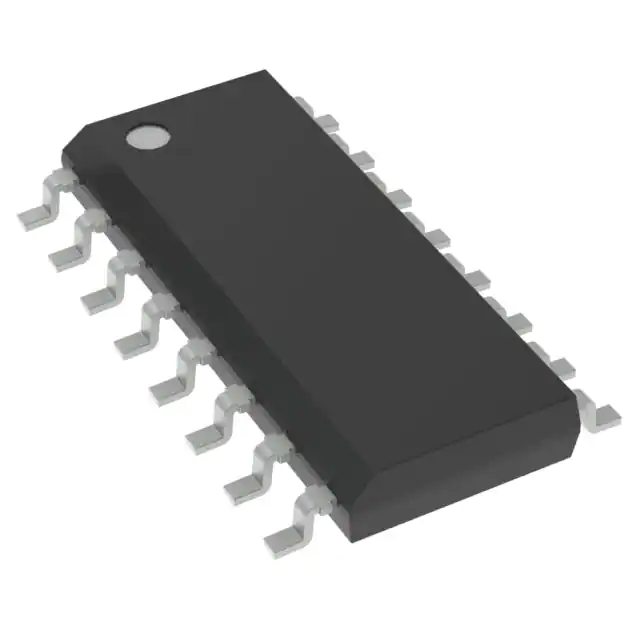
- Part No.:
- M74HC157RM13TR
- Manufacturer:
- STMicroelectronics
- Category:
- Signal Switches, Multiplexers, Decoders
- Package:
- 16-SOIC (0.154", 3.90mm Width)
- Datasheet:
-
 M74HC157RM13TR.pdf
- Description:
- IC MULTIPLEXER 4 X 2:1 16SO
- Quantity:
- Payment:

- Shipping:

Inventory:19,138
Please send an inquiry. Send us your inquiry, and we will respond immediately.
Product details
Overview
M74HC157RM13TR from STMicroelectronics is a high-speed CMOS quad 2-channel multiplexer with common select and strobe inputs, operating across 2V–6V supply, delivering 10ns typical propagation delay at 6V, ±4mA output drive, and 4µA max quiescent current at 25°C - used in digital logic routing for industrial control I/O expansion and embedded data path selection.
For engineers reviewing the M74HC157RM13TR datasheet, M74HC157RM13TR pinout, M74HC157RM13TR application, or M74HC157RM13TR equivalent, key considerations include its TSSOP-16 package compatibility, strobe-gated output enable behavior, symmetrical output impedance, wide VCC range, and pin/function equivalence with standard 74-series 157 devices.
Technical Context
The device implements four independent 2:1 digital multiplexers sharing one SELECT line and one active-low STROBE input; when STROBE is high, all Y outputs are forced low regardless of SELECT or A/B inputs. Selection is fully static - no clock required - and decoding is combinatorial: SELECT = L routes A inputs to Y, SELECT = H routes B inputs to Y.
Designed using silicon gate C2MOS technology, it features integrated ESD protection on all inputs, supports rail-to-rail input/output swing (0V to VCC), and maintains balanced tPLH/tPHL delays across temperature ranges - critical for glitch-free data switching in synchronous and asynchronous logic systems.
Key Specifications
| Parameter | Value and Actual Design Meaning |
|---|---|
| VCC Range | 2V to 6V - enables direct interface with 3.3V and 5V logic families without level shifters. |
| tPD (Typ.) | 10ns at VCC = 6V - ensures fast signal routing in timing-critical control paths. |
| IOL / IOH | ±4mA minimum - drives standard TTL/CMOS loads directly, including multiple fan-outs. |
| ICC (Max) | 4µA at TA = 25°C - supports ultra-low-power standby modes in battery-backed systems. |
| VNIH / VNIL | 28% VCC minimum - provides robust noise immunity against coupled transients on PCB traces. |
| Operating Temp | −55°C to +125°C - qualified for extended industrial and automotive under-hood environments. |
| CIN | 5pF typical - minimizes capacitive loading on driving gates, preserving signal edge integrity. |
Pinout & Package
TSSOP-16 (Thin Shrink Small Outline Package), 4.9mm × 6.4mm body, 0.65mm pitch, 16-pin surface-mount.
| Pin/Terminal | Circuit Role | Design Meaning |
|---|---|---|
| 1 | SELECT | Common control input determining whether A or B channel is routed to Y outputs. |
| 2,5,11,14 | 1A–4A | Data inputs from Source A; tied to first operand in dual-source selection logic. |
| 3,6,10,13 | 1B–4B | Data inputs from Source B; second operand for multiplexed data path selection. |
| 4,7,9,12 | 1Y–4Y | Active-high CMOS outputs reflecting selected A or B input per channel. |
| 15 | STROBE | Active-high global enable: high forces all Y outputs low, overriding SELECT state. |
| 8 | GND | Reference ground node for logic thresholds and power return path. |
| 16 | VCC | Positive supply rail; powers internal logic and output drivers across full 2–6V range. |
Key Features
| Feature | Design Value |
|---|---|
| Pin & function compatibility with 74LS157/74HC157 | Drop-in replacement for legacy designs without layout or firmware changes. |
| Symmetrical output impedance (|IOH| = IOL) | Ensures matched rise/fall times and reduces duty cycle distortion in clock/data distribution. |
| Balanced propagation delays (tPLH ≅ tPHL) | Minimizes skew between rising/falling edges - essential for clean bus arbitration signals. |
| Input protection circuits | Integrated diodes suppress ESD events up to ±2kV (HBM), reducing external TVS requirements. |
| Wide VCC range with stable VIH/VIL thresholds | Supports mixed-voltage system integration while maintaining consistent logic thresholds. |
Applications
| Industrial PLC I/O Expansion | Embedded Microcontroller Data Bus Switching |
|---|---|
Use Scenario: Routing sensor inputs or actuator command lines among multiple microcontrollers in modular control cabinets. IC Role / Device Role / Timing Role: Quad 2:1 multiplexer enabling dynamic reconfiguration of analog/digital I/O channels without hardware rewiring. Use Value: Reduces board count and connector complexity by consolidating four independent selection paths into one TSSOP-16 IC. | Use Scenario: Selecting between two memory-mapped peripheral banks (e.g., debug vs. production firmware registers) on an MCU bus. IC Role / Device Role / Timing Role: Address/data path selector controlled by GPIO or dedicated control lines, with strobe-based blanking during bus transitions. Use Value: Enables safe, glitch-free bank switching via synchronized STROBE assertion - prevents partial address latching. |
| Digital Test Equipment Signal Gating | Legacy System Logic Emulation |
Use Scenario: Enabling/disabling test signal injection points across four parallel DUT interfaces during automated functional testing. IC Role / Device Role / Timing Role: Strobe-controlled gating element that isolates test vectors from DUT until valid setup time is met. Use Value: Eliminates need for discrete AND gates and timing buffers - simplifies test fixture design and improves repeatability. | Use Scenario: Replacing obsolete 74LS157 in vintage computer repair or retro-computing hardware upgrades. IC Role / Device Role / Timing Role: Pin-compatible logic function replacement with lower power, higher speed, and wider voltage tolerance. Use Value: Restores reliability and extends service life without modifying PCB layout or firmware timing assumptions. |
Equivalent & Alternatives
The following parts are listed as comparable options for similar quad 2:1 multiplexer applications.
| Alternative Part | Technical Difference | Application Difference | Selection Advice |
|---|---|---|---|
| SN74HC157DR | Same logic function, SOIC-16 package; slightly higher ICC (8µA typ.), identical AC specs. | Requires PCB footprint change; better thermal dissipation but larger board area. | Preferred where manual assembly or thermal margin is prioritized over space constraints. |
| 74LVC157PW | 3.3V-only operation (1.65–3.6V); faster tPD (5.5ns typ. at 3.3V); lower drive (±24mA). | Not suitable for 5V systems; requires level translation if interfacing with 5V peripherals. | Select only in pure 3.3V domains needing higher speed and lower capacitance. |
Compared with SN74HC157DR and 74LVC157PW, the M74HC157RM13TR uniquely balances 2–6V operation, TSSOP-16 compactness, and proven industrial temperature resilience - making it optimal for space-constrained, mixed-voltage embedded controllers.
Availability
M74HC157RM13TR is available at Aetrix Electronics and suitable for industrial PLC I/O expansion, embedded microcontroller data bus switching, and digital test equipment signal gating requiring stable component supply across long-lifecycle programs.
Supply support for M74HC157RM13TR includes scheduled delivery planning, volume procurement assistance, BOM continuity management, traceable sourcing, and lifecycle availability coordination for OEM customers, industrial embedded developers, connected-device designers, and electronics production programs.
Manufacturer
STMicroelectronics is a global semiconductor leader headquartered in Geneva, designing and manufacturing microcontrollers, power management ICs, sensors, and analog/mixed-signal products for industrial, automotive, and consumer markets.
The M74HC157 belongs to ST's high-speed HC logic family - engineered for pin-compatible upgrades of legacy TTL designs while delivering lower power, wider voltage range, and enhanced noise immunity in industrial control and instrumentation.
FAQ
Is M74HC157RM13TR compatible with 5V TTL logic levels?
Yes - with VCC = 5V, its VIH (≥3.15V) and VIL (≤1.35V) thresholds exceed standard TTL input requirements, and its VOH/VOL meet TTL output drive specifications at ±4mA. No level-shifting circuitry is needed for direct interface with 74LS or 74F series devices.
What happens to outputs when STROBE is high?
When STROBE is high, all four Y outputs are forced low regardless of the state of SELECT or the A/B inputs. This overrides normal multiplexer operation and provides a synchronous disable function - useful for bus isolation or glitch suppression during state transitions.
Does M74HC157RM13TR require external pull-up or pull-down resistors?
No - all inputs have defined logic thresholds and internal protection diodes; no external biasing is required. However, floating inputs must be avoided: unconnected SELECT or STROBE pins may cause undefined output states due to noise coupling, so tie unused controls to VCC or GND.
Can this device operate reliably at −40°C ambient temperature?
Yes - the device is fully specified from −55°C to +125°C ambient, with validated DC and AC performance across that range. At −40°C, propagation delays increase by ≤25% versus 25°C values, and output drive remains ≥±4mA, ensuring robust operation in cold-environment industrial deployments.
M74HC157RM13TR Specifications
- Product attributes
- Attribute value
- Manufacturer:
- STMicroelectronics
- Series:
- 74HC
- Package/Case:
- 16-SOIC (0.154", 3.90mm Width)
- Packaging:
- Tape & Reel (TR)
- Product Status:
- Obsolete
- Type:
- Multiplexer
- Circuit:
- 4 x 2:1
- Independent Circuits:
- 1
- Current - Output High, Low:
- 5.2mA, 5.2mA
- Voltage Supply Source:
- Single Supply
- Voltage - Supply:
- 2V ~ 6V
- Operating Temperature:
- -55°C ~ 125°C
- Grade:
- -
- Qualification:
- -
- Mounting Type:
- Surface Mount
- Supplier Device Package:
- 16-SO
M74HC157RM13TR FAQ
1.How can I place an order for M74HC157RM13TR through Aetrix?
Please submit a Request for Quotation (RFQ) for M74HC157RM13TR on Aetrix. Our sales agent will provide a competitive quotation and guide you through the order confirmation once you accept the terms.
2.Are the price and stock information for M74HC157RM13TR reliable?
The price and inventory of M74HC157RM13TR are updated periodically and may fluctuate due to market conditions. Stock and pricing data are typically refreshed every 24 hours. Quotation validity for M74HC157RM13TR is usually 5 days.
3.What payment methods are accepted for M74HC157RM13TR?
We accept Wire Transfer, PayPal, Credit Card, Western Union, MoneyGram, and Escrow for M74HC157RM13TR transactions.
Note: Certain payment methods may incur a processing fee.
4.How is shipping managed for M74HC157RM13TR?
M74HC157RM13TR orders can be shipped via leading logistics carriers, including DHL, UPS, FedEx, TNT, or Registered Mail.
Once your M74HC157RM13TR order is processed, you will receive an email with the shipment details and tracking number.
Note: Tracking information may take up to 24 hours to appear. Express delivery typically takes 3–5 business days.
5.How can I obtain technical support or documentation for M74HC157RM13TR?
For technical support, including M74HC157RM13TR datasheets, pinout diagrams, or application guidance, please contact our engineering support team. They can provide detailed documentation and assistance for your M74HC157RM13TR requirements.
6.How does Aetrix verify that M74HC157RM13TR is sourced from the original manufacturer or authorized distributors?
All M74HC157RM13TR products on Aetrix are procured from qualified distributors and authorized channels. Our dedicated quality assurance team conducts strict verification, including traceability checks and, if necessary, third-party testing. This ensures that M74HC157RM13TR meets industry standards.
7.What is the process for return or replacement of M74HC157RM13TR?
All M74HC157RM13TR units undergo pre-shipment inspection (PSI). If there is an issue with M74HC157RM13TR, returns or replacements are accepted under the following conditions:
1.Quantity discrepancies, incorrect items, or visible external defects (such as breakage or corrosion), acknowledged by Aetrix.
2.The issue is reported within 90 days of delivery.
3.The M74HC157RM13TR part is unused and in its original packaging.
Return procedure for M74HC157RM13TR:
1.Submit a request within 90 days.
2.Obtain a Return Material Authorization (RMA) from Aetrix.
M74HC157RM13TR Tags

-
SN74HC138DR
Texas Instruments
-
TC7SB3157CFU,LF(CT
Toshiba Semiconductor and Storage
-
74CBTLV3257PW,118
Nexperia USA Inc.

-
SN74CBTLV3257PWR
Texas Instruments
-
74CBTLV3257GUX
Nexperia USA Inc.
-
74HC154BQ,118
Nexperia USA Inc.

-
P3S0200GMX
NXP USA Inc.
-
SN74CB3Q3245PWR
Texas Instruments
-
SN74CB3Q3257RGYR
Texas Instruments
-
TCA9543APWR
Texas Instruments
-
TCA9546APWR
Texas Instruments
-
SN74HC138N
Texas Instruments
Tech Hub

A practical engineering and sourcing framework covering lifecycle verification, lifetime-buy calculations, replacement qualification, supplier checks and counterfeit-risk controls.

TTL and CMOS logic families differ in thresholds, loading, output drive, power and timing. This engineering guide compares 74HC and 74HCT, calculates noise margins and checks 3.3 V/5 V compatibility.

A practical engineering guide to 3.3V and 5V logic compatibility, input thresholds, resistor dividers, translator ICs, MOSFET level shifting, I2C pull-ups, timing limits and power-sequencing risks.

The 74HC595 uses push-pull logic outputs, while the TPIC6B595 uses 50 V open-drain DMOS sinks for higher-power loads. This guide compares timing, current limits, 3.3 V interfacing, load wiring, thermal…

The 74HC595 converts serial data into eight stable parallel outputs. This guide covers pin functions, shift and storage timing, OE and MR behavior, drive-current limits, cascading, voltage compatibilit…

A technical comparison of level-sensitive latches and edge-triggered flip-flops, covering timing windows, setup and hold limits, master–slave operation, time borrowing, race-through, HDL inference and…

A D latch stores one bit while Enable controls when data can pass. This reference covers gate-level operation, truth tables, transparency, setup and hold timing, LE versus OE, common ICs and practical …

An SR latch stores one bit through cross-coupled feedback. This engineering reference covers NOR and NAND implementations, truth tables, forbidden-state recovery, gated operation, switch debouncing, fa…

Latch circuits retain one bit through feedback. This technical reference covers SR and D latches, truth tables, transparency, timing limits, latch-versus-flip-flop behavior, applications and common log…

An engineering guide to LED driver operation, constant-current and constant-voltage outputs, linear and switching topologies, dimming, IC selection, calculations, replacement compatibility, and fault c…


