
 My Inquiry
 My Account


STMicroelectronics M74HC280B1R
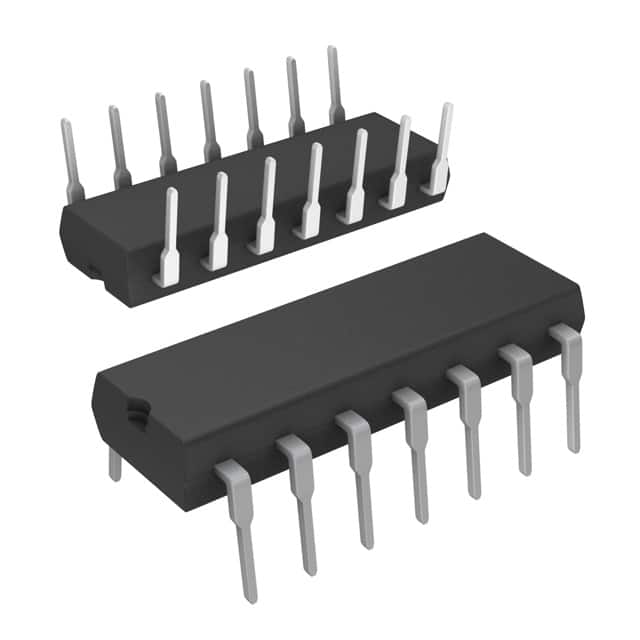
- Part No.:
- M74HC280B1R
- Manufacturer:
- STMicroelectronics
- Category:
- Parity Generators and Checkers
- Package:
- 14-DIP (0.300", 7.62mm)
- Datasheet:
-
 M74HC280B1R.pdf
- Description:
- IC PARITY GENERATOR 9-BIT 14DIP
- Quantity:
- Payment:

- Shipping:

Inventory:1,123
Please send an inquiry. Send us your inquiry, and we will respond immediately.
Product details
Overview
M74HC280B1R from STMicroelectronics is a high-speed CMOS 9-bit parity generator IC with symmetrical output impedance (|IOH| = IOL ≥ 4 mA), propagation delay of 22 ns (typ. at VCC = 6 V), and wide supply range (2–6 V). It implements odd/even parity encoding across nine data inputs (A–I) for error detection in serial/parallel data transmission systems, memory controllers, and bus integrity monitoring.
For engineers reviewing the M74HC280B1R datasheet, M74HC280B1R pinout, M74HC280B1R application, or M74HC280B1R equivalent, key selection criteria include its dual ΣODD/ΣEVEN outputs, NC pin handling, TTL-compatible logic thresholds, and DIP-14 package compatibility with legacy 74-series layouts.
Technical Context
The M74HC280B1R performs real-time combinatorial parity computation using silicon gate C2MOS technology, delivering balanced tPLH ≅ tPHL delays and high noise immunity (VNIH/VNIL ≥ 28% VCC). Its input structure includes integrated ESD protection diodes and clamping circuits compliant with ±20 mA DC input diode current limits.
It operates across industrial temperature range (−55°C to +125°C) with quiescent ICC ≤ 4 µA at 25°C and supports cascading for extended word-length parity generation. Output drive capability is specified at −4.0 mA (VOH) and +4.0 mA (VOL) under 4.5 V supply.
Key Specifications
| Parameter | Value and Actual Design Meaning |
|---|---|
| VCC Range | 2 V to 6 V - Enables direct interface with 3.3 V and 5 V logic domains without level shifters. |
| tPD (Typ.) | 22 ns at VCC = 6 V - Supports >20 MHz parity checking in synchronous data paths. |
| IOL / IOH | ≥ 4 mA - Drives standard TTL loads and multiple CMOS inputs without buffering. |
| VNIH / VNIL | ≥ 28% VCC - Rejects noise spikes up to 1.68 V (at 6 V) on data lines. |
| ICC (Max) | 40 µA at −40°C to +85°C - Suitable for low-power battery-backed parity verification. |
| Operating Temp | −55°C to +125°C - Qualified for automotive engine control and industrial PLC applications. |
| CIN | 10 pF max - Limits capacitive loading on upstream drivers in high-speed buses. |
Pinout & Package
Package: Plastic DIP-14 (dual in-line package, 0.3" width), compliant with JEDEC MS-001. Pin 3 is NC (no internal connection); all other pins are electrically active.
| Pin/Terminal | Circuit Role | Design Meaning |
|---|---|---|
| 1, 2, 4, 5, 6, 8–13 | A–I, ΣEVEN, ΣODD | Nine data inputs (A–I) and two complementary parity outputs - enables single-cycle parity decision per clock edge. |
| 3 | NC | No internal connection - must remain unconnected; floating or tied to GND/VCC causes no functional impact. |
| 7 | GND | Reference ground for all input thresholds and output voltage levels - requires low-impedance PCB return path. |
| 14 | VCC | Positive supply rail - decoupling capacitor (100 nF ceramic) required within 10 mm of this pin. |
Key Features
| Feature | Design Value |
|---|---|
| 9-bit parity generation | Simultaneous ΣODD and ΣEVEN outputs reduce external logic count in fault-tolerant designs. |
| Pin/function compatibility with 74 series | Direct drop-in replacement for obsolete TTL 74280 in legacy repair and upgrade scenarios. |
| Input ESD protection | Withstands ≥2 kV HBM - eliminates need for external TVS diodes in board-level ESD zones. |
| Cascadable architecture | Multiple M74HC280B1R units can generate parity over 18+ bit words via ΣODD/ΣEVEN chaining. |
Applications
| Memory Data Integrity | Industrial Serial Bus |
|---|---|
Use Scenario: Detecting single-bit errors in SRAM/ROM read cycles during boot-up or runtime diagnostics. IC Role / Device Role / Timing Role: Combinatorial parity encoder generating real-time ΣODD/ΣEVEN flags synchronized to memory address strobes. Use Value: Enables fail-fast detection before corrupted data propagates to CPU registers or DMA buffers. | Use Scenario: Validating packet payloads in Modbus RTU or Profibus DP slave nodes operating in noisy factory environments. IC Role / Device Role / Timing Role: Standalone parity generator inserted between UART TX buffer and line driver to enforce even/odd framing rules. Use Value: Reduces firmware overhead by offloading parity calculation from microcontroller, freeing CPU cycles for protocol stack processing. |
| Legacy System Upgrade | Avionics Data Link |
Use Scenario: Replacing failed 74LS280 in aging military comms equipment where RoHS compliance and extended temp range are mandatory. IC Role / Device Role / Timing Role: Direct-pin-compatible CMOS upgrade preserving existing PCB layout and timing margins. Use Value: Eliminates thermal runaway risk of original TTL part while maintaining identical functional behavior and test vectors. | Use Scenario: Ensuring bit-level reliability in ARINC 429 transmitter modules where deterministic latency is critical. IC Role / Device Role / Timing Role: Fixed-delay parity generator placed in the data path prior to Manchester encoding stage. Use Value: Guarantees <22 ns worst-case added latency (at 6 V), meeting ARINC 429 timing budget for 100 kbps operation. |
Equivalent & Alternatives
The following parts are listed as comparable options for similar 9-bit parity generator applications.
| Alternative Part | Technical Difference | Application Difference | Selection Advice |
|---|---|---|---|
| SN74HC280N | Same logic function, identical pinout, but TI's version specifies tPD = 23 ns (typ.) and ICC = 2 µA (max) at 25°C. | Qualified to AEC-Q100 Grade 2; better suited for automotive under-hood use cases requiring −40°C to +105°C operation. | Select when automotive qualification or lower quiescent current is prioritized over ST's wider −55°C rating. |
| 74VHC280N | Higher speed (tPD = 10.5 ns typ. at 5 V), but reduced noise margin (VNIH = 20% VCC) and narrower VCC range (2–5.5 V). | Optimized for high-frequency backplane parity checks where propagation delay dominates over noise immunity. | Select only if system clock exceeds 30 MHz and noise environment is controlled (e.g., shielded rack-mounted systems). |
Compared with SN74HC280N and 74VHC280N, the M74HC280B1R offers the widest temperature range (−55°C to +125°C) and highest noise immunity (28% VCC), making it optimal for aerospace, energy, and extreme-environment industrial deployments where reliability trumps marginal speed gains.
Availability
M74HC280B1R is available at Aetrix Electronics and suitable for memory integrity verification, industrial serial bus validation, and legacy system upgrades requiring stable component supply and long-term obsolescence management.
Supply support for M74HC280B1R includes scheduled delivery planning, volume procurement assistance, BOM continuity management, traceable sourcing, and lifecycle availability coordination for OEM customers, industrial embedded developers, connected-device designers, and electronics production programs.
Manufacturer
STMicroelectronics is a global semiconductor leader headquartered in Geneva, Switzerland, designing and manufacturing analog, digital, and mixed-signal ICs for automotive, industrial, and power applications.
The M74HC280B1R belongs to ST's high-speed HC logic family, engineered specifically for robust, low-power, pin-compatible replacements of legacy 74-series TTL components in mission-critical infrastructure.
FAQ
Is Pin 3 (NC) safe to tie to GND or VCC?
No. Pin 3 is internally unconnected with no bond wire or die attachment. Connecting it to GND or VCC introduces no benefit and risks unintended coupling through package parasitics. STMicroelectronics explicitly states it must remain floating or be left unpopulated on the PCB.
Can M74HC280B1R operate reliably at 2.0 V supply?
Yes. The device is fully specified down to 2.0 V, with VOH ≥ 1.9 V and VOL ≤ 0.1 V at 20 µA load. Propagation delay increases to 200 ns (max), but functionality remains guaranteed across the full −55°C to +125°C range per datasheet Section 4.
What is the maximum fan-out when driving other 74HC inputs?
At VCC = 4.5 V, the M74HC280B1R can drive ≥10 standard 74HC inputs (each drawing ≤ 1 µA) while maintaining VOH ≥ 4.18 V and VOL ≤ 0.26 V. Fan-out drops to ~7 at VCC = 2.0 V due to reduced output voltage swing.
Does the NC pin affect thermal performance or package stress?
No. Mechanical data (Page 6) confirms the DIP-14 package uses standard leadframe construction with no internal connection to Pin 3. Thermal resistance (θJA) and solder joint reliability are unaffected whether Pin 3 is left unpopulated, capped with solder mask, or omitted from stencil design.
M74HC280B1R Specifications
- Product attributes
- Attribute value
- Manufacturer:
- STMicroelectronics
- Series:
- 74HC
- Package/Case:
- 14-DIP (0.300", 7.62mm)
- Packaging:
- Tube
- Product Status:
- Obsolete
- Logic Type:
- Parity Generator
- Number of Circuits:
- 9-Bit
- Current - Output High, Low:
- 5.2mA, 5.2mA
- Voltage - Supply:
- 2 V ~ 6 V
- Operating Temperature:
- -55°C ~ 125°C
- Grade:
- -
- Qualification:
- -
- Mounting Type:
- Through Hole
- Supplier Device Package:
- 14-DIP
M74HC280B1R FAQ
1.How can I place an order for M74HC280B1R through Aetrix?
Please submit a Request for Quotation (RFQ) for M74HC280B1R on Aetrix. Our sales agent will provide a competitive quotation and guide you through the order confirmation once you accept the terms.
2.Are the price and stock information for M74HC280B1R reliable?
The price and inventory of M74HC280B1R are updated periodically and may fluctuate due to market conditions. Stock and pricing data are typically refreshed every 24 hours. Quotation validity for M74HC280B1R is usually 5 days.
3.What payment methods are accepted for M74HC280B1R?
We accept Wire Transfer, PayPal, Credit Card, Western Union, MoneyGram, and Escrow for M74HC280B1R transactions.
Note: Certain payment methods may incur a processing fee.
4.How is shipping managed for M74HC280B1R?
M74HC280B1R orders can be shipped via leading logistics carriers, including DHL, UPS, FedEx, TNT, or Registered Mail.
Once your M74HC280B1R order is processed, you will receive an email with the shipment details and tracking number.
Note: Tracking information may take up to 24 hours to appear. Express delivery typically takes 3–5 business days.
5.How can I obtain technical support or documentation for M74HC280B1R?
For technical support, including M74HC280B1R datasheets, pinout diagrams, or application guidance, please contact our engineering support team. They can provide detailed documentation and assistance for your M74HC280B1R requirements.
6.How does Aetrix verify that M74HC280B1R is sourced from the original manufacturer or authorized distributors?
All M74HC280B1R products on Aetrix are procured from qualified distributors and authorized channels. Our dedicated quality assurance team conducts strict verification, including traceability checks and, if necessary, third-party testing. This ensures that M74HC280B1R meets industry standards.
7.What is the process for return or replacement of M74HC280B1R?
All M74HC280B1R units undergo pre-shipment inspection (PSI). If there is an issue with M74HC280B1R, returns or replacements are accepted under the following conditions:
1.Quantity discrepancies, incorrect items, or visible external defects (such as breakage or corrosion), acknowledged by Aetrix.
2.The issue is reported within 90 days of delivery.
3.The M74HC280B1R part is unused and in its original packaging.
Return procedure for M74HC280B1R:
1.Submit a request within 90 days.
2.Obtain a Return Material Authorization (RMA) from Aetrix.
M74HC280B1R Tags
-
74HCT280D,653
Nexperia USA Inc.
-
M74HC280YRM13TR
STMicroelectronics
-
SN74F280BNSR
Texas Instruments
-
SN74AS280N
Texas Instruments
-
SN74F280BDR
Texas Instruments
-
SN74F280BN
Texas Instruments
-
74HC280D,653
Nexperia USA Inc.

-
74HCT280PWJ
Nexperia USA Inc.
-
SN74LS280N
Texas Instruments
-
SN74LS280M
onsemi
-
MC74F280D
onsemi
-
MC74F280DR2
onsemi
Tech Hub

Operational amplifier guide covering op amp basics, feedback, ideal vs real op amps, common configurations, buffer circuits, offset, bias current, gain-bandwidth, slew rate, rail-to-rail limits and sel…

Jumper cables guide covering safe connection order, red and black clamp placement, final ground connection, cable gauge, length, clamp quality, copper vs CCA cables, jump starter comparison and battery…

LDO regulator guide covering low dropout voltage, power dissipation, thermal design, PSRR, output noise, capacitor stability, adjustable LDO circuits, LDO vs buck converter and datasheet selection chec…

Conditional Access Module guide covering CAM meaning, CI/CI+ interface, smart card authorization, DVB security workflow, TV and set-top box compatibility, internal electronics, ESD protection, connecto…

Guide to electronic component obsolescence covering EOL risk, PCN/PDN notices, last-time buy planning, replacement options, form-fit-function validation, counterfeit risk and BOM lifecycle management.

18650 battery guide covering lithium-ion cell basics, 3.6V/3.7V voltage, 4.2V charging, mAh and Wh capacity, protected cells, chargers, BMS, series-parallel packs, holders, welding and sourcing checks.…

Hall effect sensor guide covering working principle, linear and digital sensors, Arduino circuits, current sensing, speed detection, automotive applications, A3144 examples, signal filtering and datash…

Product Change Notification guide for electronic components, covering PCN meaning, PCN vs PDN/EOL, common change types, risk levels, form-fit-function review, engineering validation, BOM control, LTB/L…

A practical guide to blend door actuators, covering HVAC function, symptoms, location, AC and heater issues, reset and calibration, replacement cost, electrical diagnosis, compatibility checks, and rep…

Engineering guide to Raspberry Pi alternatives, covering chip-level differences, Orange Pi, ROCK, Jetson, Banana Pi, NanoPi, Compute Module, Pico, GPIO, camera, HAT compatibility, and replacement risks…


