
 My Inquiry
 My Account


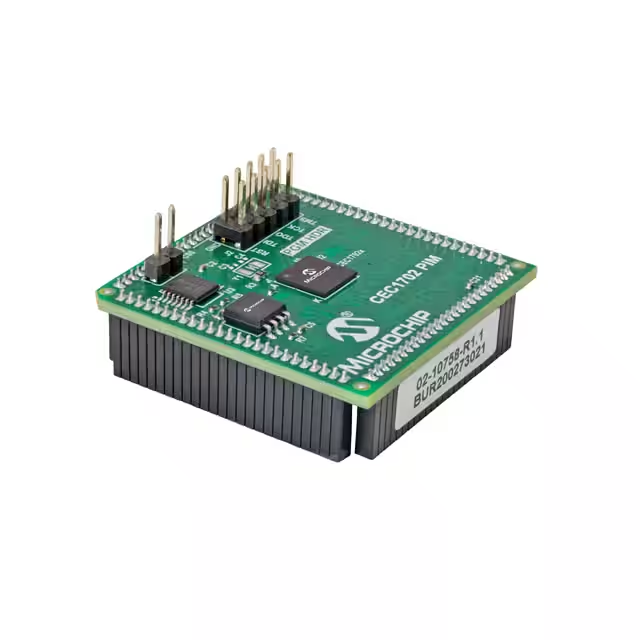
Microchip Technology MA990004
- Part No.:
- MA990004
- Manufacturer:
- Microchip Technology
- Category:
- Accessories
- Package:
- Datasheet:
-
 MA990004.pdf
- Description:
- CEC1702Q-B2 PLUG-IN MODULE
- Quantity:
- Payment:

- Shipping:

Inventory:2,436
Please send an inquiry. Send us your inquiry, and we will respond immediately.
Product details
Overview
MA990004 from Microchip Technology is the CEC1702 cryptographic embedded controller, an ARM Cortex-M4F-based secure EC designed for IoT platform management. It integrates hardware AES/SHA/RSA engines, 480KB SRAM, RTC with VBAT backup, dual I2C/SMBus controllers, and 65 GPIOs-all operating at 1.8V/3.3V. Used in server baseboard management controllers (BMC) and industrial IoT gateways for secure firmware boot and sensor telemetry aggregation.
For engineers reviewing the MA990004 datasheet, MA990004 pinout, MA990004 application, or MA990004 equivalent, key selection criteria include its VBAT-powered RTC and alarm timers, hardware root-of-trust via secure boot ROM, 84-pin WFBGA package with 1.8V GPIO compatibility, and integrated TACH/PWM fan control for thermal management in headless embedded systems.
Technical Context
The MA990004 implements a 32-bit ARM v7-M architecture with hardware FPU, NVIC supporting 240 interrupt sources and 8 priority levels, and chip-level interrupt aggregator to extend vector count. Its memory subsystem includes 416KB code SRAM and 64KB data SRAM, plus 128-byte battery-backed RAM accessible during deep sleep on 32.768 kHz clock.
Security is enforced through dedicated hardware engines: AES-128/192/256 with DMA interface, SHA-1/256/512 hash engine, RSA up to 4096-bit and ECC up to 640-bit, TRNG, monotonic counter, and immutable Boot ROM with SPI flash authentication. All cryptographic operations execute independently of the CPU core.
Key Specifications
| Parameter | Value and Actual Design Meaning |
|---|---|
| CPU Core | ARM Cortex-M4F with hardware FPU and bit-banding support |
| SRAM | 480KB total (416KB code + 64KB data), configurable per block |
| VBAT RAM | 128 bytes retained during system suspend using VBAT power plane |
| Crypto Engines | Dedicated AES/SHA/RSA/ECC engines with DMA access to SRAM |
| Real-Time Clock | VBAT-powered RTC with calendar, alarms, leap year, and daylight savings support |
| I2C Controllers | Four independent host controllers, each supporting multi-master, clock stretching, and 1 MHz max speed |
| GPIO Count | 65 programmable I/O pins, all 1.8V-capable with glitch protection and drive strength control |
| Package | 84-pin WFBGA, RoHS-compliant, 0.5 mm pitch |
Pinout & Package
MA990004 is housed in an 84-pin Wafer-Level Fine-Pitch Ball Grid Array (WFBGA) package with 0.5 mm pitch, optimized for space-constrained embedded platforms requiring low-profile mounting and thermal efficiency. Pin functions are multiplexed across GPIO, peripheral, and power domains, with default states defined per signal type (e.g., BGPO0 defaults to O2ma-Low).
| Pin/Terminal | Circuit Role | Design Meaning |
|---|---|---|
| B1 | Battery-GPO Output 0 (BGPO0) | VBAT-powered output active during deepest sleep; glitch-protected, defaults low |
| A5 | VCI_IN1# | Active-low VBAT-powered control interface input; functional even when configured as GPIO |
| D5 | VBAT | Primary standby power rail for RTC, VBAT RAM, and wake-up circuitry |
| A1 | VCI_OUT | VBAT-powered control interface output; drives high by default during reset |
| F2–H1 | ADC00–ADC04 | Five 10-bit analog inputs with ±1.5 LSB INL; share VREF_ADC and VSS_ADC rails |
| K10–J9 | PWM0–PWM1 | Two of seven 16-bit PWM outputs; support inverted polarity and flexible clock rates |
| F3–E2 | FAN_TACH0–FAN_TACH1 | Dual tachometer inputs for RPM measurement; paired with PWM0–PWM1 for closed-loop fan control |
| D9–E9 | UART0_TX–UART0_RX | Full-duplex 16C550-compatible UART; supports main or standby power operation |
Key Features
| Feature | Design Value |
|---|---|
| Secure Boot ROM | Hardware root-of-trust authenticates AES-256 encrypted SPI flash images before execution |
| VBAT-Powered Subsystem | RTC, week timer, alarm interfaces, and 128-byte RAM remain active during full system suspend |
| Hibernation Timer | Two 32.768 kHz timers enable wake-up intervals from 0.5 ms to 128 minutes |
| Keyboard Scan Matrix | 13×8 interrupt-capable scan engine replaces discrete GPIOs; supports push-pull drive |
| Breathing/Blinking LED Control | Two independent LED interfaces with piecewise-linear brightness curves and 8-bit PWM |
| RC_ID Detection | Two single-pin resistor/capacitor identification ports providing 8 quantized states per pin |
Applications
| Server Baseboard Management | Industrial IoT Gateway |
|---|---|
Use Scenario: Monitoring CPU temperature, fan speed, and power supply status in rack-mounted servers. IC Role / Device Role / Timing Role: Embedded controller managing BMC-side telemetry, executing secure firmware updates, and triggering hardware resets via RESETI#. Use Value: Hardware-accelerated AES/SHA ensures authenticated firmware loading; VBAT-powered RTC maintains time across AC loss; dual TACH/PWM enables precise thermal regulation without host CPU involvement. |
Use Scenario: Aggregating sensor data from Modbus RTU field devices and forwarding via cellular/Wi-Fi to cloud platforms. IC Role / Device Role / Timing Role: Secure edge node controller handling protocol translation, local policy enforcement, and encrypted data buffering during network outages. Use Value: 65 GPIOs support mixed-signal interfacing; 10-bit ADC channels digitize analog sensor outputs; secure boot prevents unauthorized firmware injection during remote OTA updates. |
| Smart Building HVAC Controller | Medical Device Power Supervisor |
Use Scenario: Regulating HVAC fan speeds based on CO₂ and temperature readings while logging runtime statistics. IC Role / Device Role / Timing Role: Real-time thermal manager coordinating PWM fan outputs, ADC sampling, and RTC-stamped event logging. Use Value: Breathing LED interface provides intuitive status indication; hibernation timer schedules low-power sensor polling; I2C controllers communicate with environmental sensors without host intervention. |
Use Scenario: Ensuring safe power sequencing and battery-backed timekeeping in portable diagnostic equipment. IC Role / Device Role / Timing Role: Critical safety monitor asserting RESETI# on voltage fault, maintaining accurate time via VBAT RTC, and storing last-event timestamp in battery-backed RAM. Use Value: Glitch-protected BGPO0 drives external watchdog enable; VCI_IN# inputs detect emergency shutdown signals; 128-byte VBAT RAM preserves critical fault logs across main power failure. |
Equivalent & Alternatives
The following parts are listed as comparable options for similar embedded controller applications.
| Alternative Part | Technical Difference | Application Difference | Selection Advice |
|---|---|---|---|
| CEC1702-84 | Same die, identical feature set and pinout; MA990004 is Microchip's orderable part number for CEC1702-84 WFBGA variant | No functional difference; used interchangeably in BOMs and layout | Select MA990004 for guaranteed traceability and Aetrix stocking availability |
| STM32L4A6VGT6 | Lacks hardware crypto accelerators (AES/SHA/RSA), no VBAT RTC or hibernation timer; 100-pin LQFP vs. 84-pin WFBGA | Suitable for non-security-critical sensor nodes where software crypto suffices and board space allows larger package | Choose only if cryptographic offload and ultra-low-power suspend timing are not required |
Compared with CEC1702-84, MA990004 offers identical functionality and footprint but with Aetrix's supply chain assurance; versus STM32L4A6VGT6, it delivers hardware-enforced security, deeper sleep modes, and integrated fan/thermal control-critical for infrastructure-class embedded systems.
Availability
MA990004 is available at Aetrix Electronics and suitable for server BMCs, industrial gateways, smart building controllers, and medical power supervisors requiring stable component supply, long-term lifecycle support, and secure firmware execution.
Supply support for MA990004 includes scheduled delivery planning, volume procurement assistance, BOM continuity management, traceable sourcing, and lifecycle availability coordination for OEM customers, industrial embedded developers, connected-device designers, and electronics production programs.
Manufacturer
Microchip Technology Inc. is a U.S.-based semiconductor manufacturer specializing in microcontrollers, analog devices, and security ICs for industrial, automotive, and communications markets.
The CEC1702 product line was designed specifically for secure, low-power embedded controller roles in IoT infrastructure-emphasizing hardware-rooted trust, VBAT-resident timing, and mixed-signal peripheral integration for autonomous system management.
FAQ
What is the primary function of the MA990004 in a server platform?
The MA990004 serves as the cryptographic embedded controller in server baseboard management controllers (BMC), handling secure boot, firmware integrity verification, real-time thermal monitoring via TACH/PWM, and VBAT-backed RTC operation. Its hardware AES/SHA/RSA engines accelerate cryptographic operations independently of the host CPU, enabling fast, tamper-resistant firmware updates and sensor data encryption within the MA990004 itself.
Does the MA990004 support both 1.8V and 3.3V I/O operation?
Yes, the MA990004 supports dual-voltage I/O: all 65 GPIOs are 1.8V-capable, and two separate power planes (VTR and VBAT) allow selective 1.8V or 3.3V operation for different peripheral groups. I2C ports, UARTs, and ADC inputs are explicitly rated for 1.8V logic levels, while over-voltage protected pins tolerate up to 5.5V when powered at 3.3V-enabling interoperability with legacy 3.3V or 5V peripherals without level shifters.
How does the MA990004 ensure secure firmware boot?
The MA990004 implements a hardware root-of-trust using its immutable Boot ROM, which authenticates external SPI flash images using SHA-256 before loading them into SRAM. It supports AES-256 encryption of the flash image and validates digital signatures against embedded public keys. This process occurs before any user code executes, ensuring that only cryptographically signed and unmodified firmware runs on the MA990004-preventing unauthorized or corrupted code execution at power-on.
Can the MA990004 operate in deep sleep mode while maintaining real-time functions?
Yes, the MA990004 maintains full RTC, week timer, hibernation timer, and VBAT-backed 128-byte RAM functionality during its deepest system sleep state, powered solely by the VBAT rail. It operates on the 32.768 kHz standby clock and can generate wake-up events with programmable intervals from 0.5 ms to 35 hours-enabling ultra-low-power periodic sensor polling or time-triggered tasks without host processor involvement.
What peripheral interfaces does the MA990004 provide for thermal management?
The MA990004 integrates two dedicated fan tachometer inputs (FAN_TACH0/FAN_TACH1) and seven 16-bit PWM outputs-including two assigned as GPWM0/GPWM1-enabling closed-loop fan speed control. Each tach input pairs with a PWM output to implement RPM-based feedback control with ±3% accuracy from 500–16,000 RPM, spin-up routines, ramp rate control, and aging/fault detection-all executed autonomously by the MA990004 without CPU intervention.
MA990004 Specifications
- Product attributes
- Attribute value
- Manufacturer:
- Microchip Technology
- Series:
- -
- Packaging:
- Bulk
- Product Status:
- Active
- Accessory Type:
- Plug-In Module (PIM)
- For Use With/Related Products:
- CEC1702Q-B2
MA990004 FAQ
1.How can I place an order for MA990004 through Aetrix?
Please submit a Request for Quotation (RFQ) for MA990004 on Aetrix. Our sales agent will provide a competitive quotation and guide you through the order confirmation once you accept the terms.
2.Are the price and stock information for MA990004 reliable?
The price and inventory of MA990004 are updated periodically and may fluctuate due to market conditions. Stock and pricing data are typically refreshed every 24 hours. Quotation validity for MA990004 is usually 5 days.
3.What payment methods are accepted for MA990004?
We accept Wire Transfer, PayPal, Credit Card, Western Union, MoneyGram, and Escrow for MA990004 transactions.
Note: Certain payment methods may incur a processing fee.
4.How is shipping managed for MA990004?
MA990004 orders can be shipped via leading logistics carriers, including DHL, UPS, FedEx, TNT, or Registered Mail.
Once your MA990004 order is processed, you will receive an email with the shipment details and tracking number.
Note: Tracking information may take up to 24 hours to appear. Express delivery typically takes 3–5 business days.
5.How can I obtain technical support or documentation for MA990004?
For technical support, including MA990004 datasheets, pinout diagrams, or application guidance, please contact our engineering support team. They can provide detailed documentation and assistance for your MA990004 requirements.
6.How does Aetrix verify that MA990004 is sourced from the original manufacturer or authorized distributors?
All MA990004 products on Aetrix are procured from qualified distributors and authorized channels. Our dedicated quality assurance team conducts strict verification, including traceability checks and, if necessary, third-party testing. This ensures that MA990004 meets industry standards.
7.What is the process for return or replacement of MA990004?
All MA990004 units undergo pre-shipment inspection (PSI). If there is an issue with MA990004, returns or replacements are accepted under the following conditions:
1.Quantity discrepancies, incorrect items, or visible external defects (such as breakage or corrosion), acknowledged by Aetrix.
2.The issue is reported within 90 days of delivery.
3.The MA990004 part is unused and in its original packaging.
Return procedure for MA990004:
1.Submit a request within 90 days.
2.Obtain a Return Material Authorization (RMA) from Aetrix.
MA990004 Tags
-
261
Adafruit Industries LLC
-
5385
Adafruit Industries LLC
-
FIT0587
DFRobot
-
PRT-14427
SparkFun Electronics
-
PRT-10474
SparkFun Electronics
-
PRT-15109
SparkFun Electronics
-
PRT-11417
SparkFun Electronics
-
FIT0586
DFRobot

-
1131
Adafruit Industries LLC
-
MIKROE-485
MikroElektronika
-
2223
Adafruit Industries LLC
-
PRT-14017
SparkFun Electronics
Tech Hub

TTL and CMOS logic families differ in thresholds, loading, output drive, power and timing. This engineering guide compares 74HC and 74HCT, calculates noise margins and checks 3.3 V/5 V compatibility.

A practical engineering guide to 3.3V and 5V logic compatibility, input thresholds, resistor dividers, translator ICs, MOSFET level shifting, I2C pull-ups, timing limits and power-sequencing risks.

The 74HC595 uses push-pull logic outputs, while the TPIC6B595 uses 50 V open-drain DMOS sinks for higher-power loads. This guide compares timing, current limits, 3.3 V interfacing, load wiring, thermal…

The 74HC595 converts serial data into eight stable parallel outputs. This guide covers pin functions, shift and storage timing, OE and MR behavior, drive-current limits, cascading, voltage compatibilit…

A technical comparison of level-sensitive latches and edge-triggered flip-flops, covering timing windows, setup and hold limits, master–slave operation, time borrowing, race-through, HDL inference and…

A D latch stores one bit while Enable controls when data can pass. This reference covers gate-level operation, truth tables, transparency, setup and hold timing, LE versus OE, common ICs and practical …

An SR latch stores one bit through cross-coupled feedback. This engineering reference covers NOR and NAND implementations, truth tables, forbidden-state recovery, gated operation, switch debouncing, fa…

Latch circuits retain one bit through feedback. This technical reference covers SR and D latches, truth tables, transparency, timing limits, latch-versus-flip-flop behavior, applications and common log…

An engineering guide to LED driver operation, constant-current and constant-voltage outputs, linear and switching topologies, dimming, IC selection, calculations, replacement compatibility, and fault c…

Operational amplifier guide covering op amp basics, feedback, ideal vs real op amps, common configurations, buffer circuits, offset, bias current, gain-bandwidth, slew rate, rail-to-rail limits and sel…


