
 My Inquiry
 My Account


Analog Devices Inc./Maxim Integrated MAX11202BEUB+

- Part No.:
- MAX11202BEUB+
- Manufacturer:
- Analog Devices Inc./Maxim Integrated
- Category:
- Analog to Digital Converters (ADC)
- Package:
- 10-TFSOP, 10-MSOP (0.118", 3.00mm Width)
- Datasheet:
-
 MAX11202BEUB+.pdf
- Description:
- IC ADC 24BIT SRL 13.75SPS 10UMAX
- Quantity:
- Payment:

- Shipping:

Inventory:100
Please send an inquiry. Send us your inquiry, and we will respond immediately.
Product details
Overview
MAX11202BEUB+ from Maxim Integrated is a 24-bit, single-channel, ultra-low-power delta-sigma ADC optimized for high-dynamic-range sensor measurement in battery-powered and 4–20mA loop applications. It delivers 20.5-bit noise-free resolution at 13.75sps, 720nVRMS noise, ±3ppm INL, and operates from 2.7V–3.6V AVDD with <300µA total active current.
For engineers reviewing the MAX11202BEUB+ datasheet, MAX11202BEUB+ pinout, MAX11202BEUB+ application, or MAX11202BEUB+ equivalent, this page provides verified technical context, validated pin functions, real-world use scenarios in industrial sensing and portable instrumentation, and confirmed alternative options for low-power precision ADC selection.
Technical Context
The MAX11202BEUB+ implements a third-order delta-sigma modulator with SINC4 digital filtering, enabling >80dB 50Hz/60Hz line-noise rejection at its native 13.75sps output rate. Its internal 2.2528MHz oscillator eliminates external timing components and ensures stable conversion timing across -40°C to +85°C.
It features fully differential analog inputs (AINP/AINN) and reference inputs (REFP/REFN), supports on-demand offset/gain self-calibration, and uses a 2-wire serial interface (SCLK + RDY/DOUT) with no separate data-in line-reducing PCB routing complexity in space-constrained designs.
Key Specifications
| Parameter | Value and Actual Design Meaning |
|---|---|
| Resolution | 24-bit full-scale; 20.5-bit noise-free at 13.75sps for stable low-drift measurements |
| Input Noise | 720nVRMS (MAX11202B); enables sub-µV-level signal detection in precision sensor front-ends |
| INL Error | ±3ppm FSR; ensures monotonicity and accuracy over full input range without missing codes |
| Active Current | <300µA total (AVDD + DVDD); allows multi-year operation on coin-cell batteries |
| Supply Ranges | AVDD: 2.7V–3.6V; DVDD: 1.7V–3.6V; supports mixed-voltage system integration |
| Line Rejection | >144dB 50Hz/60Hz rejection (MAX11202B); eliminates need for external notch filters in AC-mains environments |
| Internal Clock | 2.2528MHz fixed-frequency oscillator; removes crystal, capacitors, and layout sensitivity |
Pinout & Package
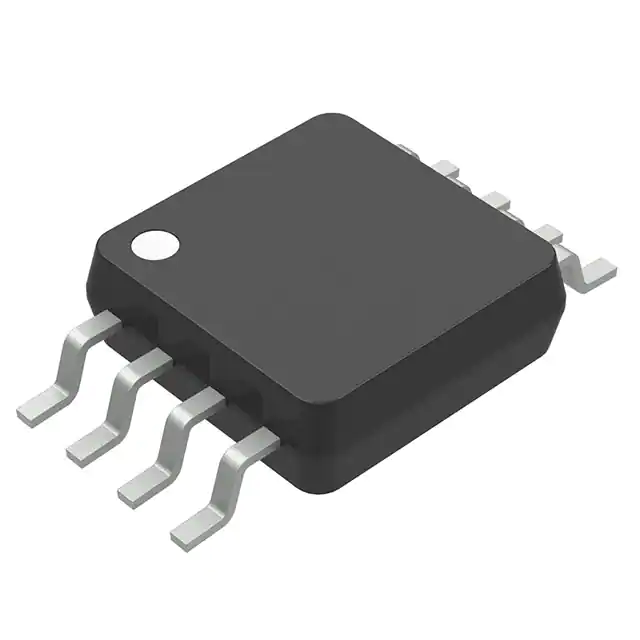
MAX11202BEUB+ is housed in a lead(Pb)-free, RoHS-compliant 10-pin µMAX (FMAX) package - 3mm × 3mm, 0.5mm pitch, exposed pad for thermal performance.
| Pin/Terminal | Circuit Role | Design Meaning |
|---|---|---|
| GND (Pin 1) | Analog & digital ground reference | Single ground plane required; decoupling caps must connect here for noise immunity |
| REFP (Pin 2) | Differential reference positive input | Accepts voltage up to AVDD; sets full-scale range when paired with REFN |
| REFN (Pin 3) | Differential reference negative input | Must be more negative than REFP; common-mode range: 0V to AVDD |
| AINN (Pin 4) | Negative fully differential analog input | Accepts bipolar input: -VREF to +VREF; matched impedance critical for CMRR |
| AINP (Pin 5) | Positive fully differential analog input | Paired with AINN; enables rejection of common-mode interference in noisy industrial settings |
| AVDD (Pin 6) | Analog supply voltage | 2.7V–3.6V; requires local 0.1µF ceramic bypass to GND for modulator stability |
| DVDD (Pin 7) | Digital supply voltage | 1.7V–3.6V; independent rail allows I/O compatibility with 1.8V or 3.3V microcontrollers |
| RDY/DOUT (Pin 8) | Data-ready flag & serial data output | Open-drain logic output; signals data availability and shifts out 24-bit two's complement MSB-first |
| SCLK (Pin 9) | Serial clock input | Accepts up to 5MHz external clock; rising edge clocks data out and controls sleep/calibration modes |
| CLK (Pin 10) | External clock input | Disables internal oscillator when driven; accepts 2.2528MHz clock for synchronization or jitter reduction |
Key Features
| Feature | Design Value |
|---|---|
| Ultra-low power operation | <300µA active current and <0.1µA sleep current enable decade-long battery life in remote sensors |
| On-demand self-calibration | Offset/gain calibration triggered via 26th SCLK pulse-no host firmware overhead or external commands needed |
| Integrated 2.2528MHz oscillator | Eliminates external crystal and load capacitors, reducing BOM count and board area by ≥3 components |
| 2-wire serial interface | Uses only SCLK and RDY/DOUT-no dedicated MOSI/MISO lines-ideal for minimal-pin-count microcontrollers |
| ±2kV HBM ESD protection | Robust I/O pins withstand field handling and industrial transients without external TVS diodes |
Applications
| RTD Temperature Sensing | Resistive Bridge Weigh Scale |
|---|---|
Use Scenario: High-accuracy temperature monitoring in HVAC control panels using Pt100 RTDs in 4–20mA loop-powered transmitters. IC Role / Device Role / Timing Role: Precision ADC digitizing ratiometric bridge output; internal clock synchronizes conversion to eliminate external timing dependencies. Use Value: 20.5-bit noise-free resolution and 144dB 50/60Hz rejection ensure ±0.05°C repeatability without software averaging or external filtering. | Use Scenario: Battery-operated portable weighing scale measuring load cell output in harsh factory environments. IC Role / Device Role / Timing Role: Low-power delta-sigma converter interfacing with full-bridge strain gauge; sleep mode activated between weigh events. Use Value: Sub-1µA sleep current extends AA battery life to >5 years; differential inputs reject common-mode noise from motor drives and welding equipment. |
| Portable Gas Detector | Industrial Loop-Powered Sensor |
Use Scenario: Handheld toxic gas monitor using electrochemical sensors requiring stable, low-noise analog front-end. IC Role / Device Role / Timing Role: Primary ADC capturing low-level sensor current converted to voltage via precision transimpedance amplifier. Use Value: 720nVRMS noise floor resolves sub-ppm gas concentrations; 2.7V–3.6V AVDD range matches lithium primary cell discharge profile. | Use Scenario: 4–20mA pressure transmitter installed in oil & gas field instrumentation with strict EMC and power constraints. IC Role / Device Role / Timing Role: Signal conditioner converting bridge output to digital for HART modulation; operates directly from loop power. Use Value: Total active current <300µA allows full functionality within 3.5mA loop budget; integrated oscillator avoids timing drift over temperature. |
Equivalent & Alternatives
The following parts are listed as comparable options for similar precision delta-sigma ADC applications.
| Alternative Part | Technical Difference | Application Difference | Selection Advice |
|---|---|---|---|
| ADS124S08IPW | 24-bit, 4-kSPS, SPI interface, integrated PGA and burn-out current sources | Better suited for multi-sensor systems requiring programmable gain and sensor diagnostics | Select when needing on-chip PGA, multiple analog inputs, or sensor excitation-not for ultra-low-power single-channel use |
| AD7172-2BRUZ | 24-bit, 250kSPS, SPI interface, 105dB SNR, higher power (3.2mA active) | Targeted at high-speed, high-SNR lab instrumentation rather than battery or loop-powered field devices | Choose only if sampling rate >1ksps is mandatory and power budget allows ≥10× higher current draw |
Compared with ADS124S08IPW and AD7172-2BRUZ, the MAX11202BEUB+ uniquely balances sub-µA sleep current, 2-wire simplicity, and 20.5-bit noise-free resolution at 13.75sps-making it irreplaceable for ultra-low-power, space-constrained industrial sensing where every nanoamp and PCB trace matters.
Availability
MAX11202BEUB+ is available at Aetrix Electronics and suitable for RTD temperature sensing, resistive bridge weigh scales, portable gas detectors, and industrial 4–20mA loop-powered sensors requiring stable component supply and long-term lifecycle support.
Supply support for MAX11202BEUB+ includes scheduled delivery planning, volume procurement assistance, BOM continuity management, traceable sourcing, and lifecycle availability coordination for OEM customers, industrial embedded developers, connected-device designers, and electronics production programs.
Manufacturer
Maxim Integrated (now part of Analog Devices) designs precision analog, mixed-signal, and power management ICs for industrial, medical, and communications applications.
The MAX11202 product line delivers ultra-low-power, high-resolution delta-sigma ADCs specifically engineered for battery-operated and loop-powered sensor transmitters demanding maximum dynamic range per microwatt.
FAQ
What is the maximum achievable noise-free resolution of the MAX11202BEUB+ at its specified output data rate?
The MAX11202BEUB+ achieves 20.5-bit noise-free resolution at its native 13.75sps output rate, measured under standard conditions (VAVDD = 3.6V, VDVDD = 1.8V, VREFP – VREFN = VAVDD). This value is guaranteed across the full –40°C to +85°C operating temperature range and reflects the effective number of bits excluding noise-induced uncertainty. The MAX11202BEUB+ does not support higher output rates-its timing and filter response are fixed to this rate.
Does the MAX11202BEUB+ require an external crystal or oscillator to operate?
No, the MAX11202BEUB+ integrates a factory-trimmed 2.2528MHz internal oscillator that requires no external components. This oscillator drives the modulator and digital filter, enabling immediate operation upon power-up. An external clock may be applied to Pin 10 (CLK) to override the internal oscillator-but it is optional and not required for basic functionality.
How does the 2-wire serial interface of the MAX11202BEUB+ differ from standard I²C or SPI protocols?
The MAX11202BEUB+ uses a proprietary 2-wire interface with SCLK and RDY/DOUT only-no separate data-in line. Data is always read-only, MSB-first, two's complement, and clocked on SCLK rising edges. RDY/DOUT serves dual roles: indicating data readiness (low = data valid) and shifting out bits. Unlike I²C or SPI, no address, command, or write cycles are supported-only timing-driven read, sleep, and calibration sequences.
Can the MAX11202BEUB+ perform self-calibration without host processor intervention?
Yes-the MAX11202BEUB+ supports fully autonomous self-calibration triggered solely by SCLK timing. After reading 24 data bits, applying a 26th SCLK pulse initiates offset/gain calibration without any register writes or firmware commands. The device asserts RDY/DOUT low again upon completion, enabling hands-off recalibration during wake-up or periodic maintenance intervals.
What is the absolute maximum rating for analog input voltage on the MAX11202BEUB+?
The absolute maximum analog input voltage for AINP and AINN on the MAX11202BEUB+ is GND – 30mV to VAVDD + 30mV. Exceeding these limits-even momentarily-may cause permanent damage. The functional input range is –VREF to +VREF (bipolar), with VREF defined as VREFP – VREFN and constrained to 1V–VAVDD. Input common-mode voltage must remain between GND and VAVDD.
MAX11202BEUB+ Specifications
- Product attributes
- Attribute value
- Manufacturer:
- Analog Devices Inc./Maxim Integrated
- Series:
- -
- Package/Case:
- 10-TFSOP, 10-MSOP (0.118", 3.00mm Width)
- Packaging:
- Tube
- Product Status:
- Active
- Number of Bits:
- 24
- Sampling Rate (Per Second):
- 120
- Number of Inputs:
- 1
- Input Type:
- Differential
- Data Interface:
- SPI
- Configuration:
- ADC
- Ratio - S/H:ADC:
- -
- Number of A/D Converters:
- 1
- Architecture:
- Sigma-Delta
- Reference Type:
- External
- Voltage - Supply, Analog:
- 2.7V ~ 3.6V
- Voltage - Supply, Digital:
- 1.7V ~ 3.6V
- Features:
- -
- Operating Temperature:
- -40°C ~ 85°C
- Supplier Device Package:
- 10-uMAX/uSOP
- Mounting Type:
- Surface Mount
- Grade:
- -
- Qualification:
- -
MAX11202BEUB+ FAQ
1.How can I place an order for MAX11202BEUB+ through Aetrix?
Please submit a Request for Quotation (RFQ) for MAX11202BEUB+ on Aetrix. Our sales agent will provide a competitive quotation and guide you through the order confirmation once you accept the terms.
2.Are the price and stock information for MAX11202BEUB+ reliable?
The price and inventory of MAX11202BEUB+ are updated periodically and may fluctuate due to market conditions. Stock and pricing data are typically refreshed every 24 hours. Quotation validity for MAX11202BEUB+ is usually 5 days.
3.What payment methods are accepted for MAX11202BEUB+?
We accept Wire Transfer, PayPal, Credit Card, Western Union, MoneyGram, and Escrow for MAX11202BEUB+ transactions.
Note: Certain payment methods may incur a processing fee.
4.How is shipping managed for MAX11202BEUB+?
MAX11202BEUB+ orders can be shipped via leading logistics carriers, including DHL, UPS, FedEx, TNT, or Registered Mail.
Once your MAX11202BEUB+ order is processed, you will receive an email with the shipment details and tracking number.
Note: Tracking information may take up to 24 hours to appear. Express delivery typically takes 3–5 business days.
5.How can I obtain technical support or documentation for MAX11202BEUB+?
For technical support, including MAX11202BEUB+ datasheets, pinout diagrams, or application guidance, please contact our engineering support team. They can provide detailed documentation and assistance for your MAX11202BEUB+ requirements.
6.How does Aetrix verify that MAX11202BEUB+ is sourced from the original manufacturer or authorized distributors?
All MAX11202BEUB+ products on Aetrix are procured from qualified distributors and authorized channels. Our dedicated quality assurance team conducts strict verification, including traceability checks and, if necessary, third-party testing. This ensures that MAX11202BEUB+ meets industry standards.
7.What is the process for return or replacement of MAX11202BEUB+?
All MAX11202BEUB+ units undergo pre-shipment inspection (PSI). If there is an issue with MAX11202BEUB+, returns or replacements are accepted under the following conditions:
1.Quantity discrepancies, incorrect items, or visible external defects (such as breakage or corrosion), acknowledged by Aetrix.
2.The issue is reported within 90 days of delivery.
3.The MAX11202BEUB+ part is unused and in its original packaging.
Return procedure for MAX11202BEUB+:
1.Submit a request within 90 days.
2.Obtain a Return Material Authorization (RMA) from Aetrix.
MAX11202BEUB+ Tags
-
ADC081C021CIMKX/NOPB
Texas Instruments

-
MCP3021A5T-E/OT
Microchip Technology
-
TLA2024IRUGR
Texas Instruments
-
MCP3221A5T-E/OT
Microchip Technology
-
MCP3221A5T-I/OT
Microchip Technology
-
MCP3221A4T-E/OT
Microchip Technology
-
MCP3221A6T-E/OT
Microchip Technology
-
MCP3221A0T-E/OT
Microchip Technology
-
MCP3221A1T-E/OT
Microchip Technology

-
ADC121S021CIMFX/NOPB
Texas Instruments
-
MCP3001-I/MS
Microchip Technology

-
MCP3001-I/SN
Microchip Technology
Tech Hub

A practical engineering guide to 3.3V and 5V logic compatibility, input thresholds, resistor dividers, translator ICs, MOSFET level shifting, I2C pull-ups, timing limits and power-sequencing risks.

The 74HC595 uses push-pull logic outputs, while the TPIC6B595 uses 50 V open-drain DMOS sinks for higher-power loads. This guide compares timing, current limits, 3.3 V interfacing, load wiring, thermal…

The 74HC595 converts serial data into eight stable parallel outputs. This guide covers pin functions, shift and storage timing, OE and MR behavior, drive-current limits, cascading, voltage compatibilit…

A technical comparison of level-sensitive latches and edge-triggered flip-flops, covering timing windows, setup and hold limits, master–slave operation, time borrowing, race-through, HDL inference and…

A D latch stores one bit while Enable controls when data can pass. This reference covers gate-level operation, truth tables, transparency, setup and hold timing, LE versus OE, common ICs and practical …

An SR latch stores one bit through cross-coupled feedback. This engineering reference covers NOR and NAND implementations, truth tables, forbidden-state recovery, gated operation, switch debouncing, fa…

Latch circuits retain one bit through feedback. This technical reference covers SR and D latches, truth tables, transparency, timing limits, latch-versus-flip-flop behavior, applications and common log…

An engineering guide to LED driver operation, constant-current and constant-voltage outputs, linear and switching topologies, dimming, IC selection, calculations, replacement compatibility, and fault c…

Operational amplifier guide covering op amp basics, feedback, ideal vs real op amps, common configurations, buffer circuits, offset, bias current, gain-bandwidth, slew rate, rail-to-rail limits and sel…

Jumper cables guide covering safe connection order, red and black clamp placement, final ground connection, cable gauge, length, clamp quality, copper vs CCA cables, jump starter comparison and battery…


