
 My Inquiry
 My Account


Analog Devices Inc./Maxim Integrated MAX3100CPD+
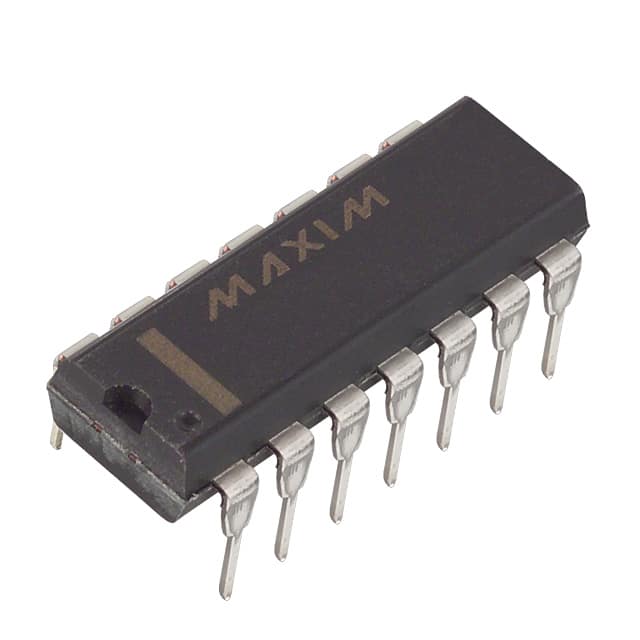
- Part No.:
- MAX3100CPD+
- Manufacturer:
- Analog Devices Inc./Maxim Integrated
- Category:
- Controllers
- Package:
- 14-DIP (0.300", 7.62mm)
- Datasheet:
-
 MAX3100CPD+.pdf
- Description:
- IC UART SPI MICROCOMPATBL 14-DIP
- Quantity:
- Payment:

- Shipping:

Inventory:271
Please send an inquiry. Send us your inquiry, and we will respond immediately.
Product details
Overview
MAX3100CPD+ from Maxim Integrated is a SPI/MICROWIRE-compatible universal asynchronous receiver/transmitter (UART) optimized for microcontroller-based systems. It integrates an on-chip crystal oscillator, 8-word FIFO, software-programmable baud-rate generator (300–230 kbaud), IrDA timing mode, and shutdown current of 10 µA. It drives opto-couplers directly via TX/RTS outputs (25 mA sink) and supports RS-232/RS-485/IR isolated links in handheld instrumentation and building control networks.
For engineers reviewing the MAX3100CPD+ datasheet, MAX3100CPD+ pinout, MAX3100CPD+ application, or MAX3100CPD+ equivalent, this page delivers verified technical context, real-world interface constraints (e.g., Schmitt-trigger inputs, open-drain IRQ), power behavior across temperature, and validated alternatives for UART-in-SPI system design.
Technical Context
The MAX3100CPD+ implements a full UART core with independent transmit/receive shift registers, 16× oversampling for start-bit detection, and majority-sampled data recovery. Its baud-rate generator uses B0–B3 bits to select 16 division ratios, enabling precise rates from 300 to 230 kbaud with 1.8432 MHz or 3.6864 MHz crystals.
It features dual shutdown modes-hardware (SHDN pin) and software (SHDNi bit)-both disabling the oscillator while preserving register access and enabling RX activity wake-up. The interrupt logic supports four maskable sources (R, T, PM, RAM), with IRQ asserted low and open-drain output compatible with 5 V or 3.3 V µC systems.
Key Specifications
| Parameter | Value and Actual Design Meaning |
|---|---|
| Interface | SPI/MICROWIRE serial bus; 16-bit word protocol with CS-controlled framing |
| Baud Rate Range | 300 to 230 kbaud; supported by programmable 4-bit divisor (B0–B3) and 1.8432/3.6864 MHz crystal |
| FIFO Depth | 8-word receive FIFO; reduces µC polling overhead at high data rates |
| Supply Voltage | +2.7 V to +5.5 V; enables direct operation from 3.3 V or 5 V rails without level-shifting |
| Shutdown Current | 10 µA at TA = +25°C; allows battery-powered wake-on-RX operation |
| TX/RTS Drive Strength | 25 mA sink capability; directly interfaces standard opto-couplers (e.g., 6N136) without external drivers |
| IrDA Support | Hardware-timed SIR mode (3/16-bit pulse width); eliminates µC timing burden for IR links |
Pinout & Package
MAX3100CPD+ is housed in a 14-pin plastic DIP package rated for 0°C to +70°C operation. Pin functions are electrically identical to the QSOP variant but mapped to DIP layout per Maxim's ordering table.
| Pin | Circuit Role | Design Meaning |
|---|---|---|
| 1 | VCC | Positive supply input; accepts +2.7 V to +5.5 V; decoupling capacitor required near pin |
| 2 | TX | Asynchronous transmitter output; CMOS-level serial data; 25 mA sink capable |
| 3 | RX | Asynchronous receiver input; Schmitt-triggered; detects start-bit transitions for wake-on-RX in shutdown |
| 4 | RTS | Request-to-send control output; active-low; 25 mA sink; used for RS-485 driver enable or flow control |
| 5 | N.C. | No connection; not internally bonded; must be left floating or tied to GND per layout best practice |
| 6 | CTS | Clear-to-send input; active-low general-purpose signal; readable via status register bit |
| 7 | X1 | Crytal oscillator input or external clock source; accepts 45–55% duty-cycle square wave up to 3.6864 MHz |
| 8 | X2 | Crytal oscillator output; leave unconnected when using external clock at X1 |
| 9 | DIN | SPI data input; Schmitt-triggered; latched on SCLK rising edge; MSB-first 16-bit command stream |
| 10 | DOUT | SPI data output; tri-stated when CS high; valid on SCLK falling edge; reads config/data registers |
| 11 | SCLK | SPI clock input; Schmitt-triggered; defines timing for DIN/DOUT transfers; max 10 MHz |
| 12 | CS | Active-low chip select; initiates 16-bit frame; DOUT enters high-Z when CS high |
| 13 | IRQ | Open-drain interrupt output; asserts low on R/T/PM/RAM events; requires external pull-up |
| 14 | SHDN | Hardware shutdown input; forces immediate oscillator stop and 10 µA quiescent current |
Key Features
| Feature | Design Value |
|---|---|
| IrDA SIR timing mode | Hardware-generated 3/16-bit pulse width eliminates µC timer dependency for infrared data links |
| 9-bit address recognition | Enables multi-drop network addressing via configurable parity bit and interrupt masking (RAM) |
| Receive activity interrupt in shutdown | Allows low-power monitoring of serial bus traffic; RX transition wakes device without external circuitry |
| Schmitt-trigger inputs (RX, CTS, DIN, SCLK, CS, SHDN) | Ensures noise immunity in industrial environments; supports slow-rising signals from opto-coupler outputs |
| Flexible interrupt with four maskable sources | Reduces µC polling load; IRQ asserts only on enabled events (R, T, PM, RAM), improving real-time response |
Applications
| Handheld Instruments | Intelligent Instrumentation |
|---|---|
Use Scenario: Portable multimeters and data loggers require low-power, isolated serial communication to host PCs or wireless gateways. IC Role / Device Role / Timing Role: MAX3100CPD+ serves as UART bridge between 3.3 V MCU and opto-isolated RS-232 transceivers, handling IrDA or RS-485 physical layer signaling. Use Value: 10 µA shutdown current extends battery life; 25 mA TX/RTS drive eliminates external buffers; Schmitt-trigger inputs tolerate opto-coupler output skew. |
Use Scenario: Programmable logic controllers (PLCs) and sensor nodes in HVAC systems use isolated UARTs for fieldbus diagnostics and firmware updates. IC Role / Device Role / Timing Role: MAX3100CPD+ provides SPI-to-asynchronous conversion for µC-hosted Modbus RTU or custom protocols over RS-485 lines. Use Value: 8-word FIFO prevents data loss during µC interrupt latency; hardware IrDA mode enables IR-based configuration without µC firmware changes. |
| UART in SPI Systems | Isolated RS-232/RS-485 |
Use Scenario: Resource-constrained microcontrollers (e.g., 8-bit PIC or ARM Cortex-M0) lack native UART peripherals but offer SPI. IC Role / Device Role / Timing Role: MAX3100CPD+ acts as offload UART engine, freeing µC cycles for sensor processing or control algorithms. Use Value: SPI interface consumes only three GPIOs (CS/SCLK/DIN/DOUT shared); 16-bit register map simplifies driver development; no external crystal needed for basic operation. |
Use Scenario: Medical devices and industrial controllers require galvanic isolation between host and peripheral serial ports. IC Role / Device Role / Timing Role: MAX3100CPD+ drives opto-couplers directly (TX/RTS sink 25 mA), eliminating discrete transistor stages in isolated RS-232/RS-485 interfaces. Use Value: Schmitt-trigger RX input ensures reliable start-bit detection after opto-coupler propagation delay; shutdown mode cuts isolation circuit power during idle periods. |
Equivalent & Alternatives
The following parts are listed as comparable options for similar UART bridging applications.
| Alternative Part | Technical Difference | Application Difference | Selection Advice |
|---|---|---|---|
| SC16IS750IPW | IO-Link-capable I²C/SPI UART with 64-byte FIFO, integrated voltage regulators, and hardware flow control (RTS/CTS) | Targets industrial IO-Link masters and higher-bandwidth embedded systems requiring larger buffer depth and dual-interface flexibility | Choose SC16IS750IPW when I²C interface, deeper FIFO, or integrated LDOs are required; MAX3100CPD+ remains optimal for ultra-low-power, cost-sensitive SPI-only designs |
| TL16C550CP | Legacy parallel-bus UART with 16-byte FIFO, Intel 8080-style bus interface, no integrated oscillator, and no shutdown mode | Designed for ISA-bus PC add-in cards and legacy industrial backplanes where parallel CPU interfacing is mandatory | TL16C550CP suits retro-computing or legacy board upgrades; MAX3100CPD+ is superior for modern µC-based SPI systems needing low power and compact footprint |
Compared with SC16IS750IPW and TL16C550CP, the MAX3100CPD+ uniquely combines sub-10 µA shutdown, direct opto-coupler drive, and IrDA SIR timing in a 14-pin DIP-making it the only choice for battery-operated handheld tools and space-constrained isolated UART bridges.
Availability
MAX3100CPD+ is available at Aetrix Electronics and suitable for handheld instrumentation, intelligent building control systems, and isolated RS-232/RS-485 interfaces requiring stable component supply across commercial temperature range (0°C to +70°C).
Supply support for MAX3100CPD+ includes scheduled delivery planning, volume procurement assistance, BOM continuity management, traceable sourcing, and lifecycle availability coordination for OEM customers, industrial embedded developers, connected-device designers, and electronics production programs.
Manufacturer
Maxim Integrated (now part of Analog Devices) designs precision analog, mixed-signal, and power management ICs for industrial, medical, and communications applications.
The MAX3100 product line delivers SPI/MICROWIRE-compatible UARTs optimized for microcontroller-based systems with tight power and board-space constraints-enabling robust serial connectivity in portable and isolated equipment.
FAQ
What is the operating temperature range for MAX3100CPD+?
The MAX3100CPD+ is specified for commercial temperature operation from 0°C to +70°C. This range aligns with its "C" grade suffix and makes it suitable for indoor instrumentation, consumer-grade test equipment, and non-automotive embedded systems where ambient thermal stress is moderate. It does not support extended industrial (-40°C to +85°C) operation like the MAX3100EPD+ variant.
Does MAX3100CPD+ require an external crystal to operate?
Yes, the MAX3100CPD+ requires either a 1.8432 MHz or 3.6864 MHz crystal connected between X1 and X2 pins for accurate baud-rate generation. Alternatively, an external square-wave clock (45–55% duty cycle) can be applied to X1 with X2 left unconnected. No internal RC oscillator is present-the crystal or external clock is mandatory for UART timing.
Can MAX3100CPD+ drive RS-232 line drivers directly?
No, MAX3100CPD+ outputs are CMOS-level (0 V to VCC) and cannot meet RS-232 voltage requirements (±3 V to ±15 V). However, it directly drives opto-couplers (e.g., 6N136) and RS-485 transceivers via RTS/TE control. For true RS-232, a level-shifter such as MAX3222 or MAX232 must be used between MAX3100CPD+ TX/RX and the connector.
How does the MAX3100CPD+ handle wake-up from shutdown mode?
The MAX3100CPD+ wakes from shutdown upon any transition on the RX pin, setting the RA (receive activity) bit and asserting IRQ if RAM is enabled. This occurs even with the oscillator disabled, allowing ultra-low-power monitoring of serial bus activity. The wake-up event is latched until cleared by reading the RA/FE register or exiting shutdown.
What is the maximum SPI clock frequency supported by MAX3100CPD+?
The MAX3100CPD+ supports SPI clock (SCLK) frequencies up to 10 MHz, as confirmed by timing parameters tCL (100 ns min), tCH (100 ns min), and tCP (238 ns min). At 10 MHz, setup/hold times are met with typical PCB routing; for robust operation across voltage/temperature, 8 MHz is recommended in production designs.
MAX3100CPD+ Specifications
- Product attributes
- Attribute value
- Manufacturer:
- Analog Devices Inc./Maxim Integrated
- Package/Case:
- 14-DIP (0.300", 7.62mm)
- Programmable:
- Not Verified
- Protocol:
- RS232, RS485
- Function:
- Controller
- Interface:
- SPI, UART
- Standards:
- -
- Voltage - Supply:
- 2.7V ~ 5.5V
- Current - Supply:
- 150µA
- Operating Temperature:
- 0°C ~ 70°C
- Supplier Device Package:
- 14-PDIP
- Grade:
- -
- Qualification:
- -
MAX3100CPD+ FAQ
1.How can I place an order for MAX3100CPD+ through Aetrix?
Please submit a Request for Quotation (RFQ) for MAX3100CPD+ on Aetrix. Our sales agent will provide a competitive quotation and guide you through the order confirmation once you accept the terms.
2.Are the price and stock information for MAX3100CPD+ reliable?
The price and inventory of MAX3100CPD+ are updated periodically and may fluctuate due to market conditions. Stock and pricing data are typically refreshed every 24 hours. Quotation validity for MAX3100CPD+ is usually 5 days.
3.What payment methods are accepted for MAX3100CPD+?
We accept Wire Transfer, PayPal, Credit Card, Western Union, MoneyGram, and Escrow for MAX3100CPD+ transactions.
Note: Certain payment methods may incur a processing fee.
4.How is shipping managed for MAX3100CPD+?
MAX3100CPD+ orders can be shipped via leading logistics carriers, including DHL, UPS, FedEx, TNT, or Registered Mail.
Once your MAX3100CPD+ order is processed, you will receive an email with the shipment details and tracking number.
Note: Tracking information may take up to 24 hours to appear. Express delivery typically takes 3–5 business days.
5.How can I obtain technical support or documentation for MAX3100CPD+?
For technical support, including MAX3100CPD+ datasheets, pinout diagrams, or application guidance, please contact our engineering support team. They can provide detailed documentation and assistance for your MAX3100CPD+ requirements.
6.How does Aetrix verify that MAX3100CPD+ is sourced from the original manufacturer or authorized distributors?
All MAX3100CPD+ products on Aetrix are procured from qualified distributors and authorized channels. Our dedicated quality assurance team conducts strict verification, including traceability checks and, if necessary, third-party testing. This ensures that MAX3100CPD+ meets industry standards.
7.What is the process for return or replacement of MAX3100CPD+?
All MAX3100CPD+ units undergo pre-shipment inspection (PSI). If there is an issue with MAX3100CPD+, returns or replacements are accepted under the following conditions:
1.Quantity discrepancies, incorrect items, or visible external defects (such as breakage or corrosion), acknowledged by Aetrix.
2.The issue is reported within 90 days of delivery.
3.The MAX3100CPD+ part is unused and in its original packaging.
Return procedure for MAX3100CPD+:
1.Submit a request within 90 days.
2.Obtain a Return Material Authorization (RMA) from Aetrix.
MAX3100CPD+ Tags
-
PTN5150AHXMP
NXP Semiconductors
-
USB3740B-AI9-TR
Microchip Technology
-
USB3740B-AI2-TR
Microchip Technology
-
USB3300-EZK-TR
Microchip Technology
-
USB3300-EZK
Microchip Technology
-
FUSB340TMX
onsemi
-
FUSB302BMPX
onsemi
-
DP83826IRHBR
Texas Instruments
-
MCP2518FDT-E/QBB
Microchip Technology
-
FUSB302MPX
onsemi
-
MCP2518FDT-E/SL
Microchip Technology
-
FT260Q-R
FTDI, Future Technology Devices International Ltd
Tech Hub

A practical engineering guide to 3.3V and 5V logic compatibility, input thresholds, resistor dividers, translator ICs, MOSFET level shifting, I2C pull-ups, timing limits and power-sequencing risks.

The 74HC595 uses push-pull logic outputs, while the TPIC6B595 uses 50 V open-drain DMOS sinks for higher-power loads. This guide compares timing, current limits, 3.3 V interfacing, load wiring, thermal…

The 74HC595 converts serial data into eight stable parallel outputs. This guide covers pin functions, shift and storage timing, OE and MR behavior, drive-current limits, cascading, voltage compatibilit…

A technical comparison of level-sensitive latches and edge-triggered flip-flops, covering timing windows, setup and hold limits, master–slave operation, time borrowing, race-through, HDL inference and…

A D latch stores one bit while Enable controls when data can pass. This reference covers gate-level operation, truth tables, transparency, setup and hold timing, LE versus OE, common ICs and practical …

An SR latch stores one bit through cross-coupled feedback. This engineering reference covers NOR and NAND implementations, truth tables, forbidden-state recovery, gated operation, switch debouncing, fa…

Latch circuits retain one bit through feedback. This technical reference covers SR and D latches, truth tables, transparency, timing limits, latch-versus-flip-flop behavior, applications and common log…

An engineering guide to LED driver operation, constant-current and constant-voltage outputs, linear and switching topologies, dimming, IC selection, calculations, replacement compatibility, and fault c…

Operational amplifier guide covering op amp basics, feedback, ideal vs real op amps, common configurations, buffer circuits, offset, bias current, gain-bandwidth, slew rate, rail-to-rail limits and sel…

Jumper cables guide covering safe connection order, red and black clamp placement, final ground connection, cable gauge, length, clamp quality, copper vs CCA cables, jump starter comparison and battery…


