
 My Inquiry
 My Account


Analog Devices Inc./Maxim Integrated MAX3100EPD+
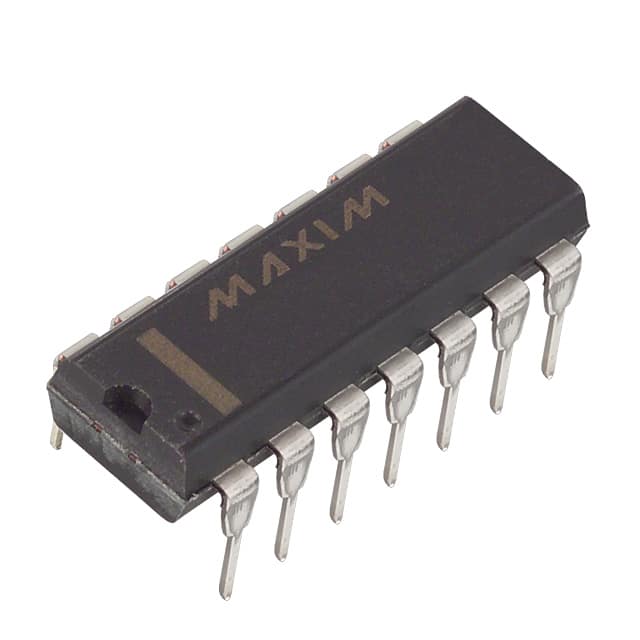
- Part No.:
- MAX3100EPD+
- Manufacturer:
- Analog Devices Inc./Maxim Integrated
- Category:
- Controllers
- Package:
- 14-DIP (0.300", 7.62mm)
- Datasheet:
-
 MAX3100EPD+.pdf
- Description:
- IC UART SPI MICROWIRE-COMP 14DIP
- Quantity:
- Payment:

- Shipping:

Inventory:1,282
Please send an inquiry. Send us your inquiry, and we will respond immediately.
Product details
Overview
MAX3100EPD+ from Maxim Integrated is a SPI/MICROWIRE-compatible universal asynchronous receiver-transmitter (UART) optimized for microcontroller-based systems. It integrates a crystal oscillator, 8-word FIFO, software-programmable baud-rate generator (300–230 kbps), IrDA SIR timing mode, and shutdown current of 10 µA. Used in isolated RS-232/RS-485 links, low-cost IR data links, and HVAC/building control networks.
For engineers reviewing the MAX3100EPD+ datasheet, MAX3100EPD+ pinout, MAX3100EPD+ application, or MAX3100EPD+ equivalent, this page delivers verified technical context, real-world interface constraints, confirmed power behavior across temperature, and validated alternative options for UART expansion in space- and power-constrained embedded designs.
Technical Context
The MAX3100EPD+ implements a full UART core with synchronous SPI/MICROWIRE host interface, 16× oversampling receiver with majority-sampled start-bit detection, and hardware/software shutdown control that halts the oscillator while preserving interrupt-on-RX capability. Its baud-rate generator uses B0–B3 bits to select 16 division ratios, supporting precise rates up to 230 kbps with 1.8432 MHz or 3.6864 MHz crystals.
It features an open-drain IRQ output with four maskable sources (RX data ready, TX buffer empty, parity error, receive activity in shutdown), Schmitt-trigger inputs for opto-coupler compatibility, and TX/RTS outputs capable of sinking 25 mA-enabling direct drive of opto-isolators without external buffers.
Key Specifications
| Parameter | Value and Actual Design Meaning |
|---|---|
| Baud Rate Range | 300 bps to 230 kbps - supports legacy modems through high-speed industrial serial links |
| FIFO Depth | 8-word deep - reduces MCU polling overhead and prevents data loss at burst rates ≥115.2 kbps |
| Supply Voltage | +2.7V to +5.5V - operates across single 3.3V or 5V rails, compatible with mixed-voltage system designs |
| Shutdown Current | 10 µA at -40°C to +85°C - enables battery-backed wake-on-RX functionality in portable instrumentation |
| TX/RTS Sink Current | 25 mA - directly drives standard opto-couplers (e.g., 6N136) without external transistors |
| IrDA SIR Mode | Enabled via IR bit - configures 3/16-bit pulse width for infrared data association compliance |
| Operating Temp | -40°C to +85°C - qualified for extended industrial environments including building automation and field instruments |
Pinout & Package
MAX3100EPD+ is housed in a 14-pin plastic DIP package rated for -40°C to +85°C operation. The DIP footprint provides robust through-hole mounting suitable for prototyping, test fixtures, and industrial control panels requiring mechanical stability and thermal margin.
| Pin/Terminal | Circuit Role | Design Meaning |
|---|---|---|
| 1 (VCC) | Positive supply input | Accepts +2.7V to +5.5V; bypass capacitor required near pin for noise immunity |
| 2 (TX) | Asynchronous transmit output | CMOS-level output; sinks 25 mA for direct opto-coupler drive |
| 3 (RX) | Asynchronous receive input | Schmitt-trigger input; detects RX transitions even in shutdown to wake MCU |
| 4 (RTS) | Request-to-send control output | Active-low general-purpose output; software-controllable for RS-485 enable |
| 5 (N.C.) | No connection | Not internally bonded; must remain unconnected per datasheet |
| 6 (CTS) | Clear-to-send input | Active-low handshaking input; readable via register for flow control |
| 7 (X1) | Clock input / crystal terminal | Accepts 1.8432 MHz or 3.6864 MHz crystal or external square-wave clock |
| 8 (X2) | Crytal terminal | Connected to crystal second lead; left floating for external clock mode |
| 9 (DIN) | SPI data input | Schmitt-triggered; latched on SCLK rising edge for noise-immune configuration |
| 10 (DOUT) | SPI data output | High-impedance when CS high; valid after SCLK falling edge |
| 11 (SCLK) | SPI clock input | Schmitt-triggered; defines timing for all register reads/writes |
| 12 (CS) | Chip-select input | Active-low; initiates 16-bit SPI frame; aborts transfer if deasserted mid-cycle |
| 13 (IRQ) | Interrupt output | Open-drain; asserts low on configurable events (RX data, TX empty, framing error, RX activity) |
| 14 (SHDN) | Hardware shutdown input | Logic-low forces immediate oscillator stop and 10 µA quiescent state |
| GND | Ground reference | Common return for VCC, I/O, and crystal circuit; critical for EMI suppression |
Key Features
| Feature | Design Value |
|---|---|
| IrDA SIR timing mode | Configurable via IR bit; enables 3/16-bit pulse width for infrared data association compliance without external timing components |
| 8-word FIFO buffer | Reduces processor interrupt frequency by >75% at 115.2 kbps, minimizing firmware latency in real-time sensor networks |
| 25 mA TX/RTS sink capability | Eliminates need for external driver transistors when interfacing with common opto-couplers (e.g., 6N136, PC817) |
| Receive-activity interrupt in shutdown | Allows ultra-low-power monitoring of serial bus activity; wakes host MCU only on valid RX transitions |
| Software- and hardware-initiated shutdown | SHDN pin provides immediate power-down; SHDNi bit enables graceful shutdown after transmission completes |
Applications
| Handheld Instruments | Intelligent Instrumentation |
|---|---|
Use Scenario: Portable multimeters and handheld oscilloscopes require low-power, compact UARTs to relay measurement data to Bluetooth or USB adapters. IC Role / Device Role / Timing Role: MAX3100EPD+ serves as the serial bridge between MCU and wireless module, using SPI for minimal pin count and IrDA mode for optional IR diagnostics. Use Value: 10 µA shutdown current extends battery life; 14-pin DIP simplifies manual assembly and field repairability. |
Use Scenario: Programmable logic controllers (PLCs) and environmental sensors use isolated UARTs to communicate over noisy factory-floor RS-485 buses. IC Role / Device Role / Timing Role: MAX3100EPD+ interfaces the controller MCU to opto-isolated RS-485 transceivers, with RTS controlling driver direction and Schmitt-trigger inputs rejecting EMI. Use Value: 25 mA TX/RTS sink drives opto-couplers directly; -40°C to +85°C rating ensures reliability in uncontrolled enclosures. |
| UART in SPI Systems | Low-Cost IR Data Links |
Use Scenario: Resource-constrained microcontrollers (e.g., 8-bit PIC or ARM Cortex-M0) lack native UART peripherals but require serial debug or sensor telemetry. IC Role / Device Role / Timing Role: MAX3100EPD+ acts as a SPI-to-asynchronous bridge, offloading UART protocol handling and timing from firmware. Use Value: 16-bit SPI interface eliminates bit-banging; programmable baud dividers support custom rates without crystal changes. |
Use Scenario: Consumer electronics like remote controls and medical devices use IrDA for short-range, low-power, license-free wireless communication. IC Role / Device Role / Timing Role: MAX3100EPD+ generates precise 3/16-bit pulses in IrDA SIR mode, synchronizing with host MCU's SPI clock for deterministic timing. Use Value: Eliminates dedicated IrDA PHY IC; integrated oscillator removes external timing components, reducing BOM cost by ≥30%. |
Equivalent & Alternatives
The following parts are listed as comparable options for similar UART interface applications.
| Alternative Part | Technical Difference | Application Difference | Selection Advice |
|---|---|---|---|
| MAX3100CEE+ | Same silicon, 16-pin QSOP package; higher pin density but requires rework for DIP-based layouts | Preferred for space-constrained PCBs; not drop-in compatible with MAX3100EPD+ due to different footprint and thermal profile | Select MAX3100CEE+ only when board redesign accommodates QSOP and thermal management is verified. |
| SC16IS750IPW | I²C interface instead of SPI; includes 64-byte FIFO, fractional baud generator, and GPIOs; operates at 2.5–3.6V only | Better suited for I²C-based SoCs and applications needing larger buffer or multi-drop bus support | Choose SC16IS750IPW when I²C is available and deeper FIFO or voltage compatibility with 3.3V-only systems is required. |
Compared with MAX3100CEE+, the MAX3100EPD+ offers proven DIP-mount reliability and simpler layout for prototyping; versus SC16IS750IPW, it delivers lower quiescent current (10 µA vs. 25 µA), broader supply range (+2.7V–+5.5V), and direct opto-driver capability-making it optimal for industrial isolation and battery-powered instrumentation.
Availability
MAX3100EPD+ is available at Aetrix Electronics and suitable for handheld instruments, intelligent instrumentation, and isolated RS-232/RS-485 interfaces requiring stable component supply across extended temperature ranges and long production lifecycles.
Supply support for MAX3100EPD+ includes scheduled delivery planning, volume procurement assistance, BOM continuity management, traceable sourcing, and lifecycle availability coordination for OEM customers, industrial embedded developers, connected-device designers, and electronics production programs.
Manufacturer
Maxim Integrated (now part of Analog Devices) is a semiconductor company specializing in precision analog, mixed-signal, and high-reliability interface solutions for industrial, medical, and communications markets.
The MAX3100 product line was designed to extend microcontroller capabilities with low-power, SPI-connected UARTs-targeting space-constrained, battery-operated, and electrically noisy embedded systems where isolation and flexibility are critical.
FAQ
What is the operating temperature range for MAX3100EPD+?
The MAX3100EPD+ is specified for -40°C to +85°C operation, making it suitable for industrial environments such as building automation controllers, field-deployed instrumentation, and HVAC systems where ambient temperatures exceed commercial-grade limits. This range is confirmed in the Ordering Information table and validated across electrical characteristics including supply current and output drive strength.
Does MAX3100EPD+ support IrDA communication?
Yes, MAX3100EPD+ supports IrDA SIR (Serial Infrared) communication via its configurable IrDA timing mode, enabled by setting the IR bit in the write-configuration register. This mode produces 3/16-bit pulse widths compliant with IrDA 1.0 physical layer requirements, enabling low-cost infrared data links without external timing circuitry.
Can MAX3100EPD+ drive opto-couplers directly?
Yes, MAX3100EPD+ can drive opto-couplers directly: its TX and RTS outputs each sink up to 25 mA at VCC = 3.3V or 5V, matching the forward current requirements of common devices like the 6N136 and PC817. This eliminates external transistor drivers and reduces BOM count in isolated RS-232/RS-485 designs.
What is the minimum supply voltage for MAX3100EPD+?
The minimum supply voltage for MAX3100EPD+ is +2.7V, as specified in the Absolute Maximum Ratings and Electrical Characteristics tables. Operation below this voltage risks functional failure or undefined register behavior; design margins should maintain VCC ≥2.75V across load and temperature extremes.
How does shutdown mode work on MAX3100EPD+?
MAX3100EPD+ supports two shutdown methods: hardware (SHDN pin pulled low) terminates transmission immediately and cuts supply current to ≤10 µA; software (SHDNi bit = 1) waits for current TX to complete before stopping the oscillator. Both modes retain IRQ capability to detect RX transitions and wake the host system.
MAX3100EPD+ Specifications
- Product attributes
- Attribute value
- Manufacturer:
- Analog Devices Inc./Maxim Integrated
- Package/Case:
- 14-DIP (0.300", 7.62mm)
- Programmable:
- Not Verified
- Protocol:
- RS232, RS485
- Function:
- Controller
- Interface:
- SPI, UART
- Standards:
- -
- Voltage - Supply:
- 2.7V ~ 5.5V
- Current - Supply:
- 150µA
- Operating Temperature:
- -40°C ~ 85°C
- Supplier Device Package:
- 14-PDIP
- Grade:
- -
- Qualification:
- -
MAX3100EPD+ FAQ
1.How can I place an order for MAX3100EPD+ through Aetrix?
Please submit a Request for Quotation (RFQ) for MAX3100EPD+ on Aetrix. Our sales agent will provide a competitive quotation and guide you through the order confirmation once you accept the terms.
2.Are the price and stock information for MAX3100EPD+ reliable?
The price and inventory of MAX3100EPD+ are updated periodically and may fluctuate due to market conditions. Stock and pricing data are typically refreshed every 24 hours. Quotation validity for MAX3100EPD+ is usually 5 days.
3.What payment methods are accepted for MAX3100EPD+?
We accept Wire Transfer, PayPal, Credit Card, Western Union, MoneyGram, and Escrow for MAX3100EPD+ transactions.
Note: Certain payment methods may incur a processing fee.
4.How is shipping managed for MAX3100EPD+?
MAX3100EPD+ orders can be shipped via leading logistics carriers, including DHL, UPS, FedEx, TNT, or Registered Mail.
Once your MAX3100EPD+ order is processed, you will receive an email with the shipment details and tracking number.
Note: Tracking information may take up to 24 hours to appear. Express delivery typically takes 3–5 business days.
5.How can I obtain technical support or documentation for MAX3100EPD+?
For technical support, including MAX3100EPD+ datasheets, pinout diagrams, or application guidance, please contact our engineering support team. They can provide detailed documentation and assistance for your MAX3100EPD+ requirements.
6.How does Aetrix verify that MAX3100EPD+ is sourced from the original manufacturer or authorized distributors?
All MAX3100EPD+ products on Aetrix are procured from qualified distributors and authorized channels. Our dedicated quality assurance team conducts strict verification, including traceability checks and, if necessary, third-party testing. This ensures that MAX3100EPD+ meets industry standards.
7.What is the process for return or replacement of MAX3100EPD+?
All MAX3100EPD+ units undergo pre-shipment inspection (PSI). If there is an issue with MAX3100EPD+, returns or replacements are accepted under the following conditions:
1.Quantity discrepancies, incorrect items, or visible external defects (such as breakage or corrosion), acknowledged by Aetrix.
2.The issue is reported within 90 days of delivery.
3.The MAX3100EPD+ part is unused and in its original packaging.
Return procedure for MAX3100EPD+:
1.Submit a request within 90 days.
2.Obtain a Return Material Authorization (RMA) from Aetrix.
MAX3100EPD+ Tags
-
PTN5150AHXMP
NXP Semiconductors
-
USB3740B-AI9-TR
Microchip Technology
-
USB3740B-AI2-TR
Microchip Technology
-
USB3300-EZK-TR
Microchip Technology
-
USB3300-EZK
Microchip Technology
-
FUSB340TMX
onsemi
-
FUSB302BMPX
onsemi
-
DP83826IRHBR
Texas Instruments
-
MCP2518FDT-E/QBB
Microchip Technology
-
FUSB302MPX
onsemi
-
MCP2518FDT-E/SL
Microchip Technology
-
FT260Q-R
FTDI, Future Technology Devices International Ltd
Tech Hub

A practical engineering guide to 3.3V and 5V logic compatibility, input thresholds, resistor dividers, translator ICs, MOSFET level shifting, I2C pull-ups, timing limits and power-sequencing risks.

The 74HC595 uses push-pull logic outputs, while the TPIC6B595 uses 50 V open-drain DMOS sinks for higher-power loads. This guide compares timing, current limits, 3.3 V interfacing, load wiring, thermal…

The 74HC595 converts serial data into eight stable parallel outputs. This guide covers pin functions, shift and storage timing, OE and MR behavior, drive-current limits, cascading, voltage compatibilit…

A technical comparison of level-sensitive latches and edge-triggered flip-flops, covering timing windows, setup and hold limits, master–slave operation, time borrowing, race-through, HDL inference and…

A D latch stores one bit while Enable controls when data can pass. This reference covers gate-level operation, truth tables, transparency, setup and hold timing, LE versus OE, common ICs and practical …

An SR latch stores one bit through cross-coupled feedback. This engineering reference covers NOR and NAND implementations, truth tables, forbidden-state recovery, gated operation, switch debouncing, fa…

Latch circuits retain one bit through feedback. This technical reference covers SR and D latches, truth tables, transparency, timing limits, latch-versus-flip-flop behavior, applications and common log…

An engineering guide to LED driver operation, constant-current and constant-voltage outputs, linear and switching topologies, dimming, IC selection, calculations, replacement compatibility, and fault c…

Operational amplifier guide covering op amp basics, feedback, ideal vs real op amps, common configurations, buffer circuits, offset, bias current, gain-bandwidth, slew rate, rail-to-rail limits and sel…

Jumper cables guide covering safe connection order, red and black clamp placement, final ground connection, cable gauge, length, clamp quality, copper vs CCA cables, jump starter comparison and battery…


