
 My Inquiry
 My Account


Analog Devices Inc./Maxim Integrated MAX31826MUA+T
- Part No.:
- MAX31826MUA+T
- Manufacturer:
- Analog Devices Inc./Maxim Integrated
- Category:
- Analog and Digital Output
- Package:
- 8-TSSOP, 8-MSOP (0.118", 3.00mm Width)
- Datasheet:
-
 MAX31826MUA+T.pdf
- Description:
- SENSOR DIGITAL -55C-125C 8UMAX
- Quantity:
- Payment:

- Shipping:

Inventory:2,538
Please send an inquiry. Send us your inquiry, and we will respond immediately.
Product details
Overview
MAX31826MUA+T from Maxim Integrated is a 1-Wire digital temperature sensor with integrated 12-bit ADC, ±0.5°C accuracy from -10°C to +85°C, -55°C to +125°C operating range, and 1Kb lockable EEPROM. It operates in parasite-power mode (no VDD required) or local power mode, and supports multidrop bus topology via unique 64-bit ROM ID for industrial thermal monitoring.
For engineers reviewing the MAX31826MUA+T datasheet, MAX31826MUA+T pinout, MAX31826MUA+T application, or MAX31826MUA+T equivalent, key selection considerations include 1-Wire interface simplicity, EEPROM lockability, AD0–AD3 location address inputs, parasitic vs. local power trade-offs, and strong-pullup timing requirements during conversion.
Technical Context
The MAX31826MUA+T implements a 1-Wire slave interface with open-drain DQ pin, requiring only one data line plus ground. Its internal architecture integrates a precision bandgap temperature sensor, 12-bit sigma-delta ADC, scratchpad RAM, and 128-byte EEPROM with CRC-8 protection and hardware lock capability.
It supports two power modes: parasite power (VDD grounded, power drawn from DQ via CPP capacitor) and local VDD supply. Parasite mode mandates external strong pullup activation within 10µs of Convert T command, lasting ≥150ms; local power eliminates this requirement and enables concurrent bus traffic during conversion.
Key Specifications
| Parameter | Value and Actual Design Meaning |
|---|---|
| Temperature Range | -55°C to +125°C continuous operation; usable for harsh-environment sensing without external conditioning |
| Accuracy | ±0.5°C over -10°C to +85°C; meets industrial calibration and HVAC control tolerances |
| Resolution | 12-bit (0.0625°C LSB); enables fine-grained thermal trending and threshold detection |
| EEPROM Size | 128 bytes (1Kb), lockable to prevent accidental or malicious writes-critical for firmware-embedded configuration storage |
| Interface | 1-Wire® (single data line + GND); reduces wiring complexity and PCB routing in distributed sensor networks |
| Power Modes | Parasite power (3.0V–3.7V on DQ) or local VDD supply; enables ultra-low-pin-count remote deployment |
| Conversion Time | 150ms at 12-bit resolution; defines minimum polling interval in time-sensitive thermal logging |
Pinout & Package
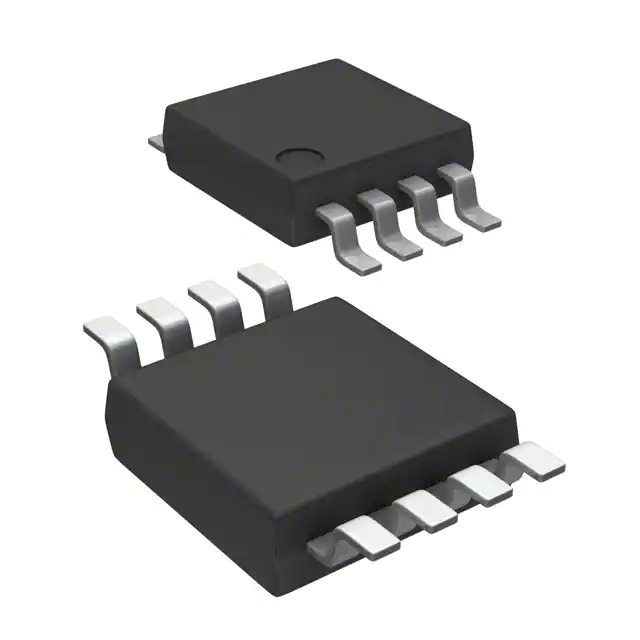
MAX31826MUA+T is housed in an 8-pin µMAX® package (3mm × 3mm, 0.5mm pitch), RoHS-compliant and moisture-sensitive level 1.
| Pin/Terminal | Circuit Role | Design Meaning |
|---|---|---|
| VDD (Pin 1) | Optional power supply input | Must be grounded in parasite-power mode; connects to 3.0V–3.7V rail in local-power mode |
| DQ (Pin 2) | 1-Wire bidirectional data I/O | Open-drain interface; provides power path in parasite mode; requires 4.7kΩ weak pullup |
| N.C. (Pin 3) | No internal connection | Not bonded; must remain unconnected-no routing or termination required |
| GND (Pin 4) | Ground reference | Common return for all analog/digital circuitry and parasitic power capacitor discharge path |
| AD0–AD3 (Pins 5–8) | Location address inputs | Hardwired LSB-to-MSB bits (AD0 = bit 0); define 16 unique physical locations per bus segment |
Key Features
| Feature | Design Value |
|---|---|
| Unique 64-bit ROM ID | Enables plug-and-play multidrop bus addressing without manual configuration or MAC assignment |
| Lockable 1Kb EEPROM | Prevents field corruption of calibration data, device IDs, or system parameters after programming |
| Four programmable address pins (AD0–AD3) | Allows hierarchical mapping of up to 16 sensors per bus segment-ideal for zone-based building automation |
| Parasite-power compatibility | Eliminates dedicated power traces in space-constrained or high-channel-count sensor nodes |
| 12-bit temperature resolution (0.0625°C) | Supports high-fidelity thermal profiling in battery-powered IoT edge devices and precision instrumentation |
Applications
| Industrial Temperature Monitoring | Building Automation Systems |
|---|---|
Use Scenario: Distributed thermal sensing across motor windings, power supplies, and control cabinets in factory-floor PLC environments. IC Role / Device Role / Timing Role: Primary temperature transducer interfacing directly to microcontroller via 1-Wire; performs autonomous conversions triggered by host commands. Use Value: Reduces wiring cost and connector count versus analog sensors; EEPROM stores per-unit calibration offsets for traceable metrology compliance. | Use Scenario: Room-by-room HVAC sensing in commercial buildings using daisy-chained wiring topology. IC Role / Device Role / Timing Role: Zone-level temperature node with AD0–AD3 encoding physical location; communicates asynchronously over shared 1-Wire bus. Use Value: Enables centralized controller to identify and map sensors without manual labeling or software provisioning-accelerates commissioning. |
| Consumer Appliance Thermal Safety | Module Identification & Calibration |
Use Scenario: Overtemperature cutoff in smart ovens, coffee makers, and induction cooktops where PCB real estate is limited. IC Role / Device Role / Timing Role: Safety-critical thermal watchdog; uses parasite power to eliminate VDD routing near high-voltage sections. Use Value: Meets IEC 60335 Class II isolation requirements; ±0.5°C accuracy ensures reliable trip-point enforcement across ambient conditions. | Use Scenario: Embedded calibration data storage in modular test equipment, medical sensors, and field-replaceable FRUs. IC Role / Device Role / Timing Role: Nonvolatile memory companion to main MCU; stores factory-trimmed gain/offset coefficients and serial traceability codes. Use Value: EEPROM lock prevents runtime corruption; 40-year data retention at +85°C ensures lifetime calibration integrity in sealed enclosures. |
Equivalent & Alternatives
The following parts are listed as comparable options for similar 1-Wire temperature sensing applications.
| Alternative Part | Technical Difference | Application Difference | Selection Advice |
|---|---|---|---|
| DS18B20+T | Lacks integrated EEPROM; no ADx address pins; 12-bit resolution but only 64-byte scratchpad RAM | Suitable for basic point-sensing where calibration storage is handled externally | Select DS18B20+T when cost sensitivity outweighs need for onboard nonvolatile storage and location encoding |
| MAX31820MUA+ | Same 1-Wire interface and parasitic power support, but no EEPROM and no AD0–AD3 pins | Targeted at minimal-footprint thermal monitoring without configuration persistence | Choose MAX31820MUA+ for legacy drop-in replacement where EEPROM and location addressing are unused |
Compared with DS18B20+T and MAX31820MUA+, the MAX31826MUA+T uniquely combines 1-Wire simplicity with lockable EEPROM and hardware location encoding-making it optimal for systems requiring tamper-resistant calibration storage and scalable multidrop topology without host-side address management.
Availability
MAX31826MUA+T is available at Aetrix Electronics and suitable for industrial temperature monitoring, building automation systems, and consumer appliance thermal safety requiring stable component supply and long-term lifecycle support.
Supply support for MAX31826MUA+T includes scheduled delivery planning, volume procurement assistance, BOM continuity management, traceable sourcing, and lifecycle availability coordination for OEM customers, industrial embedded developers, connected-device designers, and electronics production programs.
Manufacturer
Maxim Integrated, now part of Analog Devices, designs precision analog, mixed-signal, and power management ICs for industrial, automotive, and communications markets.
The MAX31826 belongs to Maxim's 1-Wire sensor family, engineered specifically for low-wire-count, multidrop thermal measurement in space- and cost-constrained embedded systems.
FAQ
What power supply options does the MAX31826MUA+T support?
The MAX31826MUA+T supports two power configurations: local VDD supply (3.0V–3.7V) or parasite power drawn from the DQ line. In parasite mode, VDD must be grounded, and a strong pullup must be activated within 10µs of issuing Convert T or Copy Scratchpad 2 commands. The MAX31826MUA+T's dual-mode flexibility simplifies design in both wired infrastructure and ultra-compact sensor nodes.
How does the MAX31826MUA+T enable multidrop 1-Wire bus operation?
The MAX31826MUA+T implements a unique 64-bit ROM code (family code 0x3B) and supports four pin-programmable address inputs (AD0–AD3), allowing up to 16 distinct physical locations per bus segment. Combined with 1-Wire ROM commands like Search ROM and Match ROM, the MAX31826MUA+T enables deterministic addressing of dozens of sensors on a single data line-eliminating manual configuration and enabling scalable thermal networks.
What is the purpose and behavior of the MAX31826MUA+T's lockable EEPROM?
MAX31826MUA+T integrates 128 bytes (1Kb) of EEPROM for storing calibration data, device identifiers, or system parameters. Once locked via the appropriate command sequence, the EEPROM becomes permanently read-only-preventing accidental or malicious modification in deployed systems. Data retention exceeds 40 years at +85°C, ensuring long-term reliability in sealed or inaccessible installations containing the MAX31826MUA+T.
What timing constraints apply during temperature conversion on the MAX31826MUA+T?
At 12-bit resolution, MAX31826MUA+T requires 150ms for full temperature conversion. In parasite-power mode, a strong pullup must be enabled on the DQ line within 10µs of issuing the Convert T command and held for the entire conversion duration. Failure to meet this timing causes incomplete conversion or communication failure. Local VDD operation removes this constraint and allows concurrent bus activity during conversion-critical for real-time systems using the MAX31826MUA+T.
Can the MAX31826MUA+T operate reliably above 100°C?
The MAX31826MUA+T is rated for operation from -55°C to +125°C, but parasite-power mode is not recommended above +100°C due to increased leakage currents that may disrupt bus communication. For high-temperature applications (e.g., motor windings, industrial ovens), use local VDD supply to ensure robust 1-Wire signaling. The MAX31826MUA+T's ±0.5°C accuracy remains valid across its full range when powered locally, making it suitable for demanding thermal validation tasks.
MAX31826MUA+T Specifications
- Product attributes
- Attribute value
- Manufacturer:
- Analog Devices Inc./Maxim Integrated
- Series:
- -
- Package/Case:
- 8-TSSOP, 8-MSOP (0.118", 3.00mm Width)
- Packaging:
- Tape & Reel (TR)
- Product Status:
- Active
- Sensor Type:
- Digital, Local
- Sensing Temperature - Local:
- -55°C ~ 125°C
- Sensing Temperature - Remote:
- -
- Output Type:
- 1-Wire®
- Voltage - Supply:
- 3V ~ 3.7V
- Resolution:
- 11 b
- Features:
- -
- Accuracy - Highest (Lowest):
- ±0.5°C (±2°C)
- Test Condition:
- 10°C ~ 85°C (-55°C ~ 125°C)
- Operating Temperature:
- -55°C ~ 125°C
- Mounting Type:
- Surface Mount
- Grade:
- -
- Qualification:
- -
- Supplier Device Package:
- 8-uMAX/uSOP
MAX31826MUA+T FAQ
1.How can I place an order for MAX31826MUA+T through Aetrix?
Please submit a Request for Quotation (RFQ) for MAX31826MUA+T on Aetrix. Our sales agent will provide a competitive quotation and guide you through the order confirmation once you accept the terms.
2.Are the price and stock information for MAX31826MUA+T reliable?
The price and inventory of MAX31826MUA+T are updated periodically and may fluctuate due to market conditions. Stock and pricing data are typically refreshed every 24 hours. Quotation validity for MAX31826MUA+T is usually 5 days.
3.What payment methods are accepted for MAX31826MUA+T?
We accept Wire Transfer, PayPal, Credit Card, Western Union, MoneyGram, and Escrow for MAX31826MUA+T transactions.
Note: Certain payment methods may incur a processing fee.
4.How is shipping managed for MAX31826MUA+T?
MAX31826MUA+T orders can be shipped via leading logistics carriers, including DHL, UPS, FedEx, TNT, or Registered Mail.
Once your MAX31826MUA+T order is processed, you will receive an email with the shipment details and tracking number.
Note: Tracking information may take up to 24 hours to appear. Express delivery typically takes 3–5 business days.
5.How can I obtain technical support or documentation for MAX31826MUA+T?
For technical support, including MAX31826MUA+T datasheets, pinout diagrams, or application guidance, please contact our engineering support team. They can provide detailed documentation and assistance for your MAX31826MUA+T requirements.
6.How does Aetrix verify that MAX31826MUA+T is sourced from the original manufacturer or authorized distributors?
All MAX31826MUA+T products on Aetrix are procured from qualified distributors and authorized channels. Our dedicated quality assurance team conducts strict verification, including traceability checks and, if necessary, third-party testing. This ensures that MAX31826MUA+T meets industry standards.
7.What is the process for return or replacement of MAX31826MUA+T?
All MAX31826MUA+T units undergo pre-shipment inspection (PSI). If there is an issue with MAX31826MUA+T, returns or replacements are accepted under the following conditions:
1.Quantity discrepancies, incorrect items, or visible external defects (such as breakage or corrosion), acknowledged by Aetrix.
2.The issue is reported within 90 days of delivery.
3.The MAX31826MUA+T part is unused and in its original packaging.
Return procedure for MAX31826MUA+T:
1.Submit a request within 90 days.
2.Obtain a Return Material Authorization (RMA) from Aetrix.
MAX31826MUA+T Tags
-
MCP9700T-E/TT
Microchip Technology
-
MCP9700T-E/LT
Microchip Technology
-
MCP9701T-E/TT
Microchip Technology
-
MCP9701T-E/LT
Microchip Technology
-
TMP235A4DBZR
Texas Instruments
-
MCP9700AT-E/TT
Microchip Technology
-
MCP9700AT-E/LT
Microchip Technology
-
MCP9701AT-E/LT
Microchip Technology
-
MCP9701AT-E/TT
Microchip Technology
,TO-226_straightlead.jpg)
-
LM335Z
STMicroelectronics
-
TMP1075NDRLR
Texas Instruments
-
TMP1075DGKR
Texas Instruments
Tech Hub

A practical engineering guide to 3.3V and 5V logic compatibility, input thresholds, resistor dividers, translator ICs, MOSFET level shifting, I2C pull-ups, timing limits and power-sequencing risks.

The 74HC595 uses push-pull logic outputs, while the TPIC6B595 uses 50 V open-drain DMOS sinks for higher-power loads. This guide compares timing, current limits, 3.3 V interfacing, load wiring, thermal…

The 74HC595 converts serial data into eight stable parallel outputs. This guide covers pin functions, shift and storage timing, OE and MR behavior, drive-current limits, cascading, voltage compatibilit…

A technical comparison of level-sensitive latches and edge-triggered flip-flops, covering timing windows, setup and hold limits, master–slave operation, time borrowing, race-through, HDL inference and…

A D latch stores one bit while Enable controls when data can pass. This reference covers gate-level operation, truth tables, transparency, setup and hold timing, LE versus OE, common ICs and practical …

An SR latch stores one bit through cross-coupled feedback. This engineering reference covers NOR and NAND implementations, truth tables, forbidden-state recovery, gated operation, switch debouncing, fa…

Latch circuits retain one bit through feedback. This technical reference covers SR and D latches, truth tables, transparency, timing limits, latch-versus-flip-flop behavior, applications and common log…

An engineering guide to LED driver operation, constant-current and constant-voltage outputs, linear and switching topologies, dimming, IC selection, calculations, replacement compatibility, and fault c…

Operational amplifier guide covering op amp basics, feedback, ideal vs real op amps, common configurations, buffer circuits, offset, bias current, gain-bandwidth, slew rate, rail-to-rail limits and sel…

Jumper cables guide covering safe connection order, red and black clamp placement, final ground connection, cable gauge, length, clamp quality, copper vs CCA cables, jump starter comparison and battery…


